

TL;DR:
- Over 81% of consumers research businesses online before making a purchase, making digital visibility critical for revenue. Building a consistent, authentic online presence enhances brand awareness, credibility, and search rankings, which ultimately drive customer engagement and loyalty. Focusing on strategic content, SEO, and social media across targeted platforms, along with patience and measurement, ensures sustainable growth for small and medium-sized businesses.
More than 81% of consumers research a business online before making a purchase. If your business is hard to find, inconsistent, or unconvincing online, those potential customers are going straight to your competitors. Understanding why boost online presence efforts matter is the first step every small and medium-sized business owner needs to take. This guide breaks down the real benefits of online presence, the strategies that work in 2026, and exactly how to put them into practice without wasting time on tactics that look busy but deliver nothing.
Table of Contents
- Key takeaways
- Why boost online presence: the core reasons it matters
- The three pillars: content, SEO, and social media
- Choosing the right platforms for your business
- Practical steps to improve your online presence
- Common pitfalls and how to avoid them
- My take on what SMBs actually get wrong
- How Digitalmarketingall helps you grow your online presence
- FAQ
Key takeaways
| Point | Details |
|---|---|
| Consumers research before buying | Over 81% start their buying process online, making digital visibility a revenue issue, not just a marketing one. |
| Content builds compounding authority | Publishing consistent, relevant content improves both search rankings and customer trust over time. |
| Platform choice beats platform quantity | Focusing on one or two platforms where your audience is active outperforms spreading thin across all channels. |
| Authenticity is an algorithm signal | Platforms actively reward genuine, behind-the-scenes content with wider organic reach. |
| Patience pays off | Meaningful online presence growth typically takes 3 to 6 months of consistent effort to show measurable results. |
Why boost online presence: the core reasons it matters
Your business may offer an exceptional product or service. But if customers cannot find you, trust you, or understand what you do within seconds of landing on your website or social profile, you lose them. The reasons to boost web presence go well beyond just "getting found."
Brand awareness and customer consideration
When your business shows up consistently across search results, social media, and review platforms, you stay top of mind. Customers rarely buy from a business the first time they see it. Multiple touchpoints build familiarity, and familiarity builds trust. A stronger digital footprint means more of those touchpoints happen on your terms.
Credibility through consistent content
90% of marketers identify content creation as a primary driver of long-term authority and return on investment. When you consistently publish useful content, whether that is a blog post, a how-to video, or a client case study, you signal expertise. Customers and search engines both reward that consistency.
Search engine rankings and organic traffic
More than 50% of website traffic comes from organic search results. That means the businesses ranking on page one of Google capture the majority of clicks without paying for every visitor. Improving your digital footprint directly improves your shot at that traffic.
The benefits of online presence go deeper than visibility, though. Here is what a well-managed online presence does for your business:
- Builds trust before the first conversation. Customers vet businesses online the same way they ask a neighbor for a recommendation. A polished, active online presence answers their questions before they have to ask.
- Creates a competitive edge. Many small businesses neglect their online presence. Showing up consistently gives you a real advantage over competitors who do not.
- Drives customer engagement and loyalty. Regular content and community interaction keep your audience engaged between purchases and encourage repeat business. This connects directly to brand loyalty strategies that compound over time.
- Enables reputation management. Proactive online presence gives you the tools to respond to reviews, address concerns, and control your brand narrative rather than leaving it to chance.
The three pillars: content, SEO, and social media
Knowing why online presence matters is step one. Knowing how to improve digital footprint performance is where most SMBs stall. Three interconnected pillars drive the majority of online presence results.
Content creation
Content is the foundation. Every blog post, video, or social update you publish adds a searchable, shareable asset to your digital footprint. It answers customer questions, demonstrates expertise, and feeds search engine algorithms with signals about your relevance. Think of consistent content publishing as interest compounding in a savings account. Each piece adds a small return, and over months those returns stack into real momentum.
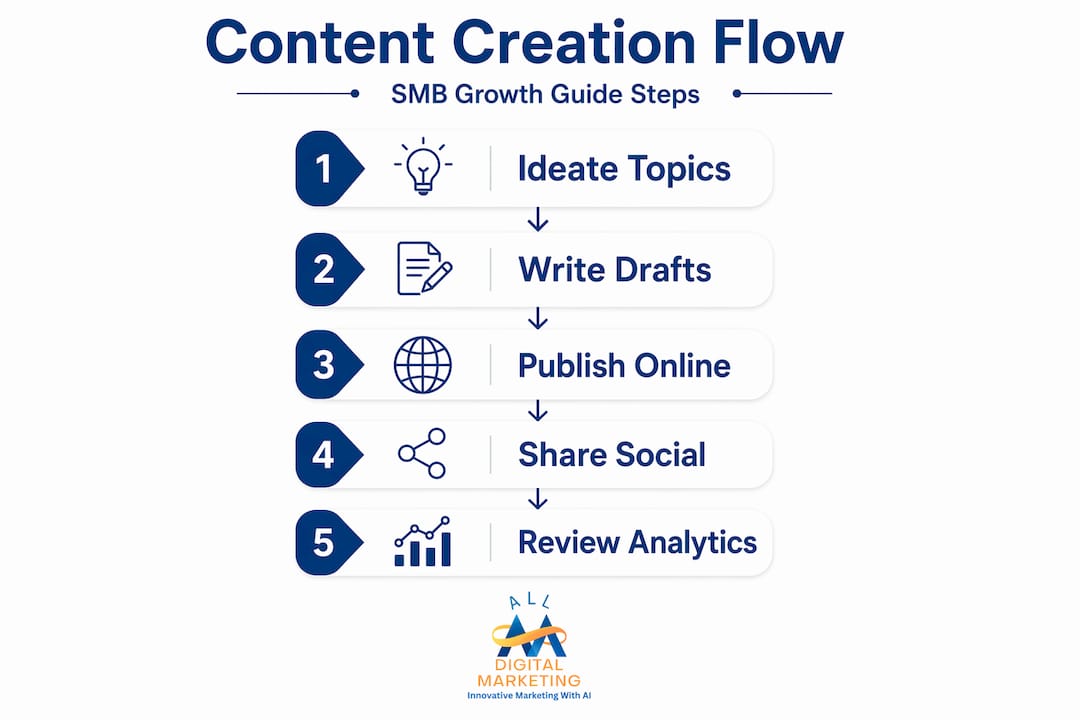
The most effective content for SMBs tends to be practical and specific. A plumber explaining the top three signs of a hidden pipe leak generates more qualified traffic than a generic "why hire a plumber" post. Specific content attracts specific customers, and specific customers convert.
Search engine optimization
SEO is how your content gets found. It covers three areas you need to address together. First, keyword research helps you understand what your customers are actually typing into search boxes. Second, technical SEO makes sure your website loads fast, works on mobile, and can be crawled by search engines. Third, local SEO puts your business in front of nearby customers at the moment they are searching. For most SMBs, improving search visibility starts with fixing local SEO fundamentals like a complete Google Business Profile and consistent NAP data across directories.

Social media management
Social media efforts produce measurable results: marketers report an 80% increase in brand exposure, 73% more website traffic, and 65% improvement in lead generation. Those numbers reflect focused, strategic social media use, not just random posting.
The goal on social media is community building, not broadcasting. Respond to comments. Ask questions. Share behind-the-scenes content from your business. Authentic content about your actual business operations drives higher engagement and trust than polished marketing copy ever will. Platforms actively reward it with wider organic reach.
Pro Tip: Do not try to be active on every social platform at once. Pick the one or two platforms where your customers already spend time, show up there consistently, and do it well before expanding anywhere else.
Choosing the right platforms for your business
One of the most overlooked strategies for online growth is platform selection. Many SMBs waste months building audiences on platforms their customers rarely use. The smarter approach is to go where your audience already is.
Focusing on platforms that match your audience's existing habits is consistently more effective than trying to maintain a presence everywhere. This applies to both your time and your content format. A B2B service firm will get far more traction on LinkedIn than on TikTok. A local bakery will see better engagement on Instagram and Facebook than on a professional networking site.
Use the comparison below to match your business type to the platforms most likely to deliver results:
| Platform | Best for | Primary content type | Key challenge for SMBs |
|---|---|---|---|
| Google Business Profile | Local service businesses | Reviews, photos, Q&A | Keeping information updated |
| Community-based and local businesses | Posts, events, groups | Declining organic reach | |
| Visual products and lifestyle brands | Photos, Reels, Stories | Requires consistent visual content | |
| B2B services and professional firms | Articles, case studies, updates | Building an engaged following takes time | |
| YouTube | Education-based or tutorial-heavy businesses | Video, how-to content | High production investment |
| TikTok | Youth-oriented or trend-driven brands | Short-form video | Steep learning curve for traditional businesses |
Two additional principles apply no matter which platform you choose. First, produce content you can actually sustain. A business owner who publishes one high-quality post per week outperforms one who posts daily for three weeks and then burns out. Second, measure engagement over follower counts. A following of 500 genuinely interested local customers is worth far more than 5,000 disengaged followers from across the country. The impact of online branding comes from depth of relationship, not width of audience.
For B2B businesses, LinkedIn deserves special attention. A well-optimized LinkedIn profile acts as a live sales asset. You can turn LinkedIn connections into clients with a consistent publishing and outreach strategy, and build a qualified B2B pipeline using AI-assisted prospecting tools that save hours each week.
Practical steps to improve your online presence
Understanding the advantages of digital marketing is one thing. Building a system that actually delivers results is another. Here is a practical roadmap you can start on this week.
-
Audit your current online presence. Search your business name and see what comes up. Check your Google Business Profile, your website, your social profiles, and your reviews. Note gaps, outdated information, and inconsistent messaging. You cannot improve what you have not measured.
-
Set specific, realistic goals. "Get more customers online" is not a goal. "Increase organic website traffic by 20% in 90 days" is. Specific goals let you track progress and adjust tactics when something is not working.
-
Build a content calendar. Decide in advance what you will publish, when, and where. Even a simple spreadsheet tracking topic, platform, and publish date keeps you consistent without requiring daily decision-making.
-
Start a daily engagement routine. A focused 15-minute daily routine of targeted commenting and replying expands your reach and establishes expertise within niche communities. Respond to every comment on your own posts. Leave thoughtful comments on posts from peers and potential customers in your industry.
-
Use analytics to guide decisions. Google Analytics, your Google Business Profile insights, and native platform analytics all show you which content drives traffic and which content gets ignored. Review these numbers monthly and double down on what works.
-
Consider community and influencer partnerships. Partnering with a local micro-influencer or a complementary business for a co-promotion can expand your reach to a pre-qualified audience faster than organic growth alone. Focus on genuine fit over follower counts.
-
Be patient and stay consistent. Long-term digital presence growth typically takes 3 to 6 months of consistent activity before you see noticeable momentum. This is not a reason to slow down. It is a reason to start now.
Pro Tip: Set a calendar reminder at the end of each month to review your analytics. Look for your top three performing content pieces, identify what they have in common, and use that pattern to plan next month's content.
Common pitfalls and how to avoid them
Many SMBs invest time and energy into their online presence without seeing results because they fall into predictable traps. Knowing what to avoid is just as important as knowing what to do.
-
Posting for the sake of posting. Digital busyness is a documented trap. High-frequency, low-value content trains your audience to ignore you and signals to algorithms that your content is not worth promoting. Fewer, better posts outperform daily filler every time.
-
Ignoring reviews and reputation. Online reputation management directly prevents customers from defecting to competitors. Responding to both positive and negative reviews shows prospective customers that you are attentive and professional. Ignoring reviews signals the opposite. Learn the basics of managing brand reputation online to stay ahead of issues before they escalate.
-
Inconsistent messaging across platforms. If your website says one thing, your Google profile says another, and your Instagram bio says a third, customers get confused. Confused customers do not buy. Audit your messaging across every platform at least twice per year.
-
Chasing vanity metrics. Follower counts and likes feel satisfying but rarely correlate with revenue. Track metrics that reflect actual business outcomes: website traffic, lead form submissions, phone calls, and review ratings.
-
Burning out on content creation. Sustainability matters more than intensity. A plan you can maintain for 12 months produces dramatically better results than an aggressive plan you abandon after six weeks. Build your system around your actual bandwidth, and scale up from there.
My take on what SMBs actually get wrong
I have worked with enough small business owners to notice a consistent pattern. The ones who struggle most are not the ones who lack effort. They are the ones who confuse activity with strategy.
I see it constantly. A business will publish to three platforms five times a week, update their website every few months, and then wonder why nothing is working. The problem is not the volume. The problem is the lack of a clear purpose behind every action.
In my experience, the SMBs who see the fastest, most sustainable growth share two qualities. They know exactly who they are trying to reach, and they pick one channel to master before touching another. That focus creates depth of engagement that scattered effort never can.
The other thing I would push back on is the obsession with keeping up. Many business owners spend enormous energy trying to be everywhere all the time because they fear missing out. What actually builds a lasting digital presence is something far simpler: showing up consistently in ways you genuinely enjoy. When you enjoy the process, it shows in the content, audiences respond to it, and the algorithms reward it.
Patience is underrated here. Most businesses give up right before results start to materialize. The businesses that stay focused, stay consistent, and trust the process are the ones that look unstoppable six months later. That is not luck. That is compounding effort doing its job.
— Diane
How Digitalmarketingall helps you grow your online presence
Building a strong online presence takes time, strategy, and consistent execution across multiple channels. If you are ready to accelerate that process, Digitalmarketingall offers the tools and expertise to make it happen faster and more effectively than going it alone.
Start with review generation and reputation management to build the social proof that converts curious visitors into paying customers. Pair that with local SEO and Google Business Profile optimization to dominate searches in your area. Digitalmarketingall also provides social media content support, website design built for conversions, and geo-fencing advertising that puts your message in front of local customers exactly when and where they are most likely to act. Whether you need a full digital marketing strategy or targeted support in one area, the team at Digitalmarketingall is ready to help you build the presence your business deserves.
FAQ
Why is online presence essential for small businesses?
Over 81% of consumers start their buying process with online research, which means businesses that are hard to find online lose customers before a conversation ever starts. A consistent digital presence builds trust, generates leads, and keeps your business competitive.
How long does it take to see results from boosting online presence?
Meaningful digital presence growth typically takes 3 to 6 months of consistent content publishing and engagement before producing noticeable results. Starting early and maintaining consistency are the two most important factors.
What is the most important platform for a small business?
The most important platform is the one your target customers already use most often. For local service businesses, Google Business Profile is typically the highest priority. For B2B companies, LinkedIn produces the strongest returns. For consumer brands with visual products, Instagram often outperforms other options.
How does reputation management connect to online presence?
Proactive reputation management keeps customers from choosing competitors by demonstrating responsiveness and professionalism. Responding to reviews, addressing complaints publicly, and collecting positive feedback are all direct ways to strengthen your digital footprint.
What should I measure to know if my online presence is improving?
Track metrics tied to business outcomes: organic website traffic, call or lead form volume, Google Business Profile views, and your average review rating. Follower counts and post likes are interesting, but conversion-related metrics tell you whether your presence is actually driving revenue.