

TL;DR:
- Most small businesses mistakenly believe that ranking on Google depends solely on high search volume keywords, which often leads to poor results dominated by larger brands.
- Effective keyword research focuses on local, intent-driven terms that your customers are actively searching for, enabling targeted content creation and better visibility.
- Success requires a disciplined approach of selecting realistic targets, producing quality content, and continuously tracking performance, rather than chasing broad or high-competition keywords blindly.
Most small business owners assume that ranking on Google is a numbers game: find the keywords with the highest search volume, stuff your pages with them, and watch the traffic roll in. This approach feels logical, but it consistently produces disappointing results. High-volume keywords are dominated by national brands with massive content budgets and years of authority built up in Google's eyes. The real opportunity for small and medium-sized businesses lies in finding the specific terms your local customers actually type when they are ready to buy, and then building content that directly answers those needs. This guide walks you through every step, from understanding why keyword research matters to turning your findings into content that wins local searches.
Table of Contents
- Why keyword research is essential for SMBs
- The fundamentals: How keyword research drives visibility
- Choosing the right keywords: Relevance, intent, and feasibility
- Keyword research tools and workflows for SMBs
- From research to results: Creating content that wins local searches
- The uncomfortable truth most guides miss about keyword research
- Amplify your results with tailored keyword and review strategies
- Frequently asked questions
Key Takeaways
| Point | Details |
|---|---|
| Focus on intent | Target keywords that match your audience’s real search intent instead of just high volume. |
| Validate keyword feasibility | Use difficulty and SERP analysis to ensure you can realistically compete for your chosen keywords. |
| Leverage free tools | Google Keyword Planner and similar tools deliver powerful insights without added cost. |
| Turn research into action | Convert findings into content briefs and optimized pages to drive local visibility. |
| Stay focused and execute | Prioritize execution over endless research for sustained growth and competitive advantage. |
Why keyword research is essential for SMBs
Running a small business means every marketing dollar has to count. You cannot afford to spend weeks creating content around keywords that were never realistic targets to begin with. Keyword research fixes this by giving you data instead of guesswork. It connects what your ideal customer is searching for with the services and products you actually offer.
Most small businesses struggle with online visibility not because their services are inferior, but because they are invisible in search results. They either target terms that are far too broad, or they have no keyword strategy at all. Both paths lead to the same result: your competitors show up, and you do not.
"The goal of keyword research is not to find the most popular terms. The goal is to find the terms where you can realistically win and where winning actually brings in paying customers."
Good keyword research helps you:
- Identify what your local customers are actively searching for right now
- Understand which questions your competitors are answering that you are not
- Prioritize content creation around searches that match your actual services
- Avoid wasting resources on broad terms you have no chance of ranking for
- Align your website content with the language real people use, not marketing speak
Google Keyword Planner is one of the most accessible tools for this. It is free, built by Google, and designed to help you expand keyword ideas and estimate monthly search counts for any keyword or topic. This makes it an ideal starting point for SMBs with limited budgets.
When you combine good research with consistent execution, keyword research becomes one of the highest-leverage activities in your marketing plan. It directly supports getting more customers without requiring a large advertising spend, and it underpins nearly every effective tactic covered in modern SMB digital marketing strategies.
The fundamentals: How keyword research drives visibility
Understanding that keyword research matters is step one. Understanding exactly how it drives visibility is step two. These are two very different things, and most guides skip the second one entirely.
When a potential customer searches for "best electrician near me" or "affordable catering for birthday parties in Austin," Google tries to match that query with the most relevant, authoritative content it can find. If your website content directly addresses those searches using the same language, you have a fighting chance of appearing in the results. If it does not, you will not appear, no matter how good your services actually are.
Here is how keyword research translates into measurable visibility gains:
| Research Action | Direct Visibility Benefit |
|---|---|
| Identifying local question keywords | Increases chances of appearing in featured snippets |
| Mapping keywords to specific pages | Strengthens topical relevance signals for Google |
| Finding question-based keyword gaps | Enables content that targets voice and AI search |
| Tracking keyword rankings over time | Reveals which pages need updates or expansion |
| Grouping related keywords by intent | Allows proper internal linking and content structure |
A particularly important development in 2026 is Answer Engine Optimization, or AEO. AEO refers to the practice of structuring your content so that it directly answers specific questions, making it eligible to appear in AI-generated summaries, voice search results, and Google's featured answer boxes. According to a HubSpot keyword research workflow, keyword research can extend into AEO by turning question gaps into content briefs and execution checklists, pushing well beyond traditional SEO tactics.
The practical workflow that produces consistent results looks like this: research, analyze, brief, and execute. Research gathers raw keyword data. Analysis filters for relevance and feasibility. A content brief outlines the structure and intent for each piece. Execution is the actual writing and publishing. Skipping any of these steps creates gaps that undermine your results.
Pro Tip: Before you start writing any piece of content, check the first page of Google for your target keyword. Look at the format of the results. Are they lists, guides, or short answers? Mirror that format in your content to match what Google already rewards for that search.
Conducting a thorough keyword gap analysis helps you find the specific topics your competitors rank for that you do not yet cover. And pairing that with searcher intent optimization ensures that when you do create content, it matches exactly what users expect to find when they arrive on your page.
Choosing the right keywords: Relevance, intent, and feasibility
This is where most SMBs either get it right or fall into the same trap repeatedly. The trap is chasing volume. A keyword with 50,000 monthly searches looks attractive, but if the top ten results are all major national brands or established industry publications, your new or relatively young website has almost no chance of ranking there in any reasonable timeframe.
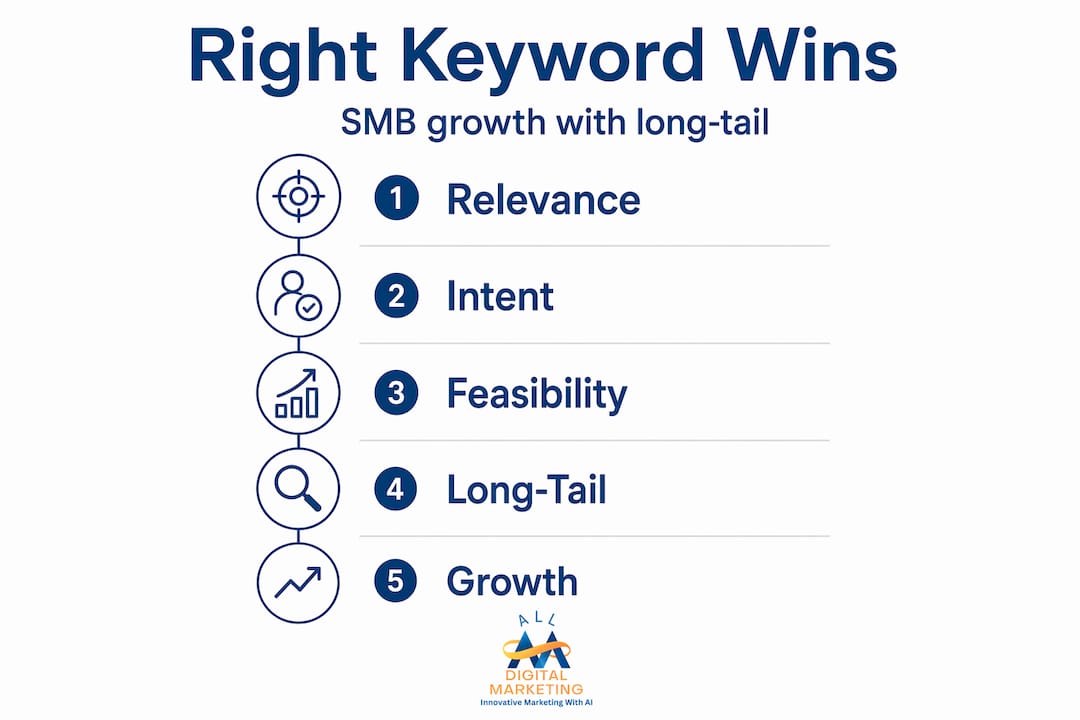
The smarter approach focuses on three filters: relevance, intent, and feasibility.
Relevance means the keyword directly relates to a service or product you actually offer. Sounds obvious, but many businesses create content around broadly related topics without confirming that the traffic they attract will actually convert.
Intent refers to what the person searching actually wants. Search intent generally falls into four categories:
- Informational: The user wants to learn something ("how does HVAC maintenance work")
- Navigational: The user is looking for a specific website or brand ("XYZ plumbing company")
- Commercial: The user is comparing options before buying ("best pest control companies in Denver")
- Transactional: The user is ready to buy or hire right now ("hire a plumber near me")
For most SMBs, commercial and transactional keywords are the highest priority because they attract people who are close to making a purchase decision. Informational keywords are valuable for building trust and awareness, but they rarely convert as quickly.
Feasibility is where tools like Ahrefs become genuinely valuable. Keyword Difficulty, or KD, is a metric that measures how competitive it is to rank for a given keyword based on the strength of the pages currently ranking for it. A common SMB nuance: prioritize relevance and intent over raw search volume because high-volume terms are often too competitive for small sites, and KD helps you identify realistic targets.

Here is a quick comparison to illustrate the difference:
| Keyword | Monthly Searches | Keyword Difficulty | SMB Ranking Potential |
|---|---|---|---|
| "marketing agency" | 90,000 | Very High (90+) | Very Low |
| "marketing agency for restaurants in Dallas" | 400 | Low (18) | High |
| "how to get more Google reviews" | 12,000 | Medium (55) | Moderate |
| "get more reviews for my plumbing company" | 150 | Very Low (8) | Very High |
The pattern is clear. Longer, more specific phrases, often called long-tail keywords, consistently offer better opportunities for SMBs. They have lower competition, they attract users with specific needs, and they convert at higher rates because the searcher knows exactly what they want.
Pro Tip: Before committing to a keyword, validate search intent by running the search yourself and studying what Google shows. If the top results are all e-commerce product pages and you are writing a service page, that keyword may not be worth pursuing regardless of its difficulty score.
Also take time to review pages where fixing SEO errors on existing content may recover rankings you are silently losing, especially before adding new keyword targets to your list. Prioritizing keyword intent throughout your site is just as important as finding new terms.
Keyword research tools and workflows for SMBs
Knowing which keywords to target is only half the equation. You need a repeatable system for finding, evaluating, and acting on keyword opportunities without burning hours every week.
Here is a step-by-step workflow that works for SMBs at any budget level:
-
Start with a seed list. Write down 10 to 20 topics that describe your services, products, and customer pain points. These are your starting points, not final keywords. Think about what someone would type the moment they realize they need what you offer.
-
Expand with Google Keyword Planner. Enter your seed topics into Google Keyword Planner to generate hundreds of related keyword ideas along with estimated monthly search volumes. This tool also shows seasonal trends, which helps you plan content at the right time of year.
-
Filter by intent and relevance. From your expanded list, remove any keywords that do not match a real service you provide or that clearly attract the wrong type of visitor. A kitchen remodeling company does not need to rank for "DIY kitchen renovation tips" if they only serve customers who hire professionals.
-
Assess keyword difficulty. For each remaining keyword, check the competitive landscape. Use a tool like Ahrefs or even a free alternative to get a rough sense of how hard ranking will be. Prioritize keywords with lower difficulty scores that still attract a meaningful number of monthly searches.
-
Group keywords by topic clusters. Keywords that share the same intent and topic should be grouped together. Each group becomes the foundation for one page or one piece of content. This prevents you from creating multiple pages that compete with each other for the same search.
-
Create a content brief for each cluster. A brief outlines the main question the content needs to answer, the format it should take, any local details to include, and the secondary keywords to weave in naturally.
-
Publish, track, and refine. Use Google Search Console to track how each piece performs over time. When a page starts appearing for queries you did not initially target, expand its content to capture more of that traffic.
Pro Tip: Use autocomplete marketing insights to find the exact phrases Google autofills when someone starts typing a query related to your business. These suggestions reflect real user behavior and often reveal high-intent keyword opportunities that do not show up in traditional tools.
Free tools get you far. But as your business grows, exploring advanced SEO tactics through paid tools and professional support can accelerate your results significantly. The workflow above, however, is fully executable at zero additional cost using free tools alone.
From research to results: Creating content that wins local searches
Research without execution is just a spreadsheet. The final and most critical stage is turning your keyword findings into content that actually shows up in front of local customers.
Start by building a content brief for each target keyword cluster. A solid brief includes:
- The primary keyword and three to five supporting keywords
- The specific question or problem the content needs to solve
- The format that best fits the intent (guide, FAQ, service page, comparison post)
- Any local details that increase relevance, such as city names, neighborhood references, or local regulations
- A clear call to action that connects the reader's need to your service
Local businesses have a significant structural advantage in search that many never fully use. When you create pages that directly answer hyper-local questions, such as "what permits do I need for a bathroom remodel in Phoenix" or "best time to schedule HVAC service in Houston," you are targeting searches with very little competition and very high local relevance. Google rewards that specificity.
Adding FAQ sections to your service pages is one of the most practical tactics available. According to the HubSpot keyword research workflow, keyword research into answer-focused content planning can turn question gaps into content briefs and execution checklists that directly support both local SEO and AEO performance. FAQs give you a structured way to target multiple question-based keywords on a single page while also increasing your chances of appearing in featured answer boxes.
Here is what high-performing local content consistently includes:
- A clear, keyword-aligned headline that reflects what local users are actually searching
- An opening paragraph that answers the core question immediately, without burying the answer
- Supporting details, steps, or examples that add depth and trust
- Locally specific details that signal geographic relevance to Google
- A FAQ section targeting related questions from your keyword research
- A call to action that converts the reader's interest into a lead or phone call
Measuring results matters as much as creating the content. Check Google Search Console monthly to see which queries are bringing visitors to each page. If a page starts ranking on page two for a keyword you care about, it is a signal to expand the content, improve the structure, or build a few more internal links pointing to that page.
The businesses that consistently win in local search treat keyword research as a cycle, not a one-time task. Conditions change. New competitors enter the market. Search behavior shifts. Staying current with AI-first ranking strategies will keep you ahead as search engines increasingly use AI to decide which content deserves to appear at the top.
The uncomfortable truth most guides miss about keyword research
Here is something we have seen consistently after working with SMBs across dozens of industries: the biggest obstacle to keyword research success is not a lack of tools or data. It is a lack of focus.
Most guides give you a process, hand you a list of tools, and send you off to research. What they do not tell you is that the process will generate far more opportunities than you can realistically pursue. A business with limited time and a small team cannot produce high-quality content around fifty keyword clusters simultaneously. Trying to do so guarantees that nothing gets done well.
The SMBs that actually see results from keyword research are the ones who commit to a short list of realistic targets and pursue them relentlessly. They pick five to ten keyword clusters that are genuinely achievable, create excellent content for each one, and track results over ninety days before adding anything new. This sounds slow. It produces results far faster than spreading effort thin across dozens of targets.
We have also seen businesses fall into what we call tool dependency: spending more time tweaking keyword lists and running reports than actually creating content. Tools are research aids, not substitutes for action. The data only has value when it leads to a published page, an updated service description, or a new FAQ section on your website.
The smartest thing any SMB can do is make one decision upfront: what are the three local searches where winning would genuinely transform our business? Start there. Build excellent content around those three searches first. Track the results. Then expand.
For businesses looking at how search price optimization intersects with keyword strategy, this focused approach also reduces wasted ad spend and helps ensure every dollar in your marketing budget works harder.
Keyword research is a discipline, not a project. The businesses that treat it that way consistently outperform those who approach it as a one-time task with a defined end date.
Amplify your results with tailored keyword and review strategies
Solid keyword research sets the foundation, but turning those rankings into real business growth requires consistent execution across your entire online presence. At Digital Marketing All, we work directly with SMBs to convert research into a steady stream of local leads, qualified traffic, and positive customer reviews. Our approach covers everything from keyword discovery and content strategy to local SEO and reputation management tailored to your specific market. If you want to strengthen your local presence even further, we can help you get more reviews that build trust and improve your visibility in Google's local results. We also specialize in helping businesses optimize their Yelp profile to capture high-intent local searchers on one of the most trusted local directories. Let us handle the complexity while you focus on serving your customers.
Frequently asked questions
What is the quickest way for a small business to start keyword research?
Use Google Keyword Planner to generate keyword ideas and check monthly search volumes for free, giving you a data-backed starting point without any cost.
Should small businesses avoid high-volume keywords?
Yes, in most cases. High-volume terms are typically too competitive for small sites, and focusing on relevant, lower-competition keywords usually delivers better rankings and stronger leads.
How can local businesses use keyword research for better local rankings?
Creating content and service pages built around local questions and location-specific keywords directly supports both organic and local map pack rankings, especially when paired with answer-focused content planning.
What is keyword difficulty and why does it matter?
Keyword difficulty measures how competitive a keyword is based on the strength of current top-ranking pages. SMBs should use it alongside feasibility metrics to select targets they can realistically rank for within a reasonable timeframe.
What's the difference between keyword research for traditional SEO and for Answer Engine Optimization (AEO)?
Traditional SEO targets keyword phrases to improve rankings, while AEO focuses on identifying specific questions and structuring content to appear in AI-powered answers and voice search results, as described in the HubSpot keyword research workflow.