

TL;DR:
- Nearly 60% of Google searches end without a click, emphasizing the importance of impressions over clicks.
- Search visibility includes all presence in search results, such as featured snippets and AI summaries, not just website traffic.
- Building consistent search visibility enhances brand trust and authority, providing a long-term competitive advantage.
Nearly 60% of Google searches end without a single click to any website. That means your business could appear in search results and still never receive a visit. For small and medium-sized business owners, this raises a critical question: are you measuring the right thing? Most SMBs track website traffic and clicks, but true search visibility is much broader. It includes every impression, every AI-generated summary, every featured snippet that puts your brand in front of a potential customer. This guide unpacks what search visibility really means, why it matters more than ever in 2026, and how you can use data-driven, AI-ready strategies to grow your business.
Table of Contents
- What is search visibility and why does it matter?
- How search visibility drives business growth for SMBs
- Navigating AI and the evolving search ecosystem
- Key strategies to maximize your search visibility
- A smarter way to think about search visibility
- Boost your search visibility with expert help
- Frequently asked questions
Key Takeaways
| Point | Details |
|---|---|
| Visibility goes beyond clicks | Online exposure now includes impressions from AI, zero-clicks, and SERP features. |
| SMBs can win with focus | Local and niche businesses have an agility advantage in adapting to search and AI trends. |
| Track and adapt for growth | Monitoring visibility and updating strategies ensures long-term competitive performance. |
| AI transforms discoverability | AI tools and overviews require new tactics such as structured content and citation management. |
What is search visibility and why does it matter?
Search visibility is not just about ranking number one on Google. Organic search visibility measures how often a website appears in unpaid search results, including zero-click searches where users get answers directly on the results page without visiting any site. This distinction matters because brand exposure happens whether or not someone clicks through to your website.
Think about how users search today. They ask a question, Google surfaces an answer box or AI Overview, and the user moves on. Your business may have provided the information behind that answer, but your analytics dashboard shows zero traffic. That is not a failure. That is visibility working in a new way.
Here is a breakdown of the key visibility metrics SMBs should track:
| Metric | What it measures | Why it matters |
|---|---|---|
| SERP impressions | How often your site appears in results | Indicates brand exposure |
| Click-through rate (CTR) | Percentage of impressions that become clicks | Measures engagement quality |
| SERP feature presence | Featured snippets, local packs, AI Overviews | Shows authority signals |
| AI citation frequency | How often AI tools reference your content | Critical for 2026 visibility |
| Impression share | Your share of available impressions | Competitive positioning tool |
Search visibility plays a role at every stage of the marketing funnel. A user who sees your business name in a local pack three times before searching again is far more likely to choose you when they are ready to buy. Not all wins show up in web analytics, but they still influence purchase decisions.
Key reasons to prioritize search visibility:
- Brand recall: Repeated SERP exposure builds familiarity and trust
- Authority signals: Appearing in featured snippets positions you as an expert
- AI readiness: Structured, cited content earns mentions in AI-driven results
- Competitive edge: Owning more SERP real estate limits competitors' exposure
- Zero-click impact: Zero-click branding builds trust even without direct traffic
"Search visibility is a long-term brand asset. Every impression is a touchpoint, and every touchpoint builds the trust that converts a stranger into a customer."
When you boost search visibility, you are investing in brand authority that compounds over time. Traffic is a short-term metric. Visibility is a long-term competitive advantage.
How search visibility drives business growth for SMBs
Visibility and revenue are more connected than most SMB owners realize. When your business appears consistently in search results, users perceive you as credible and established. That perception directly influences buying behavior, even before a single conversation takes place.

52% of SMBs cite organic search as a main traffic source, while social media leads at 64%. This tells us two things: organic search is still critical, and diversifying visibility across platforms is necessary. Relying on one channel leaves your business exposed to algorithm changes and traffic volatility.
Here is how high-visibility SMBs compare to low-visibility competitors:
| Factor | High visibility SMB | Low visibility SMB |
|---|---|---|
| Lead quality | Higher intent, pre-qualified | Mixed, often low intent |
| Customer acquisition cost | Lower over time | Higher, paid-dependent |
| Brand trust | Established through SERP presence | Requires more nurturing |
| Competitive positioning | Dominates local and niche results | Often invisible to searchers |
Steps to connect visibility to business growth:
- Set baseline impression and CTR benchmarks in Google Search Console
- Track branded vs. non-branded keyword performance separately
- Monitor local pack appearances weekly for your core service keywords
- Measure AI referral traffic as a separate channel in your analytics
- Review SERP feature presence monthly and adjust content accordingly
SEO continues to deliver strong results. Businesses that invest in organic search report measurable returns, and hiring SEO experts can accelerate results for SMBs that lack in-house resources. The key is treating visibility as a revenue driver, not just a vanity metric.
When you drive qualified leads through consistent SERP presence, your cost per acquisition drops over time. Paid ads stop the moment you stop spending. Visibility built through content and authority keeps working.
Pro Tip: Don't just count clicks. Track your SERP impression share and monitor how many SERP features (local packs, snippets, AI mentions) your business occupies. That data tells a more complete growth story than traffic alone.
Exploring autocomplete marketing is one often-overlooked tactic that puts your brand in front of users before they even finish typing their query.
Navigating AI and the evolving search ecosystem
Search is not what it was three years ago. AI Overviews, featured snippets, and conversational search tools have fundamentally changed how users find information and how businesses earn visibility. SMBs that understand this shift will adapt. Those that don't will lose ground to competitors who do.
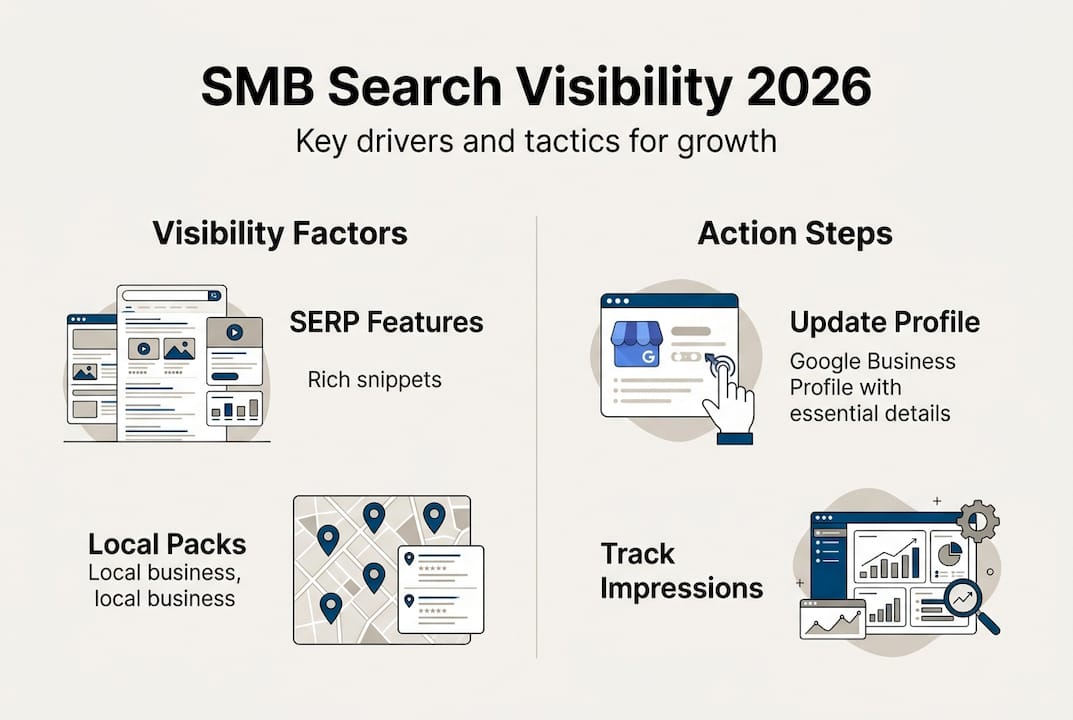
95% still use traditional search, but AI Overviews are actively shifting traffic sources and require entirely different optimization strategies. The goal is no longer just to rank. It is to be cited, referenced, and surfaced by AI systems that synthesize answers from authoritative sources.
Key visibility shifts in the AI era:
- Local packs now include AI-enhanced summaries that pull from reviews and business data
- Featured snippets reward structured, concise answers formatted for quick consumption
- AI Overviews cite specific sources, making content authority more important than ever
- Answer boxes reduce the need for users to click, but increase brand exposure for cited businesses
- Voice and conversational search favor businesses with complete, accurate public data
Statistic to note: roughly 50% of SMBs are now monitoring AI-driven referral traffic, and approximately 20% of Americans already use AI tools as part of their search behavior. These numbers are growing fast.
The AI search changes happening right now are not a distant threat. They are reshaping how your customers find you today. Businesses that update their content for structured, citable responses will earn AI-generated mentions. Those that ignore this shift will see visibility erode gradually.
Local businesses have a real advantage here. AI tools prioritize proximity, reviews, and accurate business data. Understanding local search power means keeping your Google Business Profile current, collecting reviews consistently, and structuring your website content to answer specific local questions.
Pro Tip: Add a well-structured FAQ section to every key page on your website. AI systems love concise, question-and-answer formatted content. Update your business name, address, phone number, and hours across every directory at least once per quarter.
Key strategies to maximize your search visibility
Knowing why visibility matters is step one. Knowing exactly what to do about it is where most SMBs get stuck. Here is a practical, prioritized framework you can start using now.
The audit, optimize, monitor, repeat cycle:
- Audit: Use Google Search Console and Semrush to identify which keywords trigger impressions, which SERP features you currently own, and where competitors outrank you
- Optimize: Build topical authority by creating pillar pages supported by cluster content. Add schema markup to pages to help search engines categorize your content accurately
- Monitor: Track AI referral traffic, impression share, and SERP feature changes weekly. Set up alerts for branded keyword movements
- Repeat: Refresh older content every 90 days with updated data, new FAQs, and improved structure to maintain recency signals
Content and technical factors that directly improve visibility:
- E-E-A-T signals: Demonstrate experience, expertise, authority, and trustworthiness through author bios, citations, and case studies
- Schema markup: Structured data helps search engines and AI tools understand and surface your content accurately
- Review generation: Fresh, positive reviews improve local pack rankings and AI-generated summaries
- Internal linking: A strong internal link structure distributes authority and helps search engines index your full site
Visibility drops often result from algorithm changes, zero-click cannibalization, or over-reliance on branded keywords. Measuring topical authority, SERP feature presence, and content freshness gives you the data to respond quickly.
Tools to track your SEO and AI visibility:
- Google Search Console (impressions, CTR, position tracking)
- Semrush (AI visibility scoring, keyword gaps, SERP features)
- BrightLocal (local pack tracking, review monitoring)
- Ahrefs (backlink authority, content gap analysis)
Applying local ranking strategies and keeping your Google Business Profile optimized are non-negotiable for SMBs targeting local customers. Combine those with SEO best practices and you have a foundation that works across traditional and AI-powered search. For a broader view, explore how cross-platform visibility across search, social, and AI platforms creates compounding exposure.
Pro Tip: Refresh your top five traffic pages every 90 days. Update statistics, add new FAQs, and improve formatting. Google rewards recency, and AI tools favor content that reflects current, accurate information.
A smarter way to think about search visibility
Here is the perspective most marketing guides skip: visibility is not a traffic problem. It is a trust problem. SMBs that chase clicks are optimizing for the wrong outcome. The businesses winning in 2026 are the ones showing up consistently across search results, AI Overviews, local packs, and review platforms, whether or not anyone clicks.
Big brands have massive budgets but they are slow to adapt. A local HVAC company or regional law firm that builds genuine topical authority around their specific niche can outperform a national competitor in local and AI-driven results. The reason is focus. Niche depth beats broad coverage when it comes to AI citations and local relevance.
Embracing zero-click outcomes is not giving up on traffic. It is recognizing that brand impressions at the moment of search intent are enormously valuable. A user who sees your business name answer their question in an AI Overview is far more likely to seek you out directly later.
Pro Tip: Treat every SERP impression and AI mention as a trust-building touchpoint, not just a lead generation opportunity. That mindset shift changes how you create content, manage reviews, and structure your online presence.
Boost your search visibility with expert help
Understanding search visibility is one thing. Building and sustaining it across traditional search, AI platforms, and local directories takes consistent effort and the right tools.
At Digital Marketing All, we help SMBs do exactly that. From generating more reviews that strengthen your local pack presence to Yelp support that keeps your reputation sharp across platforms, our services are built for businesses that want real, measurable visibility growth. Our AI marketing services are designed to position your business where your customers are searching right now, whether that is Google, AI Overviews, or local directories. Explore our full suite of solutions and take the next step toward owning your search presence.
Frequently asked questions
What is search visibility in SEO?
Search visibility refers to how often and prominently your site appears in unpaid search results, covering overall exposure including zero-click appearances, not just traffic-generating clicks.
Why does zero-click search matter for SMBs?
Zero-click exposure builds trust and brand awareness even when users don't visit your site, creating repeated impressions that support long-term customer acquisition and brand recall.
How can small businesses track AI-driven search visibility?
Use tools like Semrush and Google Search Console to monitor AI referrals and citation presence, giving you a clearer picture of how AI-powered results are affecting your overall exposure.
What are the first steps to improve search visibility?
Audit your current SERP presence, optimize for user intent and local SEO, and refresh content with structured data, schema markup, and FAQ sections that AI tools and search engines can easily surface.