
SEO advice is everywhere, and most of it pulls you in ten directions at once. For small and medium-sized business owners, that's a real problem. You don't have unlimited time or budget, so every SEO decision needs to count. The good news is that a focused set of best practices, applied consistently, drives the majority of results. This article walks you through a clear framework: how to prioritize your efforts, lock in technical fundamentals, create content that ranks in both Google and AI-powered search features, and measure what's actually working. No fluff, no chasing trends.
Table of Contents
- How to evaluate SEO priorities for your business
- Must-do technical SEO: Building your foundation
- People-first content creation for SEO and AI
- Maximizing visibility: On-page optimization and AI search alignment
- Measuring results and scaling what works
- Why less really is more: Our experience with SEO for small businesses
- Jumpstart your SEO success with expert help
- Frequently asked questions
Key Takeaways
| Point | Details |
|---|---|
| Focus on impact | Optimize your most important service and product pages before anything else. |
| Technical basics matter | Make sure your site is crawlable, loads quickly, and avoids spam risks. |
| People-first content wins | Write directly to customer questions and structure your pages for both Google and AI. |
| Measure and scale | Track what brings results and double down on what works best for your business. |
How to evaluate SEO priorities for your business
With the stage set, let's clarify what matters most before jumping into tactics. Not all SEO work delivers equal results, and for SMBs, misplaced effort is costly. A structured approach saves time and gets you to results faster.
Here's a proven sequence to follow:
- Fix your technical foundation first. Your site must be crawlable, load quickly, and be free of spam signals. Google Search Essentials require technical eligibility and helpful content before any page can rank.
- Create people-first content. Every page should solve a real customer problem. Generic filler content wastes your budget and confuses search engines.
- Prioritize service and commercial pages. Aim to direct roughly 70% of your content effort toward pages that directly generate leads or sales. Use a pillar-cluster model, where one strong main page links out to supporting topic pages, to build topical authority.
- Optimize for AI and search features last. Once your site is healthy and your content is strong, layer in structured data, FAQ schema, and AI-visibility tactics.
Recent core update guidance from Google emphasizes E-E-A-T (Experience, Expertise, Authoritativeness, and Trustworthiness), helpful content, and reducing AI-generated spam. Understanding E-E-A-T essentials is now a baseline requirement, not a bonus.
Pro Tip: If your site recently dropped in rankings after an algorithm update, start by removing or consolidating outdated and low-quality pages. This single action has helped many SMBs recover faster than any new content push.
For businesses also targeting AI visibility strategies, the same sequence applies. Strong technical health and genuine content quality are the entry ticket.
Must-do technical SEO: Building your foundation
Once your overall priorities are set, lock in these core technical wins for maximum SEO leverage. Technical SEO is not glamorous, but it's the difference between a site that gets found and one that doesn't.
Start with a full site audit. Tools like Google Search Console, Screaming Frog, or Semrush will surface broken links, duplicate content, slow-loading pages, and accidental "noindex" tags that block search bots. Pages must be crawlable and indexable, with links that search engines can follow, or your content simply won't appear in results.

Here's a quick comparison of common technical issues and their impact:
| Technical issue | SEO impact | Fix priority |
|---|---|---|
| Broken internal links | Blocks crawling, hurts authority | High |
| Missing meta titles | Reduces click-through rates | High |
| Slow page speed | Hurts rankings and user experience | High |
| Duplicate content | Splits ranking signals | Medium |
| Missing alt text | Reduces image search visibility | Medium |
| No XML sitemap | Slows indexing | Medium |
Beyond fixing errors, make sure every important page has a unique meta title, meta description, and descriptive image alt text with natural keyword use. Adding structured data (also called schema markup) and an XML sitemap helps both Google and AI Overviews understand and surface your content more accurately. You can review a full technical compliance checklist to make sure nothing slips through.
Pro Tip: Always test your site on both mobile and desktop. The majority of search traffic now comes from mobile devices, and Google uses mobile-first indexing, meaning it evaluates the mobile version of your site first.
People-first content creation for SEO and AI
With your foundation in place, let's tackle the most impactful ongoing SEO activity: content creation. Writing content that ranks requires more than keyword stuffing. It requires answering real questions your customers are already asking.
Here's a structured approach to content that performs:
- Identify real customer questions. Use Google's "People Also Ask" boxes, your own customer service emails, and keyword tools to find what your audience actually searches for.
- Use clear structure. Every piece of content should have H2 and H3 headings, short bulleted lists, and a direct summary near the top. This helps both readers and AI systems extract your key points quickly.
- Blend expertise with credible sources. Cite industry data, link to authoritative references, and include your own real-world experience. This builds E-E-A-T signals that Google rewards.
- Update content regularly. Fresh, accurate content compounds in value over time. A well-maintained article from two years ago often outperforms a brand-new one.
- Keep language simple. Tools like the Hemingway App flag overly complex sentences. Aim for a reading level that matches your audience, not an academic journal.
The data on AI-driven search is clear: 76% of AI Overview citations come from top-10 organic results, and hybrid AI-human content is preferred. This means ranking well in standard search is still the primary path to appearing in Google's AI Overviews.
"Content that directly answers a specific question, structured for easy scanning, is the format most likely to be cited in AI-generated summaries."
If you want to go deeper on this topic, explore the latest AI ranking secrets that are shaping how businesses show up in 2026.
Maximizing visibility: On-page optimization and AI search alignment
Now, let's fine-tune each page for max visibility in both classic and AI search. On-page optimization is about making sure every signal on your page clearly communicates what it's about and why it's trustworthy.
Key on-page actions to take:
- Place your primary keyword in the page title, the first H2 heading, and at least one image alt text field.
- Feature a quick, direct answer or key takeaway at the very top of the page. AI systems and featured snippets favor pages that answer questions immediately.
- Add internal links to related pages on your site and external links to authoritative sources. Both reinforce topical credibility.
- Use bullet lists and data tables wherever possible. These formats are easier for AI systems to scan and extract information from.
Here's a practical on-page optimization checklist:
| Page element | Optimization action |
|---|---|
| Title tag | Include primary keyword, keep under 60 characters |
| Meta description | Summarize page value, include a call to action |
| H1 heading | Match search intent, use keyword naturally |
| Body content | Answer the main question in the first 100 words |
| Images | Add descriptive alt text with relevant keywords |
| Internal links | Connect to 2-3 related pages on your site |
Standard SEO practices, including E-E-A-T, structured content, and quality answers, are sufficient for AI visibility, but scannability through bullets and FAQs gives you an added edge. For a deeper look at marketing strategies for AI search, the playbook is more accessible than most business owners expect.
Pro Tip: Revisit your top-performing commercial pages every quarter. Small updates, like adding a new FAQ section or refreshing statistics, can push a page from position 5 to position 2 without creating anything new. Learn how to drive clicks with content that converts.
Measuring results and scaling what works
Once your optimizations are live, the real question becomes: what's working and how do you grow further? Measurement is where most SMBs drop the ball, and it's also where the biggest gains hide.
Track these core metrics every month:
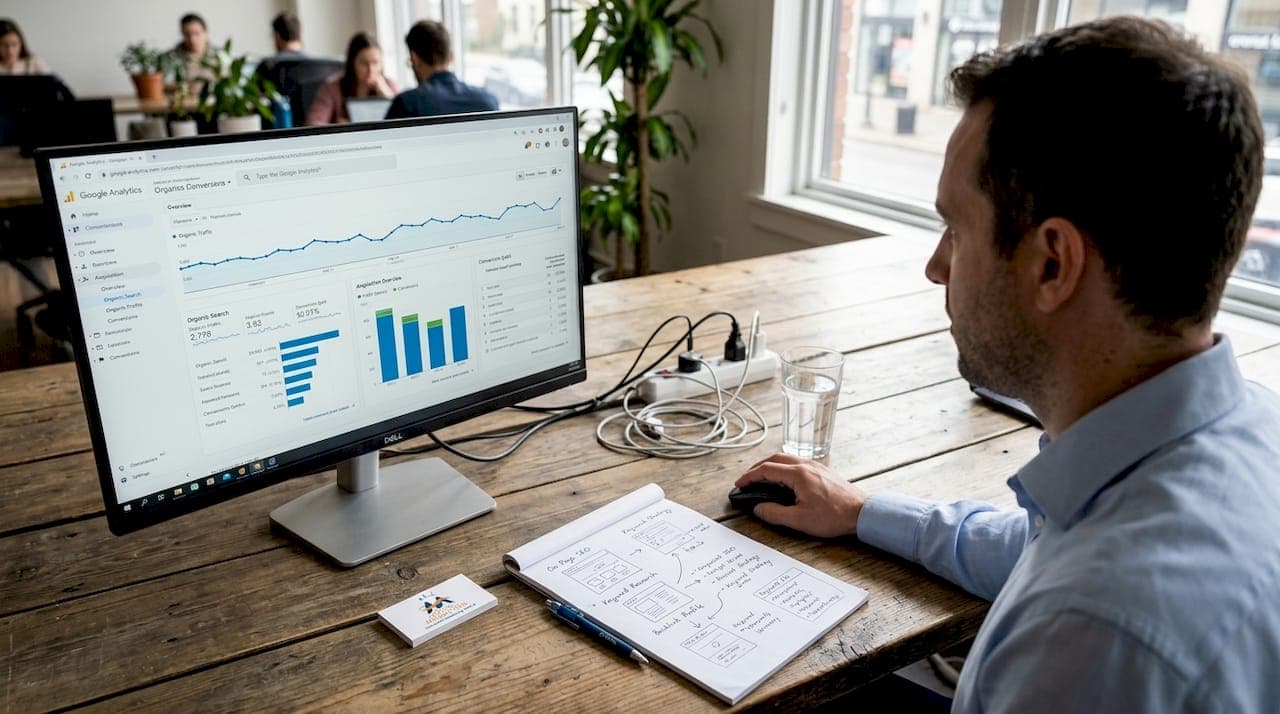
- Organic traffic from Google Search Console and Google Analytics, broken down by page.
- Keyword rankings for your most important service and commercial terms.
- Leads and conversions tied directly to organic search sessions.
- AI surface appearances, including Google AI Overviews and featured snippets, which are increasingly visible in Search Console data.
Know the difference between fast wins and long-term plays:
- Fast wins (1-3 months): Fixing technical errors, optimizing existing service pages, improving meta titles and descriptions.
- Long-term plays (6-12 months): Building topical authority through consistent content, earning backlinks, and accumulating brand signals.
SEO ROI compounds over time with authority accumulation, and most SMBs should expect to see meaningful results within 3 to 6 months of consistent effort. Budget expectations for most small businesses fall between $1,500 and $5,000 per month, depending on market competition and goals.
Once you identify what's delivering the best return, scale it. Double down on the content formats, page types, and keyword clusters that generate the most leads. Use multi-channel signals, like social media engagement and brand mentions, to reinforce your AI SEO strategy and accelerate growth.
Why less really is more: Our experience with SEO for small businesses
With measurement and scaling in mind, let's share a founder's-eye view on what separates winning SMB SEO from wasted effort. After working with hundreds of small businesses, one pattern stands out clearly: the ones that grow through search are not the ones doing the most. They're the ones doing the right things consistently.
Small business SEO is a game of focus, not abundance. Every hour you spend ruthlessly improving your core service pages, answering real customer questions, and removing low-value "SEO bloat" (thin pages, duplicate content, outdated posts) delivers far more than spreading effort across twenty tactics at once.
AI hasn't reinvented the rules either. The businesses showing up in AI Overviews and featured snippets are the same ones that built strong brand authority through E-E-A-T, clear writing, and fast, reliable websites. The algorithm has changed. The fundamentals have not.
The most common mistake we see? Business owners chasing the newest trend, whether it's a new content format or a new ranking factor, instead of reinforcing what's already working. If a service page is ranking on page two, fix it. Don't start a podcast.
Jumpstart your SEO success with expert help
Your SEO action plan builds on these essentials, and the steps above give you a clear path forward. But knowing what to do and having the time and expertise to execute it are two different things.
If you're ready to accelerate your results, Digital Marketing All offers specialized services built specifically for SMBs. From helping you get more customer reviews that strengthen your local authority, to helping you optimize your Yelp profile for local search visibility, to a full business website upgrade designed to convert more visitors into leads, we have the tools to match your goals. Get a free evaluation and see exactly where your biggest opportunities are.
Frequently asked questions
What is the single most important SEO step for small businesses?
Ensure your key service pages are crawlable, indexable, and solve real customer needs. Google Search Essentials confirm that technical eligibility and helpful content are the baseline requirements for ranking.
Do I need to do special 'AI SEO' for Google's new search features?
No. Optimize for standard SEO practices, including E-E-A-T, structured content, and quality answers, and you'll naturally appear in AI summaries too.
How long will it take to see SEO results?
You should see initial impact within 3 to 6 months; major growth typically takes 6 to 12 months. SMB SEO timelines confirm this pattern holds across most industries and market sizes.
Should I focus more on blogs or service pages?
For SMBs, prioritize service and commercial pages first, directing roughly 70% of your effort there. Use blog content to support those main pages and build topical authority around your core offerings.
Recommended
- Local Business Search Ranking Guide: SEO & AI Visibility 2026
- Ranking Higher in Searches: Simplified SEO Strategies
- 7 Local SEO Strategies & AI Tips to Boost Rankings | Digital Marketing All
- Advanced SEO tactics that drive sustainable SMB growth
- Boost local SEO with strategic UK phone number use in 2026|BM