

Nearly three-quarters of top-ranking pages are at least three years old. That single fact should change how you think about SEO entirely. Most small business owners chase quick wins, fresh content bursts, and one-time optimizations. But the businesses that consistently dominate search results are playing a longer, smarter game. Advanced SEO tactics are not just a step up from basic optimization. They are a fundamentally different approach that builds authority, generates organic leads, and compounds in value over time. This guide breaks down exactly what those tactics look like and how you can apply them to your business.
Table of Contents
- Why basic SEO falls short for modern SMBs
- The compounding ROI of advanced SEO tactics
- Building topical authority: Pillar-cluster strategies
- AI-driven SEO and GEO nuances: What SMBs need to know
- Applying advanced SEO: Action steps for SMBs
- Boost your business with expert SEO solutions
- Frequently asked questions
Key Takeaways
| Point | Details |
|---|---|
| Lasting SEO ROI | Advanced SEO efforts compound over time, generating the highest return and sustained traffic for SMBs. |
| Pillar-cluster advantage | Organizing content around pillars and clusters builds brand authority and unlocks top rankings. |
| AI and GEO essentials | Optimizing for AI-driven search and local GEO factors is critical for search visibility and lead generation. |
| Actionable framework | SMBs can follow practical steps to implement advanced SEO, from technical fixes to content strategy. |
Why basic SEO falls short for modern SMBs
Basic SEO gets you started, but it rarely gets you ahead. Tactics like adding a keyword to your page title or writing a short blog post were effective years ago. Today, they are table stakes. Search engines have grown far more sophisticated, and so have your competitors.
The most common mistakes SMBs make with basic SEO include:
- Targeting high-volume keywords without considering search intent
- Publishing thin content that does not answer user questions in depth
- Ignoring technical issues like slow page speed or broken links
- Skipping local SEO signals that matter for neighborhood-level visibility
- Treating SEO as a one-time project rather than an ongoing strategy
"Advanced SEO provides higher ROI through authority accumulation and topical depth, outperforming short-term fixes in every measurable way."
The difference between SEO vs paid marketing becomes clear when you look at longevity. Paid ads stop the moment your budget runs out. Advanced SEO keeps working. Understanding the line between bad vs good SEO is the first step toward building a strategy that actually holds up over time.
The compounding ROI of advanced SEO tactics
Here is where the numbers get compelling. Studies show an average 748% ROI for SEO investment, far outpacing most other marketing channels. A meta-analysis confirms a high effect size of d=1.049 for SEO's impact on traffic and rankings, meaning the evidence is not just anecdotal. It is statistically robust.
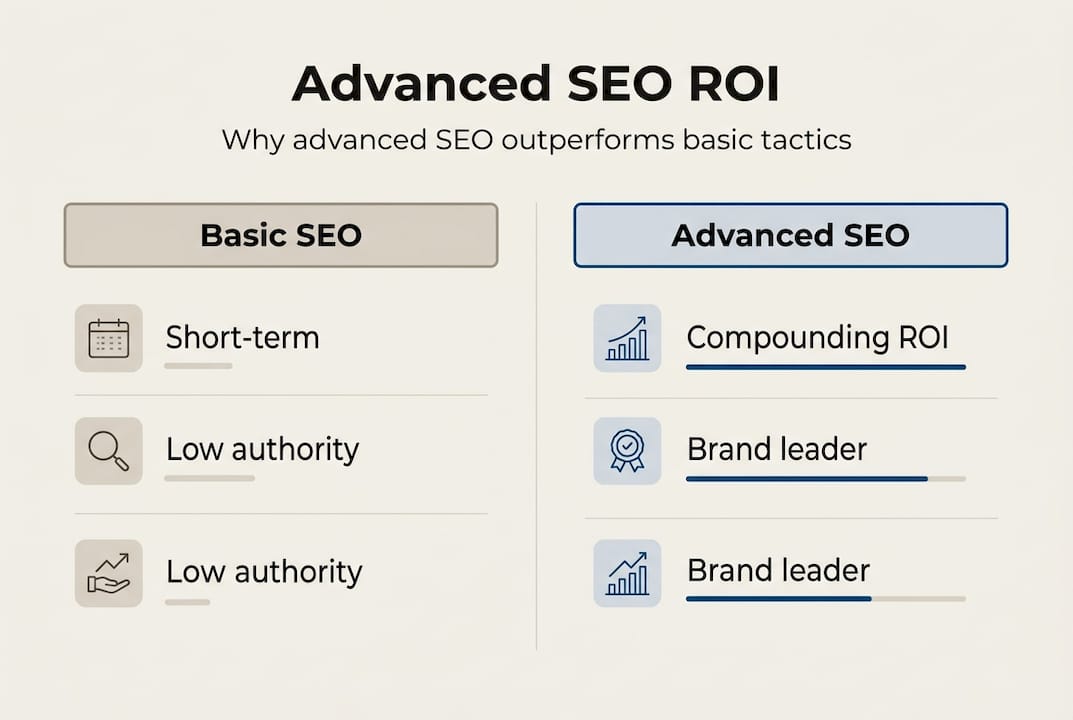
| Factor | Basic SEO | Advanced SEO |
|---|---|---|
| Time to results | 1 to 3 months | 4 to 12 months |
| Result durability | Short-lived | Long-lasting |
| Authority building | Minimal | Strong and compounding |
| Lead quality | Variable | Consistently high |
| ROI over 2 years | Low to moderate | High to exceptional |
Advanced SEO builds on itself. Every piece of authoritative content you publish, every quality backlink you earn, and every technical improvement you make adds to a growing foundation. The SEO long-term ROI advantage is not just about rankings. It is about owning a consistent channel for leads that does not require constant spending.
Tangible outcomes SMBs can expect from advanced SEO include:
- Sustained first-page rankings for high-intent keywords
- Increased organic traffic that grows month over month
- Higher conversion rates from better-targeted visitors
- Reduced dependence on paid advertising over time
- Stronger brand credibility in your local or national market
Exploring secret SEO strategies used by top-performing businesses can give you a clear picture of what separates average results from exceptional ones.
Building topical authority: Pillar-cluster strategies
One of the most powerful advanced SEO frameworks is the pillar-cluster content model. It works by organizing your website content around one broad topic (the pillar) and supporting it with a network of related, more specific articles (the clusters). Each cluster links back to the pillar, and the pillar links out to each cluster.

This structure signals to search engines that your website is a trusted, thorough resource on a given subject. It also improves user experience by guiding visitors through a logical content journey.
Steps to build a pillar-cluster framework for your business:
- Identify your core service or topic area as the pillar
- Research 8 to 15 related subtopics your audience searches for
- Create in-depth cluster articles targeting each subtopic
- Link all cluster articles back to the main pillar page
- Update both pillar and cluster content regularly to stay current
Before you build content, though, your technical foundation must be solid. Prioritize technical SEO first, including Core Web Vitals with an LCP (Largest Contentful Paint) under 2.5 seconds, before scaling your content strategy. A slow or broken site will undermine even the best content.
Pro Tip: Start with building topical authority in one focused niche before expanding. Depth beats breadth every time in modern SEO. Use tools like Google Search Console to identify which topics already drive traffic, then build your cluster around those.
For a practical breakdown of how to apply this, check out ranking higher in searches with simplified but effective strategies.
AI-driven SEO and GEO nuances: What SMBs need to know
Search is no longer just about Google's traditional algorithm. AI Overviews, generative search results, and GEO (Generative Engine Optimization) are reshaping how businesses get found. If you are not optimizing for these systems, you are leaving visibility on the table.
Here is what the data shows about AI-optimized content performance:
| Optimization tactic | Impact on AI citation |
|---|---|
| Including statistics | +41% more likely to be cited |
| Using authentic quotes | +38% more likely to be cited |
| Avoiding keyword stuffing | Prevents up to 10% ranking drop |
| GEO-specific optimization | Boosts local visibility by up to 40% |
These AI citation factors are not optional extras. They are becoming core ranking signals. Google's AI systems favor content that reads like expert analysis, not keyword-stuffed filler.
Action steps to optimize for AI-driven search:
- Include verifiable statistics and data points in every major piece of content
- Add direct quotes from credible industry sources or internal experts
- Write for search intent, not keyword density
- Optimize your Google Business Profile for local GEO signals
- Structure content with clear headings so AI systems can parse and cite it easily
Pro Tip: Review your top-performing pages and add at least two statistics and one expert quote to each. This simple update can meaningfully improve your chances of appearing in Google AI Overviews and AI-generated search summaries.
AI-driven personalization is also changing how users interact with search results. Businesses that adapt their AI marketing funnel early will have a significant advantage. Pair this with strong SMB conversion optimization to turn that visibility into actual revenue.
Applying advanced SEO: Action steps for SMBs
Knowing the strategy is one thing. Executing it consistently is what separates businesses that grow from those that stagnate. Here is a practical sequence to get started.
- Audit your technical SEO first. Check page speed, mobile usability, crawl errors, and Core Web Vitals. Fix critical issues before anything else.
- Define your pillar topic. Choose one core service or subject area and commit to building authority around it.
- Map your cluster content. List 10 related questions your customers ask and create dedicated pages for each.
- Optimize existing content for AI. Add statistics, quotes, and clear structure to your top pages.
- Build quality backlinks. Reach out to local directories, industry publications, and partners for links.
- Set up tracking. Use Google Search Console and Google Analytics 4 to monitor rankings, traffic, and conversions.
- Review and adapt quarterly. SEO is not set-and-forget. Revisit your strategy every three months.
Pro Tip: Do not try to do everything at once. Pick two or three of these steps and execute them well before moving on. Consistency matters more than speed in advanced SEO.
Advanced SEO tactics provide higher ROI and sustainable online lead generation precisely because they are built on compounding effort. Each improvement reinforces the next. Exploring search price optimization can also help you understand how to maximize your investment at every stage.
Boost your business with expert SEO solutions
Putting advanced SEO into practice takes time, expertise, and the right tools. If you are ready to move beyond guesswork and build a strategy that delivers real, measurable results, we are here to help.

At Digital Marketing All, we specialize in helping SMBs like yours grow their online presence with proven, AI-powered strategies. From review management solutions that build trust and credibility, to Yelp optimization help that strengthens your local profile, to full website upgrades designed to convert visitors into customers, we offer the complete toolkit your business needs. Reach out today and let us build a strategy tailored to your goals.
Frequently asked questions
What makes advanced SEO tactics more effective than basic SEO?
Advanced tactics build lasting authority, attract high-intent organic leads, and deliver compounding ROI over time, while basic optimizations tend to produce short-lived results that fade as competition increases.
How does AI impact SEO strategies for small businesses in 2026?
AI search systems prioritize content quality, verified statistics, and authentic quotes. Content with statistics and quotes is up to 41% more likely to be cited in AI-generated results, making content depth a critical ranking factor.
What is the pillar-cluster content strategy?
The pillar-cluster model organizes your content around one broad topic supported by related articles, helping search engines recognize your site as a topical authority and improving rankings across multiple related keywords.
Why is GEO optimization crucial for local SMBs?
GEO optimization targets location-specific search signals and can boost local visibility by up to 40%, helping local businesses attract more qualified leads from nearby customers actively searching for their services.