

Your website attracts visitors, but they leave without contacting you or making a purchase. This frustration plagues countless small and medium business owners who invest in digital marketing yet see minimal returns. The solution lies in strategic conversion optimization that combines AI-driven marketing tactics with effective local SEO techniques. This guide delivers actionable strategies to transform your website from a digital brochure into a lead generation machine that consistently converts browsers into buyers.
Table of Contents
- Understanding the conversion problem: why your website isn't generating leads
- Preparing for success: key components of an effective conversion optimization strategy
- Executing your AI-driven marketing and local SEO tactics to boost conversions
- Verifying success and continuous improvement: tools and metrics to track
- Boost your conversion rates with expert marketing support
- FAQ
Key takeaways
| Point | Details |
|---|---|
| Funnel audits reveal drop-offs | Identifying where visitors abandon your site enables targeted fixes that immediately boost conversion rates |
| Simplified forms increase completions | Reducing form fields to three or fewer can dramatically improve submission rates and lead quality |
| Mobile optimization captures local traffic | Optimizing for smartphones ensures you convert the growing segment of mobile searchers in your area |
| AI-driven content personalizes messaging | Transactional, intent-focused content powered by AI increases engagement and conversion likelihood |
| Trust signals build credibility | Testimonials, reviews, and guarantees reduce hesitation and encourage visitors to take action |
Understanding the conversion problem: why your website isn't generating leads
Many SMB websites suffer from unclear calls to action that confuse visitors about what step to take next. When your homepage presents multiple competing CTAs or buries the primary action below the fold, potential customers simply leave. Complicated contact forms requiring excessive information create friction that drives away qualified leads who would otherwise convert.
Slow loading speeds and poor mobile experiences kill conversions before visitors even see your offer. Conversion optimization mechanics emphasize that funnel audits and A/B testing reveal exactly where visitors drop off in your sales process. These diagnostic tools show whether your problem stems from confusing navigation, weak value propositions, or technical issues that frustrate users.
Trust signals make the difference between a bounce and a conversion, yet many SMBs overlook this critical element. Displaying customer testimonials, industry certifications, and money-back guarantees addresses the natural skepticism visitors feel toward unfamiliar businesses. Without these credibility markers, even interested prospects hesitate to share contact information or commit to a purchase.
Mobile optimization deserves special attention because local searches increasingly happen on smartphones. When your site loads slowly on mobile devices or requires pinching and zooming to read content, you lose the exact audience most likely to convert into local customers. Responsive design that adapts seamlessly to any screen size captures this valuable traffic segment.
Common conversion killers for SMB websites:
- Vague or multiple competing CTAs that dilute focus
- Contact forms requesting unnecessary information beyond name, email, and phone
- Pages loading slower than three seconds on mobile connections
- Missing trust indicators like reviews, guarantees, or security badges
- Navigation structures requiring more than three clicks to reach conversion points
Pro Tip: Run a simple five-second test by showing your homepage to someone unfamiliar with your business. If they cannot immediately identify what you offer and what action to take, your conversion problem starts with clarity, not traffic.
Preparing for success: key components of an effective conversion optimization strategy
Funnel audits provide the foundation for all conversion improvements by mapping the complete visitor journey from landing page to thank you page. Install analytics tracking on every page to identify where visitors enter your site, which pages they view, and at what point they exit without converting. This data reveals whether your problem lies in attracting the wrong audience or failing to nurture interested prospects through to conversion.
Form design directly impacts completion rates, with simplified forms dramatically outperforming lengthy questionnaires. Limit initial contact forms to three essential fields: name, email, and phone number. You can gather additional qualifying information during follow-up conversations after establishing the relationship. Every extra field you require reduces completion rates by creating perceived effort that outweighs the visitor's current motivation level.

Mobile optimization extends beyond responsive design to encompass page speed, touch-friendly buttons, and streamlined navigation for small screens. Test your website on actual smartphones using cellular connections rather than just resizing your desktop browser. Elements that work perfectly on desktop often become unusable on mobile, particularly dropdown menus, hover effects, and closely spaced clickable elements that frustrate users with fat-finger mistakes.
Trust signals must appear strategically throughout your conversion funnel, not just buried on a testimonials page few visitors find. Place customer reviews near your primary CTA, display security badges next to form fields requesting personal information, and showcase relevant certifications or awards in your header. These credibility markers work subconsciously to reduce the perceived risk of doing business with your company.
Essential preparation steps for conversion optimization:
- Install comprehensive analytics tracking across all pages and conversion points
- Map your complete visitor funnel from first touch to final conversion
- Audit all forms to eliminate unnecessary fields beyond core contact information
- Test mobile experience on multiple devices using actual cellular connections
- Gather and strategically place trust signals near all conversion points
- Create focused landing pages with single, clear calls to action
- Establish baseline conversion metrics before implementing changes
| Optimization Element | Implementation Priority | Expected Impact |
|---|---|---|
| Form simplification | High | 20-40% completion increase |
| Mobile speed optimization | High | 15-30% conversion lift |
| Trust signal placement | Medium | 10-25% credibility boost |
| Clear CTA design | High | 25-50% click improvement |
| Funnel audit completion | High | Identifies specific bottlenecks |
Pro Tip: Before making any changes, document your current conversion rate, average session duration, and bounce rate as baseline metrics. Without these benchmarks, you cannot accurately measure the impact of your optimization efforts or justify continued investment in conversion improvements.
Executing your AI-driven marketing and local SEO tactics to boost conversions
AI-driven content transforms generic website copy into personalized messaging that speaks directly to visitor intent and stage in the buying journey. Rather than creating one-size-fits-all pages, AI tools analyze search patterns and user behavior to generate variations that address specific pain points and objections. This targeted approach increases relevance and conversion likelihood by showing each visitor the exact information they need to move forward.
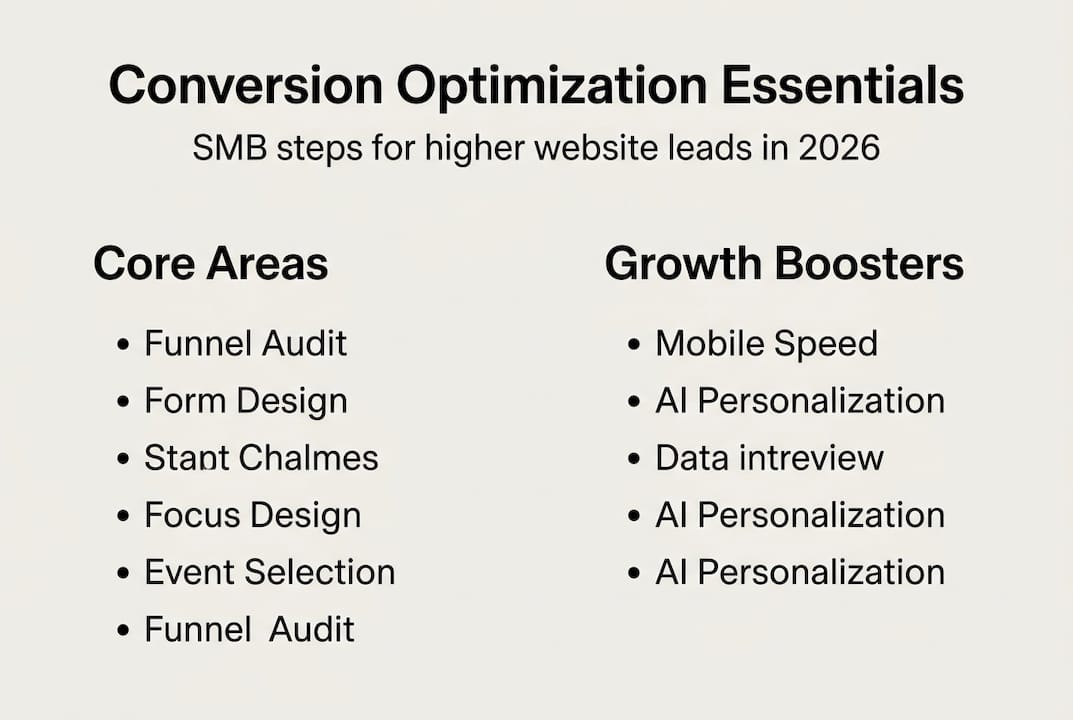
Local SEO tactics work synergistically with conversion optimization by attracting geographically qualified traffic most likely to become customers. Optimize your Google Business Profile with complete information, regular posts, and review responses that demonstrate active engagement with your community. Location-specific keywords throughout your website content help you appear in local search results where purchase intent runs highest.
Steps to implement AI-enhanced conversion tactics:
- Identify your highest-value conversion pages and map visitor intent for each
- Use AI content tools to create multiple headline and CTA variations for testing
- Implement dynamic content that changes based on traffic source or user behavior
- Optimize meta descriptions and title tags with local keywords and clear value propositions
- Create location-specific landing pages for each service area you serve
- Set up automated A/B testing to continuously refine messaging and design elements
- Monitor which AI-generated variations produce the highest conversion rates
Focused landing pages eliminate distractions and guide visitors toward a single conversion goal with laser precision. Unlike your homepage that serves multiple purposes, dedicated landing pages for specific campaigns or services remove navigation menus, sidebars, and competing CTAs. This singular focus dramatically improves conversion rates by preventing decision paralysis and keeping attention on the desired action.
| Approach | Content Creation | Personalization | Conversion Impact | Implementation Cost |
|---|---|---|---|---|
| Manual SEO | Slow, labor-intensive | Limited to broad segments | Moderate, generic appeal | High time investment |
| AI-Enhanced SEO | Rapid, scalable | Dynamic, intent-based | High, targeted relevance | Low, automated |
| Hybrid Strategy | Strategic human oversight | AI execution with human refinement | Highest, combines strengths | Moderate, balanced |
Pay-per-click advertising amplifies your conversion optimization by driving targeted traffic to your newly optimized pages. AI-powered PPC platforms automatically adjust bids, test ad copy variations, and identify high-converting audience segments faster than manual management. This combination of optimized landing pages and intelligent traffic acquisition creates a powerful conversion engine.
Trust signals to maintain throughout your funnel:
- Customer testimonials with photos and full names for authenticity
- Industry certifications and awards prominently displayed
- Security badges near form fields and payment information
- Clear privacy policies and data protection statements
- Money-back guarantees or risk-free trial offers
- Live chat or immediate response promises
Pro Tip: Create separate landing pages for each traffic source (Google Ads, Facebook, email campaigns) with messaging that matches the specific promise or pain point mentioned in the ad. This message consistency from click to conversion page significantly improves conversion rates by meeting visitor expectations.
Verifying success and continuous improvement: tools and metrics to track
Conversion rate stands as your primary success metric, calculated by dividing total conversions by total visitors and expressing as a percentage. However, this single number tells an incomplete story without supporting metrics that explain why your rate improves or declines. Track conversion rate separately for different traffic sources, device types, and landing pages to identify which elements perform best and deserve increased investment.
Bounce rate indicates the percentage of visitors who leave after viewing only one page, signaling either irrelevant traffic or poor page experience. High bounce rates on key landing pages suggest a disconnect between your traffic source messaging and page content. Average session duration reveals engagement levels, with longer visits typically correlating with higher conversion likelihood as visitors consume more information before deciding.
Critical metrics for conversion optimization:
- Overall conversion rate and rate by traffic source
- Form completion rate and abandonment point analysis
- Bounce rate for key landing pages and entry points
- Average session duration and pages per session
- Mobile versus desktop conversion rate comparison
- Cost per conversion for paid traffic sources
- Time to conversion from first visit to action
A/B testing platforms validate whether your optimization changes actually improve results or simply reflect random variation. Run tests for sufficient duration to gather statistically significant data, typically requiring at least 100 conversions per variation. Testing one element at a time (headline, CTA color, form length) produces clearer insights than changing multiple variables simultaneously.
Google Analytics provides comprehensive tracking of visitor behavior, traffic sources, and conversion paths at no cost for most SMBs. Set up goal tracking for each conversion action (form submissions, phone calls, purchases) and create custom dashboards displaying your key metrics. Enhanced ecommerce tracking reveals exactly where visitors abandon shopping carts or checkout processes.
| Metric Category | Key Indicators | Target Benchmarks | Tracking Tools |
|---|---|---|---|
| Conversion Performance | Rate, cost per conversion | 2-5% for B2B, 3-7% for B2C | Google Analytics, CRM |
| User Engagement | Session duration, pages per visit | 2+ minutes, 3+ pages | Analytics platforms |
| Technical Performance | Page load speed, mobile usability | Under 3 seconds, 90+ mobile score | PageSpeed Insights |
| Traffic Quality | Bounce rate, return visitor rate | Under 60%, 20%+ returning | Analytics, heat mapping |
Heat mapping tools visualize where visitors click, how far they scroll, and which page elements attract attention versus being ignored. These insights reveal whether your carefully crafted CTAs actually get noticed or if visitors focus on less important page areas. Session recordings show real visitor interactions, exposing usability issues that quantitative data alone cannot identify.
Form analytics deserve dedicated attention because forms represent the final conversion barrier where many qualified leads abandon the process. Track which fields cause the most hesitation, how long visitors spend on each field, and where they exit without submitting. This granular data guides form optimization that can double or triple completion rates.
Pro Tip: Interpret metric trends over rolling 30-day periods rather than reacting to daily fluctuations that often reflect normal variance. Sustainable conversion improvements emerge gradually as you accumulate testing data and refine your approach based on consistent patterns rather than isolated results.
Boost your conversion rates with expert marketing support
Optimizing website conversions requires ongoing testing, technical expertise, and strategic marketing knowledge that stretches many SMB owners beyond their core competencies. Digital Marketing All specializes in implementing the exact conversion optimization strategies covered in this guide, combining AI-driven marketing with local SEO excellence. Our team handles the technical complexity while you focus on serving the increased leads generated.

Our review generation and management services build the trust signals that convert hesitant visitors into confident customers. We help you systematically collect authentic reviews and display them strategically throughout your conversion funnel. Combined with our Yelp optimization services, your local presence becomes a powerful conversion asset that competitors cannot match. Explore our comprehensive website design and marketing solutions to discover how we transform underperforming websites into lead generation machines.
FAQ
How many form fields maximize completion rates for SMB conversion?
Keeping contact forms to three fields or fewer (name, email, phone) significantly increases completion rates by reducing perceived effort and friction. Research consistently shows that each additional form field decreases submission likelihood, with forms requesting more than five pieces of information experiencing abandonment rates above 60%. You can always gather additional qualifying details during follow-up conversations after establishing initial contact.
What role does mobile optimization play in enhancing website conversions?
Mobile optimization captures the rapidly growing segment of local searchers who use smartphones to find and evaluate businesses while on the go. Mobile-optimized sites load quickly on cellular connections, display clearly on small screens, and provide touch-friendly navigation that desktop-focused designs often lack. Google prioritizes mobile-friendly websites in search results, making optimization essential for both visibility and conversion performance.
How does AI-driven content improve website conversion rates?
AI creates personalized, intent-focused content that addresses specific visitor needs rather than generic information that fails to motivate action. Transactional AI content shifts emphasis from passive education to active engagement, presenting clear next steps and compelling reasons to convert immediately. This targeted approach increases relevance for each visitor segment, dramatically improving conversion likelihood compared to one-size-fits-all messaging.
What conversion rate should SMBs target as a realistic goal?
Most SMB websites should target conversion rates between 2% and 5% for B2B services, while B2C e-commerce sites typically achieve 3% to 7% depending on industry and price point. However, your specific benchmark depends on factors like traffic quality, average sale value, and sales cycle length. Focus on improving your current rate by 20% to 30% through systematic optimization rather than chasing arbitrary industry averages that may not reflect your unique situation.
How long does it take to see measurable conversion rate improvements?
Simple changes like form simplification or CTA redesign can produce measurable improvements within two to four weeks as sufficient traffic flows through your optimized pages. Comprehensive conversion optimization involving multiple elements typically requires 60 to 90 days to gather statistically significant data and refine based on results. Conversion-focused funnels deliver the fastest results when you implement proven best practices rather than experimenting with untested approaches.