

Many small business owners assume that large national brands automatically win the online visibility game. That belief is one of the most costly misconceptions in local marketing. The truth is, local search is specifically designed to favor relevance and proximity over budget size, which means a well-optimized small business can outrank a major chain for customers searching right in your neighborhood. This guide breaks down exactly what local search is, why it matters more than ever in 2026, which ranking factors drive results, and what actions you can take today to start showing up where it counts.
Table of Contents
- What is local search and why does it matter?
- How does local search impact your business's visibility?
- Essential local search ranking factors in 2026
- Actionable local search strategies for small business owners
- Why most local search advice misses the mark
- Ready to elevate your local visibility?
- Frequently asked questions
Key Takeaways
| Point | Details |
|---|---|
| Local search levels the field | Small businesses can outshine bigger brands by using smart local SEO strategies. |
| ROI grows over time | Investing in local search builds lasting visibility and customer trust without heavy ad costs. |
| Focus on fundamentals | Up-to-date profiles, positive reviews, and local citations make the biggest ranking difference in 2026. |
| Action drives results | Consistent, small steps in local SEO bring compounding benefits over months and years. |
What is local search and why does it matter?
Local search is what happens when someone types a query like "coffee shop near me" or "plumber in Austin" into Google, Bing, or even a voice assistant. Search engines then pull up results based on the user's location, matching them with businesses that are geographically close and contextually relevant. It sounds simple, but the implications for your business are significant.
Think about how customers actually find services today. They reach for their phone, type a need, and act on the first results they see. That moment is your opportunity. Local search connects your business to buyers who are already in decision mode, not just browsing. These are high-intent customers ready to call, visit, or purchase.
Mobile and voice search have accelerated this trend dramatically. More than half of all Google searches now happen on mobile devices, and voice queries like "find a dentist near me" are growing every year. Both behaviors are deeply tied to local intent. If your business isn't optimized for local search, you're invisible to a massive and growing pool of ready-to-buy customers.
Here's what makes local search especially valuable for small businesses:
- No massive ad budget required. Unlike paid ads, local search visibility is earned through relevance and trust.
- Long-term compounding results. Every review, citation, and optimized listing builds authority over time.
- Higher purchase intent. Local searchers are typically closer to a buying decision than general web browsers.
- Community trust. Appearing in local results signals legitimacy to nearby customers.
- Mobile-first reach. Local search is the primary way mobile users discover nearby businesses.
As the local search value data consistently shows, this channel rewards consistent effort with compounding returns. According to the U.S. Chamber of Commerce, local SEO builds authority that compounds over time, delivering cost-effective, long-term ROI that paid ads simply can't match.
"Local SEO is one of the most powerful tools small businesses have to compete against larger brands. Unlike advertising, its benefits grow over time rather than disappearing the moment you stop spending."
That compounding effect is why local search should be at the center of your marketing plan, not treated as an afterthought.
How does local search impact your business's visibility?
Visibility in local search is not just about being found. It's about being found first. The top three results in Google's local pack, the map-based listings that appear above organic results, capture a disproportionate share of clicks and calls. If you're not in that top tier, most potential customers will never see you.
Traditional advertising puts your message in front of people who may or may not need you. Local search does the opposite. It surfaces your business at the exact moment someone is looking for what you offer. That difference in timing is why getting found locally translates so directly into walk-in traffic, phone calls, and online bookings.
Consider this: nearly 80% of local searches on mobile result in an offline purchase within 24 hours. That stat alone should shift how you prioritize your marketing spend. Local search isn't just a visibility tool. It's a direct revenue driver.

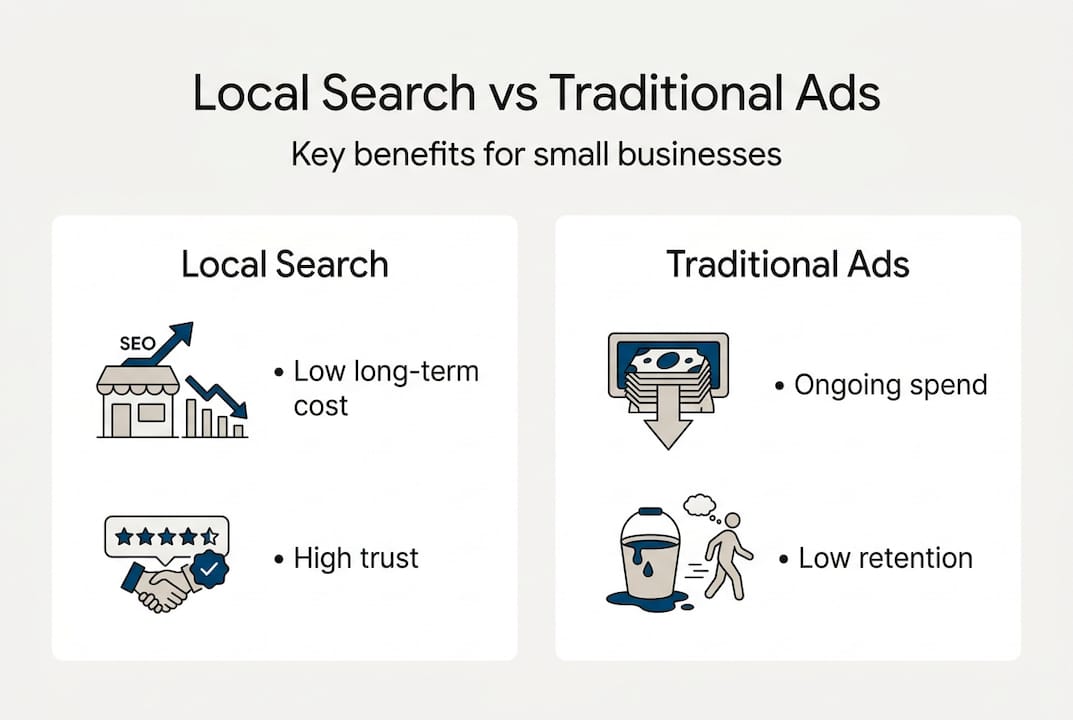
Here's a simple comparison of local search versus traditional advertising:
| Factor | Local search | Traditional ads |
|---|---|---|
| Cost over time | Decreases as authority builds | Ongoing spend required |
| Targeting precision | Hyper-local, intent-based | Broad or demographic-based |
| Trust signal | High (reviews, maps, citations) | Low (perceived as promotional) |
| Longevity | Lasting, compounding | Stops when budget stops |
| Conversion rate | Higher (purchase intent) | Lower (awareness stage) |
Controlling your Google Business Profile is the single most important step toward local visibility. Your profile is what populates the map pack, shows your hours, displays reviews, and lets customers call or get directions with one tap. Alongside that, consistent citations, which are mentions of your business name, address, and phone number across directories, reinforce your legitimacy to search engines.
Businesses that dominate local search results understand that every touchpoint, from their Google profile to their Yelp listing, works together to build a credible, visible presence. Gaps or inconsistencies in that presence can quietly suppress your rankings without you realizing it.
Essential local search ranking factors in 2026
Understanding the impact of local visibility is one thing, but achieving it requires knowing exactly what matters to search engines in 2026. The algorithm has evolved, and so have the factors that move the needle.
Here's a breakdown of the top local ranking factors and their relative importance:
| Ranking factor | Relative weight |
|---|---|
| Google Business Profile optimization | Very high |
| Review quantity and quality | High |
| Local citations and NAP consistency | High |
| On-page local keywords | Medium-high |
| Backlinks from local sources | Medium |
| Proximity to searcher | High |
| Mobile usability | Medium |
AI-powered search has added a new layer of complexity. Google's AI systems now evaluate context, intent, and entity relationships, not just keywords. That means your business needs to be described consistently and accurately across all platforms, not just optimized for a single phrase. Autocomplete marketing insights reveal how AI-driven suggestions shape what users even think to search for, making brand presence in autosuggest a growing competitive edge.
Here's a step-by-step approach to strengthen your local ranking basics:
- Claim and fully complete your Google Business Profile. Add photos, hours, services, and a keyword-rich description.
- Build consistent citations. List your business on Google, Yelp, Bing Places, Apple Maps, and industry-specific directories.
- Optimize your website for local keywords. Include your city and service area in title tags, headers, and content.
- Earn quality backlinks. Partner with local organizations, sponsors, or media outlets for mentions.
- Improve mobile experience. A slow or hard-to-navigate mobile site hurts both rankings and conversions.
- Generate reviews consistently. Ask satisfied customers after every transaction.
Pro Tip: Review generation is the single highest-leverage activity for most small businesses. A steady flow of authentic, recent reviews signals trust to both Google and potential customers. Even five new reviews per month compounds into a significant trust advantage over 12 months.
As ranking research confirms, reviews, citations, relevance, and proximity are the core pillars of local search success in 2026.
Actionable local search strategies for small business owners
Knowing which factors matter equips you. Now, let's break down what you can do starting today to move the needle on your local visibility.
The most effective local SEO strategies are not complicated. They are consistent. Here's your action checklist:
- Audit your Google Business Profile weekly. Check for unanswered questions, outdated info, or missing photos.
- Respond to every review. Positive or negative, your response shows professionalism and boosts engagement signals.
- Create local content. Blog posts about community events, local guides, or neighborhood-specific services build topical relevance.
- Fix citation inconsistencies. Use a tool like Moz Local or BrightLocal to find and correct mismatched listings.
- Tag your location on social media. Every post with a location tag adds a local signal to your brand footprint.
- Optimize for voice search. Write FAQ-style content that answers questions the way people actually speak.
- Ensure your site loads fast on mobile. Use Google's PageSpeed Insights to identify and fix speed issues.
Social media SEO is an underutilized lever for local businesses. Platforms like Facebook, Instagram, and even TikTok send behavioral signals to search engines. When users engage with your location-tagged posts, it reinforces your local relevance.
AI-driven tools now make many of these tasks faster. Automated review requests, AI-generated local content drafts, and smart citation management platforms can save hours each week while improving consistency. The local business search ranking guide outlines how to combine these tools with foundational tactics for the best results.
Pro Tip: Avoid shortcuts like keyword stuffing your business name in your Google profile or buying fake reviews. Google's spam filters are increasingly sophisticated, and penalties can set your visibility back by months.
Simple, consistent actions boost local rankings faster than most business owners expect, especially in markets where competitors are not actively optimizing.
Why most local search advice misses the mark
Here's the uncomfortable truth most marketing content won't tell you: the majority of small businesses fail at local search not because they lack knowledge, but because they chase the wrong things. They obsess over the latest Google algorithm update, spend hours on keyword research tools, or jump to trendy tactics before their Google Business Profile is even complete.
The businesses that consistently win in local search do something unglamorous. They show up every week, ask for reviews, keep their information accurate, and create content that serves their community. That's it. The long-term ROI from local search comes from building authority steadily, not from chasing short-term hacks.
We've seen businesses with flawless keyword strategies get outranked by competitors with 200 more reviews and a fully filled-out profile. Trust signals beat technical perfection every time in local search. The secret SEO strategies that actually work are rarely secret at all. They're just applied consistently by the businesses willing to do the work. And search price optimization research confirms that businesses investing in foundational local SEO see compounding returns that dwarf one-time ad campaigns. Consistency is the real competitive advantage.
Ready to elevate your local visibility?
The strategies in this guide give you a clear path forward. But implementing them consistently while running a business is where most owners get stuck. That's where having the right support makes all the difference.

At Digital Marketing All, we help small and medium-sized businesses build the kind of local presence that generates real leads. From review management tools that automate your reputation building, to Yelp help that strengthens your directory presence, to local business websites built to convert visitors into customers, we offer everything you need to compete and win locally. Reach out today and let's build your local search advantage together.
Frequently asked questions
What is local search in digital marketing?
Local search refers to the process by which search engines help users find businesses, services, or products in their immediate geographic area. It connects customers and businesses in real time based on location and intent.
Why does local search outperform traditional ads for small businesses?
Local search offers ongoing discoverability and trust, with higher ROI over time compared to short-lived ad campaigns. Unlike ads, local SEO builds authority that keeps working even when you're not actively spending.
How long does it take to see results from local SEO?
Most small businesses begin to notice measurable improvements in visibility within 1 to 3 months of consistent optimization. SEO delivers compounding authority and lasting results rather than instant wins.
What are the three most important factors for ranking in local search in 2026?
The top factors are optimized Google Business Profiles, frequent positive reviews, and consistent citations across directories. Rankings are driven by reviews, citations, relevance, and proximity working together.
Can social media activity help my local search visibility?
Yes, active social media engagement and location tagging can boost signals that help your business surface in local searches. Social media signals now play a greater role in local business SEO than many owners realize.