

TL;DR:
- Most local businesses mistakenly believe working harder ensures online visibility, but search dominance is controlled by platforms.
- AI-driven changes are shrinking traditional organic visibility, making trust signals and data accuracy crucial for SMBs.
- Focusing on consistent reviews, complete profiles, and structured data will better position businesses to benefit from AI citations and local packs.
Most local business owners assume that getting found online is a matter of working harder than the competition. The reality is far more concentrated than that. More than half of all clicks on Google go to just the first three results on the first page, and recent AI-driven changes are squeezing visibility even further. For small and medium-sized businesses, this means the rules of the game have shifted dramatically. This guide breaks down exactly what search engine dominance is, how it shapes your ability to get found, and what concrete steps you can take to compete and win in the new landscape.
Table of Contents
- Defining search engine dominance
- How search engine dominance impacts your SMB
- Understanding market vs. ranking dominance
- AI, local search, and the winner-take-most effect
- Strategies for SMBs to thrive under search engine dominance
- Perspective: The uncomfortable truth about search engine dominance for SMBs
- Accelerate your local search wins with expert support
- Frequently asked questions
Key Takeaways
| Point | Details |
|---|---|
| Visibility is concentrated | The majority of local search clicks and leads are captured by a small number of highly visible businesses on dominant platforms. |
| AI is reshaping exposure | AI Overviews and answer boxes now determine which businesses are seen, often displaying fewer results and prioritizing trust signals over keywords. |
| Trust and data are vital | Consistent business info and strong reviews matter more than ever for being cited by both traditional and AI-driven search results. |
| Measure leads, not just ranks | For SMBs, the most meaningful results now come from tracking calls and leads generated by AI/local packs instead of just chasing keyword rankings. |
Defining search engine dominance
After understanding just how high the stakes are for online visibility, let's clarify what search engine dominance actually means in practical terms.
At its core, search engine dominance means one search engine or platform captures and controls a disproportionately large share of user search demand, shaping what content gets discovered. This is not just about which search engine people prefer. It is about how one platform's rules, algorithms, and priorities determine whether your business exists in the eyes of potential customers.
Think about it this way: when a single platform controls where most people search, that platform also controls which businesses get found. This creates a winner-take-most environment where visibility is not distributed evenly. The businesses already ranking well tend to attract more clicks, more reviews, and more signals that reinforce their position. The gap between the top three results and everyone else is not just large. It widens over time.
"Search engine dominance means one platform captures a disproportionately large share of user search demand, shaping what content gets discovered and which businesses earn visibility."
For SMBs, the key metrics to watch include:
- Share of clicks: Where your business appears in ranked results and how often users actually click through
- Default status: Whether a platform is baked into devices, browsers, or apps that your customers use daily
- AI citation rates: How often AI-driven answer tools pull your business data when answering relevant local queries
- Local pack inclusion: Whether your Google Business Profile shows up in the map and listing results at the top of local searches
Understanding the search engine dominance effects on your actual click and lead volume is the starting point for building a smarter, more effective strategy.
How search engine dominance impacts your SMB
With the definition established, it is time to see the real-world effects for your business.
The concentration of clicks is not a minor inconvenience for businesses ranked outside the top three. It is a lead-generation crisis in slow motion. Research from BrightLocal confirms that first-page click share is heavily concentrated in the top positions, and AI Overviews are now taking over relevant search results, causing SMBs to lose organic clicks even when they technically rank within those overviews.
| Search result position | Estimated click share |
|---|---|
| Position 1 | 27-30% |
| Position 2 | 15-18% |
| Position 3 | 10-12% |
| Positions 4-10 | Less than 5% each |
| Page 2 and beyond | Less than 1% |
The AI Overview effect is real. When Google's AI Overview answers a question directly at the top of the page, many users never scroll down to see traditional organic results at all. Even businesses that rank in the top three are finding that their click-through rates are declining, because the AI answer satisfies the user's query before they click anything.
Your Google Business Profile (GBP) has become just as important as your website ranking, if not more so. Phone calls, direction requests, and direct messages now flow through the GBP listing. AI platforms also use GBP data to determine which businesses to cite in local recommendations. A well-maintained profile directly influences whether you show up when someone asks an AI assistant for a recommendation near them.
Here is how these shifts affect your day-to-day business in order of impact:
- Declining organic click volume even when your rankings hold steady, due to AI Overviews absorbing user attention
- Increased competition for the local pack, where only three businesses typically show up and AI is reducing that number further
- Higher reliance on review signals to earn AI citations in local recommendation queries
- Direct loss of leads when your business information is incomplete, outdated, or inconsistent across platforms
Understanding how AI changes in search visibility affect your specific category and location is critical. What works for a national brand does not necessarily work for a neighborhood service provider.
Pro Tip: Stop tracking only your keyword ranking position. Start tracking actual leads and calls originating from your Google Business Profile, AI-driven local packs, and citation appearances. That data tells you whether dominance is working in your favor or against you.
Also worth noting: owning the search box before users even finish typing is a strategy that leverages autosuggest, which sits entirely upstream of traditional ranking battles. When your business name or category appears as a suggested search, you capture attention before the competitive results page even loads.
Understanding market vs. ranking dominance
Knowing how dominance impacts you, let's clarify the two main kinds of dominance that matter for your business.
These two types operate at completely different levels, and confusing them leads to wasted effort and misdirected strategy.
Market dominance refers to how one platform, typically Google, controls the infrastructure of search itself. This is reinforced through default search agreements that lock up access points, including browser defaults, smartphone operating systems, and voice assistants. This structural control is why competing platforms struggle to gain meaningful share even when they offer strong features. For your business, this means Google's rules are the rules. Period.
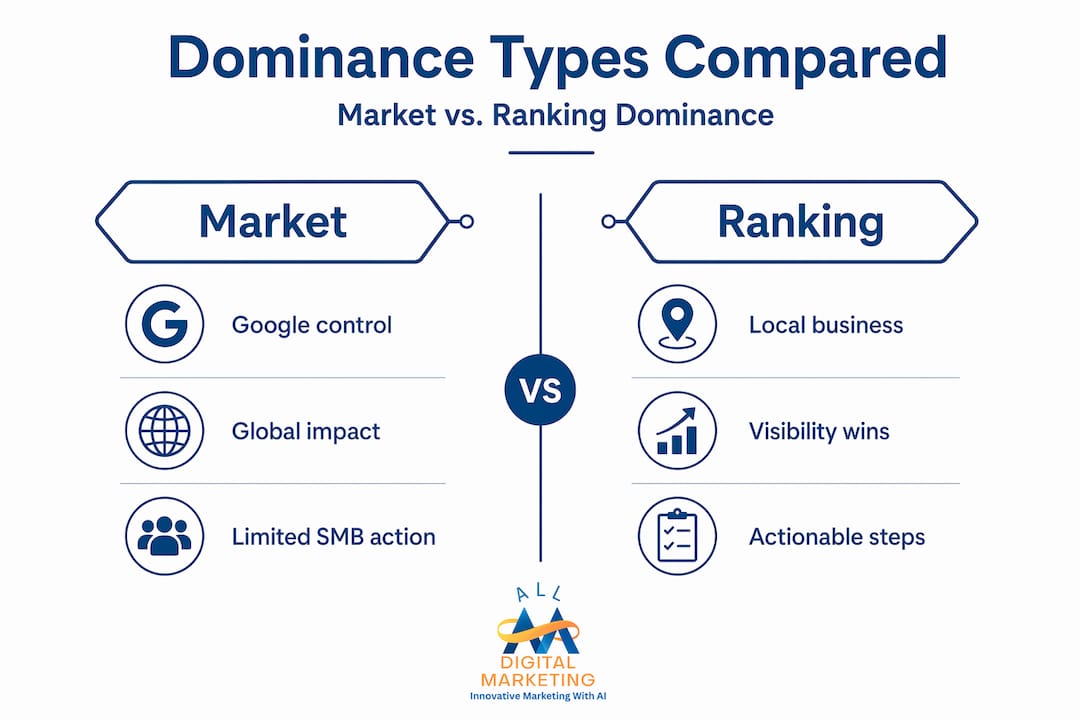
Ranking and citation dominance is what SMBs can actually influence. This is the level at which a handful of local businesses consistently show up in top organic results, local packs, and AI-generated answers. As SEO dominance increasingly depends on SERP structure and AI extraction behavior, the signals that drive citations are shifting from pure keyword optimization to trust, relevance, and data completeness.
| Type of dominance | Who controls it | How SMBs are affected | What SMBs can do |
|---|---|---|---|
| Market dominance | Platforms (Google, Bing) | Sets the rules for how visibility is earned | Adapt strategy to platform requirements |
| Ranking dominance | Algorithm and trust signals | Determines which businesses get shown | Build trust signals, reviews, data quality |
| Citation dominance | AI extraction logic | Decides who gets cited in AI answers | Optimize GBP, reviews, structured data |
Understanding how search engine dominance impacts local optimization means recognizing which level you are operating at and where your effort will produce the best return. Fighting market-level dominance as an SMB is not practical. Winning at ranking and citation dominance absolutely is.
For businesses ready to go deeper, advanced SEO tactics for SMBs include structured data implementation, semantic content optimization, and entity-based SEO approaches that speak directly to how AI systems evaluate and extract business information.
Key differences that should shape your strategy:
- Market-level dominance is set by platform economics and legal agreements, not by individual business effort
- Ranking dominance can be shifted with consistent effort over 3 to 6 months for most competitive local markets
- Citation dominance in AI answers requires data integrity across all platforms, not just on-page SEO
- The strategies for each level are distinct and should not be conflated
AI, local search, and the winner-take-most effect
As AI restructures local search, the playing field tightens. Let's see what this means for standing out.
The numbers are striking. Research from SearchAtlas found that AI-generated local packs surface only about 32% as many businesses as traditional local packs, and semantic relevance is the primary driver of which businesses earn those AI citations. This is not a marginal shift. It means that if traditional local packs showed five to seven businesses, AI-driven answers might only cite one or two.
This is the winner-take-most effect playing out in real time, and it has direct consequences for how you should invest your marketing time and budget.
| Visibility format | Typical # of businesses shown | Primary ranking signal |
|---|---|---|
| Traditional organic results | 10 per page | Backlinks, on-page SEO, authority |
| Classic local pack | 3 to 7 listings | GBP completeness, proximity, reviews |
| AI-generated local pack | 1 to 2 businesses | Semantic relevance, trust signals, data accuracy |
| AI Overview citations | 1 to 3 sources | Entity authority, structured data, reviews |
Semantic relevance means the AI system evaluates your business based on how well your full online presence matches the meaning of the user's query, not just whether you have the right keywords on your website. A user asking "who is the best plumber near me for emergency pipe repairs" triggers an AI assessment of your reputation, your review content, your service descriptions, and the consistency of your business data across every directory and platform.
Here is what you need to do to position your business for AI citation consideration:
- Write service descriptions that reflect real user language, not just industry jargon. Use the words your customers actually use when describing their problem.
- Build review volume across multiple platforms so AI systems see consistent, credible social proof from real customers.
- Complete every field in your Google Business Profile, including services, hours, photos, Q&A, and posts.
- Implement structured data markup (schema.org) on your website so AI systems can cleanly extract your business information.
- Maintain identical business name, address, and phone number across every directory listing, social profile, and citation.
Optimizing your Google Business Profile for AI citation is not the same as optimizing it for traditional local search. The requirements are more rigorous, the competition for citations is more intense, and the payoff for getting it right is significantly higher.
Pro Tip: Review content matters more than review volume alone. AI systems analyze the text of your reviews to assess semantic relevance. Encourage customers to describe the specific service they received and the outcome. Reviews that say "great plumber, fixed my burst pipe within two hours on a Sunday" carry more AI-citation weight than "great service, highly recommend."

Strategies for SMBs to thrive under search engine dominance
With the challenges mapped, here is how you can turn search dominance from obstacle to opportunity.
The good news is that the strategies required to succeed in this new environment are within reach for most small businesses. They require consistency and attention to detail more than large budgets or technical expertise. Research from Yext confirms that for SMBs, treating local SEO as data synchronization and trust-building is essential because dominant systems consume your signals, and missing or inconsistent data directly reduces your chances of being recommended.
Here is a step-by-step action plan:
- Audit your business data across every platform. Check Google Business Profile, Yelp, Facebook, Apple Maps, Bing Places, and at least ten major directory sites. Every inconsistency in your name, address, or phone number is a signal that works against you.
- Claim and complete every available directory listing. Unclaimed listings often contain outdated or incorrect information that you did not put there.
- Set up a review generation system. Ask every satisfied customer for a review, and make it easy by sending a direct link. Aim for a steady stream of new reviews rather than occasional bursts.
- Respond to every review, positive and negative. AI systems and search algorithms both favor businesses that actively engage with their review content.
- Post regular updates to your Google Business Profile. Events, offers, and new service announcements signal an active, credible business.
- Add structured data to your website. Your web developer or a schema.org plugin can add this markup in under an hour for most sites, and it significantly improves how AI systems read your business information.
- Track leads by source. Use call tracking and UTM parameters to identify whether your calls and form submissions are coming from your GBP, organic results, AI packs, or paid ads.
Beyond the technical steps, keep these principles in mind:
- Consistency beats intensity. Posting one hundred reviews in a single week looks suspicious to both users and algorithms. A steady five to ten per month is far more credible.
- Negative reviews are not the end. A thoughtful, professional response to a negative review often improves your overall reputation more than the negative review damages it.
- Your website and your GBP must tell the same story. Inconsistent service lists, different phone numbers, or mismatched business hours create confusion for both users and AI systems.
- Photos matter more than most people realize. Businesses with high-quality, regularly updated photos receive significantly more engagement on their GBP listings than those with outdated or stock photos.
AI strategies for online visibility are most effective when they are built on this foundation of clean, consistent, trustworthy data. Chasing algorithm changes without this foundation is like building on sand.
Perspective: The uncomfortable truth about search engine dominance for SMBs
Now that you know the best practices, let's highlight what most guides miss and where your focus should really be.
The marketing industry spent the last decade teaching small businesses to chase organic keyword rankings. Get to page one, the advice went. Rank for your target keywords. Build backlinks. The implicit promise was that ranking high would translate directly into leads, calls, and revenue.
That promise was always partially misleading, and in the AI era, it is even less reliable. We have seen businesses with first-page rankings watch their lead volume decline because AI Overviews now answer their customers' questions before any click happens. Ranking high is not the same as being chosen.
The real measure of success in 2026 is not your ranking position. It is whether your business is being cited, recommended, and chosen by the systems that now sit between your potential customers and the search results. Those systems are AI-powered. They evaluate trust, data integrity, and semantic relevance. They do not care whether you spent months optimizing a blog post for a keyword.
Here is the hard part: this shift requires a change in how you think about your marketing, not just a change in what tools you use. Businesses that are winning right now are treating their online presence as a data asset to be maintained with discipline, not a campaign to be launched and forgotten. They are rethinking local search strategies around customer trust signals rather than technical ranking factors alone.
The fallacy of keyword fixation is expensive. We see businesses invest significant budget into content and link building while ignoring the fact that their Google Business Profile is incomplete, their review responses are absent, and their business information is inconsistent across platforms. In the current environment, those basics outperform a sophisticated keyword strategy every single time.
The mindset shift is this: stop trying to rank, and start trying to be trusted. Reviews, data accuracy, responsive engagement, and structured information are the signals that AI systems use to decide who gets cited. Those same signals are also what real customers use to decide who to call. The two objectives are now perfectly aligned, which is actually good news for businesses willing to do the work consistently.
Accelerate your local search wins with expert support
If you are ready to put these strategies to work, expert help is available.
At Digital Marketing All, we work directly with SMBs to build the kind of online presence that earns AI citations, dominates local packs, and drives real leads. Whether you need to get more reviews through a managed review generation program or want to optimize your Yelp presence as part of a broader reputation strategy, our team knows exactly what signals the dominant platforms are looking for. We map every service we offer to the real-world requirements of AI-driven local search, so your investment builds something durable. Reach out today and let's identify the fastest, most impactful steps for your business to gain visibility and earn more customers in your local market.
Frequently asked questions
What is search engine dominance in simple terms?
It means one search engine or platform controls most of the search traffic, determining which businesses get seen and clicked. As one platform captures a disproportionately large share of user search demand, it effectively decides which businesses are visible to potential customers.
Why does search engine dominance matter for small businesses?
It matters because most customers only click on businesses listed at the top of dominant search engines, so not being visible can cost you leads. On Google, more than half of clicks go to the first three results on the first page alone.
Is ranking #1 still enough with AI Overviews and local packs?
No, because AI answer boxes now pull fewer options and often divert clicks before users reach traditional results. AI-generated local packs surface far fewer businesses than traditional packs, so being cited by AI and having strong reviews is just as crucial as ranking.
How can an SMB increase its chances for AI citation dominance?
Keep business info consistent across all platforms, focus on generating and responding to reviews, and optimize your Google Business Profile with complete and accurate data. For SMBs, synchronizing business information and prioritizing trust-building are the most direct paths to better AI citation rates.
What's the difference between market dominance and ranking dominance?
Market dominance means controlling the whole platform or ecosystem, often through default search access points, while ranking dominance means showing up above your competitors in search results or AI-generated answers. SMBs cannot influence market dominance, but they can absolutely win at ranking and citation dominance through consistent effort.