
TL;DR:
- Online visibility directly impacts leads, revenue, and long-term growth for small businesses.
- AI search tools now require businesses to build trusted citations and authoritative references.
- Combining traditional SEO with AI-adapted strategies ensures sustained online discoverability in 2026.
Most business owners assume having a website means they're visible online. That assumption is costing them real revenue. Top Google positions capture a 27.6% click-through rate while page two results receive just 0.63%. That gap is not a minor difference. It represents customers who found your competitor instead of you. In 2026, online visibility means more than ranking on Google. It means showing up in AI-generated answers, local search results, and autosuggest features. This article breaks down why visibility matters, how AI is reshaping the rules, and what specific strategies will help your business get found and stay competitive.
Table of Contents
- The case for improving online visibility
- AI-driven search and new visibility challenges
- SEO fundamentals and their evolving effectiveness
- Practical steps to boost your online visibility in 2026
- What most SMBs miss about online visibility
- Supercharge your visibility with proven AI and local solutions
- Frequently asked questions
Key Takeaways
| Point | Details |
|---|---|
| Visibility drives revenue | Top search positions capture more traffic and income, making visibility a direct business asset. |
| AI changes search rules | AI-driven search now favors trusted sources and requires new strategies beyond old SEO tactics. |
| Local search converts best | Optimizing for local 'near me' searches attracts high-value customers ready to buy. |
| Adapt for dual channels | Winning online today means targeting both traditional search and AI-driven platforms. |
The case for improving online visibility
Visibility is not a vanity metric. It directly connects to leads, revenue, and long-term business growth. Organic search drives an average of 53% of website traffic across industries, making it the single largest source for most businesses. Paid ads stop the moment you pause your budget. Organic visibility keeps working.
The difference between ranking first and ranking fifth on Google is not proportional. It is dramatic. A business in the top position captures more than four times the clicks of the fifth result. Drop to page two and you are essentially invisible. SEO long-term ROI compounds over time, which is why investing in visibility now pays dividends for years.
Local search behavior makes this even more urgent. People searching "near me" phrases are ready to buy. These are not casual browsers. They are customers with intent, looking for a business like yours right now.
Here is why visibility matters for small and medium-sized businesses:
- Levels the playing field. A well-optimized local business can outrank a national chain in local results.
- Drives cost-effective leads. Organic traffic has no per-click cost, making it far cheaper than paid advertising at scale.
- Captures high-intent local searches. "Near me" searches convert to in-store visits and purchases at rates that outperform most other channels.
- Builds long-term brand authority. Consistent visibility reinforces trust with both customers and search engines.
- Supports every other marketing effort. Email, social, and paid campaigns all perform better when your website has strong organic authority.
| Ranking position | Average click-through rate |
|---|---|
| Position 1 | 27.6% |
| Position 3 | ~10% |
| Position 5 | ~6% |
| Page 2+ | 0.63% |
The data is clear. Businesses that invest in visibility get traffic. Those that do not lose it to competitors who do. This is not about chasing trends. It is about capturing demand that already exists.
"Businesses that rank on page one of Google capture the overwhelming majority of clicks. Page two is where websites go to be forgotten."
AI-driven search and new visibility challenges
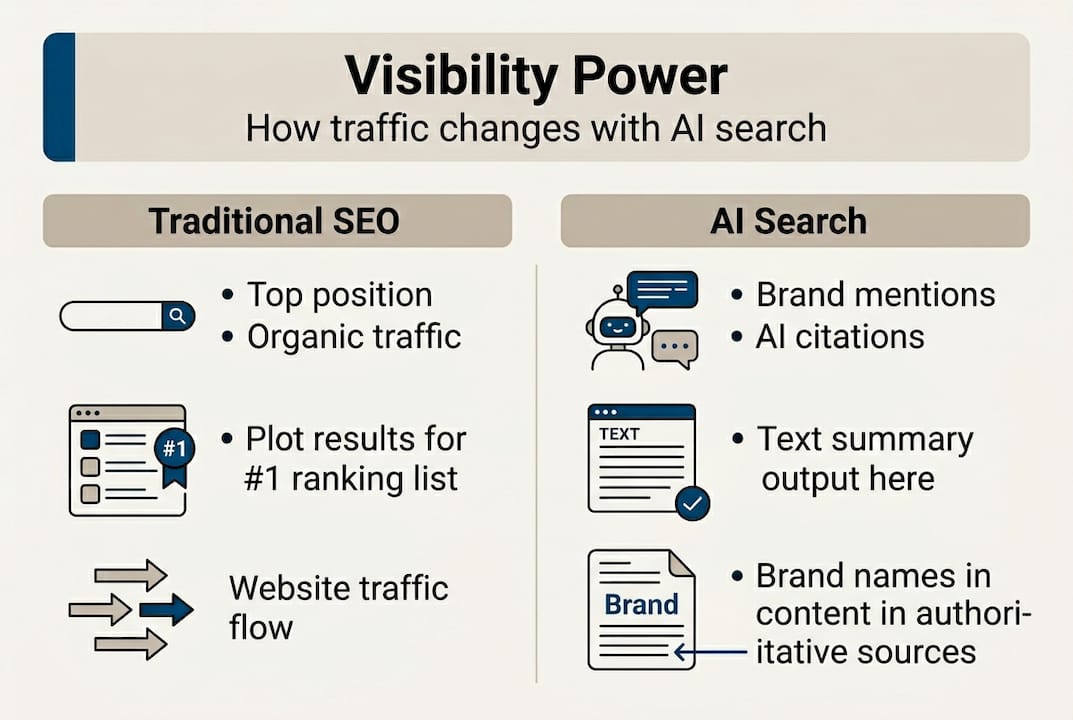
Google's AI Overviews and large language models (LLMs) like ChatGPT are fundamentally changing how people find information. These tools answer questions directly, often without requiring users to click through to a website. For businesses, this creates a new visibility challenge that traditional SEO alone cannot solve.

AI-driven search now influences 18% of searches, and AI tools like Gemini recommend specific brands 11% of the time. More importantly, 83% of AI citations come from high-trust, authoritative pages. If your business is not on those trusted sources, you are invisible to the algorithms doing the recommending.
This is where the AI vs. SEO debate gets interesting. AI does not replace SEO. It adds a second layer of visibility requirements. You now need to be found by humans and referenced by algorithms.
| Factor | Traditional SEO | AI-driven search |
|---|---|---|
| Primary goal | Rank in search results | Get cited by AI tools |
| Key signal | Backlinks and keywords | Trust, authority, citations |
| Content format | Keyword-optimized pages | Structured, factual content |
| Local relevance | Google My Business | Reviews, mentions, local data |
| Speed of results | Weeks to months | Ongoing presence building |
The concept here is presence engineering: actively managing where and how your business is referenced across the web so that AI systems recognize you as a credible source. This includes earning mentions on trusted directories, generating consistent reviews, and publishing content that authoritative sites link to.
Key challenges SMBs face in AI-driven search:
- Getting referenced on high-authority platforms that AI tools pull from
- Maintaining consistent business information across all directories
- Creating content structured enough for AI to extract and cite
- Building review volume that signals trust to both users and algorithms
Pro Tip: Focus on earning citations from well-known industry directories, local news sites, and review platforms. These are the sources AI tools trust most. Strategies for Google AI Overviews and understanding AI Overviews can help you adapt your content approach for this new reality.
SEO fundamentals and their evolving effectiveness
Despite AI disruption, traditional SEO remains one of the most effective marketing investments available. A meta-analysis of SEO studies found an effect size of d=1.049 for boosting organic rankings and traffic. That is considered a high effect, well above average for marketing tactics. SEO works. The question is how to apply it correctly in 2026.
However, 40% of SMBs reported traffic disruption from recent AI and algorithm changes. This is not a reason to abandon SEO. It is a reason to modernize your approach and combine traditional optimization with AI-adapted strategies.
SEO and GEO (geographic or local optimization) now work together more than ever. Ranking well in standard search results and ranking well in local results share many of the same signals: quality content, authoritative backlinks, consistent business information, and strong user engagement. Understanding local search ranking factors helps you prioritize where to focus your energy.
Actionable SEO basics for 2026:
- Publish high-quality, original content that answers specific questions your customers are asking
- Build backlinks from reputable sources including local directories, industry publications, and partner websites
- Optimize your Google Business Profile with accurate hours, photos, services, and regular posts
- Use structured data markup (schema) to help search engines and AI tools understand your content
- Ensure technical health including fast page load times, mobile optimization, and clean site architecture
- Generate and respond to reviews consistently across Google, Yelp, and industry-specific platforms
- Target local keywords that reflect how your customers actually search, including neighborhood and city-specific terms
The guide to getting found locally covers many of these tactics in detail, especially for businesses that rely on foot traffic or service-area customers.
Pro Tip: Think of SEO and AI visibility as two channels that feed the same goal. Optimize your website for search engines and structure your content so AI tools can easily extract and reference it. Both efforts reinforce each other.
Practical steps to boost your online visibility in 2026
Knowing the theory is useful. Taking action is what moves the needle. Here is a step-by-step approach to improving both your traditional and AI-driven visibility starting now.
- Audit your current visibility. Use Google Search Console and a tool like Semrush or Ahrefs to identify where you rank, what keywords drive traffic, and where you are losing ground.
- Claim and optimize every directory listing. Google Business Profile, Bing Places, Yelp, Apple Maps, and industry-specific directories should all have accurate, consistent information.
- Build a review generation system. Ask every satisfied customer for a review. Automate the request where possible. Volume and recency both matter to search engines and AI tools.
- Add structured data to your website. Schema markup for your business type, location, services, and FAQs makes your content machine-readable for AI systems.
- Publish content that earns citations. Write detailed guides, local resource pages, and expert commentary that other sites and AI tools will reference.
- Monitor your traffic sources weekly. Watch for sudden drops in organic traffic that may signal an algorithm update or AI shift requiring a fast response.
Key tools to support your visibility strategy:
- Google Search Console (free, essential for tracking search performance)
- Google Business Profile (free, critical for local visibility)
- Schema markup generators (free tools available online)
- Review management platforms (automate and track review requests)
- AI content optimization tools (help structure content for LLM citation)
AI marketing secrets and strategies for winning the AI search game offer deeper guidance on combining these tools effectively. For businesses adapting their full funnel, AI marketing funnel adaptation and AI-driven marketing in 2026 provide strategic context that goes beyond basic tactics.
Organic traffic drives 53% of site visits on average. That number alone justifies making visibility a top business priority.
Pro Tip: Set a monthly alert for your brand name in Google Alerts. If your mentions drop or shift in tone, that is an early signal to investigate and respond before rankings are affected.
What most SMBs miss about online visibility
Here is something we see consistently: business owners invest in a great website and then wonder why the phone is not ringing. The website is only one piece. Visibility is built across dozens of touchpoints, and most of them are off your own site.
The businesses that win local search are not always the ones with the best websites. They are the ones with the most consistent presence across directories, the most recent reviews, and the most trusted citations on the web. These are the signals that both Google and AI tools use to decide who to recommend.
There is also a common trap of chasing shortcuts. Buying low-quality backlinks or stuffing keywords into pages may produce short-term gains, but algorithm updates will erase them. The 2026 local search factors that matter most are trust, relevance, and consistency. Those take time to build and are very hard to fake.
Visibility is now earned twice: once for the humans who search, and once for the algorithms that recommend. Businesses that align their strategy to both channels will outperform those focused on just one.
Supercharge your visibility with proven AI and local solutions
You now have a clear picture of what drives visibility and what holds businesses back. The next step is putting the right tools and support in place to execute consistently.
At Digital Marketing All, we help SMBs build visibility that works across both traditional search and AI-driven channels. Our professional website services are built for performance and local discoverability. Our review management tools make it easy to generate the trust signals that search engines and AI tools prioritize. And if you want a fast path to a high-performing web presence, our website rental option gets you online quickly with zero upfront cost. Your competitors are building visibility right now. Let us help you stay ahead.
Frequently asked questions
What is online visibility and why is it important for small businesses?
Online visibility refers to how easily your business can be found across search engines, directories, and digital channels. Improving visibility directly drives more traffic, leads, and local customers to your business.
How has AI changed the way businesses achieve online visibility?
AI-driven search tools now answer queries directly, reducing traditional clicks and rewarding businesses with authoritative, trusted web presences. AI-driven search requires businesses to build presence beyond their own website to get cited by these systems.
What are the most effective strategies for improving online visibility in 2026?
Combining traditional SEO with AI-focused tactics like earning trusted citations, optimizing local listings, and using structured data delivers the strongest results. SEO effect size d=1.049 confirms it remains one of the highest-impact marketing investments available.
Can improving online visibility help compete with bigger brands?
Absolutely. Effective visibility strategies level the playing field by making smaller businesses discoverable in local and niche searches where large brands often underperform.
Recommended
- Unlock AI Visibility: Optimize for ChatGPT Recommendations and Google AI Overviews in 2025
- Why Smart Business Owners Get Found First in AI Search (2025 Guide)
- AI Overviews & Your Business: Drive Clicks & Sales with Action-Driven Content
- Why Your Brand Isn't in AI Search – Authority Signals to Earn Citations Now