

TL;DR:
- Online brand reputation reflects the overall perception of your business based on digital interactions and mentions across multiple platforms. Managing it requires active efforts beyond responding to reviews, including optimizing listings, building consistent content, and monitoring digital signals that influence visibility and trust. A proactive, holistic approach to online reputation enhances long-term growth and search ranking performance.
You search your own business name on Google. What comes up? Maybe a handful of reviews, some positive and some not. Perhaps a news mention you forgot about, a social media post from a frustrated customer, or a third-party listing with outdated information. That mix of results is your online brand reputation, and not all of it is content you created or approved. Brand reputation online is the overall perception of your business formed by customers, prospects, and others based on everything they encounter about you across digital channels. Understanding it, and actively shaping it, is one of the highest-leverage moves any small or medium-sized business can make.
Table of Contents
- Defining online brand reputation
- How online brand reputation is built (and lost))
- Where online reputation lives: channels that matter most
- Reputation management: action plan for SMBs
- The truth about online brand reputation: What most guides miss
- Boost your online reputation with expert support
- Frequently asked questions
Key Takeaways
| Point | Details |
|---|---|
| Reputation is user-driven | Online brand reputation is shaped by customer feedback, reviews, and search visibility, not just company messaging. |
| Manage beyond reviews | Responding to reviews is crucial, but full reputation management includes search results and digital narratives. |
| Identify key platforms | Focus your efforts on the search, review, and social channels where potential customers research and decide. |
| Consistency wins | Consistent, authentic online presence across all channels leads to long-term reputation strength and business growth. |
Defining online brand reputation
To tackle brand reputation, let's first get very clear on what it actually means and why you can't control it with ads alone.
Most business owners think of reputation as their brand promise: the tagline on their website, the values statement in their "About" section, or the professional logo they paid good money to design. Those things matter, but they don't define your reputation in the eyes of a potential customer doing research before making a purchase decision.
Brand reputation online is the sum of experiences, interactions, and perceptions that people form based on what they see across your digital footprint. It lives in Google search results, review platforms, social media feeds, third-party directories, local news, industry forums, and anywhere else people talk about or reference your business. Your ads and website content are just one small piece of that picture.
Here is why this distinction matters so much. When someone is deciding whether to hire your landscaping company, choose your law firm, or book your restaurant, they typically do not just visit your website and take your word for it. They search. They read reviews. They check your Google Business Profile. They might even scroll through your Facebook comments or look you up on Yelp. What they find in those moments shapes their first impression far more than any marketing message you crafted.
Understanding why reputation matters for marketing helps clarify why passive branding is not enough. You need to know what is feeding your reputation and which digital touchpoints carry the most weight.
Key digital touchpoints that shape online brand reputation:
- Google Business Profile (star ratings, reviews, Q&A, photos)
- Third-party review sites (Yelp, Trustpilot, Angi, TripAdvisor, Houzz, etc.)
- Social media platforms (Facebook, Instagram, X, LinkedIn, TikTok)
- News and editorial coverage (local publications, industry blogs, press releases)
- Online forums and communities (Reddit, Nextdoor, niche industry forums)
- Business directories and listings (BBB, Yellow Pages, data aggregators)
- Your own website content and how Google indexes it
| Reputation element | Example | Potential impact |
|---|---|---|
| Star rating average | 4.2 stars on Google | Drives or deters click-throughs |
| Review volume | 200 reviews vs. 5 reviews | Builds trust through social proof |
| Review recency | Last review 2 years ago | Signals inactivity or disengagement |
| Negative press | Local news complaint story | Can rank highly for branded searches |
| Social activity | Regular, responsive posting | Signals credibility and engagement |
| Business listing accuracy | Consistent NAP data | Affects local SEO performance |
"What you say about your business is just one input. What customers, reviewers, journalists, and communities say carries far more weight in building or breaking your actual reputation."
The table above shows how each element, taken on its own, tells only part of the story. Combined, they create the full picture that your next potential customer encounters before they ever speak to you.
How online brand reputation is built (and lost)
With a working definition in place, it's vital to know exactly how reputation is formed and how it can slip away.
Reputation does not form overnight. It accumulates gradually through a series of touchpoints, interactions, and moments of visibility. Understanding this process helps you see where to invest your effort for the greatest long-term payoff.
The key stages in building online brand reputation:
-
Initial digital impression. When someone first discovers your business, they encounter your Google Business Profile, your website, and possibly a review or two. This first impression is shaped in seconds. A sparse listing, an outdated website, or a cluster of unaddressed negative reviews can kill a lead before it starts.
-
Review accumulation. Over time, customers leave reviews across multiple platforms. These stack up and form a running score card for your business. The more consistent and positive these reviews, the stronger the trust signal you send to both potential customers and search engines.
-
Social and community chatter. People mention businesses in posts, comments, and community forums. These mentions can be positive, neutral, or damaging. Each one contributes to the broader narrative around your brand, especially when those posts rank in search results for your business name.
-
How you handle problems. This is where many businesses either strengthen or destroy their reputation. Responding thoughtfully to negative feedback shows accountability. Ignoring criticism or responding defensively signals poor customer service to everyone who reads the exchange.
-
Content authority and visibility. Businesses that consistently publish valuable content (blog posts, videos, guides, social updates) build credibility over time. Search engines pick this up, and prospects notice the depth of expertise you demonstrate publicly.
-
Third-party mentions and press. Local news coverage, industry publications, and influencer mentions carry significant weight. These signals tell search algorithms and potential customers that your business is recognized beyond its own marketing.
One of the most important things to understand is that negative events carry disproportionate weight. Research consistently shows that negative reviews impact the broader narrative context across channels, not just your response rate or star average. A single viral complaint or a prominent negative news story can undo months of positive reviews, especially if it ranks prominently when someone searches your name.
Pro Tip: Do not wait for a reputation crisis to start paying attention. Set up Google Alerts for your business name right now, and check your review profiles weekly. Brands that monitor consistently are far better positioned to catch problems early and respond before damage compounds.
The concept of managing online reviews is often framed as simply replying to what customers write. But authentic reputation building goes much deeper. It requires consistency across every interaction, message, and platform where your business appears. You cannot afford to be responsive on Google but silent on Facebook, or polished on your website but disorganized on Yelp. Inconsistency creates doubt.
Building customer loyalty online is closely tied to this. Customers who have positive, consistent experiences become advocates. Their organic mentions, referrals, and positive reviews compound over time and build the kind of reputation that no ad budget can fully replicate.
Where online reputation lives: channels that matter most
Next, knowing the "where" makes the "how" much more efficient, so let's break down the vital online touchpoints.
Online reputation is shaped across search results, social media, and review platforms. But not all channels carry equal weight for every business type. A local plumber needs to dominate Google reviews and local map results. A B2B consultant might focus more on LinkedIn and industry publications. A restaurant owner will live or die by Google, Yelp, and TripAdvisor.
Comparison of major reputation platforms:
| Platform | Primary use case | Best for SMB type | Visibility in branded search |
|---|---|---|---|
| Google Business Profile | Local discovery and reviews | Nearly all local SMBs | Very high, often top result |
| Yelp | Consumer reviews | Restaurants, home services, retail | High for service and hospitality |
| Community and social proof | B2C businesses with local audience | Moderate to high | |
| Professional credibility | B2B, professional services, consultants | Moderate, strong for professional searches | |
| X (formerly Twitter) | Real-time brand mentions | Retail, media, tech, hospitality | Moderate |
| Industry forums and Reddit | Peer recommendations | Niche and specialty businesses | Variable but often overlooked |
| Angi and Houzz | Trade and home services | Contractors, designers, home services | High within vertical |
Which channels matter most by business type:
- Restaurants and hospitality: Google, Yelp, TripAdvisor, Facebook
- Home services and contractors: Google Business Profile, Angi, Houzz, Nextdoor
- Professional services (legal, financial, medical): Google, LinkedIn, Healthgrades or Avvo where applicable
- Retail businesses: Google, Facebook, Instagram, Trustpilot
- B2B companies: LinkedIn, industry forums, Google (for branded search), media coverage
High-leverage "brand moments" are the specific touchpoints where reputation is most likely to be formed or broken. Your local map pack result, where your star rating appears next to your address in Google Maps, is one of the most visible real estate in local search. A prospect searching "best HVAC company near me" sees your rating before they ever click your website. That single number can decide whether you get the call.
Third-party press is another high-leverage channel that many SMBs underutilize. A mention in a local newspaper or a feature in an industry blog carries authority that your own content simply cannot replicate. These external sources of credibility feed brand authority and search visibility in meaningful ways.
The rise of AI-powered search adds another layer to consider. Platforms like ChatGPT, Perplexity, and Google's AI Overviews now surface business recommendations based on signals across the web. If your brand lacks depth and visibility across multiple channels, getting found in AI-powered search becomes much harder. AI systems are looking at the totality of your digital presence, not just your star rating.
Strong brand engagement strategies across multiple platforms create more surface area for your reputation to grow and be discovered. The more consistent, credible signals your business sends across channels, the more authoritative your presence becomes in both traditional search and emerging AI-driven results.
Reputation management: action plan for SMBs
Now that you know what channels to watch, here's how to take meaningful, practical steps to manage what people discover about your business.
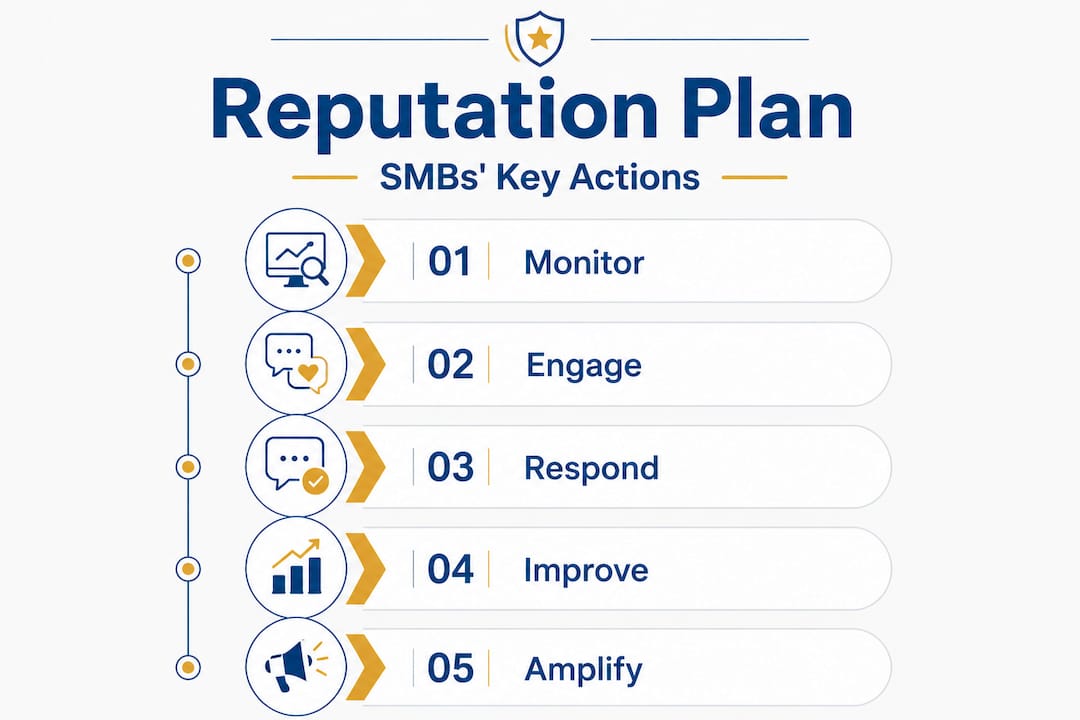
Reputation management is not a one-time project. It is an ongoing practice that, when done consistently, builds compounding value over time. The following action plan gives you a clear starting framework, whether you are starting from scratch or looking to strengthen an existing strategy.
Step-by-step reputation management action plan:
-
Audit your current reputation. Search your business name on Google in incognito mode. Note what appears on the first page: your website, your Google Business Profile, reviews, social profiles, any news mentions, and any negative content. This is what your prospects see. Document it clearly.
-
Claim and optimize your business listings. Make sure your Google Business Profile, Yelp page, Facebook business page, and relevant industry directories are claimed, fully filled out, and accurate. Consistent name, address, and phone number (NAP) data across listings is a core factor in local SEO performance. Discrepancies hurt rankings and erode trust.
-
Actively generate reviews. Do not wait for reviews to come in passively. Train your team to ask satisfied customers directly. Use follow-up emails, SMS requests, or QR codes at point of service. Focus first on Google, then on the most relevant secondary platform for your industry. Generating more reviews systematically is one of the most impactful reputation actions an SMB can take.
-
Respond to every review. Thank positive reviewers specifically and warmly. Address negative reviews professionally, acknowledge the experience, and offer a resolution path. Your response is not just for the reviewer; it is public-facing content that every future reader will see.
-
Build content that reflects your values and expertise. Blog posts, videos, FAQs, and social content that demonstrate your knowledge and values create a positive narrative around your brand. This content fills search results with material you control and gives Google (and AI systems) more signals about who you are.
-
Monitor consistently. Use tools like Google Alerts, mention tracking tools, or a simple regular search schedule. Local SEO strategies depend on staying current with how your business appears in local results, and reputation is a key factor.
-
Leverage social media for credibility. Consistent posting, community engagement, and responding to comments on social platforms signal that your business is active and trustworthy. Social SEO tips are particularly relevant here because social content now feeds local and general search visibility in ways it did not a few years ago.
-
Pursue third-party visibility. Seek out opportunities for press mentions, guest articles, local awards, community partnerships, and collaborations. These external signals strengthen your overall footprint. AI-driven visibility strategies increasingly rely on this kind of breadth of presence to place your business in AI-generated recommendations.
Top mistakes to avoid in online reputation management:
- Ignoring negative reviews entirely or deleting legitimate criticism
- Responding to reviews with generic, copy-paste replies that feel robotic
- Only managing reputation reactively, after a problem appears
- Focusing on one platform while neglecting others
- Letting business listings become stale or inaccurate
- Treating reputation management as a one-time fix rather than an ongoing practice
- Buying fake reviews, which violates platform policies and can result in penalties
Pro Tip: Check your reputation even during busy, successful periods. Many businesses only pay attention when something goes wrong. Brands that monitor proactively catch small issues before they become visible crises, and they can capitalize on positive momentum by amplifying what is working.
Responding to reviews alone is necessary but not sufficient for true online reputation management. You need to manage the broader narrative, including your visibility in search, the quality and consistency of your content, and your presence across third-party platforms. This full-spectrum approach is what separates businesses with durable, positive reputations from those that are constantly playing defense.
The truth about online brand reputation: What most guides miss
Most online reputation guides give you a checklist. Claim your listings. Respond to reviews. Post on social media. That advice is not wrong, but it is dangerously incomplete.
Here is the uncomfortable truth: responding politely to every review will not save your reputation if the broader narrative about your business is weak, fragmented, or invisible. A competitor with fewer five-star reviews but stronger content, more consistent search visibility, and wider third-party recognition will almost always win the trust of a new customer over you.
We have seen this pattern repeatedly with SMBs. A business owner spends months diligently replying to Google reviews, watches their star rating hold steady at 4.3, and then wonders why leads are still declining. The issue is not the reviews. It is that their overall digital presence is thin. Their website has not been updated in years. Their Google Business Profile has no photos and outdated hours. There are no blog posts, no press mentions, nothing that gives Google or an AI platform confidence to recommend them over a competitor with a stronger footprint.
Search algorithms and AI ranking systems do not evaluate your business on a single metric. They look at the totality of your digital presence. Your review score is one signal among dozens. Domain authority, backlink quality, content freshness, social engagement, NAP consistency, and third-party mentions all feed into how prominently you appear in results. Building durable brand authority means investing in all of these signals, not just the easiest one to manage.
The businesses that dominate their local markets are not always the ones with the best reviews. They are the ones that show up everywhere, consistently, with credible signals across every channel a potential customer might encounter. They are mentioned in local press. They have videos answering common customer questions. Their listings are complete and accurate. Their social profiles are active. Their website ranks for relevant terms.
Passive reputation management, where you simply do not make mistakes and hope people notice, has never worked. In the current AI-influenced search environment, it works even less. You need to actively build the narrative around your business rather than react to it after the fact.
"Your online reputation is not a score to maintain. It is a story being told about you across the web every day. The question is whether you are helping to tell it or leaving it entirely to others."
That shift in mindset, from defensive management to proactive narrative building, is what truly separates growing SMBs from stagnant ones.
Boost your online reputation with expert support
If you are ready to step beyond basics and take real control of your online reputation, here's where expert help fits in.
A strong reputation starts with a strong digital foundation, and that begins with your website. A professionally built, conversion-focused site signals credibility to both visitors and search engines. At Digital Marketing All, we offer professional website solutions designed specifically for SMBs that want to build authority and trust online. If upfront investment is a concern, our flexible website rental options let you get a high-performing, reputation-ready site without the large initial cost. From there, we layer in local SEO, review generation, content strategy, and AI-visibility tactics that position your business to be found, trusted, and chosen. Let us help you build the kind of digital presence that holds up under scrutiny.
Frequently asked questions
What factors most influence online brand reputation for small businesses?
Customer reviews, search results, social mentions, and business listings most impact online reputation, since brand reputation is shaped primarily by search, reviews, and social platforms, all of which a potential customer encounters before making contact.
Is responding to reviews enough to manage online reputation?
No, responding to reviews alone is not sufficient for online reputation management. Real reputation management covers search visibility, content strategy, and all digital channels, not just review replies.
How can I monitor my brand's reputation online?
You can monitor reputation by searching your business name in incognito mode regularly, tracking reviews on major platforms, and setting up alerts for online mentions, since brand reputation is shaped by what customers and others post across multiple digital platforms.
Does online reputation affect local SEO and business rankings?
Yes, positive reputation signals like reviews, consistent listings, and third-party mentions boost local search rankings, because brand perception across searches and reviews directly impacts how prominently your business appears in local and AI-driven search results.
Recommended
- Advanced SEO tactics that drive sustainable SMB growth
- SEO Gets You Seen. Digital PR Gets You Remembered — Build Your Brand Authority in 2025
- Social Media vs. Google: Where Should Local Businesses Focus Their Efforts?
- Business & Voice Listings: Dominate AI Search and Voice Results
- Τι είναι digital branding: Κατανόηση και Σημασία - maverix.gr