

TL;DR:
- A comprehensive digital presence includes website, reviews, social media, and directory listings.
- Consistent and optimized signals across channels improve local SEO and AI-driven discovery.
- Integrated management of all online touchpoints is key to building trust and increasing visibility.
Most small business owners assume that launching a website means customers can find them online. That assumption is costing businesses real revenue. 80% of consumers begin their shopping journey online, yet a website alone captures only a fraction of those discovery moments. Digital presence is far broader: it covers every online touchpoint where a customer might encounter your brand, from Google Maps to review sites to social media profiles. This guide breaks down exactly what digital presence is, why it matters for small and medium-sized businesses (SMBs), and how to build one that drives real results in 2026.
Table of Contents
- Defining digital presence: What it is and why it matters
- The core components: Channels that shape your digital presence
- How local SEO powers digital presence for SMBs
- The AI effect: Why SMBs must optimize for AI-driven discovery
- Why the best digital presence is truly integrated (and what most SMBs miss)
- Take your digital presence to the next level
- Frequently asked questions
Key Takeaways
| Point | Details |
|---|---|
| Digital presence is broad | It means being discoverable, trustworthy, and accessible across all major online platforms, not just your website. |
| Local SEO drives visibility | Optimizing your business for local search boosts your chances of attracting nearby customers. |
| AI discovery is the new frontier | Businesses must ensure their information is structured for AI to stay visible in automated search and answers. |
| Consistency builds trust | Aligning your brand details across all platforms enhances both discoverability and credibility. |
Defining digital presence: What it is and why it matters
Let's get precise. Digital presence is your brand's appearance across every online touchpoint, including your website, social media channels, business listings, and customer reviews. It is not a single asset. It is the full picture a potential customer sees when they search for a business like yours.
For this to work in your favor, your digital presence must be visible, trustworthy, and accessible. Visibility means search engines and AI platforms can find and surface your information. Trustworthiness means your reviews, ratings, and content build confidence. Accessibility means customers can reach you easily, whether through a phone number, a booking link, or a chat widget.
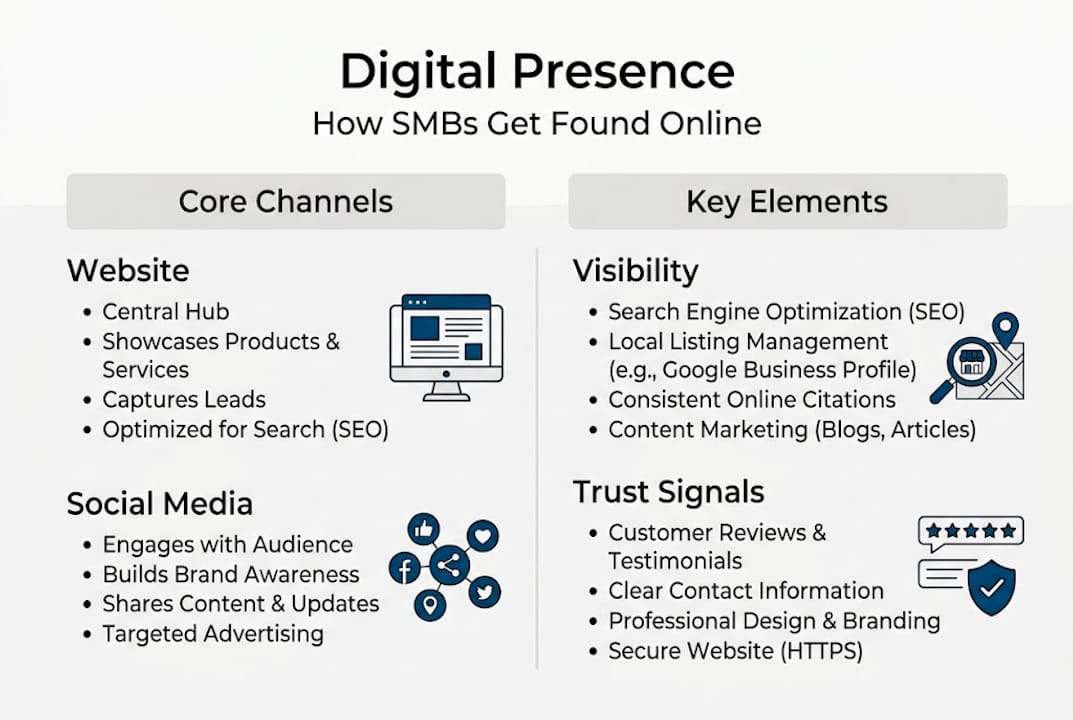
Here is a quick comparison to clarify the difference between a basic website and a full digital presence:
| Factor | Website only | Full digital presence |
|---|---|---|
| Search visibility | Limited to Google search | Google, Maps, AI, directories |
| Trust signals | None beyond your own content | Reviews, ratings, social proof |
| Customer touchpoints | One channel | Multiple channels |
| Local discoverability | Low | High |
| Brand control | Partial | Broad and consistent |
The key touchpoints that form a complete digital presence include:
- Your website: The foundation, but not the whole story
- Google Business Profile: Critical for local and map-based searches
- Social media profiles: Facebook, Instagram, LinkedIn, and more
- Business directories: Yelp, Bing Places, Apple Maps, and industry-specific listings
- Review platforms: Google Reviews, Trustpilot, and niche review sites
- Content assets: Blog posts, videos, and press mentions that build authority
When you optimize your Google Business Profile and keep your listings complete, you dramatically increase the chances of appearing where buyers are already looking. Building a strategy around getting found online locally is the first step most SMBs skip, and it shows in their results.
The core components: Channels that shape your digital presence
Knowing why digital presence matters is one thing. Knowing what actually builds it is another. Managing signals across your website, social profiles, directories, and reviews is how trust and discoverability are earned online.

Here is a breakdown of the key channels and the role each one plays:
| Channel | Primary audience | Core value |
|---|---|---|
| Website | All searchers | Credibility and conversion |
| Google Business Profile | Local and mobile users | Map and local pack visibility |
| Social media | Existing and new followers | Engagement and brand awareness |
| Business directories | Directory browsers | Citation consistency and reach |
| Review platforms | Decision-stage buyers | Trust and social proof |
Consistency across these channels is not optional. If your phone number is different on Yelp than it is on Google, search engines see a contradiction, and so do customers. This is called NAP consistency, short for Name, Address, and Phone number. Here is how to manage it:
- Audit all existing listings to find inconsistencies
- Correct your primary listings on Google, Yelp, and Bing first
- Update industry-specific directories next
- Document your standard NAP format and use it everywhere
- Monitor listings quarterly for changes or errors
Pro Tip: Inconsistent NAP information across directories sends mixed signals to Google and can push your local rankings down. A single incorrect listing can undo months of SEO work.
Reviews deserve special attention. Businesses with more verified, recent reviews consistently outperform competitors with fewer reviews, even when other factors are equal. Responding to reviews, both positive and negative, signals that you are active and trustworthy. Check out the local business ranking guide for a deeper look at how these factors interact. And if you have not yet claimed your profile, start with setting up your Google Business Profile as your first priority.
How local SEO powers digital presence for SMBs
Local SEO is one of the most direct levers you can pull to strengthen your digital presence. Local SEO works by leveraging your Google Business Profile, customer reviews, business listings, and on-page website content to drive visibility in local search results.
When someone types "plumber near me" or "best coffee shop in Austin," Google returns a map pack of local results. Those results are powered by local SEO signals, not just your website content. If your listings are incomplete or your reviews are thin, you are likely invisible to those buyers.
Here are the core actions every SMB owner should take to build local search visibility:
- Claim and fully optimize your Google Business Profile with accurate hours, photos, and categories
- Actively request reviews from satisfied customers and respond to every review promptly
- Keep your NAP information consistent across all directories and listings
- Add location-specific content to your website, such as city pages or neighborhood references
- Earn local backlinks from community organizations, local press, or partner businesses
- Use structured data markup on your website so search engines can read your business info clearly
Pro Tip: Google tracks how fast you respond to reviews and factors that into your local ranking signals. Responding within 24 hours consistently can improve both your ranking and your conversion rate with new customers.
Real SMBs that focus on these actions often see significant jumps in phone calls, direction requests, and website visits within 90 days. The results compound over time. Explore local SEO strategies to see advanced tactics that move the needle faster. Understanding local ranking factors gives you a clearer picture of where to focus your energy first.
The AI effect: Why SMBs must optimize for AI-driven discovery
Local SEO matters enormously, but there is now a new layer of discovery that SMBs cannot afford to ignore. AI systems like ChatGPT, Google Gemini, and Google AI Overviews are increasingly the first place consumers get business information. These tools do not just search. They summarize, recommend, and answer questions directly.
Failure to optimize your digital assets for machine readability means risking complete invisibility in AI-generated answers. That is not a future risk. It is happening now.
Here is how traditional SEO and AI-driven visibility differ:
| Factor | Classic SEO | AI-driven visibility |
|---|---|---|
| Goal | Rank in search results | Appear in AI answers and summaries |
| Key signals | Keywords, backlinks, authority | Structured data, citations, FAQs |
| Format | Web pages and blog posts | Structured facts and concise answers |
| Discovery method | User clicks a link | AI summarizes your business directly |
"AI systems can extract facts from digital assets, but only when those assets are structured, consistent, and well-cited. Businesses that fail to optimize risk becoming invisible to AI-powered discovery."
To stay visible as AI reshapes how people find businesses, here is what your SMB should do now:
- Add FAQ sections to key website pages so AI can extract clear answers
- Use structured data markup (Schema.org) to define your business name, hours, services, and location
- Earn citations from reputable local and industry sources that AI platforms treat as trusted references
- Keep all digital profiles updated with the same accurate information
- Create content that directly answers questions your target customers are asking
For a deeper look at getting found in AI results and how to structure your content for AI platforms, the strategies are straightforward but often overlooked. Pairing that with strong off-page SEO signals builds the authority that AI systems rely on when deciding which businesses to recommend. The broader field of generative engine optimization is growing fast and worth tracking closely.
Why the best digital presence is truly integrated (and what most SMBs miss)
Here is something we see constantly: businesses that treat their website, reviews, social accounts, and listings as separate projects. Each one gets occasional attention. None of them reinforce the others. The result is a scattered, inconsistent presence that confuses both customers and algorithms.
The SMBs that win online do something different. They treat every channel as part of one coordinated strategy. Their brand messaging is consistent from their Google Business Profile to their Instagram bio to their website homepage. Their review response tone matches their customer service values. Their content answers the same questions across platforms.
This level of integration matters even more now that AI systems are scanning all of these signals simultaneously to decide who to recommend. The more coherent your digital footprint, the more authority you build, and the more visible you become. Our proven optimization tactics reflect this integrated approach.
Pro Tip: Run a quarterly audit of your digital presence. Check your listings for accuracy, review your social profiles for consistency, and compare your website messaging to your directory descriptions. Small gaps add up to real ranking and trust losses over time.
Take your digital presence to the next level
Building a strong digital presence is not a one-time project. It requires consistent management across listings, reviews, your website, and AI-optimized content. The good news is you do not have to do it alone.
At Digital Marketing All, we help SMBs strengthen every layer of their online visibility. Whether you need to manage your reviews and build social proof, get Yelp optimization support to maximize your profile's impact, or invest in upgrading your business website for better conversions and search performance, we have the tools and expertise to make it happen. Start with one area, build momentum, and watch your visibility grow.
Frequently asked questions
What are the key elements of a strong digital presence?
A strong digital presence includes a professional website, optimized profiles on review and directory sites, active social media, and consistent, trustworthy business information across all channels. According to Yext, it spans every touchpoint where a customer might discover your brand.
How does local SEO impact digital presence for small businesses?
Local SEO helps your business appear in local search results, maps, and directories, making you easier to find for nearby customers. A solid local SEO checklist includes your Google Business Profile, customer reviews, consistent listings, and location-optimized website content.
What's the importance of AI visibility in 2026?
AI platforms now summarize and recommend businesses directly to users, so machine-readable, consistent data influences whether your brand appears in AI answers. AI systems extract facts from structured digital assets, making optimization essential rather than optional.
Is having only a website enough for digital presence in 2026?
No. Relying solely on a website limits discoverability across maps, directories, review platforms, and AI search tools. Digital presence requires completeness and consistency across numerous touchpoints to build the trust and authority that drives real visibility.
Recommended
- Advanced SEO tactics that drive sustainable SMB growth
- Why online visibility matters: boost traffic with AI strategies
- Maximize search visibility for SMB growth in 2026
- The Ultimate Guide to Getting Found Online in Your Local Area
- Online-marketing für Kanzleien 2026: Warum unverzichtbar - Hyped Performance Marketing Agentur