

TL;DR:
- Off-page SEO, including reviews and citations, heavily influences local search rankings.
- Consistently managing NAP data, reviews, and local mentions yields the best results.
- Focus on basic, authentic strategies over complex link-building for long-term growth.
Most business owners pour energy into their website's content and design, assuming that's where SEO begins and ends. Here's the reality: off-page signals like link building, local citations, online reviews, brand mentions, and social media engagement often carry more weight in local search rankings than anything you publish on your own site. If your competitors are showing up in Google's local map pack and you're not, off-page SEO is likely the gap. This article breaks down exactly what off-page SEO is, which factors matter most for small and medium-sized businesses, and how you can start taking action today to improve your local visibility.
Table of Contents
- What is off-page SEO and why does it matter for local business?
- Core off-page SEO factors: What actually moves the needle
- The power of social engagement, partnerships, and brand mentions
- How to measure off-page SEO success
- Perspective: Why small businesses should stop overcomplicating off-page SEO
- Get expert help growing your online presence
- Frequently asked questions
Key Takeaways
| Point | Details |
|---|---|
| Citations and reviews | Accurate directory listings and steady review growth are cornerstones of off-page SEO for local businesses. |
| Brand mentions matter | Mentions of your business, even without links, can boost search authority and visibility. |
| Track real results | Regularly measuring referral traffic, rankings, and review volume shows which off-page efforts work. |
| Consistency over complexity | Sticking to basics like local citations and genuine reviews wins out over complex link schemes in the long run. |
What is off-page SEO and why does it matter for local business?
Off-page SEO covers every action that affects your website's authority and rankings outside of your own site. Think of it this way: on-page SEO is what you say about yourself. Off-page SEO is what the rest of the internet says about you. Search engines like Google treat off-page signals as third-party votes of confidence.
On-page SEO includes your page titles, content quality, site speed, and internal linking. Off-page SEO is everything else: who links to you, where your business is listed, what customers say in reviews, and how often your brand name appears across the web. Both matter, but for local businesses, off-page signals often determine whether you appear in the local map pack or get buried on page three.
Why does this matter so much for brick-and-mortar or local service businesses? Because Google uses off-page data to verify that your business is real, trustworthy, and relevant to a specific geographic area. A plumber in Austin who has consistent directory listings, strong reviews, and mentions from local news sites will almost always outrank a competitor with a prettier website but no off-page presence.
"Off-page SEO influences not just organic rankings but also local map pack results and trust signals." — Search Engine Land
Here's a quick comparison of on-page vs. off-page SEO:
| Factor | On-Page SEO | Off-Page SEO |
|---|---|---|
| Location | Your website | External sites and platforms |
| Examples | Title tags, content, images | Backlinks, reviews, citations |
| Control level | Full control | Partial control |
| Local impact | Moderate | High |
The foundational elements of off-page SEO you need to know include:
- Backlinks: Links from other websites pointing to yours
- Local citations: Mentions of your business name, address, and phone number
- Online reviews: Customer feedback on Google, Yelp, and similar platforms
- Brand mentions: References to your business name, with or without a link
- Social engagement: Activity and visibility across social media platforms
Understanding these local search ranking factors gives you a clear roadmap for where to focus your energy. Now that you know the basics, let's dig into exactly what makes off-page SEO so critical for your business growth.
Core off-page SEO factors: What actually moves the needle
With the essentials established, let's examine each off-page factor in detail and see which actions drive the biggest impact for small businesses.
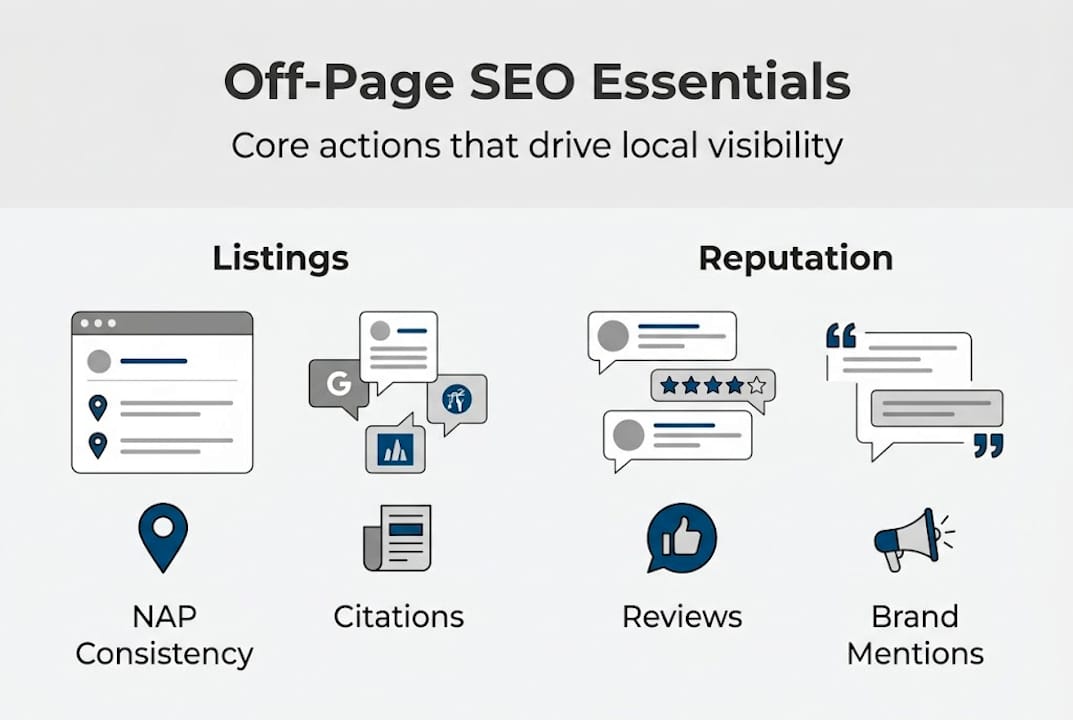
NAP consistency stands for Name, Address, and Phone number. When your business information appears differently across directories, Google gets confused. A listing that says "Suite 100" on one site and "Ste. 100" on another might seem minor, but search engines treat inconsistency as a red flag. NAP consistency is one of the most foundational off-page signals for local SEO, and mismatches can actively suppress your rankings.

Here's a comparison of strong vs. weak off-page signals:
| Signal | Strong Example | Weak Example |
|---|---|---|
| NAP consistency | Identical info on 50+ directories | Different phone numbers on 5 sites |
| Reviews | 80 reviews, 4.7 stars, recent activity | 12 reviews, last one 2 years ago |
| Backlinks | Links from local news and industry blogs | Links from unrelated, low-authority sites |
| Citations | Listed on Google, Yelp, BBB, and niche directories | Only on Google Business Profile |
The top off-page actions that move the needle for local businesses:
- Claim and optimize your Google Business Profile. This is your single most important local listing.
- Build citations on relevant directories. Yelp, Bing Places, Apple Maps, and industry-specific directories all count.
- Generate and respond to reviews. Volume and recency both matter for rankings.
- Earn backlinks from local and niche sites. A mention in a local chamber of commerce newsletter carries real weight.
- Monitor for brand mentions. Even unlinked mentions tell Google your business is talked about.
Reviews deserve special attention. Businesses with more reviews and higher ratings consistently appear higher in local results. Customers trust reviews too: the social proof effect is real and measurable. Integrating solid local SEO strategies with active review management creates a compounding effect that builds over time.
Statistic: Businesses with consistent NAP data and active review profiles see significantly stronger local map pack performance than those with fragmented or outdated listings.
Pro Tip: Run a free citation audit using a tool like BrightLocal or Whitespark. Fix the top 10 inconsistencies first. That alone can produce noticeable ranking improvements within 60 to 90 days.
The power of social engagement, partnerships, and brand mentions
Beyond technical actions, there's an entire layer of off-page SEO tied to reputation and real-world engagement.
Social media profiles often rank prominently in Google search results, especially for branded queries. When someone searches your business name, your Facebook page, LinkedIn profile, or Instagram account may appear on the first page. This means your social presence isn't just for customer engagement. It's also a visibility tool that expands your digital footprint.
Brand mentions and social signals play an increasing role as Google and AI systems get better at understanding reputation beyond just links. A mention in a local blog post, a shout-out from a community organization, or a feature in a regional news outlet all send positive signals to search engines, even if there's no clickable link attached.
Community involvement is one of the most underrated off-page strategies for local businesses. Sponsoring a local event, partnering with a neighboring business, or donating to a school fundraiser often results in mentions on event pages, local news sites, and social media. These mentions accumulate over time and strengthen your local authority.
Easy wins for building social and mention-based off-page signals:
- Create and maintain a Facebook Business Page with regular posts and responses to comments
- Reach out to local press about newsworthy business updates, milestones, or community involvement
- Partner with complementary local businesses for cross-promotions and mutual shout-outs
- Join local business associations like your chamber of commerce for directory listings and event mentions
- Engage in industry forums and Q&A sites where your expertise can be showcased
"Google increasingly understands brand reputation through signals beyond traditional links, including mentions across social and editorial content."
Pro Tip: Set up a free Google Alert for your business name. Every time someone mentions you online, you'll get notified. This helps you track brand mentions, respond to coverage, and spot new link-building opportunities.
Understanding how social media and SEO work together, and how brand mentions contribute to authority, gives you a broader view of what actually builds local search presence.
How to measure off-page SEO success
Even the best off-page strategy needs measurement. Here's how you know your efforts are working and what to tweak.
Tracking off-page SEO doesn't require expensive software or a dedicated analyst. A few focused metrics tell you most of what you need to know. Measure off-page SEO using referral traffic, local rankings, and review volume as your core indicators.
| Metric | What it tells you | Tool to use |
|---|---|---|
| Referral traffic | Which external sites send visitors to you | Google Analytics |
| Local pack rankings | Where you appear for local keyword searches | Local rank tracker |
| Backlink count and quality | How many sites link to you and their authority | Google Search Console, Ahrefs |
| Citation count | How many directories list your business | BrightLocal, Whitespark |
| Review growth | New reviews per month and average rating | Google Business Profile dashboard |
Here's a simple monthly measurement routine:
- Check Google Search Console for new backlinks and referral sources.
- Run a local rank check for your top 5 to 10 keyword phrases.
- Review your Google Business Profile for new reviews and respond to each one.
- Audit one or two directories for NAP accuracy and update anything outdated.
- Note your citation count and compare it to the previous month.
Setting benchmarks matters. Before you start any off-page campaign, document your current rankings, review count, and citation total. Then check back every 30 days. Progress in off-page SEO is often gradual, but consistent improvement over 90 to 180 days is a clear sign your strategy is working.
Pro Tip: Don't try to track everything at once. Pick three metrics that align with your current goals, like local rankings, review count, and referral traffic, and track those consistently before adding more.
For a deeper look at measuring local rankings and interpreting your data, there are practical frameworks that can help you act on what you find rather than just collect numbers.
Perspective: Why small businesses should stop overcomplicating off-page SEO
After understanding the nuts and bolts, here's an inside perspective on what truly drives off-page wins for SMBs.
We see it constantly: business owners chasing advanced link-building campaigns, guest posting on obscure blogs, or paying for link packages, while their Google Business Profile sits unclaimed and their citations are riddled with errors. That's backwards.
The uncomfortable truth is that 80% of off-page SEO gains for local businesses come from doing three things consistently: keeping your business information accurate across directories, actively collecting genuine customer reviews, and showing up in your community in ways that earn real mentions. That's it.
"Shiny object syndrome" is real in digital marketing. New tactics get attention, but the businesses that win local search over time are the ones that stay consistent with the basics. Building brand authority doesn't require a complex playbook. It requires repeatable, authentic actions that accumulate over months and years.
Simplify your approach. Fix what's broken. Do the basics well. The results will follow.
Get expert help growing your online presence
Ready to take your off-page SEO beyond the basics?
DIY off-page SEO is absolutely possible, and this guide gives you a strong starting point. But if you want faster results and a strategy built around your specific market, working with experts makes a real difference. At Digital Marketing All, we help small and medium-sized businesses build the kind of off-page presence that drives consistent local traffic, stronger map pack rankings, and more customer reviews. From citation management to reputation building and full-scale local SEO, we handle the details so you can focus on running your business.

Reach out today to find out how we can build a tailored off-page SEO strategy for your business.
Frequently asked questions
What is off-page SEO in simple terms?
Off-page SEO refers to all activities outside your own website, like link building, local listings, and reviews, that help your business rank higher in search engines.
How do I know if my off-page SEO is working?
Track your website's referral traffic, local Google rankings, and the number of online reviews. Consistent improvement across all three over 90 days is a reliable sign your efforts are paying off.
Are brand mentions without a link valuable for SEO?
Yes. Google and search engines increasingly reward unlinked brand mentions as signals of authority and local reputation, especially when those mentions appear on credible sites.
What are the fastest off-page SEO wins for local businesses?
Start by ensuring your business info matches across all directories, then actively collect customer reviews and partner with local sites for mentions. These three actions produce results faster than most other tactics.
Recommended
- Local Business Search Ranking Guide: SEO & AI Visibility 2026
- Social Media SEO: Boost Local Business Visibility & Rankings
- The Ultimate Guide to Getting Found Online in Your Local Area
- 7 Local SEO Strategies & AI Tips to Boost Rankings | Digital Marketing All
- Local SEO for Betting: Mastering Regulated Rankings