

TL;DR:
- Focus on core tactics like Google Business Profile optimization and local citations for quick results.
- Integrate AI-friendly content, schema markup, and technical SEO to future-proof visibility.
- Build genuine local authority through community engagement, reviews, and authentic backlinks.
Choosing the right search optimization tactics can feel like picking a path through a maze with no map. There are dozens of options, conflicting advice everywhere, and real money on the line. The good news: most local business wins come from a focused set of tactics that work with both Google's traditional algorithm and the AI-powered search tools reshaping how customers find businesses. This article cuts through the noise with evidence-backed examples, real data, and practical shortcuts so you can prioritize what actually moves the needle for your business.
Table of Contents
- Set the right foundation: Core criteria for search optimization success
- Optimize your Google Business Profile for maximum local impact
- Leverage AI-optimized content and technical SEO for future-proofed discovery
- Build local authority: Backlinks, reputation, and hyperlocal engagement
- When to blend social, AI, and traditional SEO — and what to avoid
- A hard-won perspective: Why future-proof SEO means going beyond checklists
- Ready to accelerate your local search growth?
- Frequently asked questions
Key Takeaways
| Point | Details |
|---|---|
| Prioritize Google Business Profile | A complete, photo-rich profile is the fastest route to local search visibility for SMBs. |
| Integrate AI-ready content | Structured answers and technical SEO help secure future rankings as AI search grows. |
| Earn local links, not just any links | Local backlinks and engagement are far more effective than general ones for search success. |
| Blend, don’t replace, strategies | Combine local, social, and AI-driven tactics instead of abandoning foundational SEO. |
Set the right foundation: Core criteria for search optimization success
Not every tactic deserves your time. Before you start executing, you need a filter. We evaluate search optimization tactics across four core criteria: visibility ROI (does it actually bring in leads?), local authority (does it strengthen your presence in your market?), AI-readiness (will it hold up as AI-driven search grows?), and speed to impact (how fast can you see results?).
Here's the honest reality about AI search right now. SEO fundamentals still drive most traffic, with AI accounting for roughly 2 to 3% of organic referrals. That means title tags, user experience, technical health, and strong content are still your biggest levers. AI is growing fast, but it rewards the same businesses that already do SEO well.
When you're evaluating which tactics to try first, look for these qualities:
- Low effort, high impact: Tactics that take a few hours but deliver weeks of results
- Compounding returns: Actions that build on each other over time (citations, reviews, links)
- Platform alignment: Tactics that work across Google, Bing, and AI tools simultaneously
- Measurability: You can track results in Google Search Console or your analytics platform
For a deeper breakdown of how these criteria apply to your market, the ranking guide for SMBs walks through real-world prioritization. You can also reference Google Business Profile tips for a fast-start checklist.
Pro Tip: Start with the tactic that has the clearest ROI signal in your category. For most local businesses, that's Google Business Profile optimization before anything else.
With this framework for smart selection, let's dive into the most effective search optimization tactics you can apply right away.
Optimize your Google Business Profile for maximum local impact
Once your core criteria are established, GBP optimization is nearly always the highest ROI first tactic for SMBs. GBP completeness accounts for 32% of local pack ranking, and businesses with 50 or more photos get 520% more directions requests. That's a massive return for uploading a few dozen images.
Here's a step-by-step approach to getting your GBP fully optimized:
- Verify and complete your NAP: Name, address, and phone number must be identical across every platform.
- Select the right primary and secondary categories: Be specific. "Italian Restaurant" beats "Restaurant" every time.
- Upload 50 or more photos: Include interior, exterior, team, and product shots.
- Add all services and products: Use the services section to mirror your most searched keywords.
- Set up your Q&A section: Seed it with questions your customers actually ask, then answer them.
- Post weekly updates: Google rewards active profiles with better visibility.
Here's a real-world example of what consistent GBP work can do:
| Metric | Before optimization | After 90 days |
|---|---|---|
| Profile views per month | 310 | 1,420 |
| Direction requests | 28 | 174 |
| Phone calls from GBP | 19 | 96 |
| Review count | 12 | 61 |
A local SEO case study showed 150% lead growth for a dental practice through GBP improvements, review generation, and citation consistency. For broader context on 2026 local search benchmarks, the local SEO 2026 guide is worth bookmarking.
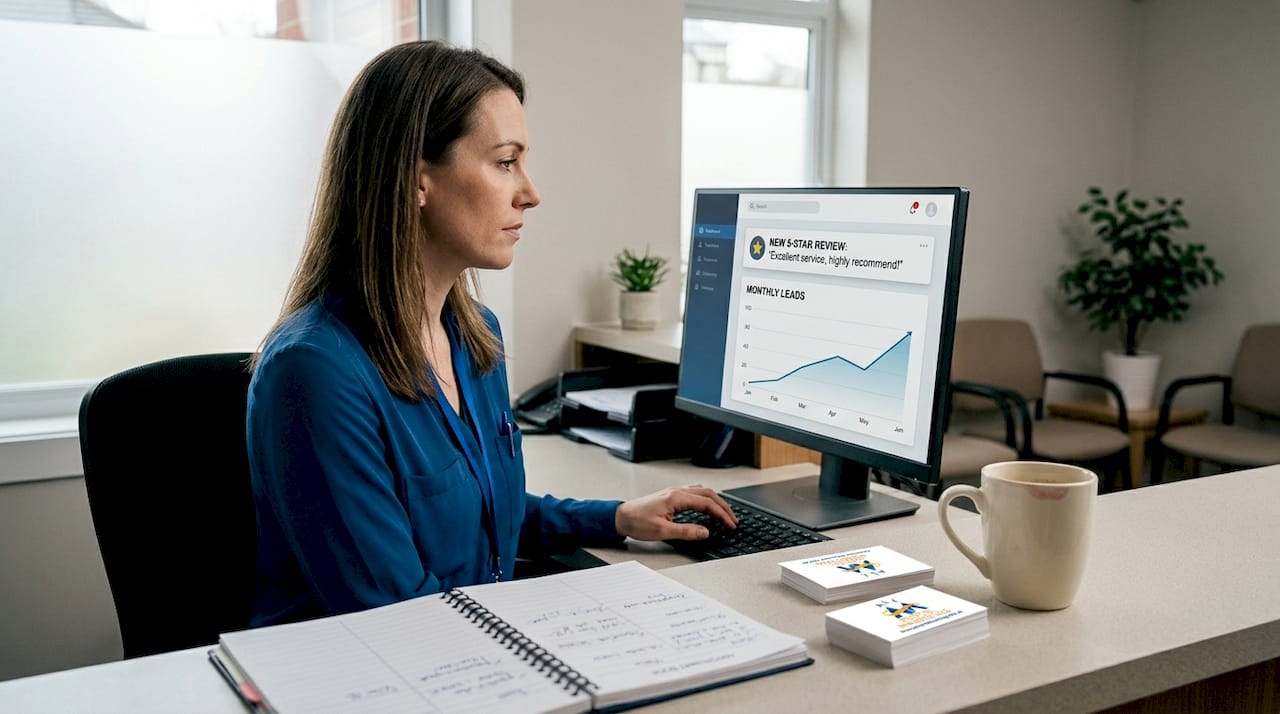
Pro Tip: Review velocity matters more than total review count. Ten new reviews this month beats 200 old ones from three years ago. Build a system to ask every satisfied customer, not just the ones who volunteer.
Your GBP optimization guide has a full checklist if you want to go deeper on each step.
Leverage AI-optimized content and technical SEO for future-proofed discovery
With your GBP and local reputation set, it's time to future-proof your business with AI and technical enhancements. AI Overviews now appear on 16% of all queries, and visitors who arrive via AI-generated results convert at 4.4 times the rate of standard organic visitors. That's not a trend to ignore.
Here's what AI-optimized content actually looks like in practice:
- Answer-first paragraphs: Lead every page section with a direct answer before the explanation
- FAQ sections on key pages: AI tools pull from structured Q&A content frequently
- Schema markup: Add LocalBusiness, FAQ, and Review schema to your site
- Clean site structure: Logical URL hierarchy and internal linking help AI crawlers understand your content
- Mobile speed: Pages that load in under 2.5 seconds on mobile perform significantly better
| Feature | Traditional SEO | AI-optimized SEO |
|---|---|---|
| Content format | Long-form narrative | Answer-first with structured sections |
| Keyword targeting | Exact match focus | Entity and intent-based |
| Schema usage | Optional | Essential |
| Result type | Blue link ranking | Featured snippets, AI Overviews |
A Moz case study documented a 375% increase in search visibility through technical SEO, schema implementation, and geotargeting. These aren't small gains. Understanding Google's AI Overviews is essential before you start optimizing for them. You can also explore AI search content tips and learn how to use AI query tracking in Google Search Console. For a broader strategy view, AI-driven SEO tips covers the full picture.
Pro Tip: Don't try to AI-optimize everything at once. Nail your local GBP and citation consistency first, then layer in schema and answer-first content as a second phase.
Build local authority: Backlinks, reputation, and hyperlocal engagement
All technical gains are amplified when you're seen as the trusted, relevant voice in your specific geography. Local authority comes from three places: links, reviews, and community presence.
Here's where to focus:
- Chamber of commerce and partner links: A single quality link from a local organization carries real weight
- Sponsorships and local events: Sponsor a community event and earn a link from the event page
- Neighborhood guides and local content: Write about your area, not just your services
- Review velocity programs: Build a repeatable ask-for-reviews process into your workflow
- Hyperlocal social engagement: Participate in neighborhood Facebook groups and Nextdoor
"A single high-quality local link can move rankings more than dozens of generic directory links. Authentic outreach and real community ties are what Google rewards in 2026."
One thing to avoid: template-based location pages. If you serve five cities and create five pages that are identical except for the city name, Google sees through it. Each location page needs unique content, local references, and genuine relevance to that area.
Reddit and hyperlocal social channels are also emerging as real tools for both rankings and community engagement. Participating in local subreddits or neighborhood forums builds brand recognition and sometimes earns organic links. For more on combining these approaches, the local link case studies show what's working right now.
Pro Tip: In-person events are an underrated digital marketing tactic. Host a free workshop or sponsor a local meetup. The digital footprint from photos, tags, and mentions often outperforms paid ads.
Your online reputation guide has more on building review systems that actually stick.
When to blend social, AI, and traditional SEO — and what to avoid
With individual tactics in place, the strategic question is how to blend them for maximum growth and avoid wasted effort. Here's a sequence that works for most SMBs:
- Start with local fundamentals: GBP, citations, NAP consistency
- Add review and link velocity: Build systems, not one-time pushes
- Layer in AI and technical SEO: Schema, answer-first content, speed improvements
- Activate social content: Short-form video, local community posts, and user-generated content
- Track and adjust monthly: Use Search Console, GBP insights, and traffic reports
Here's how SMB traffic typically breaks down across channels:
| Traffic source | Average SMB share | Growth trend |
|---|---|---|
| Social media | 64% | Stable |
| Organic SEO | 52% | Slight decline |
| AI-driven referrals | Under 3% | Fast growing |
| Direct/branded | 30% | Stable |
Social generates 64% of SMB traffic and organic SEO contributes around 52%, but AI referrals are under 3% and climbing fast. The risk is real: 40% of SMBs have lost Google organic traffic to AI-driven results. The fix is leaning into long-tail queries and entity-rich content that AI tools favor.
For a strategic view of how these forces interact, the AI vs. SEO comparison is a useful read. And if you're wondering whether page one rankings still matter, is page one enough? addresses that directly. For a 90-day execution plan, SEO for AI visibility is a practical next step.
A hard-won perspective: Why future-proof SEO means going beyond checklists
After seeing how the best tactics fit together, let's talk about what really separates successful SMBs from the rest.
The businesses we see struggling most aren't the ones ignoring SEO. They're the ones following every checklist perfectly but never adapting. They complete their GBP, build citations, add schema, and then wait. When results plateau, they assume the tactics failed. They didn't. The strategy did.
Real search optimization is iterative. You run a tactic, measure the result, and adjust based on what the data tells you. A traffic plateau isn't a dead end. It's a signal. Maybe your content isn't matching new AI query patterns. Maybe a competitor earned a key local link. Maybe your review velocity dropped.
The SMBs winning in 2026 treat every tactic as a hypothesis. They test, learn, and evolve. They also blend digital work with in-person presence, because community trust amplifies every online signal. Ranking beyond page one requires this kind of adaptive thinking.
Pro Tip: Set a 30-day review cadence. Look at what moved, what didn't, and make one focused adjustment. Consistency with reflection beats frantic activity every time.
Ready to accelerate your local search growth?
If the tactics above feel like a lot to manage on your own, you're not alone. Most SMBs see the biggest gains when they have expert support handling the details while they focus on running their business.
At Digital Marketing All, we specialize in exactly the strategies covered here: review generation, citation management, GBP optimization, and AI-ready content. Whether you need to get more reviews, optimize your Yelp presence, or want a full local SEO strategy built around your market, we're ready to help. Visit Digital Marketing All to explore your options and take the next step toward stronger, more consistent local visibility.
Frequently asked questions
Which search optimization tactic gives the fastest local results?
Optimizing your Google Business Profile with complete details, fresh photos, and active Q&A usually delivers the fastest local visibility gains. GBP completeness is one of the strongest factors for local pack ranking.
How can I check if AI search is sending traffic to my website?
You can monitor new queries and traffic sources in Google Search Console, focusing on AI-generated overviews and long-tail keyword entries. AI Overviews now show up on 16% of queries, so tracking these in GSC is increasingly important.
Are reviews or citations more important for local SEO?
Both matter, but a steady stream of new reviews typically impacts local rankings and customer trust faster than citations alone. Review velocity influences local pack success more than total review count.
What mistakes should I avoid with local SEO tactics?
Avoid template-based location pages and generic backlinks. Hyperlocal, authentic content and real community outreach consistently outperform cookie-cutter approaches that Google has learned to discount.