

TL;DR:
- Backlinks remain crucial in SEO, significantly influencing search rankings through quality, relevance, and trust signals.
- Effective link building today centers on digital PR, creating valuable content that earns editorial coverage and long-lasting backlinks.
Link building has never been more misunderstood. Google's evolving language around ranking signals leads many small business owners to believe backlinks are fading in importance. The data tells a different story. The role of link building in SEO remains central to how search engines evaluate authority, trust, and relevance. The #1 result earns 3.8x more backlinks than pages ranked below it, and 95% of web pages have zero backlinks at all. If you run a small or medium-sized business and want to compete online, understanding how links work in 2026 is non-negotiable.
Table of Contents
- Key Takeaways
- The role of link building in SEO: why backlinks still matter
- From quantity to quality: how Google actually evaluates links
- Digital PR as the leading link building strategy
- Practical strategies for SMBs building links today
- Measuring your link building success
- My honest take on link building for SMBs
- How Digitalmarketingall helps you build real authority
- FAQ
Key Takeaways
| Point | Details |
|---|---|
| Backlinks still drive rankings | The top Google result has 3.8x more backlinks than lower-ranked pages, making link quality a real differentiator. |
| Quality beats quantity every time | Ten relevant editorial links outperform thousands of low-quality ones according to current Google evaluation methods. |
| Digital PR leads modern link building | Campaigns earning editorial coverage generate strong ROI and build both backlinks and brand authority simultaneously. |
| Brand mentions power AI visibility | Brand mentions correlate 3x more with AI search visibility than traditional backlinks, making reputation management critical. |
| Track referring domains, not just counts | Monitor the quality and topical relevance of linking domains to measure real SEO progress over time. |
The role of link building in SEO: why backlinks still matter
Google has shifted its language from calling links "important" to calling them "a factor." Many marketers read that as a signal to stop investing in link building. That reading is wrong.
Backlinks contribute roughly 13% to Google's overall algorithm weight. That places them firmly among the top signals alongside content quality and user engagement. The algorithm has hundreds of inputs, so 13% is a significant slice. Ignore it and you hand that competitive advantage to every competitor who does not.
Here is what the data shows about how link building impacts SEO in practice:
- Pages ranking in position one earn dramatically more backlinks than those in positions two through ten.
- Sites with strong backlink profiles get crawled and indexed faster because Google's bots follow links to discover new content.
- Quality backlinks generate direct referral traffic, meaning users click through from other sites to yours.
- Links act as trust signals. When an authoritative website links to your page, it signals to Google that your content is credible.
The authority question is where most SMBs get confused. Domain Authority scores from tools like Moz are directional indicators, not official Google ranking factors. They help you compare sites in relative terms, but Google does not use a single domain-wide score. Instead, it evaluates relevance and trust page by page.
Pro Tip: When assessing a potential link source, check whether the site has real organic traffic using a tool like Ahrefs or Semrush. A high domain score with no real traffic is a warning sign, not an opportunity.
Beyond rankings, backlinks support crawling and indexing in ways that often get overlooked. A new page on your site with no internal links and no external links pointing to it may sit unindexed for weeks. A single quality backlink from a frequently crawled site can get that page indexed within hours. For SMBs launching new service pages or blog content, that speed matters.
From quantity to quality: how Google actually evaluates links
The era of collecting as many backlinks as possible ended years ago. What replaced it is more nuanced, and understanding it will save you from expensive mistakes.
Ten relevant editorial links outperform 1,000 low-quality links by a wide margin. Google discounts links from sites that exist primarily to pass link equity rather than serve real readers. It also discounts links from sites that are topically unrelated to your own. A plumbing company getting a link from a fashion blog earns far less value than a link from a home improvement publication.
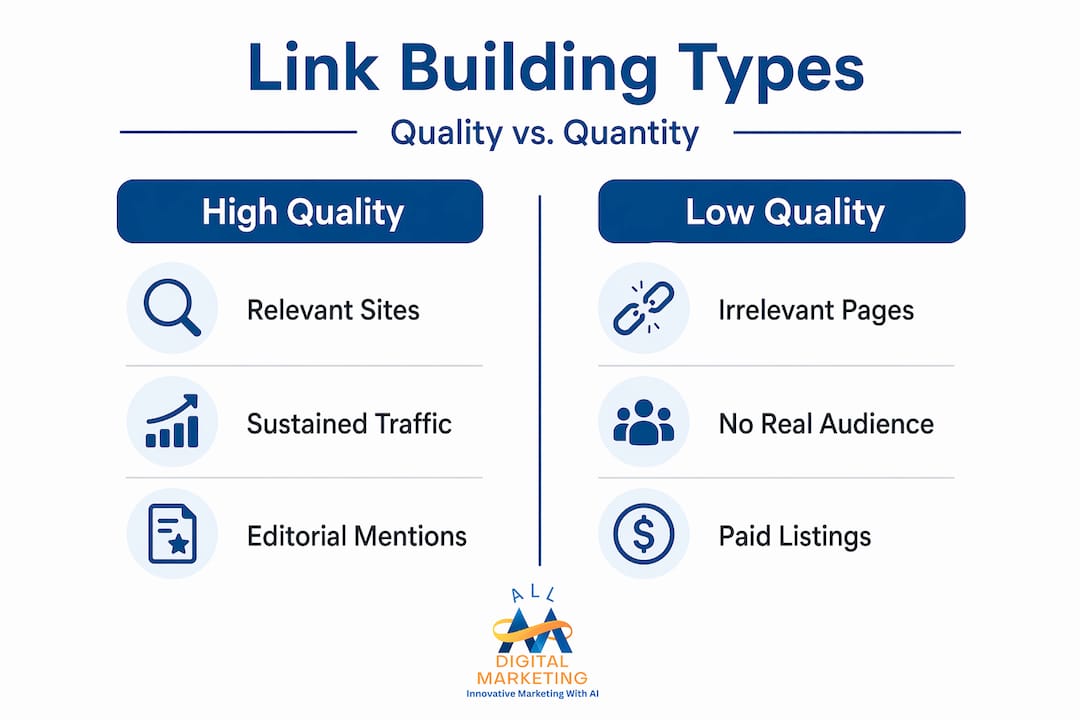
Here is a comparison of what separates high-value links from low-value ones:
| Link attribute | High-value link | Low-value link |
|---|---|---|
| Source site traffic | Real organic audience | No organic traffic |
| Topical relevance | Closely related to your niche | Unrelated industry |
| Placement context | Within editorial content | Sidebar, footer, or directory |
| Link acquisition method | Earned through content or PR | Purchased or exchanged |
| Link stability | Persists over months and years | Added and removed quickly |
Google tracks backlinks as a timeline, monitoring when links appear, how long they stay, and when they disappear. A sudden spike in backlinks with no corresponding content quality or topical reason triggers suspicion. A steady accumulation of relevant links over time builds trust.
User behavior plays a role too. Google's patent US9558233 confirms that links generating longer dwell time receive higher weighting. If users click a link to your page and leave quickly, that link contributes less to your rankings than one where visitors stay and engage. This is one reason why landing pages paired with backlinks need to be genuinely useful.
Pro Tip: Audit your existing backlinks at least once per quarter. Remove or disavow links from irrelevant or low-traffic sites. A clean, relevant backlink profile signals quality far more effectively than sheer volume.
Google's 2026 updates now evaluate authority topic by topic rather than across your entire domain. This is called entity authority. If you run a local accounting firm and consistently earn links from finance, tax, and business publications, you build topical authority in that space. Links from unrelated sources dilute that signal rather than strengthen it.
Digital PR as the leading link building strategy
If you want to understand what effective link building techniques look like in 2026, digital PR is where you need to start. It has moved from a niche tactic to the dominant strategy for earning high-quality editorial backlinks.
Digital PR means creating content worth covering. You pitch original research, compelling stories, expert commentary, or timely data to journalists and editors at publications your audience reads. When they cover your story, they link to your site. The link is earned, not bought. That distinction matters enormously to Google.

Digital PR campaigns generate an average ROI of 312%, far outperforming traditional guest posting. Editorial placements in top-tier publications cost between $1,250 and $1,500 per link, while guest posts average $220 to $609. The upfront cost is higher, but the authority and durability of an editorial link from a DR 80 news site is incomparable.
Why digital PR outperforms traditional link building tactics:
- Editorial links from established news and trade publications carry greater trust and topical authority.
- Coverage generates brand mentions alongside links, and brand mentions correlate 3x more strongly with AI search visibility than backlinks alone.
- A single well-placed article in a major publication can trigger secondary coverage from other outlets, multiplying your backlink acquisition without additional cost.
- AI search systems like Google's AI Overviews and ChatGPT consider both links and brand mentions to determine authority for recommendations.
For SMBs especially, the shift toward digital PR and brand authority represents a chance to compete against larger competitors who rely on older tactics. A well-crafted story from a local business can earn coverage in regional media and industry trades that a Fortune 500 brand would overlook entirely.
Practical strategies for SMBs building links today
Understanding the importance of link building is one thing. Acting on it with limited resources is another. Here is a practical sequence SMBs can follow to start building meaningful links without an agency budget.
-
Identify your topical lane. Before reaching out to anyone, define the two or three topics where your business genuinely has expertise. If you own a dental practice, your lane is oral health, dental care, and related patient concerns. Seek links only from sites covering those topics, because relevance determines value.
-
Use journalist sourcing platforms. Platforms like Connectively, Qwoted, and Featured.com give you access to journalists writing for DR 70-plus news sites who need expert commentary. You respond to a query, share your insight, and if the journalist uses it, you earn a citation with a backlink. This is reactive PR, and it requires almost no content creation budget.
-
Analyze competitor backlinks. Use a tool like Ahrefs or Semrush to see which sites link to your top competitors. Look for sources that cover your topic area and have real organic traffic. If a site linked to three of your competitors but not to you, that is a warm outreach target.
-
Create content worth linking to. Original research, local data studies, free tools, and comprehensive how-to content attract natural links. A regional survey or a well-researched guide becomes the kind of resource journalists and bloggers reference without being asked. Check out secret SEO strategies for 2025 for additional ideas on content-driven link acquisition.
-
Avoid spammy tactics entirely. Paid link schemes, private blog networks, and reciprocal link exchanges all carry real penalty risk. Google's manual review team and algorithmic filters both catch these patterns. The short-term gain is never worth the damage to your site's long-term trust.
-
Build local authority through directory and media links. Local news sites, chambers of commerce, and regional business directories provide geographically relevant backlinks that directly support your local search rankings. These are often easy to earn and genuinely valuable for SMBs targeting a specific service area.
Pro Tip: When you respond to a journalist query on a sourcing platform, be specific and give a concrete example from your own experience. Generic quotes rarely get used. A precise, personal anecdote earns the mention.
Measuring your link building success
You cannot improve what you do not measure. Many SMBs invest in link building and then check rankings sporadically without understanding what actually drove the change. Here is what to monitor consistently.
- Referring domains, not just backlink count. One hundred links from ten sites is weaker than one hundred links from one hundred different sites. Monitor the number of unique domains linking to you, not the raw link total.
- Topical relevance of new links. Each new referring domain should be in a field related to your business. Track this manually or with a tool and flag any links from unrelated industries.
- Organic traffic to linked pages. When a quality link points to a specific page, that page should see a traffic lift. If it does not, review the content quality and the user experience on that page.
- Link velocity and freshness. Earning ten links in one day then nothing for three months looks unnatural. Google treats backlink profiles as timelines and values steady, consistent growth. Set a monthly link acquisition target and work toward it regularly.
- Competitor gap analysis. Track which high-value sites link to your competitors but not to you. This list becomes your ongoing outreach priority list.
Tracking these signals together gives you a clear picture of whether your link building strategies for SEO are actually working. Rankings are a lagging indicator. Referring domain growth and traffic from new linking sources are leading indicators that show momentum building before rankings shift.
My honest take on link building for SMBs
I've spent years watching small business owners make the same link building mistakes, and the pattern is consistent. They either ignore links entirely because someone told them "content is king," or they buy a cheap link package and wonder why their rankings tank six months later.
What I've found is that the quality-over-quantity principle has never been more true. In my experience, a single mention from a well-regarded local news outlet or an industry trade publication does more for a business than fifty directory submissions combined. The authority signals compound over time. The spam does not.
The hardest part for SMBs is patience. I've seen business owners do everything right with digital PR and feel nothing for three months. Then a well-placed editorial link tips the domain into a new authority tier, and rankings shift noticeably on multiple keywords simultaneously. Link building for higher rankings is not a short-term tactic. It is a long-term asset.
I also think most SMBs underestimate the relationship dimension of this work. When you pitch a journalist or offer expert commentary, you are building a connection with that publication. Over time, they come back to you for quotes. Your brand appears consistently in your space. That visibility compounds in ways that pure SEO metrics cannot fully capture. Think of links as proof of real-world credibility, not just SEO signals.
For anyone feeling stuck, I recommend starting with fixing your backlink foundation before chasing new links. Clean up what you have. Then build deliberately from there.
— Diane
How Digitalmarketingall helps you build real authority
Link building does not happen in isolation. Your broader online reputation, your review profile, and your local directory presence all contribute to the trust signals that search engines and AI platforms evaluate together. At Digitalmarketingall, we help SMBs build that complete authority picture. Our review generation services strengthen the trust signals that complement your backlink profile, because positive reviews on authoritative platforms send relevance and credibility signals that support your SEO goals. For businesses with a local focus, our Yelp management support also builds presence on a platform that carries real domain authority and drives direct referral traffic. Explore how our digital marketing strategies for small businesses can work alongside your link building efforts to generate leads and grow your visibility.
FAQ
What is link building in SEO?
Link building in SEO is the process of acquiring hyperlinks from other websites that point back to your site. Search engines like Google use these links as signals of credibility and authority when determining where your pages rank.
How many backlinks do you need to rank on page one?
There is no fixed number. The #1 result in Google has 3.8x more backlinks than pages ranked below it, but link quality and topical relevance matter far more than sheer quantity.
Are backlinks still a ranking factor in 2026?
Yes. Backlinks contribute approximately 13% to Google's ranking algorithm and remain a top-three signal. Google's language around links has changed, but the underlying weight they carry in rankings has not disappeared.
What is the most effective link building strategy for small businesses?
Reactive digital PR through journalist sourcing platforms like Connectively and Qwoted offers the highest ROI for SMBs, providing access to high-authority editorial links with minimal content production costs.
Can brand mentions help SEO without direct backlinks?
Yes. Brand mentions correlate 3x more strongly with AI search visibility than traditional backlinks, and AI search systems now consider both links and mentions when evaluating authority for recommendations.