

TL;DR:
- Online lead generation is about attracting interested prospects and capturing their intent before competitors do, fundamentally differing from traditional methods.
- Effective systems rely on targeted local SEO, optimized profiles, quick follow-up, and automated management to convert leads into customers efficiently.
Lead generation is one of the most misunderstood concepts in digital marketing. Many business owners think it means collecting a list of names and phone numbers. That misses the point entirely. What is lead generation online, in practice, is the process of attracting people who are actively interested in what you sell and capturing that interest before it goes to a competitor. Online lead generation is the art and science of creating enough visibility, credibility, and engagement online that the right prospects raise their hands. For small and medium-sized businesses, getting this system right is the difference between a slow month and a full pipeline.
Table of Contents
- Understanding online lead generation and why it matters
- Local online lead generation: targeting customers nearby
- Maximizing lead capture with effective online forms
- Lead management systems: automating qualification and sales handoff
- Rethinking lead generation: Why approach and alignment matter most
- Boost your online leads with expert strategies and tools
- Frequently asked questions
Understanding online lead generation and why it matters
Online lead generation is not a single tactic. It is a coordinated process that starts the moment a potential customer types a search query and ends when they become a paying client. Digital lead generation means attracting and capturing interest through digital channels, with the goal of collecting contact information or lead actions that indicate buying intent. Every form submission, phone call from a website, or message through a Google Business Profile is a lead event.
The difference between digital lead gen and traditional methods is significant. Cold calling and print ads push your message at people whether they want it or not. Online lead generation pulls in people who are already searching for solutions like yours. That shift in dynamic means the leads you capture digitally tend to be warmer and closer to a buying decision. That is a meaningful advantage for a business with limited time and budget.
Lead generation builds trust and bonds with your audience, leading to meaningful, lasting customer relationships. That is not just a feel-good idea. It is a practical reality. When someone finds your business through a helpful blog post, a strong Google review profile, or a well-placed ad, they arrive with a degree of confidence that a cold outreach contact simply does not have.
Understanding online leads also means understanding their quality. Not all leads are equal:
- Qualified leads have shown clear intent, like requesting a quote or booking a consultation.
- Warm leads are interested but still comparing options. They may have subscribed to your email list or followed your social media page.
- Unqualified leads are early-stage contacts who may not yet know what they need.
Knowing the difference shapes how you follow up. A qualified lead deserves a phone call within the hour. A warm lead benefits from a nurturing email sequence. Treating every lead the same way wastes your team's time and kills conversion rates. Effective paid ad lead strategies and digital marketing strategies both depend on this kind of lead categorization to deliver real results.
Online lead generation is not about casting the widest net. It is about building a process that consistently attracts the right people, captures their interest, and moves them toward a decision.
Local online lead generation: targeting customers nearby
For most small and medium-sized businesses, the most valuable leads come from people within driving distance. A plumber in Denver does not need inquiries from Miami. Local lead generation requires specific geographic targeting and strong Google Business Profile optimization to surface your business in the searches that actually matter.
Here is how to approach local lead gen with the right priorities:
- Complete your Google Business Profile fully. Add every service you offer, your hours, photos, and a business description that uses the terms your local customers search. An incomplete profile is a missed opportunity every single day.
- Collect and respond to reviews consistently. Reviews are social proof and a local ranking signal. A business with 80 current reviews outperforms one with 10 old ones, even if the older reviews are slightly higher rated.
- Use accurate, consistent contact information everywhere. Your name, address, and phone number must match across your website, Google, Yelp, and every directory. Inconsistency confuses search engines and reduces trust.
- Activate Local Services Ads if your business qualifies. Local Services Ads and Google badges enhance lead quality and trust in local searches, and you only pay when a qualified lead contacts you directly through the ad. That is a pay-per-lead model that most SMBs should take seriously.
- Turn your Google Business Profile into a conversion tool. Add a booking link, a messaging feature, and answers to common questions. The profile is not just a listing. It is a lead capture interface.
If you operate in multiple locations or want to scale your local presence, the approach behind AI lead gen for multi-location businesses offers practical frameworks for managing geographic targeting at scale. And for a deeper look at how AI is changing the local search landscape, local AI lead generation breaks down tactics that are generating results right now. Social platforms also play a role. Facebook lead generation can be a cost-effective complement to your local search strategy, particularly for reaching customers in specific zip codes or neighborhoods.
Pro Tip: Set up a Google Business Profile post at least twice a month. These posts appear in search results and keep your profile looking active, which signals credibility to both Google and potential customers.
Maximizing lead capture with effective online forms
You can drive thousands of visitors to your website, but if your lead capture form is poorly designed, most of them will leave without taking action. The form is where interest converts into a lead. Getting it right matters more than most business owners realize.
The most actionable finding in form optimization is simple: shorter forms convert better. Keep lead capture forms to about 4 to 7 fields and use conditional logic to avoid friction and maintain completion rates. Every additional field you add beyond what is necessary introduces a reason for the visitor to stop and reconsider. Name, email, phone, and one qualifying question is often all you need at the top of the funnel.

The concept of progressive profiling changes how you should think about asking questions. Progressive profiling collects basic information upfront and qualifies further only after visitor interest is confirmed. In practice, this means your initial form captures just the essentials. Once the prospect is deeper in your process, you can ask more specific questions about their project timeline, budget, or location. This keeps early friction low while still giving your sales team what they need to close.
Common mistakes that reduce form performance:
- Asking for information you do not actually use. If you never sort leads by company size, do not ask for it.
- Using generic button text. "Submit" converts far worse than "Get my free quote" or "Book a free call." The button should tell the visitor exactly what happens next.
- Placing the form below the fold on mobile. Most local search traffic comes from phones. If your form requires scrolling to find, many visitors will not bother.
- No confirmation message or next step. When someone submits a form, they need immediate confirmation and a clear expectation of what happens next.
AI-enhanced forms take this further by adapting in real time. If a visitor comes from a local search, the form can pre-fill their city or show a locally relevant offer. If they have visited before, the form can skip fields they already completed. These effective lead capture forms improve the visitor experience and increase the percentage of people who complete the process.
Pro Tip: A/B test your form headline, not just the fields. The text above the form explaining why someone should fill it out often has a bigger impact on conversions than the form design itself.
Lead management systems: automating qualification and sales handoff
Capturing leads is only half the work. What happens after a lead comes in determines whether it becomes revenue or gets lost in an inbox. Many small businesses handle leads manually, which means inconsistent follow-up, delayed responses, and qualified prospects going cold. Automated lead management fixes that.
| Feature | Manual lead handling | Automated lead management |
|---|---|---|
| Response time | Hours or days | Immediate auto-response |
| Lead scoring | Subjective or absent | Rules-based or AI-driven |
| Routing to sales | Done by hand, often delayed | Instant, based on lead criteria |
| Nurturing | Inconsistent email follow-up | Automated sequences triggered by behavior |
| Reporting | Spreadsheets, incomplete | Real-time dashboards |
| Missed leads | Common | Rare, with proper setup |
Lead management systems automate capture, qualification, routing, and nurturing, improving visibility into revenue-driving activities. For a business owner juggling operations, sales, and marketing, that visibility is invaluable. You can see at a glance how many leads came in this week, which ones are in progress, and which ones need follow-up.
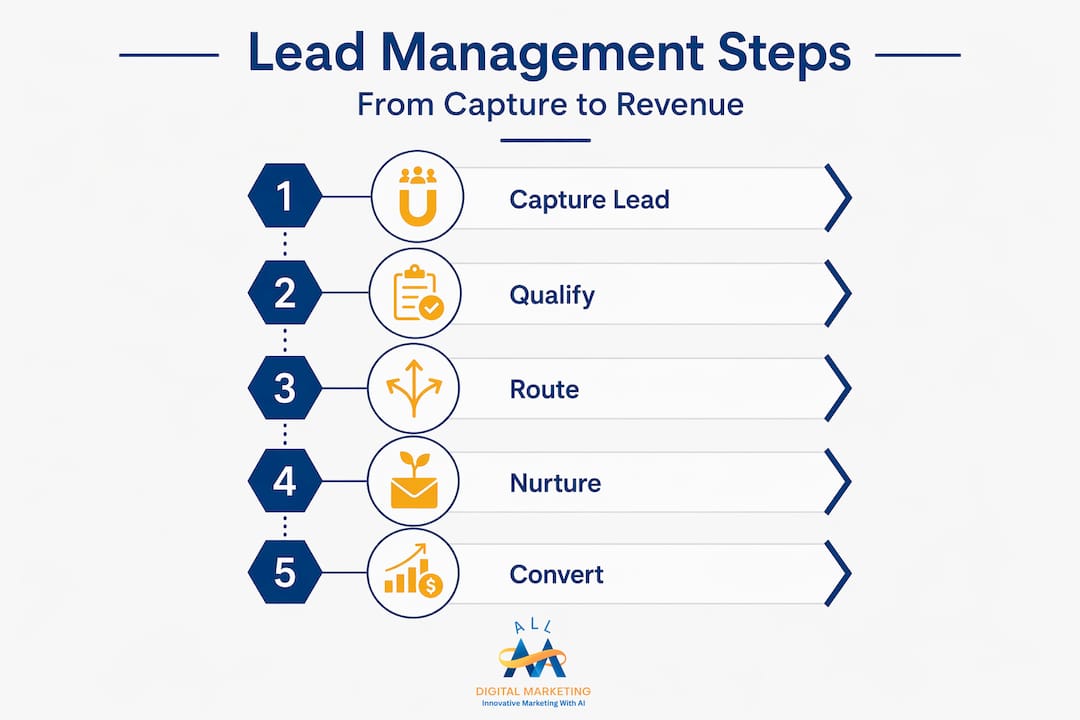
Lead scoring is one of the most powerful features in these systems. Rather than treating every inquiry the same, scoring assigns a value based on factors like which page the lead came from, what they asked about, whether they are a repeat visitor, and whether their contact info matches your ideal customer profile. Tools with scoring and predictive routing ensure your sales team focuses on the leads most likely to convert, increasing efficiency across the board.
Alignment between marketing and sales is where many SMBs fall short. Marketing generates a lead and considers the job done. Sales receives the lead without context and fumbles the follow-up. A well-configured lead management system bridges that gap by passing key behavioral data alongside the contact information. The salesperson knows what the prospect looked at, what they requested, and how quickly they need a solution.
For businesses using LinkedIn as part of their online lead generation strategy, understanding how LinkedIn lead generation integrates with your overall system is worth exploring. And if you want to see how paid channels feed your lead pipeline at scale, the Google Demand Gen guide lays out a practical approach.
Rethinking lead generation: Why approach and alignment matter most
Here is the perspective that most lead generation content avoids: volume is a vanity metric. Business owners celebrate 200 leads in a month, then wonder why revenue did not move. The issue is almost always process, not traffic.
The businesses we see consistently grow their pipelines are not the ones generating the most leads. They are the ones treating lead generation as a system with capture, routing, and handoff built in, so leads don't fall through gaps. That distinction matters enormously. A plumber who responds to every Google Business Profile inquiry within 10 minutes will outperform a competitor with twice the traffic and no follow-up process.
The other insight that changes how people approach this: local lead gen fails most often not at the top of the funnel, but at the bottom. The ad works. The profile looks great. The form gets filled out. Then nobody calls the lead back for two days, and the prospect has already hired someone else. The conversion path has to work end to end, and the Google Business Profile touchpoints, including messaging, reviews, and booking links, are often the last mile that gets ignored.
Continuous measurement is what separates businesses that grow from those that plateau. If you are not tracking where your leads come from, which sources produce qualified contacts, and what your close rate looks like by channel, you are guessing. Testing a new ad angle, a different form headline, or a revised follow-up sequence gives you real data to work with. That kind of refinement compounds over time into a genuinely better pipeline.
The most practical advice we can offer: audit your lead generation system from first click to closed deal at least once per quarter. Find where prospects drop off and fix that before spending more money to drive traffic into a leaky process.
Boost your online leads with expert strategies and tools
Now that you understand what effective online lead generation looks like in practice, the next step is putting the right tools and support in place. At Digital Marketing All, we help small and medium-sized businesses build lead generation systems that actually convert. That starts with your online reputation, because reviews are one of the highest-impact local ranking and trust signals available to any SMB. Our review generation and management service helps you build a steady stream of positive reviews that attract qualified local leads. We also offer dedicated Yelp reputation management to make sure your presence on high-traffic platforms is working in your favor. Combined with Google Business Profile optimization and local SEO, these services give your business the credibility and visibility that turns searches into sales conversations.
Frequently asked questions
What exactly is a lead in online lead generation?
A lead is a contact who has shown interest in your product or service through actions like subscribing, requesting a quote, or downloading material. In B2B settings, a lead downloads a brochure or subscribes to indicate initial buying interest.
How does local lead generation differ from general online lead generation?
Local lead generation targets potential customers within a geographic area using tactics like Google Business Profile optimization and local search ads. Local lead gen requires geographic targeting and strong Google Business Profile strategies that general online lead gen does not prioritize.
Why are shorter lead capture forms recommended?
Shorter forms with 4 to 7 fields reduce visitor friction, leading to better completion rates and more qualified leads. Keeping forms to 4 to 7 fields reduces friction and improves the percentage of visitors who complete the process.
What role do lead management systems play in converting leads?
Lead management systems automate capture, scoring, and routing of leads to ensure timely and personalized follow-up, improving conversion rates significantly. Lead management systems improve visibility into revenue-driving activities and automate lead qualification and routing.
How can AI enhance online lead generation?
AI improves lead generation by automating qualification, applying predictive routing, and personalizing engagement so your sales team focuses on the prospects most likely to convert. It also enables dynamic forms and real-time audience targeting that manual processes cannot replicate at scale.