

AI recommendations are the named suggestions, citations, and business callouts that AI platforms like ChatGPT, Gemini, and Claude generate when a user asks a question. For small and medium-sized businesses, being named in those answers is now a direct path to leads. About 80% of sources cited by AI platforms for local queries do not appear in Google's top 100 organic results, which means your Google ranking and your AI visibility are two separate problems that need separate solutions. Digital Marketing All, led by Diane O'Brien, works specifically on closing that gap for SMBs.
Table of Contents
- What are AI recommendations and how do they work?
- How AI recommendations differ from traditional local SEO
- What signals actually get your business recommended by AI?
- Your 30–90 day action plan for AI recommendation visibility
- How to measure whether AI recommendations are driving leads
- Common mistakes that kill your AI recommendation chances
- When should you hire an agency for AI recommendation work?
- Privacy and ethical considerations of AI recommendations for SMBs
- Key Takeaways
- The signal most SMBs are still missing
- How Digital Marketing All helps SMBs get recommended by AI
- Useful sources
- FAQ
What are AI recommendations and how do they work?
AI recommendation systems pull from three sources simultaneously: a large language model trained on web-scale data, real-time web retrieval, and structured entity signals like schema markup and directory listings. The process moves in four steps.
- Retrieval: The AI pulls candidate sources from its training data and live web index.
- Grounding: It cross-references those sources against structured entity data, reviews, and third-party corroboration.
- Ranking: A scoring layer weighs authority, relevance, and entity clarity to select which sources to cite.
- Citation: The AI names or links the business in its answer.
Different AI engines weigh signals differently. ChatGPT draws heavily on directories, reviews, and live web search. Claude favors editorial mentions and authoritative third-party sources. Gemini leans on Google Business Profile and the Knowledge Graph. Knowing which engine your customers use most shapes where you invest first.
Pro Tip: Check your robots.txt file and confirm you are not blocking AI crawlers like GPTBot or ClaudeBot. Many SMB sites accidentally exclude these crawlers, making the business invisible to AI retrieval entirely.
How AI recommendations differ from traditional local SEO
Traditional local SEO targets keyword ranking positions in Google's blue-link results. AI recommendation optimization targets citations in conversational answers, and the signals that drive each outcome are meaningfully different.
A business ranking #1 on Google for "plumber near me" may never appear in a ChatGPT answer about local plumbers if its entity data is inconsistent across directories. Conversely, a smaller competitor with clean NAP data, a fully populated Google Business Profile, and mentions in three local editorial sources can show up in AI answers despite ranking on page two of Google.

The practical implication: your SEO strategy and your AI visibility strategy need to run in parallel, not as the same program.
What signals actually get your business recommended by AI?
Entity clarity and third-party corroboration are the two factors AI systems rely on most to trust and cite a local business. Here is a prioritized checklist.
Must do:
- Consistent NAP (name, address, phone) across every directory
- Fully completed Google Business Profile with photos, hours, and services
- Schema.org JSON-LD markup on your website's key service pages
- Listings in vertical directories relevant to your industry (Yelp, Houzz, Healthgrades, etc.)
Should do:
- Service pages structured into appropriately sized sections, which are significantly more likely to earn AI citations
- FAQ sections on service pages that mirror how customers ask questions conversationally
- Local editorial mentions (community blogs, local news, industry publications)
Can do:
- Video content with transcripts for additional entity signals
- Review response templates that reinforce your service categories
Pro Tip: Ask customers to mention the specific service they received and the neighborhood or city in their review. Review content quality correlates about 6x more with AI visibility than star count alone.
Your 30–90 day action plan for AI recommendation visibility
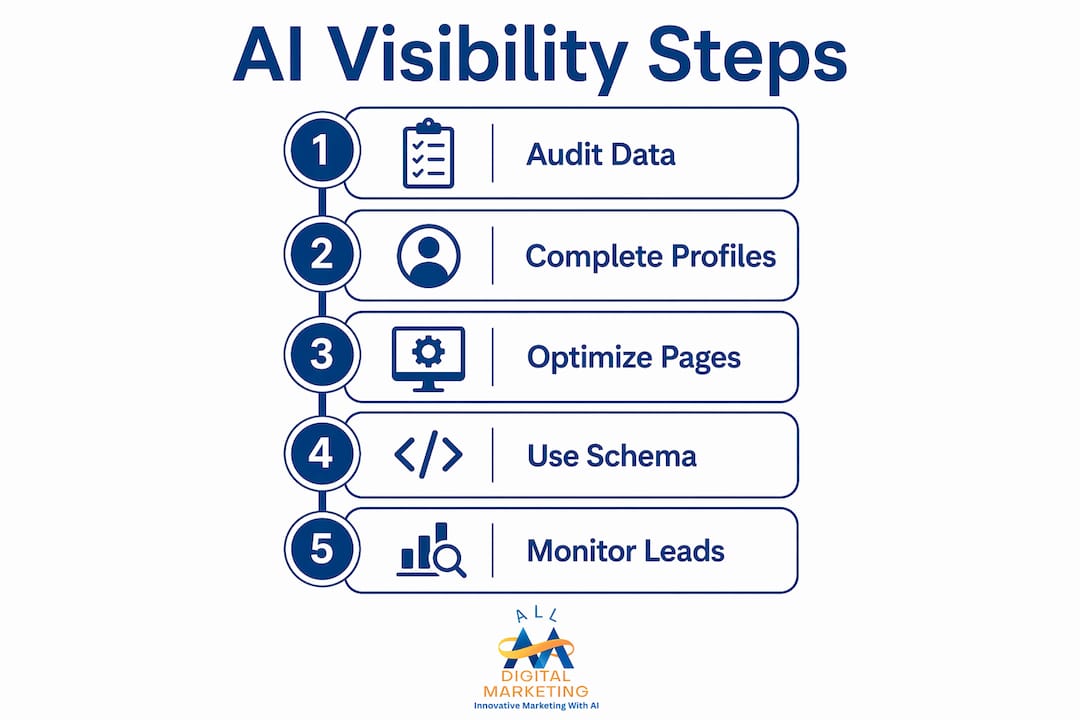
The fastest wins come from data hygiene, Google Business Profile completion, and one well-structured service page. Medium-term gains come from content depth and earned editorial mentions.
| Weeks | Actions | Owner | Est. Hours |
|---|---|---|---|
| 1–4 | NAP audit, GBP completion, JSON-LD schema on top 3 pages | Internal or agency | 15–20 hours |
| — | Service page rewrites, FAQ additions, directory submissions | Internal or agency | — |
| — | Local editorial outreach, review quality program, measurement setup | Agency recommended | — |
Cost ranges:
- DIY: $0–$200/month in tools; expect 15–20 hours of owner or staff time.
- Freelance contractor: $500–$1,500 per project for schema, GBP, and one content sprint.
- Full-service agency: $1,500–$3,500/month for ongoing entity management, content, and measurement.
Combining schema markup with consistent directory NAP data can markedly improve AI visibility compared to businesses without that data hygiene in place.
How to measure whether AI recommendations are driving leads
Measure outcomes first: leads, calls, and booked jobs. AI mention counts are a secondary signal, not the goal.
- AI visibility mentions: Use tools like Semrush AI Toolkit or BrightEdge Copilot to track how often your business appears in AI-generated answers for target queries.
- Click-throughs from cited pages: Monitor organic traffic to the specific pages AI engines tend to cite (service pages, GBP landing pages).
- Lead volume by source: Add a "How did you find us?" field to contact forms; include "AI search / ChatGPT" as an option.
- Call tracking: Assign a unique phone number to your GBP listing to isolate AI-influenced calls.
- Cost per AI-influenced lead: Divide your monthly optimization spend by the number of leads attributable to AI channels.
Marketing experts recommend linking AI marketing outputs directly to conversion and revenue metrics rather than tracking content volume or mention counts. That framing keeps your budget accountable. Explore marketing automation trends to see how A/B testing and attribution tools are evolving alongside AI channels.
Common mistakes that kill your AI recommendation chances
The single biggest mistake SMBs make is treating AI as a content generator rather than a visibility channel that requires clean data and third-party trust signals.
- Ignoring data hygiene: Inconsistent NAP across directories confuses AI grounding and suppresses citations.
- Blocking AI crawlers: A misconfigured robots.txt file that excludes GPTBot or ClaudeBot removes you from retrieval entirely.
- Collecting low-quality reviews: Star ratings with no text give AI engines nothing to parse; generic "Great service!" reviews add minimal citation value.
- Measuring the wrong KPIs: Tracking AI mentions without connecting them to leads creates the illusion of progress.
- Over-relying on mass content: Publishing dozens of thin pages does not build entity trust; one well-structured, corroborated service page outperforms ten shallow ones.
Red flag from any vendor: a promise of "instant AI recommendations" with no mention of directory audits, schema work, or third-party corroboration.
When should you hire an agency for AI recommendation work?
Hire when you have limited time for technical fixes, need structured content at scale, or have immediate lead goals that require faster execution than a DIY approach allows.
Questions to ask any agency you're evaluating:
- Can you show examples of clients appearing in ChatGPT or Gemini answers for local queries?
- How do you audit and fix entity data across directories?
- What is your approach to schema markup and GBP optimization?
- How do you measure AI-influenced leads, not just mentions?
- Do you allow AI crawlers to access client sites, and how do you verify that?
Vendor red flags: vague measurement ("we track AI sentiment"), no case studies, promises of fast results without corroboration work, or a strategy that is entirely content generation with no entity or directory component.
Pro Tip: Ask any prospective agency to pull your current NAP consistency score across 50+ directories before the first proposal. If they can't do that, they're not equipped for AI visibility work.
Privacy and ethical considerations of AI recommendations for SMBs
AI recommendation systems surface business data from public directories, review platforms, and indexed web pages. For SMBs, the practical privacy concern is data accuracy, not data secrecy. If your business address, phone number, or ownership details are outdated in public directories, AI engines will cite that incorrect information to potential customers.
On the ethical side, avoid tactics designed to game AI systems through fake reviews, fabricated editorial mentions, or schema markup that misrepresents your services. AI engines are increasingly capable of detecting corroboration gaps, and a business that appears in AI answers based on manipulated signals tends to lose that visibility quickly when the engines update. Build citations on accurate, verifiable data and genuine customer reviews. That approach holds up across algorithm changes and protects your reputation with the customers AI sends your way.
This article is general informational guidance, not legal or professional advice. Confirm current platform policies and data practices with qualified professionals for your specific situation.
Key Takeaways
AI recommendations are a distinct visibility channel from traditional SEO, and the businesses that win citations are those with clean entity data, strong GBP profiles, and genuine third-party corroboration.
| Point | Details |
|---|---|
| Entity data is the foundation | Consistent NAP across directories is the first fix; inconsistency suppresses AI citations. |
| GBP completeness drives Gemini | A fully populated Google Business Profile is the primary grounding source for Google's AI outputs. |
| Review text beats review count | Review content quality correlates substantially more with AI visibility than sheer volume. |
| Measure leads, not mentions | Track calls, form fills, and booked jobs attributed to AI channels, not just citation counts. |
| Digital Marketing All | Provides entity audits, GBP optimization, and structured content programs that build AI recommendation visibility for SMBs. |
The signal most SMBs are still missing
Most SMB owners assume that if they rank well on Google, they're covered. That assumption is costing them leads. The businesses showing up in AI answers right now are not necessarily the biggest or the best-ranked. They're the ones whose data is cleanest, whose reviews say something specific, and whose service pages are structured so an AI can actually parse and cite them.
An anonymized client in the home services space came to Digital Marketing All with strong Google rankings but near-zero AI citation presence. After a directory NAP audit, a GBP overhaul, and three restructured service pages with JSON-LD schema, that business began appearing in Gemini and ChatGPT answers for local queries within 60 days. No new ad spend. No viral content. Just cleaner data.
The one action worth doing today: run a NAP consistency check across your top 20 directory listings and fix every mismatch you find. That single step removes the most common barrier to AI citation.
How Digital Marketing All helps SMBs get recommended by AI
Getting named by AI platforms requires a specific set of technical and content actions that most SMBs don't have time to execute alone. Digital Marketing All handles the full stack: entity data audits, Google Business Profile optimization, schema markup implementation, structured service page content, review quality programs, and attribution tracking that connects AI citations to actual leads.
The agency works with small and medium-sized businesses across the United States that need AI visibility results on a defined timeline. If you want to know where your business stands today, the right first step is a quick audit. Request your AI visibility audit at Digital Marketing All and get a clear picture of what's holding your business back from AI recommendations.
Useful sources
| Source | What it supports |
|---|---|
| ZipTie.dev: Local SEO for AI Search | Entity clarity stats, visibility lift, review quality data, content structure guidance |
| Semrush: AI Search Optimization for Local Businesses | Third-party corroboration and entity trust signals |
| BrightWill: How AI Engines Recommend Businesses | Engine-specific signal weighting (ChatGPT, Claude, Gemini) |
| Factors.ai: AI for Small Business Marketing | Outcome-based measurement and revenue attribution |
| Thryv: How to Use AI in Marketing for SMBs | Phased implementation and workflow automation guidance |
For deeper reading on building an AI-ready presence, see Digital Marketing All's guide on AI-powered marketing strategies and the tactical breakdown of earning AI citations fast.
FAQ
What is an AI recommendation in simple terms?
An AI recommendation is when a platform like ChatGPT, Gemini, or Claude names or suggests a specific business, product, or piece of content in response to a user's question, based on entity data, reviews, and web sources it has retrieved and ranked.
How do AI recommendations differ from Google search results?
Google ranks pages by keyword relevance and backlinks; AI recommendations cite businesses based on entity clarity, structured data, and third-party corroboration. About 80% of sources cited by AI platforms for local queries do not appear in Google's top 100 organic results.
How long does it take to start appearing in AI recommendations?
Most SMBs see measurable improvement within a few months of completing a NAP audit, GBP optimization, and structured service page updates, though timelines vary by industry and competition level.
Which AI platform should SMBs prioritize first?
Prioritize Gemini if your customers use Google Search, since a fully populated Google Business Profile is its primary grounding source. ChatGPT and Claude require broader directory and editorial corroboration.
Can Digital Marketing All help a business get cited by AI platforms?
Yes. Digital Marketing All provides entity data audits, GBP optimization, schema markup, and structured content programs specifically designed to improve AI recommendation visibility for SMBs across the United States.