

TL;DR:
- For most small businesses, choosing between SEO and paid ads depends on budget, timeline, and revenue goals. SEO offers long-term growth and cost savings, while paid ads deliver immediate leads but stop generating traffic once the budget ends. A hybrid approach balances short-term revenue with sustainable organic growth through phased budget adjustments.
If you can wait 6–12 months for results, prioritize SEO. If you need leads this month, run paid ads and build SEO in parallel. That is the honest answer for most U.S. small businesses, and everything below explains how to execute it without losing revenue in the gap.
The decision is not a channel war. It is a budget and timeline question. SEO is an ownership model: the content, links, and technical authority you build keep generating traffic long after you stop spending. Paid ads are a rental model: traffic stops the moment your budget does. Knowing which model fits your current stage is what separates smart allocation from wasted spend.
Quick verdict:
- SEO first if you have a 12-month-plus horizon, steady cash flow, and can absorb a slow ramp.
- Ads first if you need leads within 30 days, are launching a new product, or have a short selling season.
- Hybrid when you need immediate revenue AND want to reduce long-term cost-per-lead over 6–18 months.
- Always fix technical site quality first. A significant share of mobile visitors abandon pages that take longer than 3 seconds to load, which means slow sites waste both paid and organic budgets.
Table of Contents
- What is the difference between SEO and paid ads?
- How do the real tradeoffs affect your ROI and risk?
- When should you choose ads, SEO, or both?
- What do realistic SEO and paid ad costs look like?
- How do you run a smart hybrid while SEO builds?
- How does SEO compound across 12–24 months?
- Is now the right time to move budget from ads into SEO?
- Key Takeaways
- Digital Marketing All helps you build organic growth without sacrificing leads today
- FAQ
What is the difference between SEO and paid ads?
SEO (search engine optimization) is the practice of earning unpaid placement in search results by building content, earning backlinks, and maintaining a technically sound website. Think of it as buying real estate: the asset appreciates over time and generates returns without a recurring lease payment. The traffic is inbound — users find you because your content answers their question.

Paid search (Google Ads, Microsoft Advertising) works on an auction model. You bid on keywords, pay per click, and appear at the top of results immediately. It is outbound in structure: you are paying to interrupt the user's search with a sponsored placement. Stop paying, and your visibility disappears within hours.
The dimensions that drive business decisions are cost model, speed, and longevity:
| Dimension | SEO | Paid Ads |
|---|---|---|
| How you pay | Time and content investment | Cost-per-click, ongoing |
| Traffic longevity | Persists after investment stops | Stops when spend stops |
| Time to first results | 3–6 months (meaningful); 6–12 months (compounding) | Days to weeks |
| Placement type | Organic listings (earned) | Auctioned ad slots (rented) |
| Trust signal | Higher perceived credibility | Lower (labeled "Sponsored") |
| Control over targeting | Limited (algorithm-driven) | Precise (demographics, intent, device) |
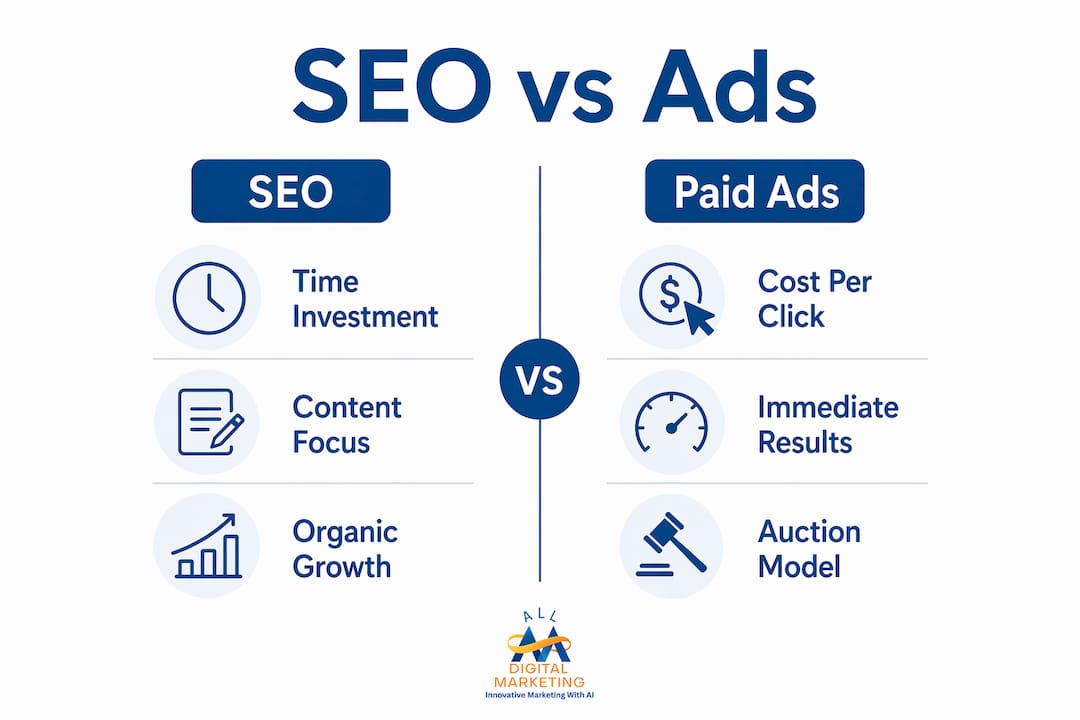
The inbound vs. outbound distinction matters for trust. Organic results carry an implied third-party endorsement from Google's algorithm. Paid placements are labeled "Sponsored," and a meaningful share of users skip them deliberately. For organic traffic that converts at higher rates, SEO is the stronger long-term play.
How do the real tradeoffs affect your ROI and risk?
The tradeoffs below are the ones that actually change a budget decision, not just a channel preference.

| Dimension | SEO | Paid Ads |
|---|---|---|
| Speed to results | 3–12 months | Days |
| Cost model | Fixed investment, declining CPL over time | Variable, CPL rises with competition |
| Scalability | Compounds; more content = more traffic | Linear; more spend = proportionally more clicks |
| Targeting precision | Low (keyword + content match) | High (intent, location, device, audience) |
| Long-term value | Asset that persists | No residual value after spend stops |
| Measurement | Slower attribution cycle | Near-real-time conversion data |
| Best use case | Trust-building, research-phase queries | High-intent transactional queries, launches |
SEO advantages worth knowing:
- Compounding returns: a well-ranked page earns traffic for years without additional spend.
- Lower cost-per-lead over time as organic authority grows.
- Credibility lift: users trust organic results more than sponsored placements.
- Long-term ROI can reach a reported median of around 748% over three years for well-run campaigns, per industry analyses.
Paid ads advantages worth knowing:
- Immediate traffic and lead flow, even on a brand-new domain.
- Precise audience targeting by geography, device, and search intent.
- Easy A/B testing of offers, headlines, and landing pages.
- Predictable short-term volume when you control the budget.
Where business model shifts the advantage: A local service business (plumber, dentist, HVAC contractor) often benefits most from local SEO and Google Business Profile optimization because searchers have high purchase intent and trust organic results. A B2B SaaS company with a long sales cycle benefits from SEO-driven thought leadership content that nurtures prospects over months. An e-commerce brand with seasonal peaks needs paid ads for peak periods and SEO for year-round baseline traffic. High-intent transactional queries often justify paid spend because the lifetime value of the customer can absorb a higher cost-per-lead.
When should you choose ads, SEO, or both?
Matching your situation to the right channel priority is more useful than debating which channel is "better" in the abstract.
Common small-business scenarios:
- New domain, no organic footprint, urgent revenue need: Run paid ads immediately to generate leads. Start SEO in parallel so you are not still 100% dependent on paid spend at month 12.
- Established site with 6+ months of runway: Shift primary budget to SEO. Use a small paid budget to protect branded terms and test new offers.
- Seasonal e-commerce: Use paid ads during peak seasons for immediate volume. Build SEO content during off-seasons so organic traffic covers more of the baseline.
- High-LTV B2B services: SEO-first makes sense. A single closed deal often covers months of SEO investment, and organic content builds the trust that long sales cycles require.
- Product launch with no search volume yet: Paid ads are the only option initially. SEO cannot rank for a term no one is searching yet.
Decision checklist — answer these before allocating budget:
- Do you need leads within 30 days? (Yes → ads required now)
- Is your domain older than 12 months with existing content? (Yes → SEO will ramp faster)
- Can your margins absorb a cost-per-lead of $50–$200+ from paid search? (No → SEO is more urgent)
- Is your product or service searched by name or category? (Category searches → SEO opportunity)
- Do you have a defined content or blogging strategy? (No → start there before scaling SEO spend)
- Is your sales cycle longer than 30 days? (Yes → SEO content nurtures better than ads)
- Are your paid ad costs rising quarter over quarter? (Yes → SEO is the cost-reduction lever)
Pro Tip: Never pause paid ads entirely while SEO ramps. Stage the transition: reduce paid spend by 10–20% every quarter as organic traffic grows to replace it. A hard cutover almost always creates a revenue gap that takes months to recover from.
What do realistic SEO and paid ad costs look like?
Budget ranges and timelines vary widely, but the table below reflects common U.S. small-business scenarios based on industry practice.
| Monthly Budget | Channel | Time to Meaningful Results | What to Expect |
|---|---|---|---|
| $500–$1,000 | SEO | 6–12 months | Early rankings on long-tail terms; traffic growth by month 6 |
| $500–$1,000 | Paid Ads | Days to 2 weeks | Immediate clicks; CPL often $50–$100 depending on industry |
| $1,500–$2,000 | SEO | 4–6 months | Faster content production; broader keyword coverage |
| $1,500–$2,000 | Paid Ads | Days to 2 weeks | Higher volume; more A/B testing capacity |
| $3,000–$5,000 | SEO | 3–6 months | Competitive keyword targeting; link-building programs |
| $3,000–$5,000 | Paid Ads | Days | Competitive bidding; retargeting audiences |
Industry analyses report a median SEO ROI of around 748% over three years for campaigns run with a clear revenue focus. Paid search ROI is typically positive in the short term but does not compound: you spend $1, you get $X back, and the relationship stays roughly linear. The crossover point where cumulative SEO returns surpass cumulative paid search returns typically falls somewhere in the 12–18 month range for well-executed programs.
KPIs to track monthly during a transition:
- Organic sessions (month-over-month growth rate)
- Keyword ranking positions for target terms
- Organic leads and cost-per-organic-lead
- Paid CPL (to compare against organic as SEO matures)
- Conversion rate by traffic source
A stalling SEO program shows flat or declining organic sessions after month 6, no new keyword rankings, and zero growth in referring domains. Those are the signals to audit content quality and link-building activity before adding more budget.
How do you run a smart hybrid while SEO builds?
The most effective approach for most small businesses is not a binary choice. It is a phased hybrid where paid ads fund short-term revenue while SEO builds the long-term asset.
Tactical steps for a hybrid program:
- Use paid campaigns to validate demand before investing in SEO content. If a keyword converts well in Google Ads, it is worth targeting organically.
- Mine your paid search data for the exact search terms that drive conversions, then build SEO content around those terms.
- Use paid ads to cover high-intent transactional queries while SEO targets informational and research-phase content.
- Protect branded keywords with a small paid budget even as organic grows, since branded paid CPCs are typically low and protect your SERP real estate.
- Retarget organic visitors with paid display or social ads. Someone who found you through a blog post but did not convert is a warm audience worth a small retargeting spend.
Suggested budget phasing over 18 months:
- Months 1–3: 70% paid / 30% SEO. Fix technical site issues, publish foundational content, set up conversion tracking.
- Months 4–6: 60% paid / 40% SEO. First organic rankings appear; begin shifting budget as organic CPL data comes in.
- Months 7–12: 50/50 or 40% paid / 60% SEO. Organic traffic compounding; reduce paid spend on keywords where organic ranks in the top 5.
- Months 13–18: 30% paid / 70% SEO. Paid reserved for launches, seasonal peaks, and branded defense.
Pro Tip: Appearing in both the paid ad slot and the organic result for the same query gives you two bites at the click. Even if a user skips the ad, seeing your brand twice on one page builds recognition. As organic rankings mature, test turning off the paid version of that keyword and watch whether total clicks hold.
How does SEO compound across 12–24 months?
The compounding effect is what separates SEO from every other channel. Paid ads deliver linear returns: double the spend, roughly double the clicks. SEO delivers exponential returns over time because each piece of content, each backlink, and each technical improvement builds on the last.
At Digital Marketing All, the agency's AI-powered visibility programs are designed around this compounding model: building content authority, optimizing Google Business Profiles, and layering auto-suggest optimization to capture search intent before users even finish typing.
The compounding phases most businesses experience:
- Months 0–3: Technical foundation, keyword research, content architecture. Little visible traffic growth. This is the investment phase.
- Months 3–6: First rankings appear on long-tail and low-competition terms. Organic sessions begin climbing. Early leads from organic start appearing.
- Months 6–12: Compounding begins. Existing content earns more links and climbs rankings. New content ranks faster because domain authority is growing. CPL from organic drops noticeably.
- Months 12–24: Scale phase. Top-of-funnel content drives consistent lead flow. Paid dependency shrinks. The organic traffic asset is now generating returns on investment made 18 months earlier.
The critical variable is strategy quality. A revenue-focused SEO program targeting high-intent keywords with strong content and active link-building produces dramatically different outcomes than a generic blog-posting schedule. Choosing the right work matters more than the budget size.
Is now the right time to move budget from ads into SEO?
Use this checklist to make the call. Answer honestly — the right answer for your business may not be the one you want to hear.
- Is your paid CPL rising? If yes, SEO is increasingly urgent as a cost-reduction lever.
- Do you have at least 6 months of operating runway? If no, keep ads running and start SEO with a minimum investment.
- Is your website technically sound? (Mobile-friendly, loads in under 3 seconds, no crawl errors.) If no, fix this before scaling either channel.
- Do you have existing content that ranks for anything? If yes, SEO will ramp faster than starting from zero.
- Is your sales cycle longer than 30 days? If yes, SEO content nurtures prospects better than paid ads alone.
- Are your conversion margins above 30%? If yes, you can afford to invest in SEO while ads carry short-term revenue.
- Do you have a content production capacity? If no, budget for content creation as part of your SEO investment.
Decision flow:
- 5–7 "yes" answers: Strong candidate for a phased shift to SEO-primary. Reduce paid spend by 15–20% per quarter as organic grows.
- 3–4 "yes" answers: Hybrid is the right model. Keep paid ads at current levels; add SEO investment without cutting paid.
- 0–2 "yes" answers: Ads remain the primary channel. Start SEO with a minimum viable investment ($500–$1,000/month) to build the foundation while ads carry revenue.
Guardrails to protect short-term revenue during a transition:
- Never cut paid spend faster than organic traffic can replace it. Track weekly organic sessions against paid session volume.
- Keep conversion tracking active across both channels so you can see the real CPL comparison.
- Maintain a minimum paid budget on your highest-converting keywords until organic ranks in the top 3 for those terms.
Pro Tip: Before shifting any budget, run a 30-day paid search test on your top 5 target SEO keywords. The conversion data tells you exactly which keywords deserve SEO investment first, and it gives you a CPL benchmark to measure organic performance against.
Key Takeaways
SEO outperforms paid ads on long-term ROI for most small businesses, but only when you have the runway to wait for compounding to kick in at months 6–12.
| Point | Details |
|---|---|
| Timeline drives the decision | SEO needs 6–12 months for meaningful results; ads deliver leads within days. |
| SEO is an asset, ads are a rental | Organic rankings persist after investment stops; paid traffic stops the moment spend does. |
| Hybrid beats binary | Run paid ads while SEO builds; reduce paid spend by 10–20% per quarter as organic grows. |
| Strategy quality determines ROI | A revenue-focused SEO program produces far better returns than a generic content schedule. |
| Digital Marketing All | Offers hybrid SEO and PPC programs designed to protect short-term revenue while building long-term organic growth. |
The case for patience — and for protecting your revenue while you wait
Most small businesses lose the SEO vs. ads debate before it starts because they frame it as a permanent choice. It is not. The real question is sequencing: which channel carries revenue now, and which channel reduces your cost-per-lead over the next 18 months?
The businesses that win are the ones that resist the urge to cut paid ads too fast. SEO does compound, and the long-term ROI figures are genuinely compelling. But the compounding only helps you if you are still in business when it kicks in. Protecting short-term revenue while building long-term organic authority is not a compromise. It is the actual strategy.
One thing that often gets overlooked: SEO is not outdated or declining. It is evolving. AI-driven search, autosuggest optimization, and Google Business Profile prominence are expanding what "organic visibility" means. The businesses investing in those channels now are building assets that will compound for years. The ones waiting for a perfect moment to start are simply handing that advantage to competitors.
Digital Marketing All helps you build organic growth without sacrificing leads today
Shifting budget from paid ads to SEO is a smart long-term move, but it requires a plan that keeps revenue flowing during the ramp. Digital Marketing All offers exactly that: a structured approach combining local SEO, Google Business Profile optimization, content programs, and PPC management designed to work together. The agency's hybrid programs are built for small and mid-sized businesses that need short-term lead flow and long-term cost reduction, not one or the other.
The starting point is a clear picture of where you stand: which keywords you already rank for, where paid spend is leaking, and what technical issues are limiting both channels. From there, Digital Marketing All builds a phased plan that reduces paid dependency quarter by quarter as organic authority grows. Ready to see what that looks like for your business? Contact Digital Marketing All to get started.
Useful sources and further reading
- Google Ads: SEO vs. PPC — Understanding the Difference — Primary source for how Google defines the two channels and their placement mechanics.
- SEO ROI Statistics: Returns, Costs & Break-Even Time — Industry data on median SEO ROI figures and the timeline to break-even vs. paid search.
- SEO vs. Paid Advertising: What's Right for Your Business? — Practical framework for matching channel to business stage.
- Is SEO Dead in 2026? Why Search Engine Optimization Still Works — Addresses the "SEO is outdated" concern with current evidence.
- SEO vs. PPC: Differences, Pros, Cons, & Use Cases — Detailed breakdown of use cases and cost comparisons for both channels.
FAQ
Is SEO better than paid ads for small businesses?
SEO delivers better long-term ROI for most small businesses, with industry analyses reporting a median return around 748% over three years, but paid ads are the right choice when you need leads within 30 days or are launching a new product with no organic footprint.
Is SEO outdated in 2026?
SEO is evolving, not dying. AI-driven search, autosuggest optimization, and Google Business Profile prominence are expanding what organic visibility means, and well-executed SEO still drives meaningful long-term results for businesses that invest in it strategically.
What is the 80/20 rule for SEO?
In practice, a large share of organic traffic tends to come from a small portion of your pages or keywords, which means focusing content and link-building efforts on your highest-intent, highest-converting terms produces far better returns than spreading effort evenly across many topics.
How long does SEO take to show results?
Paid ads generate leads within days; SEO commonly requires 3–6 months for meaningful traction and 6–12 months for the compounding effect to produce a measurable reduction in cost-per-lead compared to paid search.
Should I stop running ads when I start SEO?
No. Stage the transition by reducing paid spend 10–20% per quarter as organic traffic grows to replace it. A hard cutover almost always creates a revenue gap that takes months to recover, especially if your SEO program is still in its early ramp phase.