

TL;DR:
- Organic traffic consists of unpaid visitors arriving through natural search engine results. It offers high intent, long-term growth, and minimal ongoing costs for small businesses. Building and maintaining it requires consistent effort over several months but yields lasting online visibility.
Organic traffic is defined as website visitors who arrive through unpaid, natural search engine results on platforms like Google, Bing, or Yahoo. It is one of the most valuable traffic sources available to digital marketers and small business owners because it captures people who are actively searching for what you offer. Organic search drives 50% to 60% of all website traffic for many businesses. That single statistic explains why understanding organic traffic is not optional for anyone serious about online growth.
What is organic traffic and why does it matter?
Organic traffic is the industry term for unpaid search visits earned through search engine optimization (SEO). A visitor counts as organic when they type a query into a search engine and click a non-paid result to reach your site. No ad spend triggers that visit. No sponsored placement puts your page in front of them.

The significance of this channel goes beyond volume. Organic traffic visitors actively search for specific solutions, which makes them far more likely to convert than someone who sees a display ad while scrolling. That intent is the core reason organic traffic sits at the top of most digital marketing priority lists.
For small businesses especially, organic traffic represents a way to compete with larger brands without matching their advertising budgets. A well-optimized local service page can outrank a national competitor for a city-specific search term. That kind of visibility is earned, not bought, and it compounds over time in ways paid ads never can.
How is organic traffic different from paid, direct, and referral traffic?
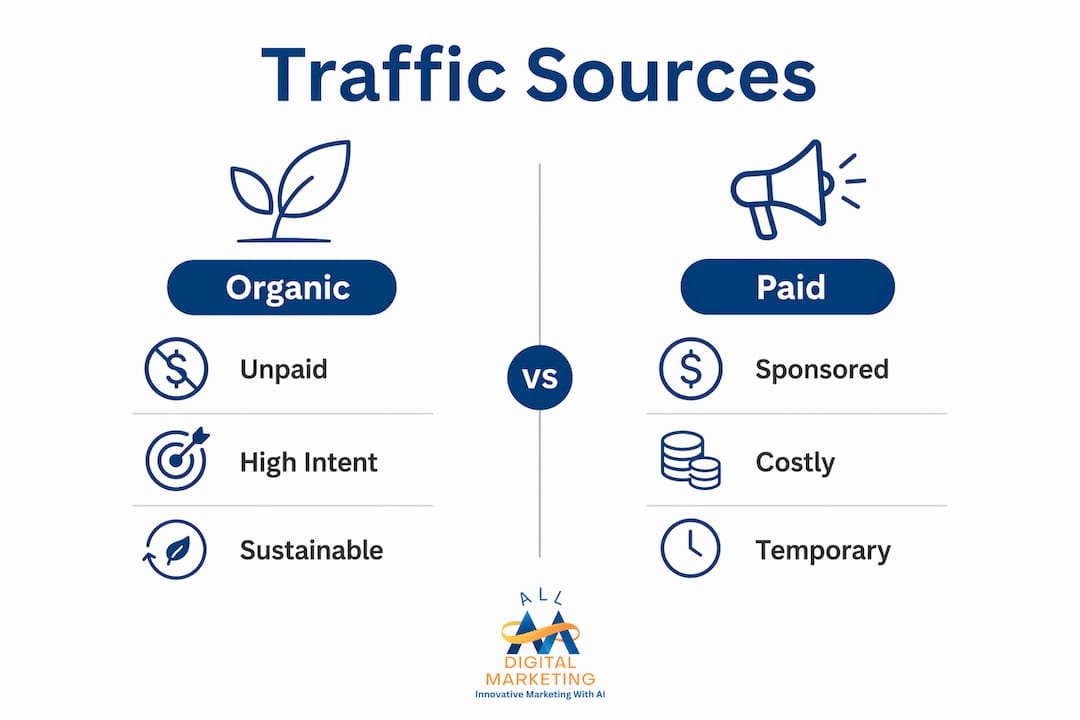
Traffic sources tell you where your visitors came from. Mixing them up leads to bad decisions about where to invest your time and money. Organic traffic is distinct from paid, direct, referral, and social traffic in four key ways: source, user intent, cost, and sustainability.
Paid traffic comes from sponsored search ads. You pay per click, and the moment your budget runs out, the traffic stops. The intent can be high, but you are renting visibility rather than earning it.
Direct traffic occurs when someone types your URL directly into a browser or uses a bookmark. This usually signals brand recognition. It costs nothing per visit, but you cannot manufacture it without first building awareness through other channels.
Referral traffic arrives when another website links to yours and a reader clicks that link. A single strong backlink from a high-authority site can send consistent referral visitors for years.
Social traffic comes from platforms like Facebook, Instagram, LinkedIn, or X (formerly Twitter). It can be organic (unpaid posts) or paid (boosted ads). Social visitors tend to be in a discovery mindset rather than a buying mindset, which generally means lower conversion rates compared to search-driven visits. For a deeper look at how social traffic works alongside search, the social media traffic guide at Digitalmarketingall covers the key differences.
| Traffic source | Origin | Cost per visit | User intent | Sustainability |
|---|---|---|---|---|
| Organic | Unpaid search results | Near zero after ranking | High, solution-seeking | Long-term, compounds |
| Paid search | Sponsored ads | Cost per click | High, solution-seeking | Stops when budget ends |
| Direct | URL entry or bookmark | Zero | High, brand-aware | Depends on brand strength |
| Referral | External website links | Zero | Moderate | Depends on link quality |
| Social | Social media platforms | Zero to paid | Low to moderate | Inconsistent |
The table makes one pattern clear. Organic traffic is the only channel that combines high intent with near-zero ongoing cost and long-term sustainability.
What factors influence organic traffic?
Organic traffic does not happen by accident. It relies on four pillars: relevance, accessibility, authority, and user satisfaction. If any one of those pillars fails, your traffic ceiling drops.
Here is what each pillar means in practice:
- Relevance means your content matches what searchers actually want. A page about "best running shoes for flat feet" must answer that exact question thoroughly. Google's algorithms evaluate whether your content satisfies the intent behind a query, not just whether it contains the right keywords.
- Accessibility covers technical SEO. Search engines must be able to crawl and index your pages. Slow load times, broken links, missing sitemaps, and poor mobile performance all block crawlers and suppress rankings. Google's Core Web Vitals are the current standard for measuring page experience.
- Authority reflects how much trust search engines assign to your domain. Backlinks from credible, relevant websites are the primary signal. A local plumbing company with ten high-quality links from regional news sites will often outrank a competitor with hundreds of low-quality directory links.
- User satisfaction is measured through behavioral signals. If visitors land on your page and immediately return to the search results (a behavior called "pogo-sticking"), Google interprets that as a sign your content did not deliver. Dwell time, scroll depth, and click-through rate all feed into this signal.
Pro Tip: Audit your site's technical health before creating new content. A page that cannot be crawled will never rank, no matter how good the writing is. Use Google Search Console's Coverage report to find indexing errors before they cost you traffic.
Keyword research sits at the intersection of relevance and accessibility. Targeting queries with clear commercial or informational intent, rather than broad vanity terms, produces faster and more durable ranking gains. A small business that ranks on page one for "emergency HVAC repair in Austin" will see far better results than one chasing a generic term like "air conditioning."
How is organic traffic measured and analyzed?
Measurement is where strategy meets reality. Organic traffic is tracked using tools like Google Analytics and Google Search Console, which together give you a complete picture of search performance.
Google Analytics shows you organic sessions, the pages visitors land on, how long they stay, and whether they convert. Google Search Console shows you the queries that triggered your pages, your average position, impressions, and click-through rate (CTR). Neither tool alone tells the full story. You need both.
The metrics that matter most for organic traffic analysis are organized below:
| Metric | What it measures | Why it matters |
|---|---|---|
| Organic sessions | Total visits from unpaid search | Baseline volume indicator |
| Impressions | How often your page appears in results | Shows ranking reach |
| Click-through rate (CTR) | Clicks divided by impressions | Reveals title and meta description effectiveness |
| Average position | Mean ranking across all queries | Identifies pages close to page-one breakthroughs |
| Organic conversion rate | Conversions from organic visits | Measures actual business impact |
| Top landing pages | Pages receiving most organic entries | Shows which content drives traffic |
One attribution nuance worth knowing: Google Analytics sometimes assigns sessions to the "direct" bucket when it cannot identify the source. This happens with dark social sharing, certain mobile browsers, and HTTPS-to-HTTP redirects. Your organic traffic numbers may be slightly understated as a result. Treat organic session counts as a floor, not a ceiling.
Pro Tip: Filter Google Search Console data by query type. Separate branded queries (searches that include your business name) from non-branded ones. Non-branded organic traffic is the true measure of your SEO reach because it shows how many new people are finding you.
For a technical edge in reading search data, Digitalmarketingall's guide on Google Search Console techniques walks through advanced filtering methods that most marketers overlook.
What are the benefits of organic traffic for small businesses?
The benefits of organic traffic are concrete and measurable, not theoretical. Here is what makes this channel worth prioritizing:
- Higher conversion rates. Organic visitors arrive with intent. They searched for a solution and clicked your result because it looked relevant. That mindset produces better conversion rates than interruptive ad formats. For more on turning traffic into revenue, the Digitalmarketingall article on focusing on conversions explains the mechanics clearly.
- Near-zero marginal cost. Once content ranks, each additional visitor costs essentially nothing. Compare that to paid search, where every click carries a price tag. A single well-ranked blog post can deliver thousands of free visits over its lifetime.
- Compounding growth. Organic traffic builds on itself. A page that ranks today earns backlinks, which improves authority, which lifts other pages. Paid traffic does not compound. It resets to zero the moment you stop spending.
- Brand trust and authority. Appearing organically on page one signals credibility. Searchers trust organic results more than ads because they know organic rankings are earned. That trust transfers to your brand.
- Long-term ROI. Content can continue driving free leads for years after publication. A well-written evergreen guide published today may still generate qualified visitors in 2029. No paid channel offers that kind of return on a one-time investment.
The combination of high intent, low cost, and compounding returns makes organic traffic the highest-ROI channel for most small businesses over a 12-to-24-month horizon. The long-term SEO advantage over paid marketing is well documented and worth understanding before you allocate your next marketing budget.
How to increase your organic traffic: practical strategies
Growing organic traffic requires consistent effort across content, technical health, and authority building. There is no shortcut, but the process is straightforward when you follow it in order.
-
Create content that matches search intent. Every page you publish should answer a specific question your audience is typing into search engines. Research keywords using tools like Google Search Console or keyword research platforms. Write content that fully satisfies the query, not just content that mentions the keyword. Thin, vague pages do not rank.
-
Fix your technical foundation first. Before publishing new content, confirm your site loads quickly, works on mobile, and has no crawl errors. Google's Core Web Vitals measure loading speed, interactivity, and visual stability. Pages that fail these benchmarks rank below technically sound competitors, regardless of content quality. The guide on why your website isn't generating leads at Digitalmarketingall covers the most common technical problems and their fixes.
-
Build authority through ethical link acquisition. Reach out to industry publications, local news sites, and complementary businesses for guest posts or mentions. Create data-driven content that others naturally want to cite. Avoid link schemes and paid link networks. Google's manual actions for unnatural links can erase months of progress overnight.
-
Interlink your content deliberately. Connect related pages on your site so search engines understand the relationship between topics. A local plumber's site should link its "water heater repair" page to its "emergency plumbing" page and its "plumbing maintenance tips" blog post. This structure signals topical depth.
-
Maintain and update existing content. Rankings decay when content becomes outdated. Set a quarterly review schedule for your top-performing pages. Update statistics, add new examples, and expand thin sections. Refreshed content often recovers lost rankings faster than publishing new pages.
-
Be patient and consistent. It typically takes 4 to 6 months of consistent SEO effort before meaningful organic traffic materializes. That timeline frustrates marketers used to the instant feedback of paid ads. The payoff, however, is traffic that keeps arriving long after the work is done.
Pro Tip: Treat your website as a knowledge hub. Group related content into topic clusters with one authoritative "pillar" page and several supporting articles linked to it. This structure helps search engines understand your expertise and rank your pages higher across an entire subject area.
For practical SEO tactics you can apply immediately, the simplified SEO strategies guide at Digitalmarketingall breaks down the ranking process without the technical jargon.
Key takeaways
Organic traffic is the highest-ROI channel for most small businesses because it combines high user intent, near-zero marginal cost, and compounding long-term growth that paid advertising cannot replicate.
| Point | Details |
|---|---|
| Organic traffic definition | Unpaid search engine visits earned through SEO, not ad spend. |
| Four ranking pillars | Relevance, accessibility, authority, and user satisfaction all must work together. |
| Measurement tools | Use Google Analytics and Google Search Console together for a complete performance picture. |
| Cost efficiency | Once a page ranks, each additional visitor costs essentially nothing. |
| Time to results | Expect 4 to 6 months of consistent effort before significant organic traffic appears. |
Organic traffic is earned, not free: my honest assessment
After years of working with digital marketers and small business owners, I keep seeing the same misconception. People call organic traffic "free traffic." It is not free. Organic traffic is earned demand capture. It requires real investment in content creation, technical maintenance, and authority building. What makes it different from paid traffic is not the absence of cost. It is the absence of ongoing cost per visitor once you have done the work.
The other thing I have seen trip people up is the timeline. Marketers who are used to running paid campaigns expect to see results in days. Organic SEO does not work that way. Four to six months is a realistic minimum before you see meaningful movement. That patience requirement is actually a competitive advantage for businesses willing to commit. Most of your competitors will give up before the results arrive.
The businesses I have seen win with organic traffic treat it as a system, not a campaign. They publish consistently, fix technical issues promptly, and build authority over months and years. The ones who treat SEO as a one-time project always end up back at square one. If you are a small business owner reading this, the mindset shift worth making is simple: organic traffic is infrastructure, not a tactic. Build it once, maintain it regularly, and it pays you back for years.
— Diane
How Digitalmarketingall supports your organic traffic growth
Digitalmarketingall works with small and medium-sized businesses that want to build real, lasting visibility in search results. The agency's approach combines technical SEO, content strategy, local search optimization, and AI-driven search prominence to help businesses attract the right visitors without relying entirely on ad spend. Whether you are starting from zero or trying to recover lost rankings, the team at Digitalmarketingall brings the expertise to move the needle. For a full picture of what organic traffic growth looks like in practice, visit the organic traffic growth resources and explore how Digitalmarketingall's SEO and digital marketing services can support your goals.
FAQ
What is the organic traffic definition in simple terms?
Organic traffic is the count of visitors who reach your website by clicking an unpaid search result on Google, Bing, or another search engine. No ad spend is involved in generating these visits.
How long does it take to increase organic traffic?
It typically takes 4 to 6 months of consistent SEO effort before meaningful organic traffic appears. Evergreen content can then continue delivering visitors for years after publication.
What drives organic traffic to a website?
Organic traffic is driven by four factors: content relevance to search queries, technical site accessibility for crawlers, domain authority built through backlinks, and user satisfaction signals like dwell time and low bounce rates.
How is organic traffic measured?
Organic traffic is measured using Google Analytics for session data and Google Search Console for impressions, clicks, average position, and click-through rate. Both tools together give the most complete view of search performance.
Is organic traffic better than paid traffic?
Organic traffic has near-zero marginal cost per visitor once content ranks and compounds over time, while paid traffic stops the moment your budget ends. For long-term ROI, organic traffic outperforms paid traffic for most small businesses.