

TL;DR:
- Adjusting your focus from increasing website traffic to improving conversion rates can double your revenue without additional ad spend.
- Structured testing, segmentation, and optimizing micro and macro conversions enable smarter decisions and higher profitability.
- Building a continuous CRO program enhances long-term growth by making existing visitors more likely to convert and maximizing marketing ROI.
You're already paying for traffic. Every dollar you spend on ads, SEO, or content marketing sends visitors to your website. But if those visitors leave without taking action, none of it matters. Understanding why focus on conversions should sit at the center of your marketing strategy is the single most important shift a business owner or marketing professional can make. Improving your conversion rate can double your revenue from the same traffic volume, without increasing ad spend by a single dollar. That is the kind of return no additional traffic budget can reliably match.
Table of Contents
- Key takeaways
- Why focus on conversions: the core argument
- Understanding what conversion rates actually measure
- Why conversions outperform traffic as a growth lever
- Practical conversion rate optimization tips
- Measuring conversions accurately for better decisions
- Common conversion challenges and how to fix them
- My honest take on why most businesses get this wrong
- Ready to turn more visitors into customers?
- FAQ
Key takeaways
| Point | Details |
|---|---|
| Conversions multiply existing traffic value | Doubling your conversion rate doubles revenue without acquiring more visitors or raising ad spend. |
| Segmentation reveals real performance | Breaking down conversion rates by channel, device, and audience uncovers where you are losing the most money. |
| CRO is a structured process | Systematic testing and validation, not guesswork, produces reliable and compounding conversion gains. |
| Measurement accuracy matters | Defining conversion events consistently and choosing the right denominator prevents misleading results and bad decisions. |
| Trust drives conversions | Buyer education, social proof, and messaging alignment with your ads are the highest-leverage conversion levers. |
Why focus on conversions: the core argument
Most businesses treat traffic as the answer to every revenue problem. When sales slow down, the instinct is to run more ads, write more content, or push harder on social media. That instinct is understandable but expensive. The real question is not how many people visit your site. It is how many of them do what you need them to do.
A conversion is any desired action a visitor takes on your website. That includes making a purchase, submitting a lead form, signing up for an email list, booking a consultation, or downloading a resource. The importance of conversion rates lies in how directly they connect visitor volume to actual business outcomes. You can have ten thousand visitors a month and generate almost no revenue if your conversion rate is broken.
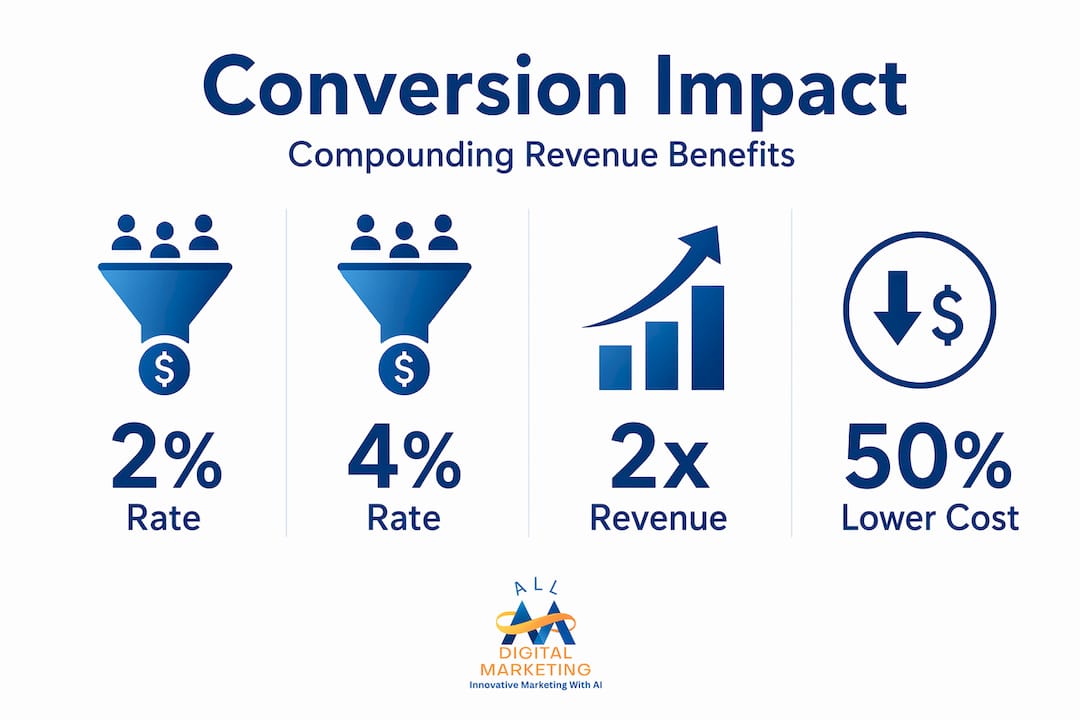
Here is the math that makes this concrete. Increasing conversion rate from 2% to 4% doubles your revenue from every channel simultaneously. Paid search, organic traffic, social, referrals. All of it gets more productive at once, with zero additional traffic cost. That is the business case in one sentence.
The benefits of improving conversions extend well beyond revenue. A higher conversion rate also lowers your customer acquisition cost (CAC). Doubling your conversion rate halves CAC, which means ad channels that were previously unprofitable can suddenly generate positive returns. You gain competitive pricing power, better ROI, and a more sustainable growth model.

Understanding what conversion rates actually measure
Before you can improve your conversion rate, you need to know what you are measuring. The basic formula is straightforward: divide the number of conversions by the number of visitors or sessions, then multiply by 100 to get a percentage. But measuring conversion rate correctly requires defining your conversion events and denominators consistently, or your data will mislead you.
Session-based conversion rates count how many sessions resulted in a conversion. Visitor-based rates count how many unique visitors converted. Both are legitimate, but they tell different stories. A visitor who visits three times before buying will show up as three sessions but one unique visitor. Which metric you use depends on what decision you are making.
There are also two levels of conversion to track: macro and micro. Macro conversions are your primary goals, like a purchase or a booked call. Micro conversions are the smaller steps that indicate progress toward those goals, such as adding a product to a cart, watching a demo video, or clicking a pricing page. Micro conversions are diagnostic. When your macro conversion rate drops, micro conversion data tells you where in the funnel visitors are falling off.
Common measurement pitfalls to avoid
Pro Tip: Always segment your conversion data before drawing conclusions. A blended conversion rate across all traffic sources can hide the fact that one channel converts at 8% while another converts at 0.5%.
The table below shows how segmentation changes your understanding of performance.
| Traffic source | Sessions | Conversions | Conversion rate |
|---|---|---|---|
| Organic search | 4,000 | 160 | 4.0% |
| Paid search | 2,000 | 60 | 3.0% |
| Social media | 3,000 | 30 | 1.0% |
| Direct | 1,000 | 50 | 5.0% |
Without segmentation, your blended rate looks fine. With it, you can see that social media is badly underperforming and deserves immediate attention. Segmentation by channel and device transforms conversion rate from a vanity number into a decision-making tool.
Why conversions outperform traffic as a growth lever
Here is a scenario that plays out in businesses of every size. A marketing team doubles their paid search budget to get more traffic. Costs go up. Revenue goes up a little. But the conversion rate stays the same, so the cost to acquire each customer barely moves. Now flip that. The same team spends two months running structured A/B tests on their landing pages and improves their conversion rate from 2% to 3.5%. Revenue increases by 75% from the exact same traffic. The ad budget stays flat. Profit margin improves.
The impact of conversions on sales is compounding in a way that traffic growth is not. When you optimize your website for conversions, every traffic source benefits simultaneously and permanently. That improvement does not expire when you stop running campaigns.
The cost-efficiency case for CRO
Consider what happens when your conversion rate improves across the full funnel:
- Your cost per lead drops, making previously marginal campaigns profitable
- Your Google Ads quality scores often improve when landing pages align better with ad intent
- Your email nurture sequences convert better because you have tested subject lines and CTAs
- Your organic traffic generates more revenue without any increase in SEO spend
Small UX improvements compound across every stage of the funnel and improve the profitability of every traffic source you already have. This is the practical argument for why conversions matter more than raw visitor numbers.
The comparison below makes the financial impact clear.
| Strategy | Monthly visitors | Conversion rate | Monthly conversions | Ad budget required |
|---|---|---|---|---|
| Traffic-only focus | 20,000 | 2% | 400 | $10,000 |
| CRO-first focus | 10,000 | 4% | 400 | $5,000 |
Same result. Half the budget. That gap is the business case for conversion rate optimization.
Pro Tip: Before scaling any paid campaign, run a two-week audit of your top landing pages. If your conversion rate is under 2%, you are paying to send traffic into a broken funnel. Fix the funnel first.
Practical conversion rate optimization tips
Effective conversion strategies follow a process. Random changes and design refreshes based on personal preference rarely move the needle. The teams that consistently improve conversions operate a structured system.
-
Define your conversion goals clearly. Pick one primary conversion event per page and make sure your analytics platform is tracking it accurately. Ambiguous goals produce ambiguous results.
-
Collect voice-of-customer data. Survey your existing customers. Use on-site polls and session recordings. Find out what nearly stopped them from buying. Their words will tell you exactly what your copy and design need to say. Buyer education and trust-building early in the journey increases engagement and improves conversion opportunities more reliably than most design changes.
-
Prioritize copy over design. Copy-first CRO produces larger lifts than design tweaks. Your headline, value proposition, social proof, and call-to-action wording are the variables most likely to move your conversion rate. Test those before you redesign a button color.
-
Fix message-to-page alignment. Visitors from specific ads expect to land on a page that matches the ad they clicked. If someone clicks an ad for "emergency HVAC repair" and lands on your general homepage, they will leave. Every ad needs a dedicated landing page that mirrors its message.
-
Run A/B tests on one variable at a time. Testing one variable at a time is critical for valid results. If you change the headline, the image, and the CTA button simultaneously and conversions go up, you have no idea what drove the improvement.
-
Optimize for page speed. Every additional second of load time reduces conversions by 7% on average. Pages that load three seconds slower than a competitor lose roughly 20% of potential conversions. Speed is not a technical nicety. It is a revenue variable.
Segment before you optimize
Different audiences behave differently. Mobile users convert differently than desktop users. Paid traffic behaves differently than organic search visitors. If you try to optimize for everyone at once, you will optimize for no one effectively. Review your conversion data by device, by traffic source, and by audience segment before deciding what to test. The highest-impact opportunity is almost never in your average conversion rate. It is in your worst-performing segment.
Pro Tip: Use heat maps and session recordings on your highest-traffic pages for at least two weeks before writing a test hypothesis. You will almost always find something that surprises you about how visitors actually behave.
You can also explore how no-risk guarantee messaging eliminates hesitation and increases trust, which is one of the most consistently high-performing conversion levers across industries.
Measuring conversions accurately for better decisions
Getting the measurement right is where most teams stumble. They track macro conversions but ignore the micro conversion data that explains why. They look at blended conversion rates instead of segmented ones. They make decisions based on two weeks of data when statistical significance requires far more. And they confuse correlation with causation when two things change at once.
The right approach to funnel analysis follows a clear structure:
- Map every step in your conversion funnel from first visit to final conversion.
- Track drop-off rates at each step, not just the final conversion rate.
- Identify the single step with the highest drop-off. That is your highest-priority optimization target.
- Use micro conversions to distinguish between traffic quality problems and UX problems. If visitors add items to cart but do not check out, you have a checkout friction problem. If they never add to cart, you have a product page or pricing problem.
Segmented conversion tracking identifies bottlenecks for targeted improvement, which means you stop guessing about where to focus and start allocating effort based on data. The marketing funnels guide for local businesses offers a clear framework for mapping upstream funnel stages that directly influence conversion rates.
Pro Tip: Set up conversion rate dashboards segmented by at least three dimensions: traffic source, device type, and landing page. Review them weekly, not monthly. Small drops caught early are easy to diagnose. Large drops found a month later are expensive to reverse.
Integrating your conversion data with ad spend reports also transforms how you allocate budget. When you can see cost per conversion by channel and campaign, you can reallocate budget from low-converting channels to high-converting ones in real time, rather than waiting until the end of a quarterly review.
Common conversion challenges and how to fix them
Even teams that understand why conversions matter run into predictable obstacles when they try to prioritize them. The most common challenge is organizational. Traffic metrics are visible and easy to report. More sessions, more impressions, more clicks. Conversion rate requires more context and more patience, so it often loses the internal argument to vanity metrics.
The second challenge is over-reliance on gut feeling. Most conversion decisions are made based on what the team thinks looks better or what a competitor seems to be doing. CRO works best as a learning system with structured testing and validation. Replacing opinion with evidence is not a one-time fix. It is a discipline that needs to be built into your marketing process.
A third obstacle is the failure to personalize. A single generic landing page serving all audience segments will always underperform a segmented experience. The same offer presented differently to a first-time visitor versus a returning visitor, or to a mobile user versus a desktop user, will convert at different rates. Personalization is not an advanced tactic reserved for enterprise brands. It is a basic principle of effective conversion strategy.
"Most teams chase traffic first, but CRO reframes success as efficiency, making each visitor worth more and driving faster payback." Source: Prescient AI
Finally, many businesses treat CRO as a one-time project rather than a continuous process. They run a few tests, see an improvement, and move on. But CRO as an ongoing cycle of testing and learning produces cumulative monthly gains that compound over time. A 10% improvement this quarter plus a 15% improvement next quarter adds up to significantly more than either one alone.
The fix for all of these challenges is the same: build a formal CRO program with dedicated ownership, a testing calendar, and clear metrics tied to revenue, not just traffic.
My honest take on why most businesses get this wrong
I have worked with dozens of businesses on their digital marketing, and the pattern is almost always the same. They come in wanting more traffic. They are frustrated that their ads are not working or their SEO is not generating leads. And when you dig into the data, you find a website converting at 1.2% when it should be converting at 3% or 4%.
The traffic was never the problem. The funnel was.
What I have found is that business owners resist CRO because the results feel less tangible than traffic numbers. You can see sessions go up in real time. Conversion rate improvements feel slower and less exciting, even when the math says they are worth far more.
The uncomfortable truth I have observed is that most businesses are reporting conversions inaccurately. They count form fills that never turn into customers, or they measure conversions at the session level without accounting for return visitors. The correct conversion rate formula and proper segmentation matter enormously, and most teams skip that foundation and wonder why their tests never produce reliable results.
The shift I encourage every client to make is simple. Stop asking "how do I get more visitors?" Start asking "what would it take to get more of my existing visitors to convert?" That question is more profitable, faster to answer, and builds a compounding advantage over every competitor still chasing clicks.
The businesses I have seen grow fastest in 2026 are the ones treating CRO as a standing program, not a quarterly project. They test consistently, they measure accurately, and they treat every visitor as a learning opportunity. That mindset is what separates teams who grow predictably from teams who grow randomly.
— Diane
Ready to turn more visitors into customers?
Everything covered in this article points to one practical truth: the fastest path to more revenue is making your existing traffic work harder. At Digitalmarketingall, we help business owners and marketing teams do exactly that. One of the highest-leverage places to start is your online reputation. Reviews build trust, and trust drives conversions. If potential customers are landing on your site and not converting, what they find when they search your name is often a major factor. Our review generation service helps you build a steady stream of authentic reviews that reduce hesitation and increase confidence at the moment of decision. For businesses on Yelp, our Yelp reputation management service protects and strengthens the profile that buyers check right before they decide whether to contact you. Start where conversions are lost, and recover that revenue.
FAQ
What does it mean to focus on conversions?
Focusing on conversions means prioritizing the percentage of website visitors who complete a desired action, such as a purchase, sign-up, or inquiry, rather than simply increasing traffic volume. It is the most direct way to grow revenue from your existing marketing investment.
How does conversion rate affect revenue?
Conversion rate has a direct multiplier effect on revenue. Increasing your conversion rate from 2% to 4% doubles your revenue from all traffic sources simultaneously, without increasing ad spend or acquiring new visitors.
What are the best conversion rate optimization tips for beginners?
Start by defining one clear conversion goal per page, collecting voice-of-customer feedback, and testing your headline and call-to-action copy before making design changes. Fix page speed issues and align your landing page messaging with the specific ad or source that drives traffic to it.
Why do businesses focus on traffic instead of conversions?
Traffic metrics are visible and easy to report, which makes them feel like a measure of success. Conversion rate requires more context and structured testing, so it often gets deprioritized even though it delivers a higher return on marketing investment.
How do I know if my conversion rate needs improvement?
If your website converts at under 2% across all channels, there is almost certainly a significant revenue opportunity being left unrealized. Segment your conversion data by channel and device to identify where the biggest gaps are, then prioritize testing on those pages and audiences first.