

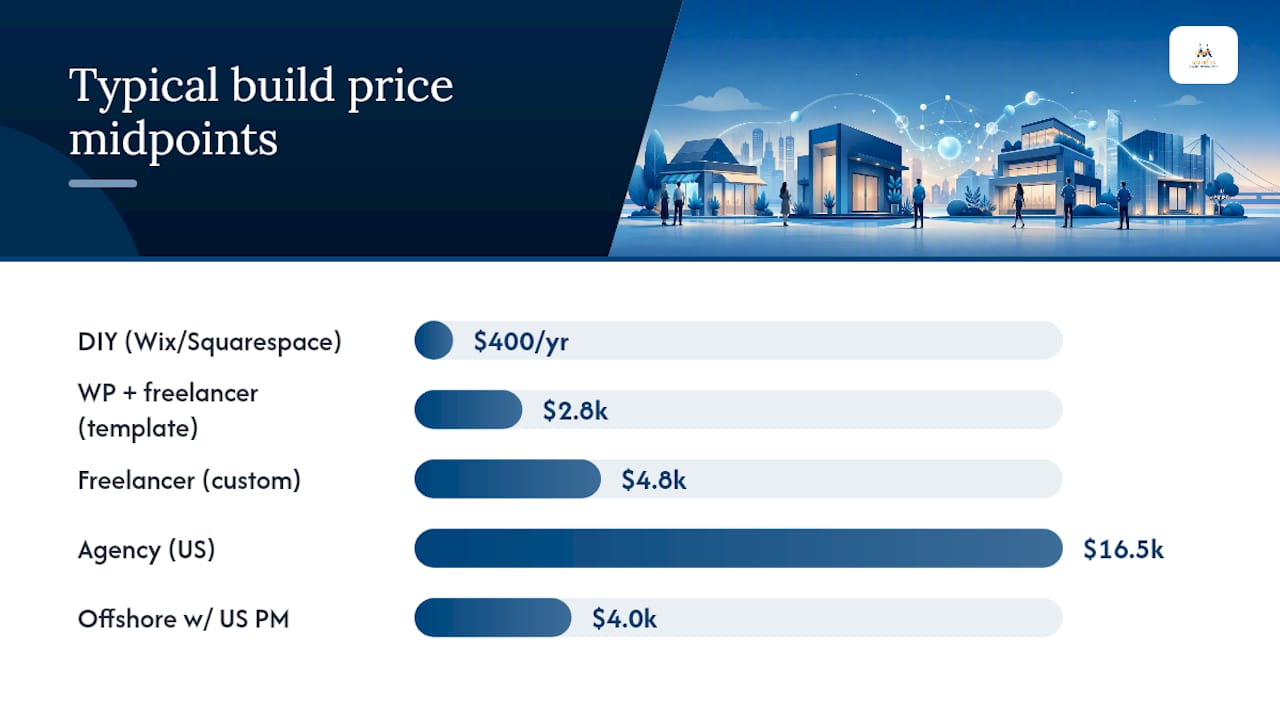
Expect to pay somewhere between $200 a year and $25,000 upfront for a small business website, and the gap comes down to who builds it and what it needs to do. DIY builders run $200 to $800 a year. Freelancer builds land between $1,500 and $8,000. US agencies charge $8,000 to $25,000 or more. Offshore development teams with US support usually cost a few thousand dollars. On top of any of these, plan for $50 to $300 a month in ongoing maintenance, more if you sell products online.
TL;DR:
- Small business website costs vary from $200 yearly for DIY builders to over $25,000 for agency custom builds, with most paying between $1,500 and $8,000 upfront.
- Maintenance expenses range from $50 to $300 per month for standard sites, increasing to $200 to $800 or more for ecommerce due to payment and inventory integrations.
- Offshoring with US support can save money with upfront costs between $2,000 and $6,000, but requires clear contracts on revisions, ownership, and support terms.
- Site longevity depends heavily on architecture; a cheaper WordPress site may incur higher maintenance and security costs over five years than a more expensive static or optimized build.
- Vendors and owners should prioritize understanding ongoing maintenance, support costs, and security practices over the initial build price to ensure long-term value.
Table of Contents
- What Does a Small Business Website Cost? A Quick Snapshot
- Website Development Pricing: What Each Line Item Actually Covers
- DIY, Freelancer, or Agency: Which Build Path Fits Your Business?
- What Does Website Maintenance Really Cost Over Time?
- Budgeting Rules and Red Flags to Watch For
- Three Real Budget Scenarios for 2026
- Where the Extra Investment Actually Pays Off
- Why the Cheapest Quote Is Rarely the Real Number
- Get a Website Built Around Leads, Not Just Looks
- Sources
- FAQ
What Does a Small Business Website Cost? A Quick Snapshot
The right tier depends less on your industry and more on what you're asking the site to do. A brochure site that just needs to exist online has very different requirements than a lead-generation machine built to convert visitors into booked calls.
Here's how the tiers break down in practice:
- Template plus freelancer customization: $1,500 to $4,000 upfront, with $50 to $150 monthly maintenance. Good for a service business that wants a professional look without a full custom build.
- Freelancer custom build: $3,000 to $8,000 upfront. Median freelancer projects tend to cluster around $3,000 to $5,000, with maintenance running $100 to $250 a month. Suited to businesses that need custom features, like a booking calendar or a quote form tied to CRM.
- US domestic agency: $8,000 to $25,000 or more upfront, plus $200 to $500 a month for maintenance and strategy. This tier makes sense when the website is your primary lead-generation channel and conversion design and technical SEO matter to revenue.
- Offshore with US-based support: $2,000 to $6,000 upfront, with maintenance costs that vary widely based on the support arrangement. This can work well for straightforward builds, but contract clarity matters more here than in any other tier.
Ecommerce sites generally increase costs across all tiers due to additional technical and content requirements, regardless of who builds the site. A brochure site and an online store vary significantly in scope and cost, even if both get called "a website" in a quote.
Website Development Pricing: What Each Line Item Actually Covers
Every quote you receive breaks down into the same handful of cost categories. Understanding what belongs in each one helps you compare vendors accurately instead of just comparing bottom-line numbers.
Domain name and email. A standard .com domain usually costs around ten to twenty dollars a year. Premium domains (short, keyword-rich, or already registered) can cost hundreds or thousands as a one-time purchase. Domain privacy protection adds $5 to $15 a year, and professional email through Google Workspace or Microsoft 365 typically runs $6 to $12 per user per month.
Hosting. This is where price ranges vary the most, because "hosting" describes several very different products:
- Shared hosting: $3 to $15 a month. Fine for a low-traffic brochure site, risky for anything customer-facing at scale.
- Managed WordPress hosting: $20 to $50 a month. Includes automatic updates and basic security monitoring.
- Cloud VPS hosting: $40 to $150 a month. Appropriate for higher-traffic sites or those running custom applications.
- Static site hosting (Cloudflare Pages, Netlify): Often $0 to $20 a month, since there's no database or plugin ecosystem to maintain.
Hosting and third-party apps together commonly run $15 to $150 a month, depending on how many services you stack.
Design and development. A template with light customization might run $1,000 to $3,000. Heavy customization, meaning custom layouts, animations, and integrations, runs $3,000 to $10,000. A fully custom build from scratch, with no theme or template as a starting point, can exceed $15,000 depending on page count and functionality.
Content. Professional copywriting runs $50 to $150 per page. Stock photography licensing costs $10 to $50 per image, while custom photography for a local business can run $500 to $2,000 for a half-day shoot. SEO-optimized content, written to actually rank, tends to cost more per page than generic filler copy, and it's worth the difference.
Plugins, apps, and subscriptions. Booking tools, contact form builders, and membership plugins each carry their own monthly fee, typically $10 to $50 apiece. If you're running an online store, expect to add ecommerce app fees on top. Website builders built on platforms like Elementor make design flexible, but every additional plugin is another piece of software that needs updates and can conflict with the others.
Security, backups, and SSL. SSL certificates are free and standard through most hosts now. Backups and security monitoring should be included in any reputable hosting or maintenance plan. If a vendor lists these as paid add-ons rather than baseline inclusions, that's worth questioning.
Statistic Callout: Maintenance packages for small business sites typically run $50 to $300 a month, while ecommerce sites often run $200 to $800 or more, largely because of payment processing compliance and inventory-related plugin overhead.
The hidden charges to watch for: payment processing transaction fees (2.9% plus $0.30 per transaction is standard), premium plugin licenses that renew annually outside your maintenance contract, and integration fees when connecting your site to a CRM or email platform. Ask about all three before signing anything.
DIY, Freelancer, or Agency: Which Build Path Fits Your Business?
Each path delivers a genuinely different product, not just a different price tag. Here's what you're actually buying at each level.
- DIY builders. Platforms like Wix and Squarespace get you online fast for $200 to $600 a year. The tradeoff is your own time: expect 20 to 40 hours to build a decent site, and you'll hit a ceiling on SEO customization, page speed, and design flexibility. DIY works well for a solo service provider who mainly needs a digital business card.
- WordPress template plus freelancer. A freelancer working from a proven template can deliver a professional five-to-eight-page site for $1,500 to $4,000 in two to four weeks. Quality varies enormously by freelancer, so ask for a live portfolio site you can test on your own phone before hiring.
- Freelancer custom or agency builds. Freelancer builds commonly land between $1,500 and $8,000, while US agencies commonly charge $8,000 to $25,000. At this level, you're paying for strategy, not just pages: conversion-focused layout, technical SEO structure, and often analytics setup baked in from day one.
- Offshore with US-based support. Offshore development teams paired with a US project manager can deliver comparable work for $2,000 to $6,000. Savings are real, but contract terms need to be airtight: get everything in writing about revision rounds, response times, and who owns the code.
Pro Tip: Whatever path you choose, insist on receiving your source files, full CMS login credentials, and basic documentation before making the final payment. A vendor who resists handing these over is holding your website hostage, even if they don't frame it that way.
Timelines track roughly with budget: DIY sites launch in days, freelancer builds take two to six weeks, and agency projects with strategy and conversion design typically take six to twelve weeks from kickoff to launch.
What Does Website Maintenance Really Cost Over Time?
The sticker price on a new site is only half the budget conversation. What happens in year two, three, and five often determines whether the site was actually a good investment.
Small business sites typically run $50 to $300 a month in maintenance, covering hosting, updates, backups, and minor content changes. Ecommerce sites run higher, often $200 to $800 a month, because of payment compliance monitoring and inventory sync issues.
Statistic Callout: A traditional WordPress site can rack up $3,000 to $8,000 a year in maintenance once you count hosting, plugin license renewals, developer time for updates, and security monitoring. A modern static site architecture can shrink that recurring bill down to little more than domain renewal.
That architectural gap compounds fast over five years. A WordPress site accumulating a security breach, which is common when plugin updates lapse, can cost several thousand dollars in remediation, cleanup, and lost customer trust that never shows up on the original quote.
These are directional ranges, not quotes, but the pattern holds: architecture choice matters as much as who builds the initial site.
Budgeting Rules and Red Flags to Watch For
It's important to set your budget before collecting quotes; unusually low custom website prices may indicate limited deliverables, since that price rarely covers real strategy or testing.
Ask every vendor these questions before signing:
- What exactly is included in the deliverables, and what counts as a paid add-on later?
- Who owns the final source files and domain registration?
- What's the support response time once the site is live?
- How often are backups run, and where are they stored?
- What security practices are in place, and who's responsible if something breaks?
- What performance benchmarks (like a target Lighthouse score) will the finished site hit?
A properly itemized quote separates one-time costs from recurring ones, so watch for these red flags:
- A scope of work that's vague about page count, revision rounds, or features
- No mention of backups or security in the maintenance agreement
- "Unlimited revisions" promised with no milestone structure to keep the project on track
- No staging or test site offered before launch
Three Real Budget Scenarios for 2026
Tight budget (DIY): A $30-a-month Squarespace plan plus a $15-a-month booking app comes to roughly $540 in year one and about $360 annually after that. Fine for a single-location service business testing the waters online.
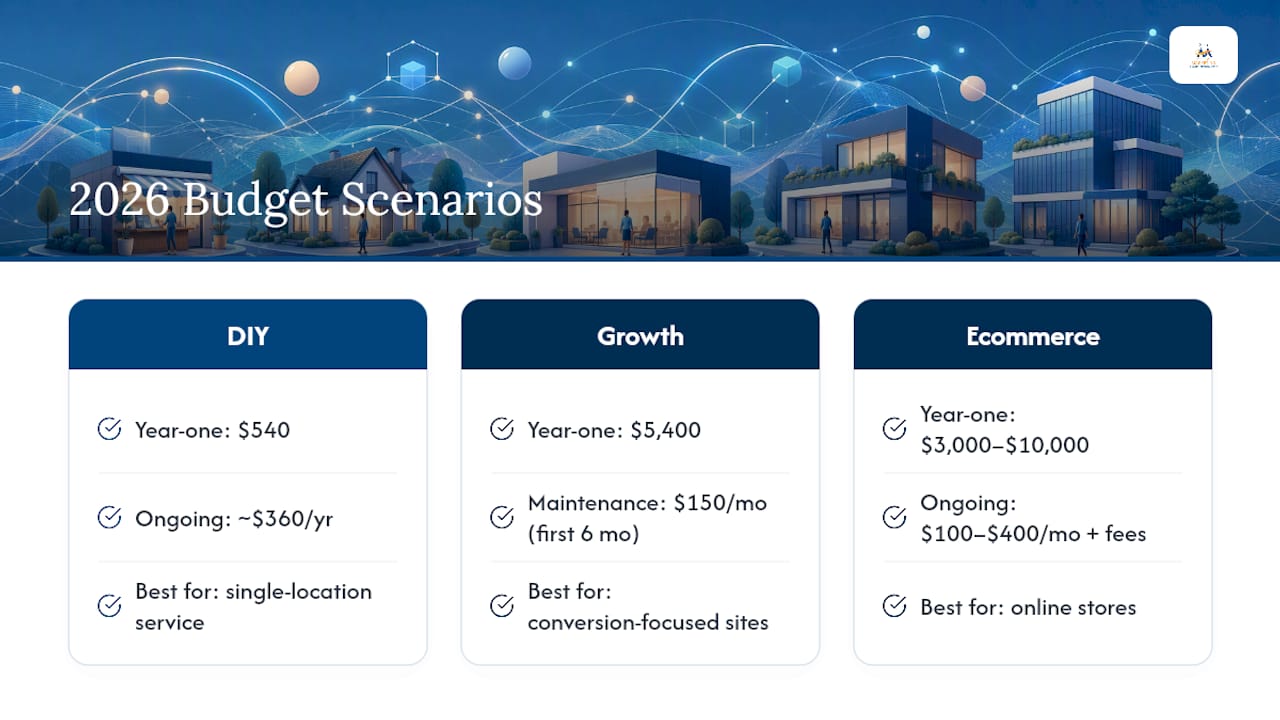
Growth-focused (freelancer or offshore): A $4,500 custom freelancer build, plus $150 monthly maintenance for the first six months, totals around $5,400 in year one. This budget typically buys conversion-focused layout and basic analytics tracking.
Ecommerce: Shopify plans start around $39 a month plus transaction fees, while a WooCommerce build on WordPress needs hosting, an SSL certificate, and paid extensions for shipping and tax. Either route commonly lands between $3,000 and $10,000 upfront, with $100 to $400 monthly in app and hosting fees.
Where the Extra Investment Actually Pays Off
Higher-budget builds aren't just prettier. They're structured around conversion design: clear calls to action, forms placed where visitors actually look, and page speed tuned for mobile visitors who abandon slow pages within seconds.
A barebones template site and a conversion-focused build can drive very different lead volumes from identical traffic. The difference usually isn't visual polish. It's strategy: where the phone number sits, how many fields the contact form asks for, and whether the site tracks which pages actually generate calls. Managed maintenance plans that include proactive monitoring reduce the risk of a costly breach eating into that investment months later.
Why the Cheapest Quote Is Rarely the Real Number
Most small business owners budget for the build and forget the five years after it. That's backward. The build is a fraction of what you'll spend keeping a site secure, current, and actually generating leads.
The conventional advice, "get three quotes and pick the middle one," misses the real variable: architecture. A $6,000 WordPress site that costs $6,000 a year to maintain is a worse deal over five years than an $8,000 static build that costs $1,000 a year to run. Nobody asks vendors about five-year maintenance math, and vendors rarely volunteer it.
Prioritize the vendor who can explain their maintenance model in plain terms before you sign anything. If a $2,000 discount on the build comes with a vague answer about "ongoing support," that discount is an illusion. The real cost of a small business website is the maintenance line item, not the invoice you get on launch day.
— Diane O'Brien
Get a Website Built Around Leads, Not Just Looks
A template site tells visitors you exist. A conversion-focused build tells them to call, book, or buy, and that's the gap most freelancer and offshore quotes never close. Digital Marketing All builds small business websites around measurable outcomes: lead capture placement, mobile page speed, and ongoing review generation and management that keeps your reputation compounding after launch.
Engagements run as either a fixed-price project for the build or a monthly retainer for ongoing optimization and maintenance, and Digital Marketing All works with budgets across the freelancer-to-agency range covered above. To get an accurate quote, pull together your current analytics (if you have a site already), a short list of business goals for the next twelve months, and two or three example sites whose design or functionality you like. Reach out through Digital Marketing All to start that conversation and get a scope built around your actual numbers, not a generic package.
Sources
Check current hosting and app cost benchmarks and run your project through a quote calculator before finalizing your budget, adjusting for US labor rates and your specific scope.
- Small Business Website Cost 2026: $1,499–$15,000 (USA Guide)
- How much a website costs (Forbes Advisor)
- Small Business Website Cost 2026 — Real Pricing Data
FAQ
How Much Should I Pay for a Small Business Website?
Budget $1,500 to $8,000 for a freelancer build or $8,000 to $25,000 for a US agency build, plus $50 to $300 a month for maintenance. The right number depends on whether you need a simple brochure site or a lead-generation system with conversion design built in.
Is $1,500 a Good Price for a Website?
It's reasonable for a template-based freelancer build with light customization, but it's on the low end for a fully custom site with strategy and conversion optimization included. At that price, confirm exactly what's included before signing.
Do I Need an LLC to Run a Website?
No, an LLC is not required to own or operate a business website. It's a business structure decision separate from web development, though many small business owners form one for liability protection and tax purposes regardless of their website plans.
How Much Does a Website Cost in the USA?
Costs range from $200 a year for DIY builders to $25,000 or more for a full custom agency build, with most small businesses landing between $1,500 and $8,000 upfront plus $50 to $300 monthly in maintenance. Ecommerce sites typically cost more on both ends.