

Most U.S. small and mid-sized businesses should budget a typical monthly amount for social media management in 2026, according to current market data. The full realistic range runs from $500/month for a part-time freelancer up to $25,000+/month for a full-service enterprise program. Here is the one-line rule: if your time is worth more than a moderate hourly rate, outsourcing almost always beats building in-house at the entry and growth tiers.
Quick benchmarks to anchor your budget:
- Freelancer/entry: $300–$1,500/month, 2–5 posts/week, one or two platforms
- Boutique agency retainer: $1,500–$4,000/month, multi-platform, light strategy
- Growth/mid-agency retainer: $4,000–$10,000/month, original content, paid social, reporting
Start by picking the tier that matches your current revenue from social, then run the break-even calculation in Section 6 before you sign anything.
Key Takeaways
Most U.S. SMBs should budget $1,000–$3,000/month for social media management, with the biggest cost drivers being content format (especially video), platform count, and the seniority of the team managing the account.
| Point | Details |
|---|---|
| Realistic monthly range | Most SMBs pay $1,000–$3,000/month; comprehensive programs start around $5,000/month. |
| Biggest cost driver | Video content and platform count push costs up faster than posting frequency alone. |
| In-house vs. agency | A fully loaded in-house hire costs $6,000–$8,000/month, making agencies cost-effective below that threshold. |
| Top red flag | Vague deliverables and no named account manager are the clearest signs to walk away from a proposal. |
| Digital Marketing All | Offers tiered SMB programs with transparent scoping, AI-assisted production, and a free 30-minute consult to match your budget to a realistic scope. |
Table of Contents
- What does social media management actually include?
- What are the real social media management pricing tiers in 2026?
- What factors push your social media costs up or down?
- How do agencies structure their fees?
- Agency retainer vs. in-house hire: which costs less?
- What questions should you ask before signing with an agency?
- How Digital Marketing All approaches social media pricing
- How does location affect what you pay for social media management?
- An agency-side perspective on common budget mistakes
- Ready to get a scoped quote from Digital Marketing All?
- Sources
- FAQ
What does social media management actually include?
Buyers often compare prices without comparing scopes, which is where budget surprises come from. Social media management covers several distinct service buckets, and providers rarely include all of them at every price point.
Core service buckets:
- Strategy: Audience research, platform selection, content calendar, competitive analysis
- Content creation: Copywriting, graphic design, short-form video scripting and editing
- Publishing and scheduling: Platform posting, optimal timing, cross-platform coordination
- Community management: Comment replies, DM responses, review monitoring
- Paid social management: Ad setup, audience targeting, A/B testing, budget pacing
- Reporting and analytics: Monthly or weekly performance dashboards, KPI tracking
- Creative production: Photography direction, video production, branded asset libraries
A scope of five posts per week across two platforms typically requires 15–25 hours of labor per month when you count strategy, creation, approval rounds, and publishing. Add paid social and that number climbs fast.
Several items are commonly billed as add-ons rather than included in a base retainer: short-form video production, influencer coordination fees, social listening tools, crisis communications support, and ad spend itself (which is almost always a pass-through on top of the management fee).
Pro Tip: Most buyers forget to ask about revision rounds. Each approval cycle on a content calendar adds 1–3 hours of labor per month. If your brand requires legal or compliance review on every post, factor in at least one additional revision pass per platform per week, which can add $200–$500/month to your effective cost.
Platform API and seat fees are another hidden line item. Enterprise scheduling tools run $79–$199 per user per month, and those costs either get absorbed into your retainer or passed through separately. Always ask which tools are included and who pays for the seats.
What are the real social media management pricing tiers in 2026?
A basic program starts at a few hundred to a few thousand dollars per month; a comprehensive one commonly begins at several thousand per month once content, paid social, and platform fees are included. Here is how those numbers break down by tier.
Freelancer / entry tier: typically low to mid thousands per month
Best for local businesses, solopreneurs, and brands testing social for the first time. You get consistent posting on one or two platforms, basic graphics, and light engagement. Strategy is minimal. Onboarding is typically informal, with no setup fee, and work can start within a week. The tradeoff: limited bandwidth, no backup if the freelancer is unavailable, and little to no paid social expertise.
Boutique / small agency: typically mid range thousands per month
This tier suits regional businesses and service providers who need a consistent brand voice across two to four platforms. Deliverables typically include 3–5 posts per week, a monthly content calendar, basic analytics, and some community management. Onboarding fees of $500–$1,500 are common, with a 3-month minimum contract. A local restaurant group or regional retailer fits well here.
Growth / mid-agency: typically mid to high thousands per month
At this level, you get a dedicated account manager, original short-form video, paid social management, and monthly strategy reviews. Reporting moves from vanity metrics to conversion tracking. Setup fees run $1,500–$3,000, contracts are typically 6 months, and the team usually includes a strategist, a content creator, and a media buyer. A regional brand scaling to national awareness or a B2B company generating leads through LinkedIn belongs in this tier.
Full-service / enterprise: $10,000–$25,000+/month
Published agency ranges show enterprise bands at $25,000+/month. These are driven by senior strategy, multi-market execution, influencer programs, and real-time community management. National mid-market brands and companies running always-on paid social campaigns at scale operate here. Onboarding can take 4–8 weeks and cost $3,000–$10,000.
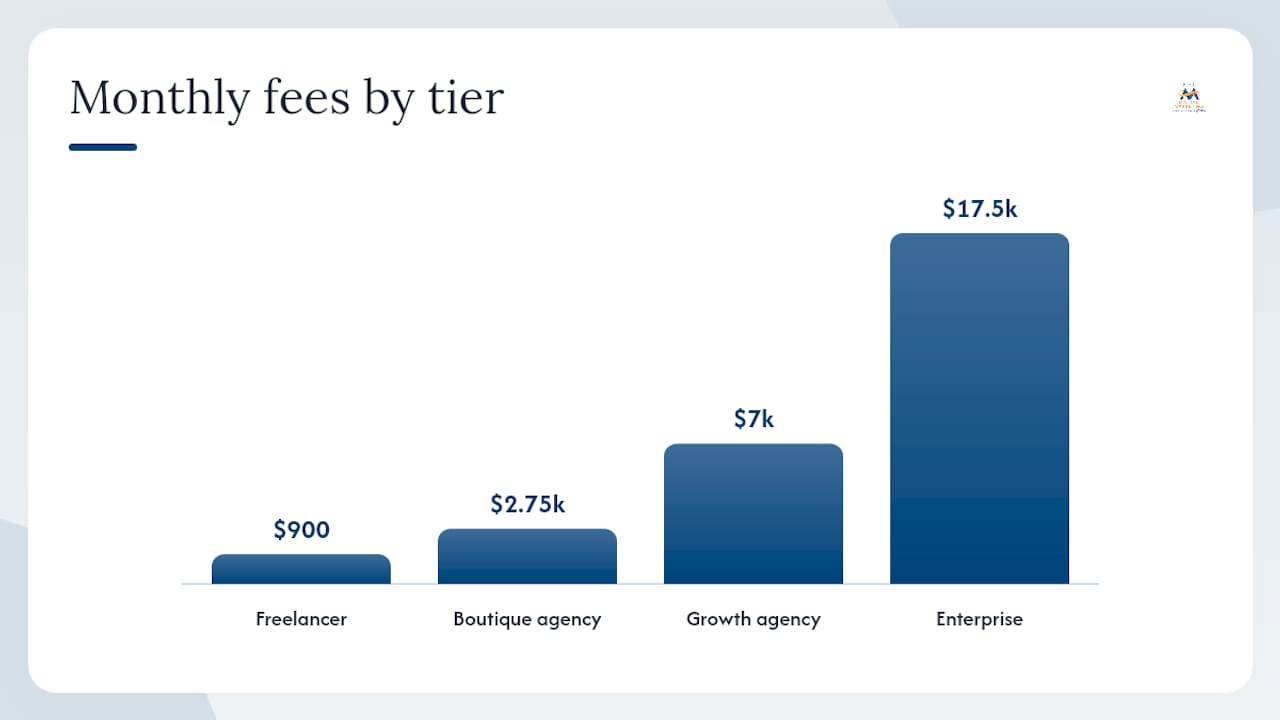
| Tier | Monthly Fee | Hourly Equivalent | Best For | Posts/Week | Paid Social | Reporting |
|---|---|---|---|---|---|---|
| Freelancer | $300–$1,500 | $25–$75 | Local/solo businesses | 2–5 | Rarely included | Basic |
| Boutique agency | $1,500–$4,000 | $75–$125 | Regional SMBs | 3–5 | Optional add-on | Monthly |
| Growth agency | $4,000–$10,000 | $100–$150 | Scaling brands | 5–10 | Included | Weekly |
| Enterprise | $10,000–$25,000+ | $150–$300+ | National/multi-market | 10+ | Full management | Real-time |
What factors push your social media costs up or down?
Price differences between proposals at the same tier almost always trace back to a handful of specific drivers. Knowing them lets you negotiate scope rather than just price.
- Platform count (High impact): Each additional platform adds 5–10 hours of monthly labor. Going from two platforms to four can increase your retainer by 30–50%.
- Content format (High impact): Video-first strategies are the single biggest driver of per-post cost escalation because production hours, editing, and creator fees compound quickly. A static graphic post might cost $50–$150 to produce; a polished 60-second Reel can run $300–$800.
- Posting frequency (Medium impact): Moving from 3 posts/week to 7 posts/week does not double your cost, but it typically adds 20–35% to the retainer.
- Paid social management (High impact): Ad management fees are usually 10–20% of monthly ad spend, with a minimum floor of $500–$1,000/month. A $5,000/month ad budget adds $500–$1,000 in management fees on top of your retainer.
- Community volume and response SLA (Medium impact): Brands with high comment and DM volume, or those requiring same-day responses, need dedicated community management hours. High-volume accounts can add $500–$2,000/month.
- Geographic or multi-market needs (Medium impact): Localized content for multiple cities or regions multiplies creative production. Each additional market typically adds $500–$1,500/month.
- Required staff seniority (High impact): A junior coordinator costs far less per hour than a senior strategist. The difference between a $2,000/month and a $6,000/month retainer is usually the seniority of who owns your account.
Hidden recurring costs to budget for: tool seats ($79–$199/user/month for enterprise platforms), social listening subscriptions ($100–$500/month), creator or influencer fees (negotiated separately), and ad spend pass-throughs. Platform compliance requirements can also introduce integration overhead or require specialized tooling, particularly for regulated industries.
How do agencies structure their fees?
Understanding the billing model matters as much as the dollar amount. Two proposals at $3,000/month can represent very different risk profiles depending on how that fee is structured.
Monthly retainer is the most common model for ongoing social media management. You pay a fixed fee for a defined scope of work each month.
- Pros: Predictable budgeting, aligned incentives for long-term results, easier to plan content calendars
- Cons: Scope creep is common if deliverables are not clearly defined; you pay the same even in slow months
Hourly / consulting works well for audits, strategy sessions, or short-term projects.
- Pros: Pay only for what you use; good for one-time needs
- Cons: Hard to budget; costs can escalate if the project expands
Per-post or per-asset pricing is common with freelancers and content-only providers.
- Pros: Transparent cost per deliverable; easy to scale up or down
- Cons: No strategic continuity; quality can vary post-to-post
Project-based fees cover defined deliverables like a campaign launch or a brand refresh.
- Pros: Clear scope and end date; good for one-time initiatives
- Cons: Ongoing management is not included; requires a new agreement for each project
Performance-based add-ons tie a portion of the fee to results (follower growth, lead volume, ROAS).
- Pros: Aligns agency incentives with your goals
- Cons: Can incentivize short-term tactics over brand health; hard to attribute cleanly
Contract terms to watch before you sign:
- Minimum term: Most agencies require 3–6 months. Enterprise programs often require 12 months.
- Onboarding fee: Typically $500–$3,000, billed at signing. Ask whether it is refundable if you cancel early.
- Notice period: Standard is 30–60 days written notice to cancel after the minimum term.
- Scope change clauses: Confirm whether adding a platform or increasing post frequency triggers a new rate card or a mid-contract amendment.
- Ad spend ownership: Clarify who owns the ad accounts and what happens to campaign data if you leave.
Agencies that publish transparent tiered pricing and onboarding fees reduce negotiation time and set clearer ROI expectations from day one.
Agency retainer vs. in-house hire: which costs less?
The fully loaded monthly cost of an in-house social media manager runs approximately $6,000–$8,000/month when you account for salary, benefits, tools, and equipment, according to current hiring benchmarks.
Break-even example: If a growth-tier agency retainer costs $6,000/month and a fully loaded in-house hire costs $7,000/month, the agency is cheaper until your social program requires more than one full-time person's capacity. At that point, a hybrid model (one in-house strategist plus an agency for production) often wins on both cost and quality.
Decision rules:
- If social media drives more than 25% of your leads or revenue, consider an in-house strategist supported by a production agency.
- If you need more than three platforms managed actively, an agency team typically outperforms a single in-house hire on output volume.
- If you are below $50,000/year in social-attributable revenue, a boutique agency or freelancer almost always delivers better ROI than a full-time hire.
- If brand voice consistency is your top concern, an in-house hire with agency production support is worth the premium.
Check whether your social media strategy is actually producing results before committing to either model. Spending more on management without a clear attribution framework is the most common budget mistake at this decision point.
What questions should you ask before signing with an agency?
A good discovery call takes 30 minutes and tells you most of what you need to know. Use this checklist and the scripted questions below to vet any proposal consistently.
Evaluation checklist:
- Do their case studies show results for businesses in your industry and revenue range?
- Can they name the specific person who will manage your account day-to-day?
- Do they provide a written content calendar with approval deadlines?
- Is reporting tied to business outcomes (leads, revenue, traffic) or just engagement metrics?
- Do they have verifiable third-party reviews? Check profiles on platforms like Clutch for client feedback and case studies.
- Are they a verified Google Partner, and can they show local office presence or a verified business listing?
Exact questions to ask on the call:
- "Who specifically will write and approve our content, and what is their background?"
- "Walk me through what happens in the first 30 days after we sign."
- "How do you handle a post that gets negative comments or a PR issue?"
- "What does your reporting look like, and how often will we meet to review it?"
- "If we want to add a platform or increase frequency mid-contract, how is that priced?"
- "What happens to our ad accounts and content assets if we cancel?"
Red flags to walk away from:
- Vague deliverables ("we'll post regularly" with no defined frequency or platform list)
- No onboarding process or timeline provided
- Reporting limited to follower counts and likes with no conversion tracking
- Pressure to sign a 12-month contract before seeing a sample content calendar
- No named account manager, only a "team" with no individual accountability
How Digital Marketing All approaches social media pricing
At Digital Marketing All, pricing is built around three variables: the number of active platforms, the content format mix (static vs. video), and the seniority level required for your goals. That means no two scopes are identical, and every engagement starts with a strategy session before a dollar amount is set.
Sample SMB package outline:
- Onboarding: Brand audit, competitor analysis, platform strategy, content pillar development (2–3 weeks)
- Strategy: Monthly content calendar, audience targeting review, KPI alignment
- Production: Copywriting, graphic design, short-form video scripting and editing
- Approvals: Two-round review cycle with a shared content calendar tool
- Publishing: Scheduled posting with platform-native optimization
- Reporting: Monthly performance dashboard tied to traffic, leads, and engagement
Pricing reflects who does the work. Entry-level scopes are handled by trained specialists; growth and enterprise programs include a senior strategist who owns your account and attends monthly reviews. You are not paying for post volume. You are paying for the thinking behind each post and the accountability for results.
That is how we maintain quality at SMB-friendly price points.*
Our social media content workflow is designed for SMBs that need professional output without enterprise overhead. If you want to see what a realistic scope looks like for your business size and goals, a scoping call takes 30 minutes and produces a written deliverables outline at no cost.
How does location affect what you pay for social media management?
Geography moves the needle on social media management cost in two ways: labor market rates and local market competition among agencies.
A boutique agency scope that costs $2,500/month in a mid-size market like Columbus or Nashville can easily run $3,500–$4,000/month from a comparable firm in Manhattan. Senior strategist hourly rates in coastal metros often start at $150–$200/hour versus $75–$125/hour in smaller markets.
Remote-first agencies have compressed this gap significantly. Many SMBs now work with agencies headquartered in lower-cost markets and pay mid-tier rates for senior talent that would cost enterprise rates locally.
Multilingual or multi-market content adds cost regardless of location.
An agency-side perspective on common budget mistakes
The most common mistake I see SMBs make is treating social media management as a commodity purchase. They collect three proposals, sort by price, and pick the cheapest one. Six months later, they are back in the market because the low-cost provider posted generic content that generated zero leads and the relationship ended with a dispute over what "regular posting" meant.
A regional home services company once came to us after spending $800/month for a year with a freelancer. The account had 400 followers, no content calendar, and no reporting. The fix was not spending more money. It was defining two platforms, setting a 3-post-per-week cadence, and tying every post to a service category with a clear call to action. Within 90 days, inbound form submissions from social doubled, at a retainer of $1,800/month. The extra $1,000/month paid for itself in the first month.
Top three budget mistakes and their fixes:
- Paying for platforms you do not need. Most SMBs get better results from two platforms done well than five platforms done poorly. Cut scope before cutting quality.
- Skipping the strategy layer to save money. A $1,200/month posting-only retainer with no strategy produces content that looks fine and performs poorly. Allocate at least 20% of your budget to strategy and reporting.
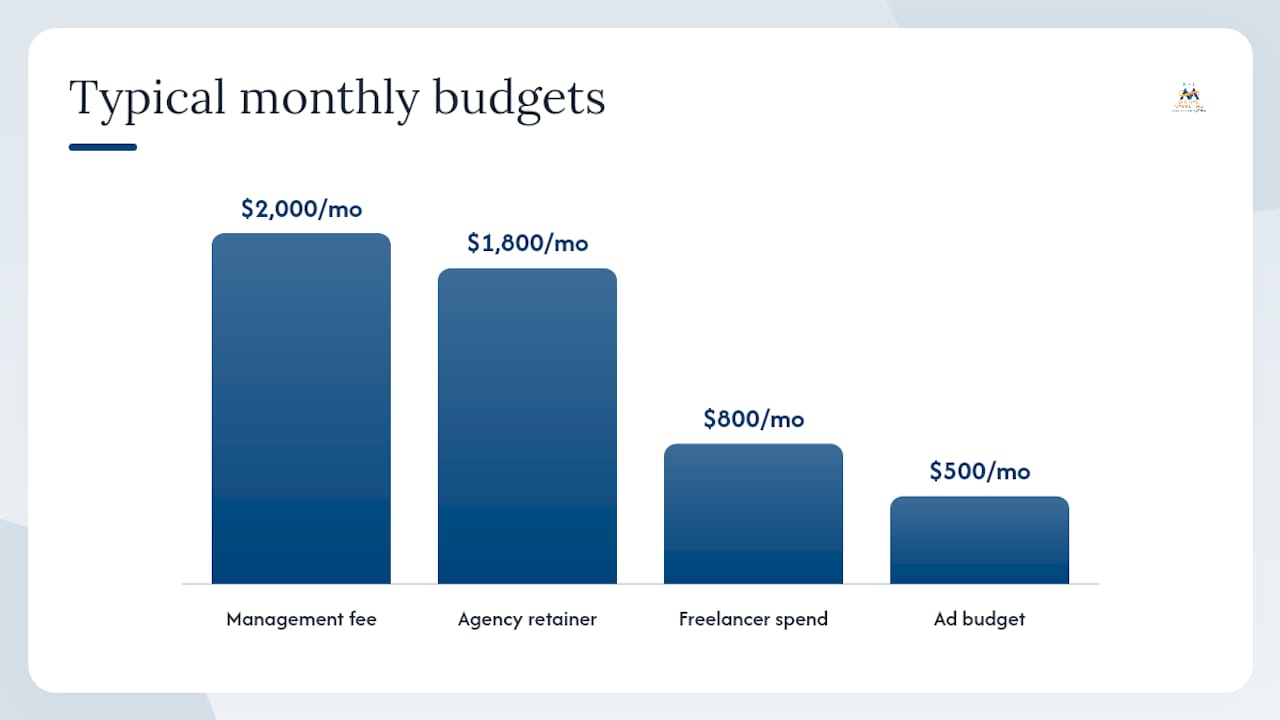
- Ignoring the paid social component. Organic reach on most platforms is limited without ad support. A $500/month ad budget paired with a $2,000/month management fee will outperform a $2,500/month organic-only program on almost every measurable outcome.
Pro Tip: Ask your agency for a 90-day content performance review at the 60-day mark. Reviewing what is working before the quarter ends lets you reallocate budget toward high-performing content types before you have wasted a full cycle on formats that are not converting.
Ready to get a scoped quote from Digital Marketing All?
Digital Marketing All offers social media management programs built specifically for SMBs that need professional execution without a six-figure annual commitment. Here is what each program level covers:
- SMB Starter: Two platforms, 3 posts/week, monthly reporting, community management. Best for local businesses building a consistent presence.
- Growth Program: Three to four platforms, 5–7 posts/week, short-form video, paid social management, bi-weekly strategy reviews. Best for brands actively generating leads through social.
- Enterprise-Ready: Full-platform management, original video, influencer coordination, real-time reporting. Best for national or multi-location businesses.
An initial scoping call takes 30 minutes. You will leave with a written deliverables outline, a realistic monthly range for your goals, and a clear picture of who will manage your account. There is no obligation to sign, and no generic pitch deck.
Get your free scoping call and see what a professionally managed social program looks like for your business size and budget.
Sources
- Social Media Management Pricing 2026: Real Costs by Tier
- How Much Does a Social Media Manager Cost in 2026?
- Cost in 2026? (Tools, Freelancers, Agencies)
- Social Media Management Pricing for Businesses In 2026 | Sprout Social
- Social Media Management Pricing 2026
FAQ
How much does social media management cost per month in the U.S.?
Most businesses pay $1,000–$3,000/month, with the full range running $500–$25,000+ depending on scope, platform count, and whether paid social is included.
What is the difference between a freelancer and an agency for social media?
Freelancers typically charge $300–$1,500/month and handle one or two platforms with limited strategy; agencies run $1,000–$25,000+/month and provide a team, strategic oversight, and more consistent output.
Is it cheaper to hire in-house than to use an agency?
Not at the SMB level. A fully loaded in-house social media manager costs approximately $6,000–$8,000/month once salary, benefits, and tools are included, which exceeds most boutique and growth-tier agency retainers.
What should a social media management contract include?
Look for a defined posting frequency, named account manager, reporting cadence tied to business outcomes, a clear onboarding timeline, and explicit terms for cancellation notice (typically 30–60 days) and scope changes.
How do I know if I am paying too much for social media management?
If your reporting covers only follower counts and likes with no conversion or traffic data, and you cannot name who owns your account strategy, you are likely overpaying for the results you are getting regardless of the dollar amount.