

Small business owners pour hours into social media posts that barely get noticed. You create content, hit publish, and wait for engagement that never comes. Meanwhile, competitors seem to effortlessly attract followers and convert them into customers. The gap between effort and results feels insurmountable. AI-driven social media strategies can bridge this divide, cutting content creation time while dramatically improving engagement and return on investment for small to medium-sized businesses.
Table of Contents
- Key Takeaways
- What you need: essential tools and prerequisites for AI-powered social media marketing
- Step-by-step execution: crafting and optimizing your AI-driven social media campaigns
- Avoiding pitfalls: common mistakes and ethical considerations when using AI for social media
- Measuring success: tracking and verifying your social media marketing performance
- Explore professional marketing services to amplify your social media success
- Frequently asked questions
Key Takeaways
| Point | Details |
|---|---|
| AI saves time | AI tools reduce content production time by 60 percent and boost engagement by 40 percent. |
| Platform focus limited | Focusing on a small number of platforms where your customers are active yields higher ROI. |
| Paid organic balance | Most SMBs allocate about sixty to seventy percent to organic and thirty to forty percent to paid promotion to balance authenticity with growth. |
| Audience targeting precision | Define detailed buyer personas and use AI insights to sharpen targeting and content relevance. |
What you need: essential tools and prerequisites for AI-powered social media marketing
Before launching AI-enhanced campaigns, you need the right foundation. Success starts with selecting tools that match your business goals and capacity. The technology exists to transform your social presence, but only when paired with strategic planning.

Start by evaluating AI content creation platforms. Tools like ChatGPT, Jasper, or Copy.ai can generate post ideas, captions, and even full articles. AI tools reduce content production time by 60% and increase engagement by 40% for social channels. Scheduling platforms such as Buffer, Hootsuite, or Later integrate AI suggestions with calendar management. These systems analyze optimal posting times and suggest content variations based on past performance.
Platform selection matters more than spreading yourself thin. SMB benchmarks show focusing on 2-3 platforms like Facebook and Instagram delivers ROI between 150-229%. Choose channels where your customers actively engage, not where you think you should be. A plumbing company might thrive on Facebook and YouTube, while a design agency could dominate Instagram and Pinterest.
Establish clear, measurable goals before creating a single post. Vague objectives like "increase awareness" lead nowhere. Instead, target specific metrics: gain 500 followers in 90 days, generate 50 leads monthly, or achieve 5% engagement rate. Track cost per click, conversion rate, and customer acquisition cost. These numbers reveal what works and what wastes money.
Balance paid and organic strategies from day one. Organic content builds community and trust over time. Paid campaigns deliver immediate visibility and precise targeting. Most successful SMBs allocate 60-70% of effort to organic relationship building and 30-40% to strategic paid promotion. This mix maintains authenticity while accelerating growth.
Essential tool categories:
- Content creation AI (ChatGPT, Jasper, Copy.ai)
- Scheduling and analytics platforms (Buffer, Hootsuite, Later)
- Visual design tools (Canva, Adobe Express)
- Performance tracking dashboards (native platform analytics, Google Analytics)
| Tool Type | Primary Function | Typical Monthly Cost |
|---|---|---|
| AI content generator | Post ideas, captions, articles | $20-$80 |
| Scheduling platform | Publishing, analytics, team collaboration | $15-$100 |
| Design software | Graphics, videos, templates | $0-$55 |
| Analytics suite | Performance tracking, reporting | $0-$150 |
Pro Tip: Start with free tiers of multiple tools before committing to paid plans. Test which platforms actually save you time versus adding complexity. Many best AI tools for business offer robust free versions that handle SMB needs perfectly.
Step-by-step execution: crafting and optimizing your AI-driven social media campaigns
Executing effective campaigns requires systematic planning and continuous optimization. Follow this framework to launch campaigns that convert browsers into buyers.
1. Define your audience with precision. Create detailed customer personas including demographics, pain points, and social media habits. Use AI tools to analyze competitor audiences and identify content gaps. The more specific your targeting, the better your AI recommendations become.
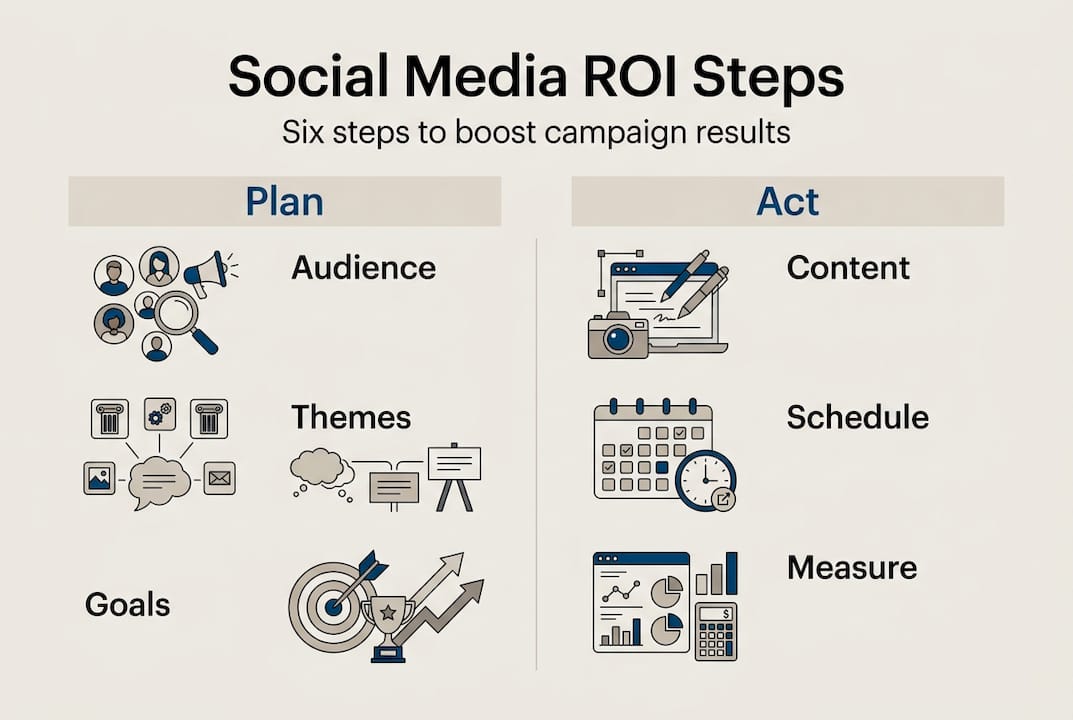
2. Generate content themes using AI assistance. Input your business goals, audience insights, and brand voice into your AI tool. Request 30-day content calendars organized by theme: educational posts, customer stories, product highlights, and engagement questions. Review and customize every AI suggestion to maintain your authentic voice.
3. Personalize ad targeting with AI optimization. Upload customer lists to Facebook or Instagram. Let AI lookalike modeling find similar high-value prospects. AI-optimized ads improve ROI by 32% to 6.8x across B2B and B2C campaigns. Start with small budgets, test multiple ad variations, and scale winners.
4. Schedule strategically based on engagement data. AI scheduling tools identify when your audience is most active. Post during these windows for maximum organic reach. Avoid posting just to maintain frequency. Quality and timing beat quantity every time.
5. Monitor performance and iterate rapidly. Check metrics daily during the first month. Identify top performing content types and double down. Eliminate underperformers without hesitation. AI analytics reveal patterns humans miss, but you must act on insights.
6. Engage authentically with your community. AI can draft responses, but you must add personal touches. Reply to comments within hours, not days. Ask questions that spark conversations. Brands using social media have 2.8x higher engagement leading to 157% higher ROI when they prioritize genuine interaction.
| Strategy Type | Best For | Expected Timeline | Typical ROI |
|---|---|---|---|
| Organic content | Brand building, community engagement | 3-6 months | 150-200% |
| Paid social ads | Lead generation, product launches | 1-2 weeks | 250-680% |
| Influencer partnerships | Credibility, reach expansion | 1-3 months | 180-320% |
| User-generated content | Trust building, social proof | 2-4 months | 200-400% |
Organic strategies build sustainable growth. They cost time instead of money and create loyal communities. Paid campaigns deliver fast results and precise targeting but require ongoing investment. LinkedIn generates B2B lead ROI of 4.1x, making it ideal for service businesses. Instagram and Facebook excel for visual products and local services.
Pro Tip: Create a swipe file of your best performing posts. Feed these examples to your AI tool with instructions to generate similar content. This trains the AI on your proven winners while maintaining consistency. Learn more AI marketing secrets to refine your approach. Understanding paid social media advertising dynamics helps you allocate budget effectively.
Avoiding pitfalls: common mistakes and ethical considerations when using AI for social media
AI accelerates results but introduces risks that can damage your reputation overnight. Understanding these dangers protects your brand while maximizing AI benefits.
Full automation strips away authenticity. When every post comes from AI without human review, your content becomes generic and forgettable. AI lacks emotional intelligence and misreads sarcasm and cultural nuances. Over-reliance erodes trust as audiences detect the robotic tone. Platforms increasingly penalize engagement bait and generic AI content through reduced organic reach.
Cultural misreads create embarrassing mistakes. AI trained primarily on English language data struggles with idioms, regional humor, and cultural sensitivities. A joke that works in one market can offend in another. Always review AI-generated content through the lens of your specific audience's values and communication style.
Engagement bait tactics backfire spectacularly. Asking followers to "comment below" or "tag a friend" might seem harmless, but platforms now actively suppress these posts. The short-term boost in metrics leads to long-term visibility penalties. Focus on genuine value instead of manipulation.
"Experimental studies demonstrate that while AI increases content volume, it simultaneously decreases perceived quality and authenticity, creating negative spillover effects that harm overall brand perception." Research shows this quality perception gap persists even when AI content is objectively accurate.
Biased content damages credibility. AI models reflect biases present in training data. Review generated content for stereotypes, exclusionary language, or assumptions about your audience. A single insensitive post can undo months of community building.
Transparency builds trust. Disclose AI use when appropriate, especially for customer service interactions. People appreciate honesty about automation while expecting human oversight for important decisions. Strike a balance between efficiency and personal connection.
Critical mistakes to avoid:
- Publishing AI content without human review and customization
- Using engagement bait tactics that platforms penalize
- Ignoring cultural context and audience-specific sensitivities
- Failing to disclose AI use in customer interactions
- Relying on AI for crisis management or sensitive communications
- Copying competitor content through AI without adding unique value
Maintain your brand voice by creating detailed AI prompts. Specify tone, vocabulary, sentence structure, and topics to avoid. The more guidance you provide, the better AI matches your authentic style. Review every piece before publishing. Edit ruthlessly to inject personality and remove generic phrasing. Your audience follows you for your perspective, not a robot's interpretation of your industry. Understanding AI content quality issues helps you maintain standards that protect your reputation.
Measuring success: tracking and verifying your social media marketing performance
Numbers reveal truth. Without measurement, you're guessing whether your efforts deliver results or waste resources. Establish tracking systems before launching campaigns.
Track engagement metrics first. Monitor likes, comments, shares, and saves across all platforms. These indicators show whether content resonates with your audience. Calculate engagement rate by dividing total interactions by follower count. Rates above 3% indicate strong content performance. Below 1% signals a need for strategy adjustment.
Conversion tracking connects social activity to business outcomes. Install platform pixels on your website to track visitors from social channels. Measure lead form submissions, phone calls, and purchases attributed to social media. Average social media ROI is $5.78 per $1 spent, with B2B achieving 3.2x and B2C reaching 6.1x returns.
Cost metrics prevent budget waste. Calculate cost per click, cost per lead, and customer acquisition cost for paid campaigns. Compare these numbers against customer lifetime value. If acquiring a customer costs $50 but they spend $500 over two years, you have a winning formula. If acquisition costs exceed customer value, pause campaigns and refine targeting.
Performance tracking workflow:
- Set up native analytics dashboards on each social platform
- Install tracking pixels on your website for conversion attribution
- Create a weekly reporting schedule to review key metrics
- Identify top and bottom performing content each month
- Adjust strategy based on data patterns, not assumptions
- Test new approaches in controlled experiments with clear success criteria
| Metric Category | Key Indicators | Healthy Benchmark | Action Threshold |
|---|---|---|---|
| Engagement | Likes, comments, shares, saves | 3-5% rate | Below 1% requires content revision |
| Reach | Impressions, unique viewers | 15-20% of followers | Below 10% signals algorithm issues |
| Conversion | Leads, sales, sign-ups | 1.2-2.5% paid, 2-4% organic | Below 1% needs targeting review |
| Cost efficiency | CPC, CPL, CAC | $0.50-$2 CPC, $10-$50 CPL | Above $3 CPC requires optimization |
AI analytics tools aggregate data across platforms into single dashboards. They identify trends, predict performance, and suggest optimizations. Tools like Sprout Social, Agorapulse, or HubSpot combine AI insights with human-friendly reporting. Use these platforms to spot patterns you might miss reviewing individual platform analytics.
Adapt quickly based on results. If video content consistently outperforms images, shift resources toward video production. When certain posting times generate higher engagement, concentrate your schedule around those windows. Data-driven decisions remove guesswork and compound results over time. Regular evaluation through assessing social media strategy frameworks keeps you focused on what works. Understanding SEO vs social media strategies helps you allocate resources across channels effectively.
Explore professional marketing services to amplify your social media success
Implementing these strategies requires time and expertise many small business owners lack. Professional marketing services accelerate results while you focus on running your business. Digital Marketing All specializes in AI-powered strategies that boost online visibility and drive measurable growth for SMBs.
Social media success connects directly to reputation management. Positive reviews amplify social credibility and conversion rates. Our review generation and management services systematically build your online reputation across platforms. When prospects research your business after seeing social content, strong reviews close the sale.
Your website serves as the foundation for all digital marketing. Social campaigns drive traffic, but your site must convert visitors into customers. Explore our professional website services designed for conversion optimization. For businesses testing markets or needing immediate online presence, our website rental services provide professional sites without large upfront investment. These solutions integrate seamlessly with social strategies to maximize return on every marketing dollar.
Frequently asked questions
What are the best social media platforms for small businesses?
Focus on 2-3 platforms like Facebook and Instagram, which deliver ROI between 150-229% for SMBs. Choose channels where your target customers actively spend time rather than spreading efforts across every network. A local restaurant thrives on Facebook and Instagram, while a B2B consultant might prioritize LinkedIn and Twitter.
How can AI improve my social media marketing campaigns?
AI tools reduce content production time by 60% and increase engagement by 40% through data-driven personalization. They analyze audience behavior patterns to suggest optimal posting times, generate content variations for testing, and automate repetitive tasks like scheduling. This efficiency lets you focus on strategy and genuine audience interaction rather than administrative work.
What are common mistakes when using AI in social media marketing?
Avoid full automation and generic AI content that lacks authentic brand voice. Over-reliance on AI erodes trust and causes misreads of tone and cultural context. Platforms penalize engagement bait tactics like "tag a friend" or "comment below" with reduced organic reach. Always review and customize AI-generated content before publishing to maintain authenticity.
How long does it take to see results from social media marketing?
Organic strategies typically show meaningful engagement improvements within 3-6 months of consistent posting. Paid campaigns can generate leads within 1-2 weeks when properly targeted. The timeline depends on your industry competitiveness, content quality, and posting frequency. Building a loyal community requires patience, while paid advertising delivers faster but less sustainable results without ongoing investment.
What budget should small businesses allocate to social media marketing?
Start with $500-$1000 monthly for combined organic and paid efforts. Allocate 60-70% to content creation and community management, with 30-40% for strategic paid promotion. As you identify winning campaigns, scale budgets proportionally. Track cost per acquisition closely to ensure spending aligns with customer lifetime value and business profitability goals.
Recommended
- Social Media SEO: Boost Local Business Visibility & Rankings
- Social Media vs. Google: Where Should Local Businesses Focus Their Efforts?
- Website conversion optimization guide for SMBs in 2026
- Is Your Social Media Strategy Actually Working?
- Lokale Suchmaschinenoptimierung 2026: 73% mehr Sichtbarkeit - Hyped Performance Marketing Agentur
- Gestión reputación online pymes: 90% clientes leen reseñas - YellowRock Marketing: Posicionamiento Local TOP 3 en Google