

Reputation management pricing in the U.S. breaks into four clear bands: DIY software runs $0 to $300 a month, small-business managed services land between $500 and $3,000 a month, advanced ORM and mid-market programs cost $3,000 to $10,000 a month, and enterprise or active crisis work starts at $10,000 a month and can climb into $10,000 to $50,000+ project territory. If your Google rating sits above 4.0 and you have no active PR fires, software alone often does the job. If you're fielding fake reviews, a viral complaint, or negative search results tied to your brand name, you need a managed service or a crisis-tier engagement.
Most contracts follow either a monthly retainer or a fixed-scope project fee, and confusing the two is the single most common budgeting mistake business owners make.
Quick reference:
- Software/DIY: $0–$300/month
- Small-business managed service: $500–$3,000/month
- Advanced ORM/mid-market: $3,000–$10,000/month
- Enterprise/crisis: $10,000+/month or $10,000–$50,000+ per project
Pro Tip: Before requesting a single quote, write down your current star rating, review volume, and whether you operate one location or fifty. That data point alone determines which pricing tier you should even be talking to.
Key Takeaways
Reputation management pricing depends far more on scope, scale, and urgency than on the label a vendor puts on the service.
| Point | Details |
|---|---|
| Match tier to risk level | Software works for healthy single-location businesses; crisis situations need agency-level response. |
| Retainer vs project matters | A retainer covers ongoing months of work; a project fee covers one deliverable and then ends. |
| Per-location math scales fast | A low versus high per-location fee can mean thousands of dollars a month difference across multiple sites. |
| Verify scope before comparing price | Ask about per-platform fees, removal fees, and contract minimum terms before judging any quote. |
| Digital Marketing All scopes by audit first | Its managed retainer bundles review generation, Google Business Profile optimization, and AI-assisted responses into one predictable fee. |
Table of Contents
- What Affects Reputation Management Pricing?
- Common Pricing Models: Retainer, Project, Hourly, or Hybrid?
- How Much Does Reputation Management Cost by Business Size?
- How Do You Compare Reputation Management Quotes?
- DIY, Software, In-House, or Agency: Which Fits Your Budget?
- How Digital Marketing All Scopes a Pricing Proposal
- Can You Negotiate Reputation Management Pricing?
- Is a Higher-Priced Reputation Management Tier Worth It?
- Sources
- FAQ
What Affects Reputation Management Pricing?
Two agencies can quote wildly different numbers for what sounds like the same job, because "reputation management" covers a spread of work that ranges from posting review responses to coordinating legal takedown requests. The quote reflects the scope, not just the brand.
Five variables drive the final number:
- Service scope — basic monitoring and review replies cost far less than full-service work that adds content creation, SEO suppression, PR outreach, and legal escalation.
- Scale — the number of locations, review platforms tracked, and total profile volume multiplies cost directly; a five-location business pays materially more than a single storefront.
- Severity and urgency — proactive maintenance is cheap compared to crisis response, and any agreement promising 24/7 monitoring or a guaranteed same-day SLA carries a premium.
- Team seniority — a junior account coordinator handling review replies costs less per hour than a PR specialist or media attorney brought in for a defamation issue or viral incident.
- Tools and integrations — software licensing, API connections to your CRM or point-of-sale system, and multi-platform dashboards add recurring fees on top of labor.
DesignRush's cost analysis notes that entry-level tasks like monitoring and local search repair stay predictable and low-cost, while high-risk work involving legal exposure or a viral incident requires senior staff and commands premium pricing. That gap between routine maintenance and crisis response is where most sticker shock originates.
Common Pricing Models: Retainer, Project, Hourly, or Hybrid?
Understanding how a vendor bills you matters as much as the number itself, because each model shifts risk in a different direction.
- Monthly retainer. This covers ongoing monitoring, review responses, and periodic reporting for a fixed monthly fee, usually with a three, six, or twelve-month minimum term. You get predictable budgeting and continuous coverage, but you're paying even in quiet months.
- Fixed-scope project. A one-time fee covers a defined deliverable, such as suppressing three negative search results or cleaning up a specific review cluster. Good for discrete problems, but coverage ends when the project does.
- Hourly billing. Common for legal consultation, PR crisis response, or specialized SEO work where the scope is hard to predict in advance.
- Pay-for-results. Vendors promise payment tied to outcomes like review count increases or star-rating improvements. Treat these carefully. Results in search suppression and review generation depend on factors outside any agency's full control, and a pay-for-results structure can incentivize shortcuts like fake reviews that violate platform policy.
- Hybrid. A project fee for initial cleanup followed by a lighter maintenance retainer.
Business warns that comparing a retainer's monthly rate to a project's one-time total is a common way buyers misjudge true ongoing cost. A $2,500 project sounds cheaper than a $2,500-a-month retainer until you realize the retainer includes twelve months of coverage the project doesn't.
How Much Does Reputation Management Cost by Business Size?
The honest answer depends entirely on where your business sits on the risk-and-scale spectrum, but real U.S. ranges give you something concrete to plan against.
Software and DIY tools run $19 to $300 a month and work well for healthy single-location businesses with a rating above 4.0 and no active crisis. According to Reviewly, software covers monitoring, basic review requests, and alert notifications, which is often enough when your biggest need is staying informed rather than fixing damage.
Small-business managed services typically cost $500 to $3,000 a month. Industry roundups converge on $1,500 to $3,500 a month as the common range for professional services that include review management, response drafting, and basic suppression work. This tier usually adds a human account manager who reviews responses before they post and flags patterns software alone would miss.
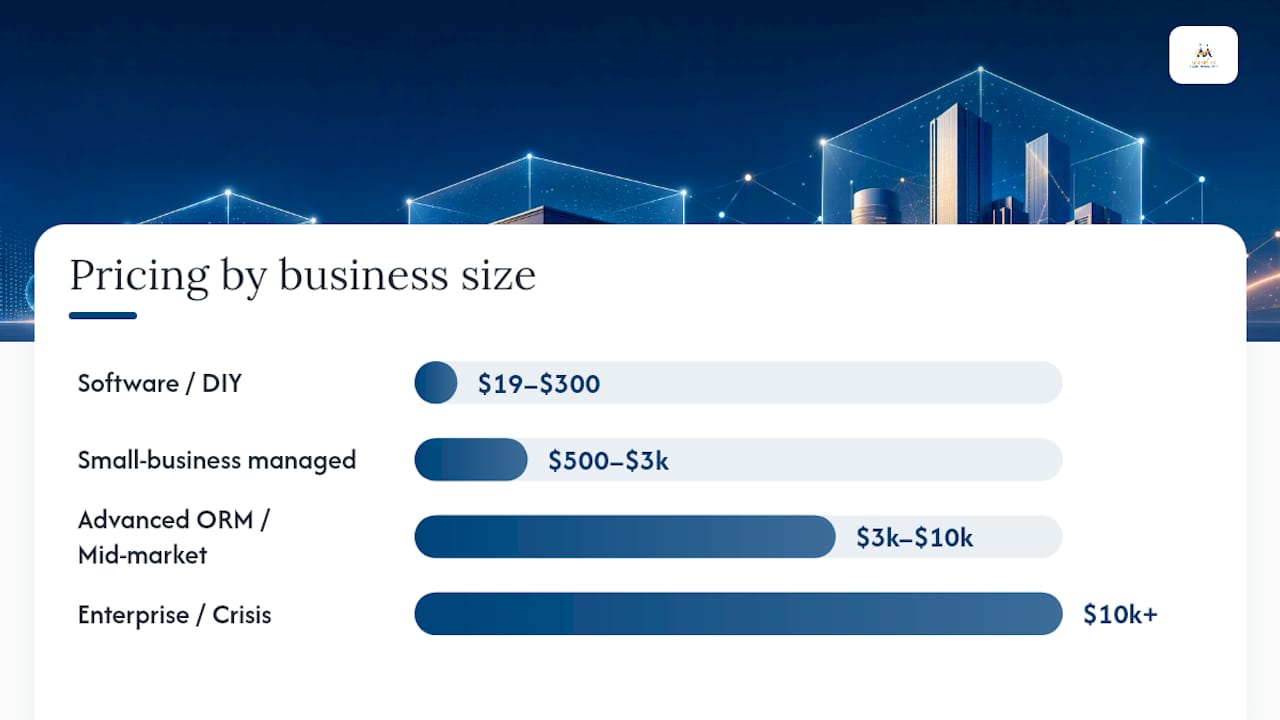
Advanced ORM and mid-market programs run $3,000 to $10,000 a month. DesignRush's portfolio data puts full engagements at $5,000 to $100,000 total, which translates to roughly $2,000 to $9,000 a month for mid-market clients running search suppression campaigns alongside content and PR work.
Enterprise and active crisis engagements start at $10,000 a month and frequently structure as $10,000 to $50,000+ projects when a business is managing a lawsuit-adjacent situation or a viral incident that threatens brand-wide damage.
Hourly rates follow a similar spread: entry-level consulting runs $100 to $135 an hour, mid-tier specialists charge $150 to $200 an hour, and elite crisis consultants or media attorneys bill $400 to $500 or more per hour.
Per-location pricing deserves special attention if you operate more than one site. Pricing per location can multiply monthly costs significantly for multi-location businesses, so always ask for the per-location rate in writing before you sign anything.
How Do You Compare Reputation Management Quotes?
A low headline number means nothing if it excludes half of what you actually need. Run every proposal through this checklist before signing.
- Confirm the deliverables. Which review platforms are monitored? Is content creation included, or billed separately? Does the quote include PR outreach, or only reactive review responses?
- Verify the price drivers. Ask directly whether pricing is per-location, per-platform, or flat. Ask about per-item removal fees for suppression work, since some vendors charge separately for each negative result they attempt to push down.
- Read the contract terms. Look for minimum term length, cancellation penalties, and what happens if suppressed content resurfaces after the engagement ends.
- Ask operational questions. Who owns the content created during the engagement? Do you retain login access to your own profiles? What's the escalation path if a crisis hits mid-contract?
Business.com recommends asking four specific questions of every vendor: what pricing model they use, what their resurface policy is, what content they cannot remove, and who owns the final assets. If a salesperson can't answer all four clearly, that's a red flag worth taking seriously.
Pro Tip: Watch for contract language that guarantees specific search rankings or promises "permanent removal" of negative content. Full removal is rarely possible, and any vendor promising it outright is often overselling what suppression work can actually achieve.
DIY, Software, In-House, or Agency: Which Fits Your Budget?
Your decision should weigh four factors together: budget, risk tolerance, scale, and how fast you need results.
- Low risk, single location, healthy rating: Software alone often covers 80% of routine monitoring needs, making it the strongest starting point for ROI.
- Growing risk or multiple locations: A managed small-business service adds human judgment software can't replicate.
- Active crisis or legal exposure: Skip straight to an agency with crisis experience; DIY tools cannot negotiate suppression or manage legal escalation.
Hiring in-house looks cheaper on paper until you count salary, benefits, software licenses, and training, which frequently exceeds what a mid-tier managed retainer costs; you can learn more about how to budget and compare costs in our guide to accounting service pricing explained for small business. The most cost-effective path for many businesses is a hybrid: a project-based cleanup to fix an existing problem, followed by a lighter retainer for ongoing reputation management tactics.
How Digital Marketing All Scopes a Pricing Proposal
Every engagement starts with an audit: current ratings across platforms, review velocity, and any existing negative search results. From there, triage separates urgent issues from routine maintenance, followed by a scoped plan for suppression, content, and ongoing monitoring.
A typical managed retainer includes:
- Review generation campaigns and response management
- Google Business Profile optimization
- AI-assisted response drafting reviewed by a human before posting
- Monthly reporting on rating trends and platform coverage
Before a pricing call, gather your current review counts by platform, your location count, and a summary of any active complaints or legal concerns.
The businesses that get the most accurate quotes are the ones who show up with their numbers already pulled together. Vague answers to "what's your current rating trend" lead to vague, padded proposals.
Can You Negotiate Reputation Management Pricing?
Yes, and most agencies expect some negotiation, particularly on retainer length and included services. Annual contracts commonly earn a discount over month-to-month billing, sometimes 10% to 15% off the monthly rate, since the agency gains budget predictability in exchange.
Bundling services also creates leverage. If you need review management and Google Business Profile optimization, asking for both under one retainer usually costs less than purchasing them as separate line items from different vendors.
Watch for seasonal promotions, especially around January when agencies push new-client incentives tied to annual budget planning, and around major platform algorithm updates when demand for reputation cleanup spikes and pricing tends to firm up rather than soften.
Don't be afraid to ask for a pilot period. A 60 or 90-day trial at a reduced rate lets you evaluate response quality and reporting before committing to a 12-month term. Agencies confident in their process are usually willing to offer this because it converts well once a client sees real review growth.

The biggest negotiation mistake is focusing only on the monthly rate while ignoring scope. A vendor who drops the price but also drops platform coverage from five sites to two hasn't actually given you a discount. Always negotiate scope and price together, and get whatever you agree to in writing before the first invoice.
Is a Higher-Priced Reputation Management Tier Worth It?
The math changes depending on which tier you're evaluating, and running a rough return calculation before signing saves a lot of second-guessing later.
At the software tier, the return is straightforward: a $50 to $300 monthly tool that helps you request and respond to reviews faster typically pays for itself if it generates even a handful of new five-star reviews a month, since reputation directly influences purchase decisions for most local customers comparing options.
At the managed-service tier ($500 to $3,000 a month), the calculation shifts toward time saved and consistency. A human team drafting on-brand responses and catching patterns, like a specific product line generating repeat complaints, delivers value that's harder to quantify but shows up in retention and referral rates over time.
At the advanced and enterprise tiers, ROI depends heavily on what's at stake. Suppressing a defamatory article ranking on page one for your company name has a nearly infinite ceiling on value if it's actively costing you deals, but expectation management matters here: full removal of negative content is often impossible, and suppression through SEO effort commonly takes months rather than weeks depending on the target site's authority.
Before committing to any tier, ask what specific, measurable outcome the spend is meant to produce, whether that's more reviews, a rating increase, or a suppressed search result, and hold the vendor to reporting against it.
What Budget Blind Spots Should You Watch For?
Most owners underestimate two things: how fast costs scale per additional location, and the need for a crisis buffer even when things look fine. Don't pay agency rates for work software can handle. My rule of thumb: take your realistic baseline monthly cost and add 25% to 50% as a contingency for platform changes or a sudden reputation hit. That cushion is usually the difference between a manageable response and a scramble.
— Diane O'Brien
Get Started With Digital Marketing All's Review Generation Service
If you've read this far and landed somewhere in the small-business or mid-market tier, Digital Marketing All's Review Generation and Management service covers review generation campaigns, Google Business Profile optimization, and AI-assisted response drafting under one predictable monthly retainer, without the per-platform surprise fees that make so many quotes hard to compare. Before booking a pricing call, pull together your current review counts across platforms, your location count, and a short list of any recurring complaints, since that data lets us scope a proposal accurately on the first pass instead of after multiple rounds of back-and-forth. The next step is simple: request a scoped quote through the Review Generation and Management page and get a realistic number based on your actual situation rather than a generic tier.
Sources
- Reputation management cost (DesignRush)
- Business
- Reviewly
- How Much Do Reputation Management Services Cost (Onewrk)
FAQ
How Much Does Reputation Management Cost?
Costs range from $0 to $300 a month for software, $500 to $3,000 a month for small-business managed services, and $10,000 or more monthly for enterprise or crisis-level engagements, depending on scope and urgency.
How Much Does an ORM Program Typically Cost?
Advanced ORM programs covering search suppression, content, and PR typically run $3,000 to $10,000 a month, while entry-level managed services start around $500 to $1,500 a month.
What Should I Look for in a Reputation Management Company?
Look for clear deliverables, transparent per-location or per-platform pricing, a defined resurface policy, and a team willing to answer direct questions about content ownership and success metrics. Digital Marketing All structures its retainers this way, scoping each proposal from an initial audit rather than a flat, one-size-fits-all rate.
Is Hourly Billing Common in Reputation Management?
Hourly billing appears mainly for legal consultation, crisis PR, or specialized SEO work, with rates ranging from $100 to $135 an hour for entry-level work up to $400 to $500 or more for elite crisis consultants.
Can Negative Reviews or Search Results Be Fully Removed?
Full removal is rarely possible; most work focuses on suppression through SEO effort, which commonly takes months rather than weeks depending on the target site's authority.