

TL;DR:
- Reputation management involves monitoring and shaping public perception to build trust and drive customer loyalty. Businesses that respond professionally and consistently to reviews demonstrate accountability and enhance their long-term credibility.
Reputation management is the process of monitoring and shaping public perception of your business to build trust and drive customer loyalty. Every review, rating, and public response you make contributes to how potential customers see you before they ever walk through your door or visit your website. Why is reputation management important? Because 91% of consumers say online reviews directly impact their perception of a business. That single number tells you that your reputation is not a soft, intangible asset. It is a measurable driver of revenue, customer acquisition, and long-term competitive strength.
Why is reputation management important for customer trust?
Customer trust is built before the first transaction. Consumers research businesses online, read reviews, and form opinions based on what they find. The formal industry term for managing this process is online reputation management (ORM), and it covers everything from Google reviews to social media mentions to press coverage.
Online reviews shape trust more powerfully than most business owners realize. When a potential customer searches for your business, the first thing they see is your star rating and the most recent reviews. A strong rating signals reliability. A weak one signals risk.
Consumer skepticism is also rising. 62.3% of consumers are now skeptical of AI-generated or potentially fake reviews. That skepticism raises the bar for authenticity. Businesses that respond professionally and consistently to real reviews stand out precisely because so many do not.
The data on written reviews adds another layer. 43% of consumers trust star ratings combined with detailed written reviews or photos more than star ratings alone. A five-star average with no written context carries less weight than a 4.3-star average with dozens of specific, detailed reviews.
"Consumers look for patterns and company responsiveness rather than a perfect review profile to determine trustworthiness."
— PissedConsumer 2026 Consumer Trust Study
This insight reframes the entire goal of reputation management. You are not chasing a perfect score. You are demonstrating consistent accountability. Businesses that engage with feedback, good and bad, signal to potential customers that they take service seriously. That signal builds confidence and moves buyers closer to a decision.
- Reviews influence purchase intent. Buyers who read positive reviews are more likely to convert than those who find no reviews at all.
- Response patterns matter. 33% of consumers say they trust companies more when those companies respond professionally to negative feedback.
- Recency counts. Reviews older than three months carry less weight with consumers than fresh, recent feedback.
- Volume builds credibility. A business with 200 reviews at 4.2 stars typically outperforms one with 10 reviews at 5.0 stars in consumer trust.
Pro Tip: Set up Google Alerts for your business name so you catch new mentions the moment they appear, not days later when the window to respond has already closed.
What are the key benefits of effective reputation management?
A well-managed reputation delivers concrete, measurable advantages across multiple areas of your business. These benefits compound over time, making early investment in ORM one of the highest-return activities a business owner can pursue.
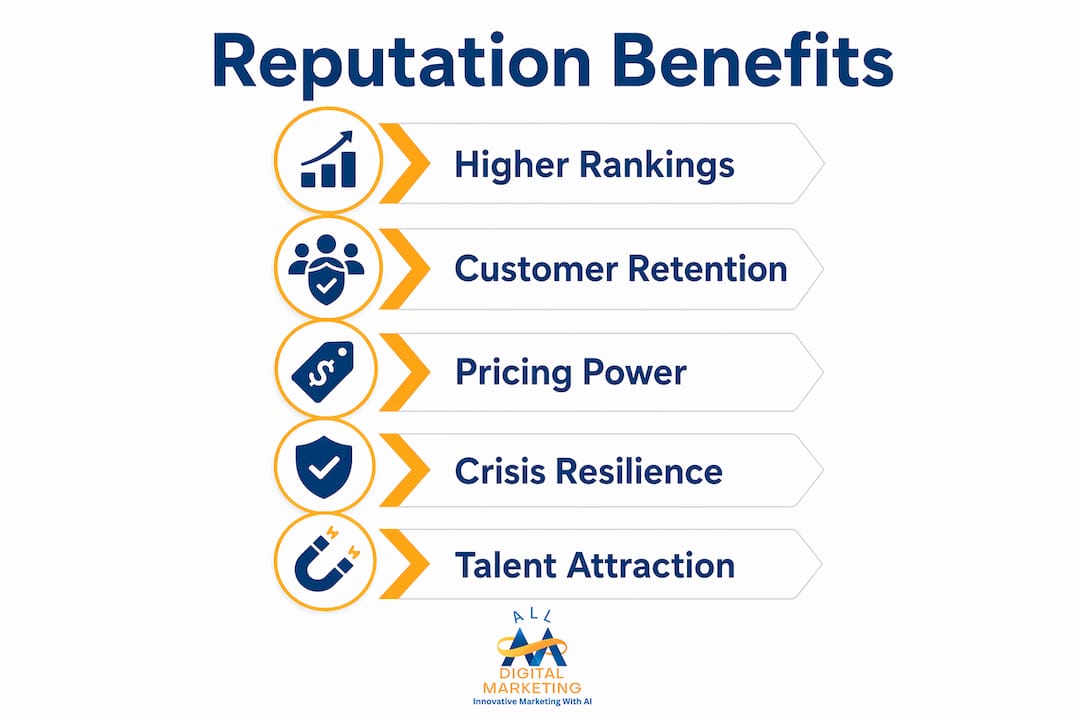
1. Higher search rankings and organic traffic
Positive reviews improve local search ranking and drive greater organic traffic. Google uses review signals, including volume, recency, and rating, as ranking factors for local search results. A business with consistent positive reviews appears higher in Google Maps and local pack results, which means more visibility without paying for ads.

2. Stronger customer acquisition and retention
54% of consumers trust online reviews above personal recommendations and company claims. That means your reviews are doing sales work around the clock. Businesses with strong reputations attract new customers more efficiently and retain existing ones longer because trust reduces the friction in every buying decision.
3. Pricing power
A business known for quality and reliability can charge more. Customers pay a premium when they trust the outcome. A strong reputation removes price as the primary decision factor and replaces it with confidence. This is especially true in service industries where the outcome is hard to evaluate before purchase.
4. Crisis resilience
Businesses with established positive reputations recover faster from negative events. When a loyal customer base already trusts you, a single bad review or a minor service failure does not define you. 88% of consumers prefer companies that address negative feedback, which means your response to a crisis can actually strengthen trust rather than damage it.
5. Talent and investor attraction
Your reputation reaches beyond customers. Job candidates research employers before applying. Investors evaluate public perception before committing capital. A business with a strong, visible reputation attracts better candidates and signals stability to potential partners.
Pro Tip: Ask satisfied customers for reviews immediately after a positive interaction. The request lands best within 24 hours of the experience, when the memory is fresh and the goodwill is highest.
What strategies can businesses use to manage their reputation?
Effective reputation management strategies require consistency, not occasional effort. The businesses that maintain strong reputations treat ORM as an ongoing operational function, not a one-time fix. The Journal of Small Business Strategy confirms that reputation management works best when integrated as a core business function rather than a reactive marketing task.
Build a review generation system
Authentic reviews do not appear by accident. You need a repeatable process for asking customers to share their experiences. This means training your team to make the ask, using follow-up emails or SMS messages after purchases, and making it easy by providing a direct link to your Google Business Profile or preferred review platform. Avoid incentivizing reviews with discounts or gifts. That practice violates platform policies and erodes the authenticity that makes reviews valuable in the first place.
Monitor all relevant platforms consistently
Your reputation lives across multiple channels simultaneously. Google, Yelp, Facebook, industry-specific directories, and social media all carry reviews and mentions that affect how customers perceive you. Use a monitoring system that aggregates mentions across platforms so nothing slips through. The Digitalmarketingall reputation monitoring guide outlines how small and medium-sized businesses can set up effective monitoring without a large team.
Respond to every review
Response rate is a visible signal of how much you value customer feedback. Responding to positive reviews reinforces loyalty. Responding to negative reviews demonstrates accountability. Both actions are visible to every future customer who reads your profile.
| Review type | Response goal | Response timeframe |
|---|---|---|
| Positive review | Thank the customer, reinforce the experience | Within 48 hours |
| Neutral review | Acknowledge feedback, invite further conversation | Within 24 hours |
| Negative review | Apologize, offer a solution, take it offline | Within 12 hours |
Use feedback to improve your business
Reviews are free market research. Patterns in negative feedback reveal real operational problems. If three customers in one month mention slow response times, that is a signal to fix your process, not just a PR problem to manage. Businesses that treat feedback as operational data improve faster and build reputations that reflect genuine quality.
- Avoid fake reviews. Purchasing fake reviews destroys credibility when discovered and violates platform terms of service.
- Never delete legitimate negative reviews. Suppressing criticism signals dishonesty and often backfires publicly.
- Claim all your business listings. Unclaimed profiles can be edited by others and often display outdated or incorrect information.
- Track your net promoter score (NPS). Regular NPS surveys give you a private channel for feedback before it becomes a public review.
Pro Tip: Create a simple response template library for common review types. Templates speed up your response time while leaving room to personalize each reply. Personalization matters because generic responses read as automated and reduce their trust impact.
How should businesses handle negative reviews?
Negative reviews are inevitable. Every business receives them. The difference between businesses that recover and those that suffer lasting damage comes down to how they respond. 88% of consumers prefer companies that address negative feedback, which means a well-handled complaint is a public demonstration of your values.
The first rule is to respond quickly and professionally. A delayed response signals indifference. A defensive response signals insecurity. Neither builds trust. The goal of your response is not to win an argument. The goal is to show every future reader that you take concerns seriously and act on them.
"A negative review handled with transparency and accountability often builds more trust than a business with only five-star reviews. Perfection reads as suspicious. Accountability reads as human."
— Reputation management best practice, widely observed across consumer trust research
Follow these principles when responding to criticism:
- Acknowledge the experience. Start by validating the customer's frustration without admitting fault prematurely. "We're sorry to hear your experience didn't meet your expectations" is a strong opening.
- Offer a specific solution. Vague apologies without action steps feel hollow. Offer a refund, a replacement, a direct call, or whatever fits the situation.
- Take the conversation offline. Provide a direct phone number or email so the resolution happens privately. This protects both parties and prevents a public back-and-forth.
- Follow through. If you promise to call, call. Broken follow-through on a public complaint is worse than no response at all.
- Never retaliate. Responding with hostility or accusations destroys trust instantly and permanently. Future customers read every word.
Consistency matters as much as quality. A business that responds to 90% of reviews builds a stronger reputation than one that writes brilliant responses to 20%. Volume of engagement signals that you are genuinely attentive, not selectively defensive. Explore the Digitalmarketingall review management guide for a full framework on building consistent response habits.
Key Takeaways
Reputation management is a direct revenue driver: businesses that monitor, respond to, and build on customer feedback consistently outperform those that treat reputation as an afterthought.
| Point | Details |
|---|---|
| Reviews drive decisions | 91% of consumers say online reviews impact their perception of a business. |
| Response rate signals trust | 89% of consumers expect businesses to respond to reviews, up from 81% in 2025. |
| Revenue impact is real | A one-star drop from 4.0 to 3.0 can reduce annual revenue by 5–9%. |
| Authenticity beats perfection | Consumers trust patterns and responsiveness more than a flawless review profile. |
| ORM must be proactive | Reputation management works best as an integrated business function, not a reactive fix. |
Reputation management is not optional anymore
After years of working with business owners across industries, one pattern stands out clearly. The businesses that treat reputation management as a background task, something to address when a crisis hits, consistently fall behind those that make it a weekly operational habit.
The shift I have seen in consumer behavior is real and accelerating. Buyers in 2026 are more skeptical, more informed, and more likely to check multiple sources before making a decision. A single glowing review no longer carries the weight it once did. What carries weight now is a visible track record of engagement. Businesses that respond to every review, good and bad, signal something that no ad campaign can replicate: that they actually care what customers think.
The financial stakes are not abstract. A one-star drop in rating can cut annual revenue by 5–9%. That is not a marketing metric. That is a P&L line item. Business owners who understand this stop asking whether reputation management is worth the effort and start asking how to build a system that runs consistently.
My honest advice is this: do not wait for a bad review to force your hand. Build your review generation process now, set up monitoring across every platform where your customers are active, and respond to every piece of feedback within 24 hours. The businesses I have seen do this well do not just have better ratings. They have more loyal customers, lower churn, and a competitive position that is genuinely hard to replicate.
Reputation is not built in a crisis. It is built in the hundreds of small interactions that happen before the crisis arrives.
— Diane
How Digitalmarketingall helps businesses build a stronger reputation
Digitalmarketingall works with local and national businesses to build the kind of online reputation that drives real customer trust and measurable growth. The agency's review generation and management services help businesses collect authentic reviews, respond consistently, and monitor their presence across all major platforms. Beyond reviews, Digitalmarketingall connects reputation management to broader visibility goals, including local SEO, Google Business Profile optimization, and AI-driven search prominence. If you want a reputation that actively works to bring in new customers, the Digitalmarketingall team provides the tools and guidance to make that happen. Visit Digitalmarketingall to see how the agency supports businesses at every stage of reputation growth.
FAQ
Why is reputation management important for small businesses?
Reputation management directly affects whether potential customers choose your business over a competitor. With 54% of consumers trusting online reviews more than personal recommendations, a strong reputation is one of the most effective sales tools a small business has.
How do online reviews affect business revenue?
A one-star drop from 4.0 to 3.0 on major review platforms can reduce annual revenue by 5–9%. Positive reviews also improve local search rankings, which drives more organic traffic and customer acquisition without additional ad spend.
What is the best way to respond to negative reviews?
Respond quickly, acknowledge the customer's experience, offer a specific solution, and invite the conversation offline. 88% of consumers prefer businesses that address negative feedback, so a professional response builds trust with every future reader who sees it.
How often should businesses monitor their online reputation?
Daily monitoring is the standard for businesses that take ORM seriously. Review platforms, social media, and directory listings can receive new content at any time. Setting up automated alerts and using an aggregated monitoring tool reduces the manual effort while keeping you informed in real time.
What is the difference between reputation management and public relations?
Public relations focuses on proactive brand storytelling through media and press. Reputation management focuses on monitoring and responding to what customers say about your business across review platforms, social media, and search results. The two overlap but serve different functions, and ORM operates at a more direct, customer-facing level.