

TL;DR:
- Reputation management involves proactively monitoring and shaping your business's online perception across multiple platforms. It includes managing reviews, search rankings, social media mentions, and AI summaries to protect and grow brand trust. Businesses that treat reputation as a continuous, cross-team function see significant revenue benefits and competitive advantages.
Reputation management is defined as the continuous, proactive practice of monitoring, influencing, and shaping how your business is perceived across search engines, review platforms, social media, and AI-generated summaries. Every business owner and marketer needs to understand what is reputation management before a crisis forces the lesson. The stakes are concrete: a 1-star improvement on Yelp alone can increase revenue between 5% and 9%, according to Harvard Business School research. That number reflects how directly public perception connects to your bottom line. Your reputation is not a vague brand feeling. It is a measurable, manageable business asset.
What is reputation management and what does it actually include?
Reputation management is the structured process of controlling what people find, read, and believe about your business online. The industry term most professionals use is online reputation management, often abbreviated as ORM. Both phrases describe the same discipline: actively managing your digital footprint so that the strongest, most accurate version of your brand appears first in search results, review sites, and AI platforms like Google's Search Generative Experience or Perplexity.

ORM covers far more ground than most business owners expect. It includes monitoring Google reviews, Yelp, Trustpilot, and industry-specific directories. It also includes tracking social media mentions on platforms like Facebook, Instagram, LinkedIn, and X (formerly Twitter). News coverage, forum discussions on Reddit, and AI-generated summaries all fall within its scope.
The core insight that separates effective ORM from reactive damage control is this: reputation is a first-page search problem, not a vague brand feeling. What ranks on page one of Google shapes what customers, partners, and potential employees believe about you. Controlling that first page with high-quality, accurate assets is the foundation of trust building.
Pro Tip: Set up Google Alerts for your business name, your top executives' names, and your main product or service names. This gives you a free, real-time signal before problems escalate.
What processes and activities make up reputation management?
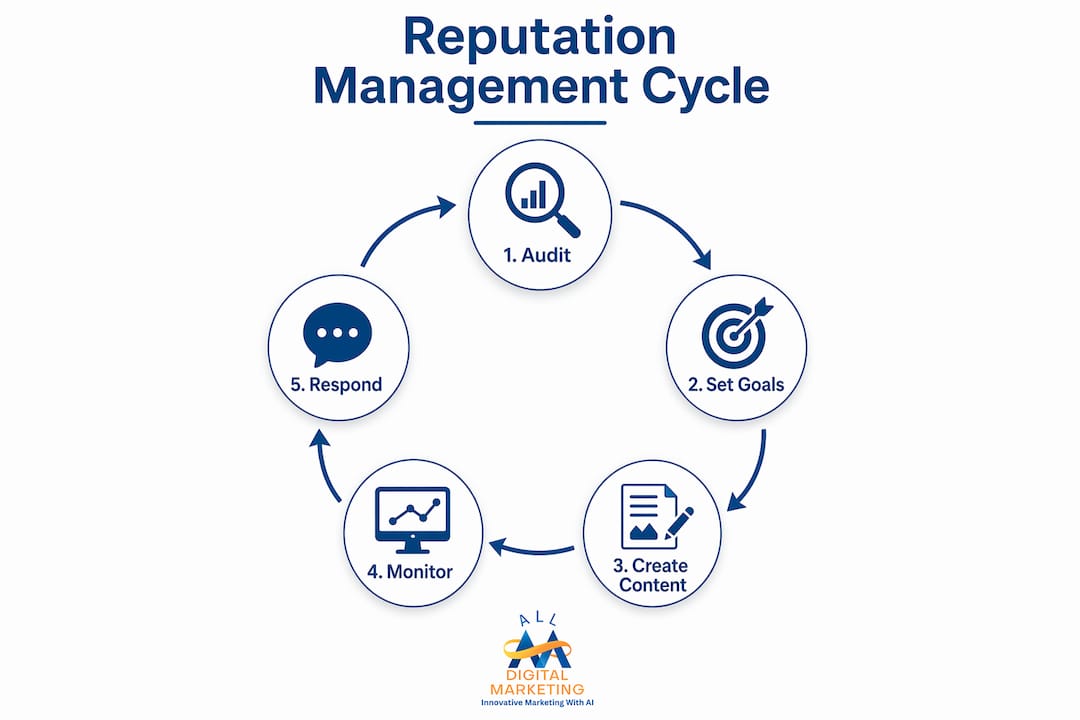
The reputation management process follows a defined cycle, not a one-time fix. Treating it as a recurring business function rather than an emergency response is what separates companies that grow their reputation from those that scramble to protect it.
A practical framework covers seven core activities:
- Reputation audit. Map your current sentiment trends, share of voice, and the quality of your first-page search assets. Tools like Semrush, BrightLocal, and Google Search Console give you a baseline. Reputation audits reveal where your brand stands before you set any goals.
- Set SMART KPIs. Define measurable targets: average star rating, review response rate, share of positive first-page results, and social sentiment score. Vague goals produce vague results.
- Build positive content assets. Publish blog posts, case studies, press releases, and video content that rank for your brand name. These assets push negative or irrelevant content further down search results.
- Manage review and social response plans. Assign ownership for responding to reviews and mentions. A 24-hour response target for online reviews and social mentions is the current industry standard for mitigating negative sentiment and demonstrating active engagement.
- Apply SEO suppression tactics. Use internal linking, structured data, and authoritative third-party placements to amplify positive content. This is not about hiding the truth. The goal of reputation management is to ensure the strongest, most accurate version of your brand is prioritized by search engines and AI summaries.
- Monitor continuously. Track mentions across 100 million or more sources using tools like Sprinklr, Mention, or Brand24. Monitoring is not a monthly task. It is a daily discipline.
- Conduct quarterly business reviews. Measure progress against your KPIs, identify recurring complaint themes, and update your strategy. Quarterly reviews prevent drift and keep the process aligned with business goals.
Pro Tip: Assign a named owner for reputation management inside your organization. Without clear accountability, monitoring tasks fall through the cracks and response times slip past the 24-hour standard.
Why is reputation management critical for business success?
A strong reputation directly drives revenue, talent acquisition, and partnership opportunities. A weak or unmanaged reputation costs money in ways that are hard to recover from quickly.
The business case for proactive ORM is clear:
- Revenue impact. A single star improvement on Yelp correlates with a 5%–9% revenue increase. For a business generating $500,000 annually, that is $25,000–$45,000 in additional revenue from one rating point.
- Search ranking influence. Google's algorithm factors in review quantity, recency, and sentiment when ranking local businesses. More positive reviews mean higher visibility in Google Maps and local search packs.
- Talent attraction. Job seekers check Glassdoor and LinkedIn reviews before applying. A poor employer reputation reduces the quality and quantity of applicants.
- Partnership credibility. Vendors, investors, and referral partners research your reputation before committing. A clean, well-managed online presence removes friction from those conversations.
- Crisis cost reduction. Failure to proactively manage reputation leads to higher recovery costs, slower customer return, and greater revenue loss compared to businesses with proactive strategies in place.
The data on executive awareness is striking. 88% of executives identify reputational risk as a top business risk. Yet fewer than 30% have proactive strategies in place. That gap is where most businesses lose ground to competitors who treat ORM as a core function rather than an afterthought.
The contrast between proactive and reactive approaches is significant. Proactive reputation management builds a buffer of positive content, reviews, and sentiment that absorbs negative incidents without catastrophic damage. Reactive management means every crisis starts from zero, with no goodwill reserve to draw from.
How does online reputation management differ from traditional PR?
Online reputation management and traditional public relations are related but distinct disciplines. Confusing them leads to misallocated budgets and coverage gaps.
| Dimension | Traditional PR | Online Reputation Management |
|---|---|---|
| Primary focus | Earned media, press coverage, brand narrative | Reviews, search results, social mentions, AI summaries |
| Approach | Relationship-driven, long-term communications | Data-driven, responsive, self-directed |
| Speed | Weeks to months for campaign cycles | Hours to days for response and content deployment |
| Measurement | Media impressions, share of voice in press | Star ratings, search rank, sentiment scores, response rate |
| Tools | PR Newswire, Cision, media contacts | Sprinklr, BrightLocal, Google Business Profile, Mention |
| Ownership | PR agency or communications team | Marketing, CX, or dedicated ORM team |
ORM is more data-driven, responsive, and self-directed than traditional PR's earned media focus. A PR campaign might take three months to generate a feature story in a trade publication. An ORM response to a negative review needs to happen within 24 hours.
The two disciplines work best together. PR builds the narrative and earns high-authority placements that strengthen your search presence. ORM monitors the digital environment daily and responds to what customers actually say. Combining both gives you long-term brand authority and short-term responsiveness. For a deeper look at how SEO and PR intersect, the SEO and digital PR guide from Digitalmarketingall covers the tactical overlap in detail.
What reputation management strategies actually improve your online presence?
Effective reputation management strategies require a documented plan with clear goals, assigned ownership, and a defined response process. Informal approaches produce inconsistent results.
Here are the core strategies that produce measurable improvement:
- Document your strategy. Write down your monitoring channels, response templates, escalation paths, and KPIs. A written plan creates consistency across team members and reduces response time.
- Monitor across all channels. Cover Google, Yelp, Facebook, LinkedIn, Glassdoor, Reddit, and industry-specific review sites. Missing a channel means missing conversations that shape your reputation.
- Respond with context and speed. Generic responses damage credibility. Address the specific issue the customer raised, acknowledge the experience, and offer a resolution. Do this within 24 hours for reviews and social mentions.
- Use SEO to amplify positive assets. Publish content that ranks for your brand name and key service terms. Linking insights to cross-functional teams to fix root causes prevents the same complaints from recurring. Social monitoring alone does not improve reputation.
- Coordinate across departments. Effective reputation management integrates workflows across marketing, customer experience, product, and legal teams. A complaint about a billing error needs the finance team involved, not just a social media manager posting a generic apology.
- Build a review generation process. Ask satisfied customers for reviews at the right moment: after a successful project, after a positive support interaction, or at checkout. Tools like Digitalmarketingall's review generation platform systematize this process so it happens consistently.
- Prepare for crises before they happen. Identify your three most likely reputation risks and write response protocols for each. When an incident occurs, respond within 24–72 hours to preserve evidence, limit escalation, and coordinate with legal or PR teams.
Pro Tip: Triage incoming reputation issues by severity. A single negative review gets a standard response within 24 hours. A viral complaint or media inquiry triggers your crisis protocol within two hours and involves your legal and communications leads.
Understanding what is brand reputation at a foundational level helps you prioritize which channels and issues deserve the most attention. The brand reputation guide for SMBs from Digitalmarketingall breaks down platform selection and monitoring workflows for businesses at every stage.
Key Takeaways
Reputation management is a continuous, proactive business function that requires monitoring, response, SEO, and cross-team coordination to protect and grow brand trust.
| Point | Details |
|---|---|
| ORM is a daily discipline | Monitor reviews, social mentions, and search results continuously, not monthly. |
| Response speed matters | Respond to reviews and mentions within 24 hours to reduce negative sentiment impact. |
| Proactive beats reactive | Fewer than 30% of businesses have proactive strategies, creating a clear competitive advantage for those who do. |
| Revenue is directly linked | A 1-star Yelp improvement correlates with 5%–9% revenue growth, per Harvard Business School research. |
| Cross-team ownership is required | Marketing, CX, product, and legal must coordinate to fix root causes, not just manage optics. |
Why most businesses get reputation management backwards
Working with business owners across industries, I see the same pattern repeatedly. A business invests nothing in reputation management until a bad review goes viral or a competitor starts outranking them on Google. Then they panic, spend money on reactive fixes, and wonder why the results are slow.
The uncomfortable truth is that reputation management only works as prevention. By the time you need it urgently, you are already behind. The businesses that win on reputation are the ones that treat it like accounting: a continuous, non-negotiable function with assigned ownership and regular reporting.
What most articles miss is the AI dimension. In 2026, AI tools like ChatGPT, Perplexity, and Google's AI Overviews pull from your reviews, your website, your press coverage, and your social presence to generate summaries that millions of people read before they ever visit your site. If your reputation data is weak, inconsistent, or negative, those AI summaries reflect that. You cannot optimize for AI citations without first building a clean, consistent reputation foundation across every digital channel.
The other overlooked factor is internal alignment. I have seen marketing teams build excellent review response workflows while the product team keeps shipping the feature that generates the complaints. Social monitoring alone does not fix anything. The insight has to travel from the monitoring dashboard to the person who can actually change the product, the policy, or the process. That requires leadership buy-in and cross-functional accountability, not just a social media tool.
Start treating reputation as a business intelligence function, not a communications task. The data your reputation channels generate tells you what customers actually think, what competitors are doing better, and where your operations are failing. That intelligence is worth more than any single marketing campaign.
— Diane
How Digitalmarketingall supports your reputation management goals
Digitalmarketingall works with local and national businesses to build reputation systems that produce measurable results. The agency combines review generation, SEO content strategy, and social monitoring into a coordinated approach that addresses both daily management and long-term brand authority. If your business is losing ground to competitors with stronger review profiles or better search visibility, the resources and services at Digitalmarketingall give you a clear starting point. From review workflows to AI search optimization, the team brings the expertise and tools to help you build a reputation that works for your business every day.
FAQ
What is reputation management in simple terms?
Reputation management is the practice of monitoring and influencing what people find about your business online. It covers reviews, search results, social media, and AI-generated summaries.
How does the reputation management process work?
The process follows a cycle of auditing your current reputation, setting measurable goals, building positive content, responding to reviews, applying SEO tactics, and reviewing results quarterly.
What is the difference between ORM and traditional PR?
ORM focuses on digital channels like reviews, search rankings, and social mentions with fast, data-driven responses. Traditional PR focuses on earned media and long-term communications campaigns.
How do you improve your online reputation quickly?
Respond to all existing reviews within 24 hours, ask satisfied customers for new reviews, and publish fresh content that ranks for your brand name. These three actions produce visible results within 30–60 days.
Why is reputation management important for small businesses?
Small businesses rely heavily on local search and word-of-mouth referrals. A strong review profile and clean search presence directly increase foot traffic, leads, and revenue for businesses competing in local markets.