

TL;DR:
- Online reputation monitoring is essential for small and medium-sized businesses to maintain customer trust and search visibility.
- Consistent tracking of reviews, social mentions, forums, and AI-generated summaries prevents reputation crises and boosts local SEO.
Online reputation monitoring is the practice of tracking, analyzing, and responding to what customers, media, and AI platforms say about your business across the web. For small and medium-sized businesses, the stakes are high. 54% of consumers prioritize online reviews over personal recommendations when making buying decisions. That single statistic explains why monitor online reputation is not a marketing luxury. It is a core business function that directly shapes customer trust and search visibility.
Why does online reputation monitoring affect customer trust?
Customer trust is built or broken before a prospect ever contacts you. Reviews, social mentions, forum threads, and news coverage all form a picture of your business in the mind of a potential buyer. If you are not watching that picture form, you cannot correct it when it goes wrong.
The connection between reputation and revenue is direct. One negative review can cost a business approximately 30 potential customers. That is not a minor inconvenience. For a local service business or a small retailer, losing 30 prospects per negative review compounds quickly into real revenue loss.
Positive signals matter just as much. Responding to reviews improves visibility and drives new customer acquisition. Search engines and AI platforms both reward businesses that engage actively with their audience. Silence, on the other hand, signals indifference.
Here is what reputation monitoring protects at the customer trust level:
- Review credibility: Fresh, responded-to reviews signal an active, trustworthy business.
- Search trust signals: Google factors review quantity, recency, and response rate into local rankings.
- Social proof: Positive mentions on forums and social media reinforce buying confidence.
- Crisis prevention: Catching a pattern of complaints early stops a small problem from becoming a public relations issue.
- Brand consistency: Monitoring confirms that your messaging matches what customers actually experience.
Each of these trust signals feeds into the broader importance of online reputation for your business's ability to attract and keep customers.
Pro Tip: Set a policy to respond to every review, positive or negative, within 48 hours. Businesses that respond consistently earn higher trust scores and better local search placement.
What sources and channels should you monitor for brand reputation?
Brand monitoring is a process of discovering, analyzing, and acting on brand mentions across multiple media formats, not just social media. That distinction matters. Many business owners check their Google reviews and stop there. A complete picture requires far more ground to cover.
Core sources to track
- Review platforms: Google Business Profile, Yelp, Tripadvisor, and industry-specific directories are the highest-priority sources for most SMBs.
- Social media: Facebook, Instagram, X (formerly Twitter), LinkedIn, and TikTok all generate public commentary about your brand.
- Forums and community sites: Reddit threads and niche community boards often surface early complaints or praise before they reach mainstream platforms.
- News sites and blogs: Local press coverage and industry blogs shape how journalists and partners perceive your business.
- Podcasts: Audio content now appears in AI search summaries. A negative mention in a podcast can influence your brand's AI-generated profile.
- AI-generated search outputs: ChatGPT, Perplexity, and Google's AI Overviews now summarize your brand for searchers. What those summaries say is shaped by the content they index.
The last source on that list is the newest and the most underestimated. Monitoring AI platforms for accurate brand information is now a critical part of protecting digital reputation. If an AI tool describes your business incorrectly, thousands of searchers may receive that wrong description before you even know it exists.
There is also an important distinction between basic brand monitoring and narrative intelligence. Basic monitoring counts mentions. Narrative intelligence tracks how a story about your brand is forming over time. Detecting evolving stories before they become crises is the defining capability of mature reputation programs. A single complaint is noise. Five complaints using the same language in the same week is a pattern worth addressing immediately.
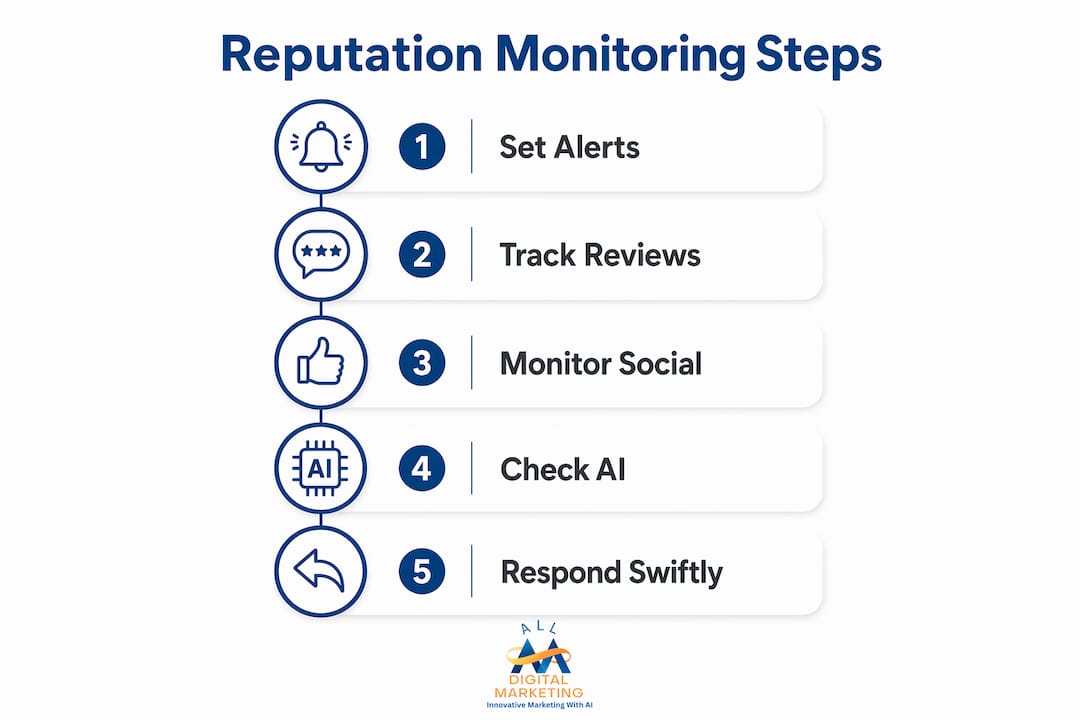
Pro Tip: Use Google Alerts as a free starting point. Set alerts for your business name, your owner's name, your top products, and common misspellings of your brand. Review the digest every morning before you open your inbox.
How to build an online reputation monitoring strategy for your SMB
A reputation monitoring strategy does not require a large budget or a dedicated team. It requires consistency and a clear schedule. The recommended monitoring frequency for SMBs follows a three-tier structure: daily automated alerts, weekly checks of review platforms, and monthly audits of your top search results.
Here is how to build that structure from the ground up:
-
Set up automated alerts. Use Google Alerts or a free social listening tool to receive daily notifications whenever your brand name appears online. This catches news coverage, blog mentions, and forum posts without manual effort.
-
Conduct weekly review platform checks. Log into Google Business Profile, Yelp, and any industry-specific directories every week. Read new reviews, respond to all of them, and flag any patterns in the feedback.
-
Run a monthly search audit. Search your business name on Google, Bing, and at least one AI platform. Note what appears on the first page. Check whether the descriptions, images, and linked content accurately represent your business.
-
Prioritize your platforms. Not every channel carries equal weight for every business. A restaurant should prioritize Google and Yelp. A B2B service firm should watch LinkedIn and industry forums more closely. Match your monitoring effort to where your customers actually spend time.
-
Respond proactively to all feedback. Responding to negative reviews with a calm, solution-focused reply reduces the damage of that review significantly. Responding to positive reviews builds loyalty and encourages more customers to leave feedback.
The table below shows how to allocate monitoring effort across a typical week:
| Task | Frequency | Time required | Priority |
|---|---|---|---|
| Google Alerts review | Daily | 5 minutes | High |
| Review platform responses | Weekly | 20–30 minutes | High |
| Social media mention check | Weekly | 15 minutes | Medium |
| Google and AI search audit | Monthly | 45 minutes | High |
| Forum and news scan | Monthly | 30 minutes | Medium |

Reputation management for SMBs does not need to be complex. The businesses that do it well are the ones that do it consistently, not the ones with the most sophisticated tools.
Pro Tip: Block time on your calendar for reputation tasks the same way you block time for payroll or inventory. Treating it as a scheduled task prevents it from being skipped during busy weeks.
What 2026 trends are reshaping online reputation monitoring?
The monitoring environment has shifted significantly. The biggest change is the rise of AI-generated search results as a primary channel for brand discovery. When a potential customer asks ChatGPT or Perplexity about the best local plumber or the top-rated accountant in their city, the answer they receive is shaped by the content those platforms have indexed about your business.
Business owners must manage how their brand appears in AI-generated search results to maintain visibility and authority. This is a new requirement, not an optional upgrade. Businesses that ignore AI-generated summaries risk having outdated or inaccurate information presented to thousands of searchers.
Here are the key trends shaping brand image monitoring in 2026:
- Predictive narrative intelligence: The shift from reactive damage control to predictive narrative intelligence is the defining evolution in reputation management this year. Tools now detect slow-forming negative stories before they reach crisis volume.
- Sentiment analysis at scale: AI-powered sentiment tools can process thousands of mentions and flag emotional tone shifts in real time. Early warning detection through anomaly detection gives businesses time to respond before a story spreads.
- Conversational platform monitoring: Customers now discuss brands in private and semi-private spaces, including Discord servers, Reddit communities, and WhatsApp groups. These conversations are harder to track but increasingly influential.
- Misinformation risk: False claims about businesses spread faster than corrections. Monitoring allows you to identify and address misinformation before it reaches a wide audience.
"Monitoring mention volume alone misses slow-forming negative narratives. Narrative intelligence is the capability that separates businesses that manage their reputation from those that react to crises after the damage is done." — Pulsar Platform, 2026
Understanding AI search and brand authority is now part of what it means to protect your digital reputation. The businesses that adapt to this shift will maintain visibility. Those that do not will find themselves absent from the conversations that matter most.
What are the broader benefits of proactive reputation monitoring?
Reputation monitoring delivers value well beyond crisis prevention. Businesses that track their brand image consistently gain advantages that compound over time.
- Competitive positioning: Monitoring competitor mentions alongside your own reveals gaps in the market and opportunities to differentiate your messaging.
- Customer loyalty: Customers who receive a personal response to their review are significantly more likely to return and recommend your business to others.
- Marketing intelligence: Real-time feedback from reviews and social mentions tells you what customers actually value about your product or service. That information is more reliable than any focus group.
- Search ranking improvement: Review activity, response rate, and recency all factor into local SEO rankings. Active reputation management directly supports your search visibility goals.
- Revenue protection: Catching a negative trend early and addressing it prevents the compounding customer loss that comes from an unmonitored reputation problem.
The benefits of online reputation management extend into every part of your business. Sales teams close more deals when prospects see a well-maintained review profile. Hiring improves when job seekers find positive coverage of your company culture. Partnerships form more easily when your brand appears credible and active online.
Key Takeaways
Monitoring your online reputation is the single most direct action a small or medium-sized business can take to protect customer trust, improve search visibility, and prevent revenue loss from unaddressed negative feedback.
| Point | Details |
|---|---|
| Reviews drive buying decisions | 54% of consumers trust online reviews over personal recommendations, making monitoring non-negotiable. |
| One bad review has real cost | A single negative review can cost approximately 30 potential customers, compounding quickly for SMBs. |
| Monitoring scope is broad | Track review platforms, social media, forums, news sites, podcasts, and AI-generated search outputs. |
| Consistency beats complexity | Daily alerts, weekly review checks, and monthly search audits form the foundation of an effective program. |
| AI search requires active management | AI platforms now summarize your brand for searchers, making AI-generated content a critical monitoring channel in 2026. |
What I have learned from watching SMBs ignore their reputation until it is too late
I have worked with dozens of small business owners who treated reputation monitoring as something to deal with "when there is a problem." The pattern is almost always the same. By the time they notice the problem, it has been forming for months. A cluster of similar complaints on Google. A Reddit thread that ranks on page one for their business name. An AI-generated summary that describes their service based on outdated or inaccurate content.
The mistake is not malicious. It comes from a genuine belief that monitoring is passive, that you will notice when something goes wrong. You will not. Negative narratives form slowly. A single complaint is easy to miss. Five complaints using the same language over three months is a pattern that a monitoring system would have flagged in week two.
What I tell every business owner I work with is this: your reputation is not what you say about yourself. It is the sum of what everyone else says, including AI platforms that have never spoken to you. That sum is being calculated right now, whether you are watching or not.
The businesses that win at reputation management are not the ones with the most five-star reviews. They are the ones that respond fastest, address issues most directly, and treat every piece of feedback as data. Digital reputation management in 2026 requires treating your brand's online presence as a living asset that needs regular attention, not a static page you set up once.
Start with the basics. Set your alerts today. Respond to your last ten reviews this week. Run a search audit on your business name and see what an AI platform says about you. Those three steps will tell you more about your current reputation than any report.
— Diane
How Digitalmarketingall supports your reputation monitoring goals
Digitalmarketingall works with small and medium-sized businesses that want a structured, consistent approach to managing what customers find when they search for them. The review generation and management service covers the full cycle: collecting new reviews from satisfied customers, monitoring incoming feedback across platforms, and providing the response framework that keeps your profile active and credible. For businesses that want to go further, Digitalmarketingall's broader digital marketing services connect reputation management directly to local SEO, AI search visibility, and customer acquisition. If your business is ready to treat its online reputation as the revenue asset it actually is, the partner with us page is the right place to start that conversation.
FAQ
Why does monitoring online reputation matter for small businesses?
Small businesses are more vulnerable to reputation damage than large ones because a single wave of negative reviews represents a larger share of their total feedback. Active monitoring allows early detection and fast response before damage compounds.
How often should an SMB check its online reputation?
The recommended schedule is daily automated alerts, weekly review platform checks, and a monthly audit of search and AI results. This three-tier approach balances thoroughness with realistic time investment.
What is the difference between brand monitoring and reputation management?
Brand monitoring is the process of tracking mentions across channels. Reputation management is the broader practice of analyzing that data and taking action. Monitoring is the input; management is the response.
Do AI platforms like ChatGPT affect my business reputation?
Yes. AI platforms now generate summaries of local businesses based on indexed content. Inaccurate AI-generated descriptions can mislead potential customers before they ever visit your website, making AI monitoring a necessary part of any reputation program.
What is the fastest free step to start monitoring my reputation?
Set up a Google Alert for your business name today. It takes under two minutes and delivers daily email notifications whenever your brand appears in new web content, giving you a baseline monitoring layer at no cost.