

The online reputation management process is a continuous cycle: monitor → build → respond → correct → measure. Run it consistently and your branded search results, review ratings, and customer trust all improve over time. Skip it and competitors with better-managed reputations will win the customers you should have had.
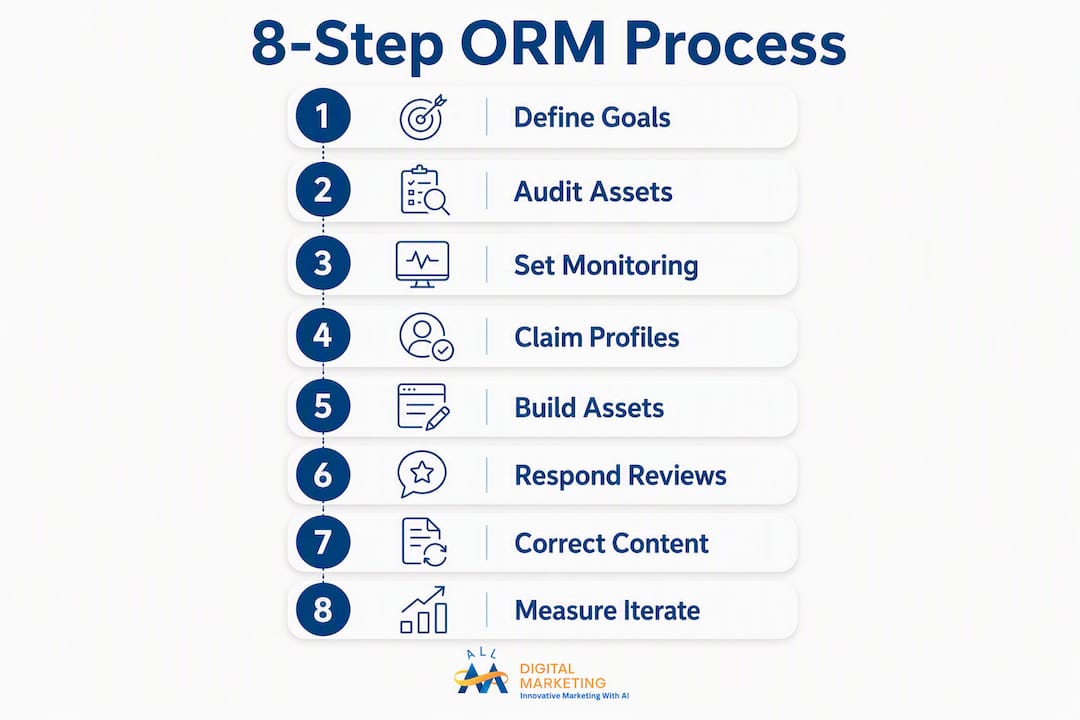
Your 8-step process at a glance:
- Define reputation goals and assign stakeholders
- Audit your owned assets and search results
- Set up continuous monitoring
- Claim and standardize your profiles (NAP consistency)
- Build reputation assets: reviews, content, and press
- Respond to every review with the right tone and template
- Correct or suppress harmful content
- Measure KPIs and iterate monthly
Timeline: Expect profile cleanup and alert setup within the first week, noticeable review improvement in 1–3 months, and meaningful SERP shifts in 3–6 months.
Cost: DIY with free tools like Google Alerts costs only your time (roughly 3–5 hours per week). Managed services typically run from a few hundred to several thousand dollars per month depending on scope.
Table of Contents
- What is the online reputation management process?
- Why your online brand reputation directly affects revenue
- How to run the full 8-step online reputation management process
- Which tools should you use for reputation monitoring?
- How do you measure ORM success?
- How long does reputation improvement take, and what does it cost?
- Why trend analysis beats single-review firefighting
- Key Takeaways
- When should you hire an agency instead of doing it yourself?
- Digital Marketing All handles reputation management for you
- Useful sources
- FAQ
What is the online reputation management process?
Online reputation management (ORM) is the practice of monitoring, building, responding to, and suppressing information about your brand across every digital channel where customers form opinions. It is not a one-time fix. It is an ongoing business discipline with four operational pillars:
- Monitoring: Tracking mentions, reviews, and search results in real time
- Building: Generating reviews, publishing owned content, and earning press
- Responding: Engaging with reviews and comments publicly and privately
- Suppressing/Repairing: Flagging policy violations, outranking negative pages with positive assets, and pursuing legal remedies when warranted
ORM spans both proactive and reactive work. Proactive activities include review generation, content publishing, and listings management. Reactive activities include review responses, takedown requests, and, in serious cases, defamation claims under U.S. law.
ORM's scope has expanded significantly. AI-powered search tools like ChatGPT, Perplexity, and Google's AI Overviews now summarize your brand for users who never click a link. That means your digital reputation management strategy must account for what AI engines say about you, not just what ranks on page one.
Why your online brand reputation directly affects revenue
A weak or unmanaged reputation costs real money. According to The SMB Hub, a single negative Google review can cost a local business many customers. That is not a rounding error. For a service business, one unanswered complaint could represent substantial lost revenue.
Concrete benefits of active reputation management:
- Higher conversion rates from branded searches (prospects trust businesses with strong, recent reviews)
- Better local search rankings, since Google factors review quantity, recency, and response rate into map pack placement
- Lower customer acquisition costs when referrals and organic trust replace paid ads
- Stronger employee recruiting, since candidates research employers on Glassdoor and LinkedIn before applying
Risks of ignoring it:
- Lost leads to competitors with more and better reviews
- Lower click-through rates on branded search results when negative listings appear above your site
- Viral complaints on social media that compound without a response protocol in place
- Invisible brand presence in AI search summaries that cite only well-documented, review-rich businesses
Pro Tip: Set up weekly reputation monitoring before you do anything else. You cannot manage what you are not tracking.
How to run the full 8-step online reputation management process
This is the operational playbook. Each step maps to a role, a tool, and a measurable output.
Step 1: Define reputation goals and assign stakeholders
Before you touch a single profile, decide what "good" looks like. A 4.5-star average on Google? Positive sentiment in AI search summaries? Zero unanswered reviews within 24 hours? Write it down. Then assign an owner. Wharton's guidance on small business ORM recommends designating a community manager and setting explicit response protocols for speed and tone. Without a named owner, nothing gets done consistently.
Step 2: Audit your owned assets and search results
Open an incognito browser and search your business name. Then search "[your business] reviews," "[your business] complaints," and "[your business] vs [competitor]." Document what appears on page one. Check your star ratings on Google, Yelp, Facebook, and any industry-specific sites. Read your last 20 reviews across all platforms and note recurring themes. Count unanswered reviews. This audit is your baseline.
Step 3: Set up continuous monitoring
Start with Google Alerts for your business name, owner name, and common misspellings. Enable all Google Business Profile notifications. Add social listening for your brand name on Facebook, LinkedIn, and X. For broader coverage, tools like Mention or Brand24 aggregate mentions from review sites, forums, and news into one dashboard. Check alerts daily; do a deeper review sweep weekly.

Step 4: Claim and standardize your profiles
Claim your Google Business Profile, Yelp page, Facebook/Meta Page, and LinkedIn company page if you have not already. Ensure your Name, Address, and Phone number are identical across every listing. Inconsistent NAP data confuses both search engines and customers. Complete every profile field: hours, photos, description, website URL, and service categories.
Step 5: Build reputation assets
Systematic review requests timed after a successful delivery outperform passive accumulation every time. Ask immediately after a positive experience, via email, text, or in person. Create a direct Google review link using Google's Place ID Finder so customers land directly on the review form. Publish owned content (blog posts, FAQs, press releases) to fill branded SERP gaps and give AI engines accurate, positive source material to cite.
Step 6: Respond to every review
Response templates save time and keep tone consistent. Use these as starting points:
Positive review: "Thank you, [Name]! We're glad [specific detail they mentioned] met your expectations. We look forward to serving you again."
Neutral review: "Thanks for the feedback, [Name]. We'd love to hear more about your experience so we can keep improving. Feel free to reach out directly at [contact]."
Negative review: "We're sorry to hear this, [Name]. This is not the experience we aim to deliver. Please contact us at [contact] so we can make it right."
Never use a generic "Thank you for your review" for every response. Generic replies signal indifference and harm long-term trust. Respond to negative reviews within 24 hours. Take the conversation offline quickly.
Triage matrix:
| Severity | Platform | Next Step |
|---|---|---|
| Legal threat / press mention | Any | Escalate to legal/PR immediately |
| Serious negative review | Google, Yelp | Public response + offline resolution within 24 hours |
| Moderate negative comment | Social media | Acknowledge publicly, resolve privately |
| Positive mention | Any | Thank publicly, save for testimonial use |
| Policy-violating review | Google, Yelp | Flag for removal through platform dashboard |
Step 7: Correct or suppress harmful content
Flag reviews that violate platform policies (fake, off-topic, or containing personal attacks) through your Google Business Profile or Yelp dashboard. For harmful third-party content, contact the publisher directly. For persistent negative pages, use SEO suppression: publish and promote positive owned content that outranks the negative result. In cases involving defamation, the FTC's rules on fake reviews and U.S. defamation law provide legal remedies, but consult an attorney before pursuing them.

Step 8: Measure and iterate
Track your KPIs monthly. Compare your current average rating, review volume, and branded SERP composition to your baseline audit. Identify what moved and why. Adjust your review-generation cadence, response templates, or content strategy based on what the data shows.
Pro Tip: Do not react to individual reviews in isolation. Look for patterns across 20 or more reviews. Recurring complaints about wait times or communication are operational signals, not just reputation problems.
Which tools should you use for reputation monitoring?
The right tool mix depends on your budget and review volume. Here is how to think about it:
Free and foundational:
- Google Alerts: Set up alerts for your business name and owner name. Free, takes five minutes, and catches new web mentions automatically.
- Google Business Profile: Your most important single listing. Monitor it daily for new reviews, Q&A activity, and suggested edits.
- Yelp for Business: Claim your page and enable review notifications. Yelp carries significant weight in local search and AI summaries.
- Facebook/Meta Pages: Monitor your page reviews and tagged mentions. Facebook's recommendation feature directly influences purchase decisions.
- LinkedIn: For B2B businesses, LinkedIn company page reviews and employee posts shape professional reputation.
Paid tools worth the investment:
- Mention or Brand24: Both aggregate mentions from social media, forums, news, and review sites into one feed. Useful once manual monitoring becomes impractical.
- ReviewTrackers or similar review management platforms: Centralize reviews from Google, Yelp, Facebook, and dozens of industry-specific sites. Most offer response management and sentiment reporting.
- Hootsuite or a comparable social scheduler: Schedule content, monitor brand mentions, and manage responses across social channels from one dashboard.
Platform priority for small budgets: Cover Google Business Profile, Yelp, and Facebook first. These three platforms account for the majority of local review traffic in the U.S. Add LinkedIn if you serve B2B clients. Expand to paid tools when you are managing more than 20 new reviews per month.
For businesses that also want to track website uptime and technical signals alongside reputation metrics, pairing a monitoring tool with a site health tracker gives a more complete picture of your digital presence.
How do you measure ORM success?
The KPIs below connect reputation work to business outcomes. Track them on a monthly dashboard and review the full picture quarterly.
| KPI | How to Measure | Target |
|---|---|---|
| Average star rating | Google Business Profile, Yelp, Facebook dashboards | 4.5 or above |
| New reviews per month | Count new reviews across all platforms | Steady month-over-month growth |
| Response time | Time from review posted to response published | Under 24 hours |
| Sentiment trend | Positive vs. negative review ratio over time | Improving ratio |
| Branded SERP composition | Count positive vs. negative page-one results for your brand name | Majority of results positive or neutral |
| Conversion rate from branded searches | Google Analytics or Search Console data | Improving quarter over quarter |
Reporting cadence:
- Daily: Check Google Alerts and review platform notifications
- Weekly: Respond to all new reviews; review social mentions
- Monthly: Pull KPI dashboard; compare to prior month baseline
- Quarterly: Full SERP audit; update response templates; address recurring negative themes with operational changes
How long does reputation improvement take, and what does it cost?
| Timeline | Milestone |
|---|---|
| Week 1 | Profiles claimed, Google Alerts live, audit complete |
| Month 1–3 | Review generation cadence active; response rate at 100%; rating trend improving |
| Month 3–6 | Noticeable shift in branded SERP composition; positive content ranking |
| Month 6 | Older negative pages suppressed or outranked; AI search summaries improving |
Cost ranges:
- DIY: Free tools (Google Alerts, platform dashboards) plus 3–5 hours per week of internal time. Add $50–$200/month for a paid monitoring tool like Mention or ReviewTrackers.
- Managed service: Professional ORM services typically range from a few hundred dollars per month for basic review management to several thousand for full-service suppression, content, and PR campaigns.
Pro Tip: Calculate your internal hourly cost before defaulting to DIY. If your time is worth $100/hour and ORM takes 4 hours per week, that is $1,600/month in internal cost. A managed service at $800/month may be the better investment.
Why trend analysis beats single-review firefighting
The most durable form of reputation management is not responding faster. It is fixing the underlying problem that generates negative reviews in the first place.
Practitioners consistently find that recurring negative feedback is an early warning of an operational issue. A pattern of complaints about slow response times, billing errors, or product quality is not a reputation problem. It is a business problem wearing a reputation costume. Fix the operation, and the reviews fix themselves.
Consider a home services company that received repeated complaints about technicians arriving outside the promised time window. Responding to each review individually did not change the rating. Implementing a dispatch notification system that texted customers 30 minutes before arrival did. Within three months, the volume of time-related complaints dropped, and the average rating climbed.
Pro Tip: Export your last 50 reviews into a spreadsheet and tag each one by theme (speed, quality, communication, price, staff). Count the tags. The top two or three themes are your operational priorities, not just your reputation priorities. Share that list with your operations team as a prioritized improvement ticket.
Key Takeaways
A well-executed online reputation management process combines continuous monitoring, systematic review generation, and trend-based operational fixes to produce compounding improvements in ratings, search visibility, and customer trust.
| Point | Details |
|---|---|
| ORM is a continuous cycle | Monitor, build, respond, and correct on a weekly cadence, not as a one-time project. |
| Audit first, act second | A baseline SERP and review audit tells you exactly where to focus effort and budget. |
| Trends beat single reviews | Recurring negative themes signal operational problems; fix the root cause for lasting results. |
| Response time matters | Aim to respond to every review within 24 hours to protect trust and local search signals. |
| Digital Marketing All | Offers managed review generation and reputation services for SMBs that want a done-for-you approach. |
When should you hire an agency instead of doing it yourself?
DIY ORM works well when your review volume is low, your team has bandwidth, and your reputation is stable. The calculus changes quickly when any of these conditions appear:
- You are receiving more than 20 new reviews per month across platforms
- A crisis (viral complaint, press mention, or coordinated negative campaign) is active or likely
- You need SEO suppression of a negative page that ranks for your brand name
- Your internal team lacks the time or expertise to run a consistent process
Agency vs. DIY tradeoffs:
An agency brings speed, expertise, and escalation capacity. They have established relationships with platform support teams, legal contacts for defamation cases, and PR networks for positive press placement. The tradeoff is cost and the need for clear governance: you must define who approves public responses and what the escalation chain looks like.
What to expect from a reputable agency engagement: an onboarding audit in the first two weeks, a written playbook with role assignments and response templates, monthly KPI reporting, and a defined retainer scope. Avoid agencies that promise guaranteed review removal or specific star ratings. Those are red flags.
For businesses that want broader digital marketing context alongside reputation work, pairing ORM with SEO and content strategy produces faster branded SERP results than reputation management alone.
Digital Marketing All handles reputation management for you
Managing your online reputation takes consistent effort across monitoring, review generation, response management, and content. Digital Marketing All's review generation and management service gives small and medium businesses a done-for-you system that covers the full cycle: setting up monitoring, building a review request workflow, responding to reviews on your behalf, and reporting on the KPIs that matter.
A consultation starts with a reputation audit covering your current ratings, branded SERP composition, and review response gaps. From there, you receive a prioritized action plan with a realistic timeline and clear scope. No guesswork about what to fix first.
Contact Digital Marketing All to schedule your audit and see exactly where your reputation stands today.
Useful sources
- FTC Final Rule on Fake Reviews and Testimonials
- The Small Business Guide to Online Reputation Management, The SMB Hub
- Online Reputation Management Guide, Xero US
- Business Reputation Management: Complete Guide, Birdeye
- Online Reputation Management Guide 2026, Neel Networks
- A Beginner's Guide to Online Reputation Management, Semrush
- Small Business Online Reputation Management Tips, Wharton
- Why Monitor Online Reputation: A 2026 Guide for SMBs, Digital Marketing All
- Why Manage Online Reputation: A Guide for SMBs, Digital Marketing All
- Review Generation and Management, Digital Marketing All
FAQ
What is the first step in the online reputation management process?
The first step is a baseline audit: search your business name in an incognito browser, check your ratings on Google, Yelp, and Facebook, and read your last 20 reviews to identify recurring themes. You cannot build a plan without knowing your starting point.
How long does it take to improve your online reputation?
Most businesses see measurable improvement in review ratings within 1–3 months of running a consistent review-generation and response process. Meaningful changes to branded search results typically take 3–6 months.
What tools do you need to monitor your online reputation?
Start with Google Alerts and your Google Business Profile dashboard, both free. Add Yelp for Business and Facebook/Meta Pages notifications. When review volume grows, tools like Mention, Brand24, or ReviewTrackers centralize monitoring across platforms into one feed.
Is it legal to ask customers for reviews?
Yes, asking customers for honest reviews is legal and encouraged. The FTC's 2024 rule on fake reviews prohibits buying, incentivizing, or fabricating reviews, but genuine requests to satisfied customers are fully compliant. Always ask for honest feedback, not just positive reviews.
When should a business hire a reputation management agency?
Hire an agency when your review volume exceeds what your team can manage consistently, when a crisis is active, or when you need SEO suppression of a negative page ranking for your brand name. Digital Marketing All's managed service covers all three scenarios for U.S. small and medium businesses.
This article provides general informational guidance on online reputation management practices. It is not legal advice. For defamation claims, takedown requests, or compliance questions specific to your situation, consult a qualified attorney or review the relevant platform's current policies.