

TL;DR:
- Digital reputation management is an ongoing process of monitoring, influencing, and improving how a brand is perceived across digital channels to protect trust and enhance business outcomes. It involves proactive strategies targeting search results, reviews, social media, and news mentions, emphasizing continuous analysis, structured responses, and FTC compliance. Effectively managing reputation requires assigning ownership, systematic measurement, and content strategies to build long-term trust and mitigate risks from negative reviews or misinformation.
Digital reputation management is defined as the ongoing practice of monitoring, influencing, and improving how a brand is perceived across digital channels, specifically search results, review sites, and social media. Known in the industry as online reputation management (ORM), it covers every touchpoint where a customer, partner, or potential hire forms an opinion about your business online. For business owners and marketers, ORM is not a one-time fix. It is a continuous operational system that protects trust, supports search visibility, and directly affects revenue. The FTC's December 2025 warning letters to businesses about fake review practices signal that the stakes for getting this right have never been higher.
What is digital reputation management and why does it matter?
Digital reputation management is the ongoing practice of monitoring, influencing, and improving how a brand is perceived across digital channels, especially search results, review sites, and social media. The industry term is online reputation management, or ORM. Both terms describe the same discipline, and understanding the distinction matters because ORM is a recognized field with established frameworks, tools, and compliance requirements.

The importance of digital reputation is tied directly to how customers make decisions. Before a prospect calls your office, books a service, or clicks "buy," they search your name. What they find in those first few results shapes their entire perception of your business. ORM influences multiple business outcomes including search rankings, talent acquisition, partnership opportunities, and crisis management readiness. That makes it a strategic function, not a marketing afterthought.
For local and national businesses alike, what is online brand management comes down to one question: do you control your narrative, or does the internet control it for you? Brands that treat ORM as infrastructure answer that question proactively. Those that ignore it find out the hard way when a single negative review or a damaging news mention starts ranking on page one of Google.
The online reputation management field has expanded significantly as AI-driven search platforms like Google's AI Overviews, Perplexity, and ChatGPT now surface brand mentions and reviews directly in answers. Your reputation is no longer just what appears on your website. It is what the entire web says about you, synthesized and delivered instantly to anyone who asks.
What channels and platforms are central to ORM?
ORM spans a wide range of digital channels, and knowing where to focus your attention is half the battle. Each channel carries a different type of risk and requires a different response strategy.
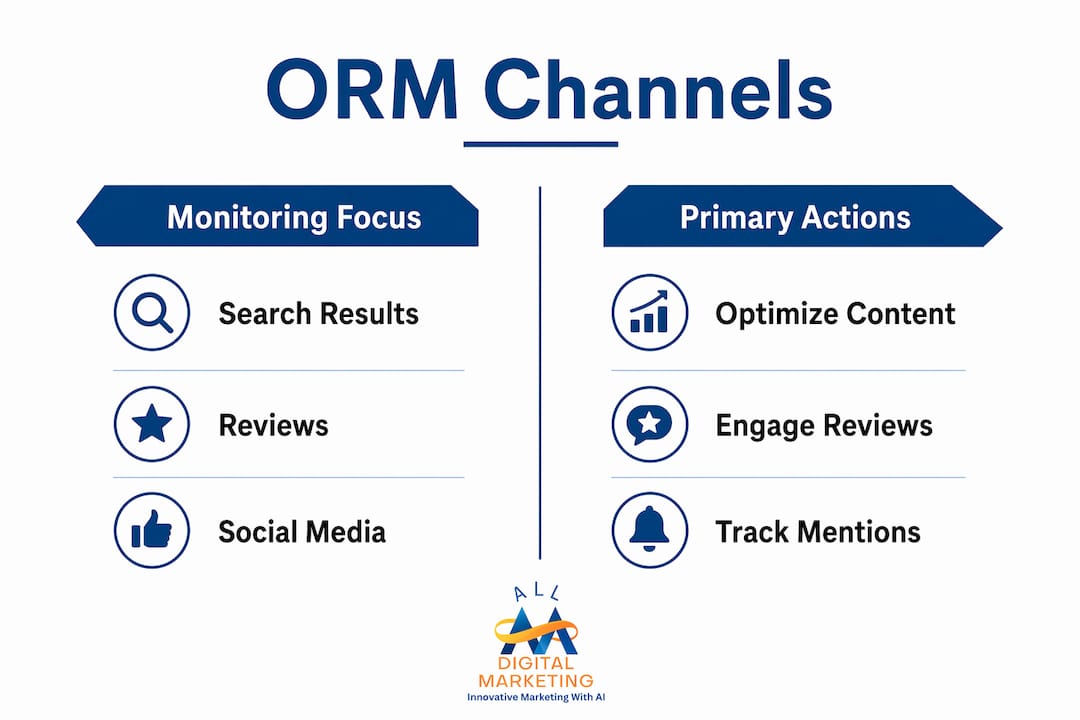
| Channel | Monitoring Focus | Primary Action Type |
|---|---|---|
| Google Search Results | Brand name, product, and review snippet rankings | SEO, content creation, review responses |
| Google Reviews & Trustpilot | Star ratings, review volume, sentiment trends | Solicitation, response, flagging policy violations |
| Social Media (Facebook, Instagram, X) | Mentions, tags, comments, direct messages | Engagement, moderation, proactive posting |
| News and Media Sites | Brand mentions in articles and press coverage | PR outreach, correction requests, content amplification |
| Forums and Communities (Reddit, Quora) | Organic brand discussions and complaints | Participation, clarification, community building |
Search engine results sit at the top of the priority list. ORM heavily depends on what appears in search results, making SEO and content strategies core components of the discipline. If a negative article or a competitor comparison ranks for your brand name, that is a reputation problem with an SEO solution.
Review platforms like Google Reviews and Trustpilot carry enormous weight because they appear directly in search results and influence click-through rates. Industry-specific directories, such as Healthgrades for medical practices or Avvo for law firms, carry similar authority within their verticals. Monitoring these platforms consistently is non-negotiable for any business that depends on local or service-based search traffic.
Social media monitoring goes beyond tracking your own posts. It includes tracking untagged mentions, hashtags, and competitor conversations where your brand might surface. Tools like Brandwatch, Mention, and Sprout Social automate this process at scale, giving marketing teams early warning signals before a conversation becomes a crisis.
News and media mentions require a different approach. A single negative article from a credible outlet can outrank your homepage for months. Proactive PR relationships, press release distribution, and rapid response protocols are the standard techniques for reputation management in this channel. Forums like Reddit and Quora are often overlooked, yet they rank prominently for long-tail brand queries and carry high trust signals with readers who treat peer advice as more credible than brand messaging.
What is the standard process cycle for managing digital reputation?
Effective ORM follows a four-stage continuous cycle. Understanding this cycle transforms reputation management from a reactive scramble into a predictable, manageable system.
- Monitor — Set up alerts and dashboards to track brand mentions, review activity, and sentiment signals across all relevant channels. Tools like Brandwatch, Google Alerts, and ReviewTrackers automate this step so nothing slips through.
- Analyze — Review the data for sentiment trends, volume spikes, and emerging themes. Sentiment scores and volume trends give early warnings and reputation insights at scale, converting unstructured conversations into intelligence your team can act on.
- Take action — Respond to negative reviews with empathy and specificity. Amplify positive mentions through social sharing, testimonial pages, and content repurposing. Address misinformation in forums or news articles through direct outreach or published corrections.
- Maintain engagement — Keep the cycle running. Proactively solicit reviews from satisfied customers, publish content that reinforces your brand values, and refine your response templates based on what has worked.
The ORM cycle emphasizes proactive, continuous monitoring and engagement rather than reactive crisis control. This distinction separates businesses that manage their reputation from those that merely react to it.
Assigning ownership is critical. Without a named person or team responsible for each stage of the cycle, monitoring lapses and response times slow down. Many small and mid-sized businesses assign ORM responsibilities to a marketing manager or agency partner, with clear escalation paths for high-priority issues.
Pro Tip: Set up a centralized reputation dashboard using a tool like Brandwatch or ReviewTrackers that aggregates mentions, review scores, and sentiment data in one view. Assign a weekly review cadence to a specific team member and document response templates for your five most common complaint types. This single step eliminates the reactive scramble that derails most ORM programs.
How does FTC compliance affect digital reputation management in 2026?
The FTC's Consumer Review Rule is one of the most misunderstood compliance areas in digital marketing. Many businesses believe that generating more positive reviews is always safe. It is not.
In December 2025, the FTC issued warning letters to businesses about practices that violate the Consumer Review Rule, including suppressing negative reviews, offering incentives only for positive feedback, and using fake or AI-generated reviews. Civil penalties reach up to $53,088 per violation. That is not a theoretical risk. It is an active enforcement priority.
"Fake reviews not only deceive consumers but also distort competition, harming honest businesses that play by the rules." — FTC, December 2025
The practical compliance requirements for any ORM program include the following:
- Solicit reviews from all customers, not just those you expect to leave positive feedback.
- Never offer discounts, gifts, or other incentives in exchange for positive reviews specifically.
- Disclose any material relationship between your business and a reviewer (such as an employee or paid partner).
- Do not suppress or selectively display reviews based on star rating.
- Avoid using third-party services that generate fake reviews, even if you did not create them directly.
Trying to game reviews for reputation protection is a misconception that can backfire legally. Compliance with FTC rules is not separate from reputation management. It is integral to it. A business caught violating the Consumer Review Rule faces not only financial penalties but also the reputational damage of being publicly named in an FTC enforcement action.
Pro Tip: Conduct a quarterly audit of your review solicitation process. Review every email, SMS, or in-app prompt you use to request feedback and confirm it asks for honest reviews without conditioning the request on a positive outcome. If you use a third-party review generation platform, verify their compliance policies in writing.
What best practices build a strong digital reputation strategy?
A sustainable digital reputation strategy is built on structure, not luck. The difference between businesses that maintain strong reputations and those that struggle is the presence of documented systems, not the absence of problems.
Build a monitoring and response framework first. Before you publish a single piece of content or send a review request, document who monitors which channels, how often, and what the escalation path looks like for a one-star review versus a media crisis. A sustainable reputation strategy treats trust as infrastructure requiring disciplined processes and measurement dashboards.
Personalize your responses to negative feedback. Generic responses to complaints signal that no one is actually listening. Address the reviewer by name, reference the specific issue they raised, and offer a concrete resolution path. This practice does more for your reputation than any volume of positive reviews, because it demonstrates accountability in public view.
Create content that shapes the narrative. ORM is more than reacting to negatives. It is about proactively shaping your digital footprint across all customer-relevant channels. Publish case studies, thought leadership articles, video testimonials, and FAQ content that ranks for your brand name and reinforces the story you want told. This content acts as a buffer against negative results by occupying search real estate with authoritative, positive signals.
Measure reputation as an operational metric. Continuous measurement of star ratings, sentiment scores, and review trends allows organizations to manage reputation as an operational system. Volatility in sentiment scores often signals inconsistency in the customer experience itself, not just in communications. When your scores swing widely week to week, the problem is usually operational, and no amount of review solicitation will fix it.
Handle crisis communication with transparency. Rapid acknowledgment and detailed communication during a crisis decreases negative sentiment over time and builds long-term trust. Silence or deflection amplifies the damage. A public statement that acknowledges the issue, explains what happened, and commits to a specific resolution timeline consistently outperforms "no comment" in both sentiment recovery speed and customer retention.
Align reputation efforts with brand values. Every response, every piece of content, and every review request should reflect the same brand voice and values. Inconsistency between what your brand claims and how it behaves online is immediately visible to customers and search algorithms alike. Brands that build authority in AI-driven search do so by maintaining consistent, credible signals across every channel over time.
Pro Tip: Align your ORM metrics directly with business goals. If your goal is to increase local service bookings, track how your Google Reviews star rating correlates with call volume month over month. This connection makes reputation management a revenue conversation, not just a marketing one, and secures leadership buy-in for the resources you need.
Key takeaways
Digital reputation management is a continuous operational system that requires monitoring, compliance, structured response protocols, and measurement to protect and grow brand trust across all digital channels.
| Point | Details |
|---|---|
| ORM is a continuous cycle | Monitor, analyze, act, and maintain engagement on a regular cadence rather than reacting to crises. |
| Channel prioritization matters | Focus on search results, Google Reviews, Trustpilot, social media, and industry forums based on where your customers are most active. |
| FTC compliance is non-negotiable | Fake or incentivized reviews carry civil penalties up to $53,088 per violation under the Consumer Review Rule. |
| Measurement drives improvement | Track star ratings, sentiment scores, and review trends as operational metrics tied to business outcomes. |
| Transparency builds long-term trust | Rapid, honest crisis communication reduces negative sentiment faster than any other single tactic. |
Why I think most businesses are one bad review away from a real problem
I have spent years watching businesses treat their online reputation like a smoke detector. They only think about it when something is already on fire. The businesses that come to Digitalmarketingall after a reputation crisis almost always share the same story: they had no monitoring in place, no response protocol, and no content strategy. When a damaging review or article appeared, they had nothing to push back with.
What strikes me most is how preventable the damage usually is. A single unanswered one-star review on Google, left sitting for six months, tells every prospective customer that no one at this company is paying attention. That signal is louder than ten positive reviews. And yet most small business owners I speak with check their Google Reviews maybe once a month, if at all.
The compliance piece is where I see the most dangerous blind spots. Business owners hear "get more reviews" and assume that means any reviews, by any means. The FTC's December 2025 enforcement actions are a wake-up call that the rules here are real and the penalties are significant. I have seen businesses use third-party services that promised review volume without disclosing their methods. That is a liability, not a strategy.
The businesses that get ORM right treat it the way they treat their accounting. They assign ownership, set a cadence, track the numbers, and adjust when something looks off. They do not wait for a crisis to care about their reputation. They build the system before they need it. That discipline is what separates brands that grow through trust from those that constantly fight fires they could have prevented.
— Diane
Ready to take control of your online reviews?
Your reputation is built one review at a time, and the businesses that manage that process deliberately outperform those that leave it to chance. Digitalmarketingall offers review generation and management services designed to help you monitor incoming reviews, solicit authentic feedback from satisfied customers, and respond to negative reviews with speed and professionalism. The platform also supports FTC-compliant review practices, so you can grow your review volume without legal exposure. If Yelp is a priority channel for your business, explore Yelp reputation support to address your specific needs there. Start building a reputation system that works for your business every day.
FAQ
What is digital reputation management in simple terms?
Digital reputation management is the practice of monitoring and influencing what people find when they search for your business online. It covers search results, review sites, social media, and news mentions.
How do online reputation management tools help businesses?
Tools like Brandwatch, ReviewTrackers, and Google Alerts automate mention tracking and sentiment analysis, giving businesses real-time visibility into how their brand is perceived across multiple channels simultaneously.
What are the FTC rules businesses must follow for online reviews?
The FTC's Consumer Review Rule prohibits fake reviews, suppressing negative feedback, and offering incentives only for positive reviews. Violations carry civil penalties up to $53,088 per violation as of the December 2025 enforcement actions.
How does ORM affect search engine rankings?
Search engine results are a primary channel for reputation management, and content strategy, review signals, and brand mentions all influence how your business ranks. A strong ORM program improves both visibility and the quality of results that appear for your brand name.
How often should a business review its digital reputation?
Reputation monitoring should run continuously through automated tools, with a dedicated human review of data at least weekly. Response to new reviews or mentions should happen within 24 to 48 hours to demonstrate active engagement.