

TL;DR:
- Structured data (schema markup) helps search engines understand content and boost visibility.
- Using the right schema types like LocalBusiness or Product increases chances of rich results and local pack appearances.
- Proper implementation and regular updates are essential to avoid penalties and maximize SEO benefits.
Most small business owners think SEO is all about keywords and content. That's part of it, but Google's search results are shaped by far more than what's on your page. Structured data, also called schema markup, tells search engines exactly what your content means, not just what it says. For local and national businesses, this distinction is critical. In this guide, we cover what structured data is, which types matter most for your business, and how to implement it to get real, measurable results in search rankings.
Table of Contents
- What is structured data, and why does it matter for SEO?
- Types of structured data most relevant for SMB SEO
- How structured data improves search results and visibility
- Best practices and common mistakes when implementing structured data
- Why structured data is the SEO advantage most businesses still miss
- Supercharge your SEO with expert help
- Frequently asked questions
Key Takeaways
| Point | Details |
|---|---|
| Direct SEO benefits | Structured data increases your website’s chance to appear in rich results and local map packs. |
| Essential schema types | Focus on LocalBusiness, Product, Article, and Organization schema for maximum visibility. |
| Implementation best practices | Accuracy, regular updates, and testing are critical to avoid penalties and ensure results. |
| Hidden competitive edge | Most small businesses ignore structured data, so using it can quickly set you apart. |
What is structured data, and why does it matter for SEO?
Structured data is a standardized format that organizes information so search engines can read and understand it quickly. Think of it as a label on a product: instead of Google having to guess what your business does, you tell it directly using code from schema.org, the universal vocabulary for structured markup.
To understand why this matters, it helps to compare three types of web content:
- Unstructured content: Plain text, like a paragraph on your homepage. Google reads it but must interpret meaning on its own.
- Semi-structured content: HTML with some tags, like headings or lists. Better, but still not fully clear to search engines.
- Structured data: Schema markup that explicitly defines your content's meaning, such as your business name, hours, location, or product price.
When you add schema markup to your site, you're essentially speaking Google's language. And that has real consequences for your visibility.
"Structured data is one of the clearest signals you can send to a search engine. It removes guesswork and gives Google the confidence to display your business more prominently."
The SEO impacts are direct and measurable. Structured data enables rich results, which are enhanced search listings that show star ratings, pricing, FAQs, or product images right in the results page. It also boosts your chances of appearing in the local map pack, AI-driven search answers, and featured snippets. You can get a full overview of how this works in our schema markup overview.
According to industry data, LocalBusiness schema boosts map pack and local pack visibility by 30 to 60 percent, and national visibility improves through Product and Article schemas for rich snippets across competitive queries. Those are not minor gains. For a small business competing with larger brands, that kind of edge can translate directly into more calls, more clicks, and more customers.
Types of structured data most relevant for SMB SEO
Not all schema types are equally useful for every business. The right markup depends on your business model and your primary goals, whether that's local foot traffic, e-commerce sales, or content-driven authority.
Here are the four most impactful schema types for small and medium-sized businesses:
- LocalBusiness schema: Designed for brick-and-mortar or service-area businesses. It includes your address, phone number, hours, and geographic coordinates. This is the foundation for local map pack visibility.
- Product schema: Ideal for e-commerce businesses. It surfaces price, availability, and reviews directly in search results.
- Article schema: Used for blogs and news content. It signals to Google that your content is editorial, which can qualify it for top stories or AI-generated answer features.
- Organization schema: A site-wide schema that defines your brand identity, including your logo, social profiles, and contact info. Every business should have this.
Here's a quick comparison to help you identify what fits your situation:
| Business type | Top schema to use | Primary benefit |
|---|---|---|
| Local service business | LocalBusiness | Map pack visibility |
| E-commerce store | Product | Rich snippets with pricing |
| Blog or media site | Article | Featured snippets, top stories |
| Any business | Organization | Brand recognition site-wide |
The key schema types for SMBs are LocalBusiness for local markets, Product for e-commerce, Article for blogs, and Organization for your overall brand presence. Choosing the right one matters more than trying to use all of them.
For businesses competing locally, combining LocalBusiness schema with a fully optimized profile is a powerful move. If you haven't already, it's worth reviewing how to optimize Google Business Profile alongside your schema work. And if you want to go deeper on visibility tactics, our guide on local business SEO tactics has a lot of actionable detail.
How structured data improves search results and visibility
Understanding which schema to use is just the first step. Let's look at what actually happens when you implement it correctly.
Rich results are the most visible outcome. When your schema is validated and indexed, Google may display your listing with star ratings, event dates, product prices, or FAQ dropdowns directly in the search results. This makes your listing larger and more informative, which drives higher click-through rates even if your ranking position doesn't change immediately.
Here's a look at how different schema types affect search performance:
| Schema type | Search feature unlocked | Typical visibility impact |
|---|---|---|
| LocalBusiness | Map pack, local panel | 30 to 60% increase in local visibility |
| Product | Price, stock, review stars | Higher CTR on product pages |
| Article | Top stories, AI answers | Content featured in AI-driven results |
| FAQ | Dropdown answers in SERP | More page space, reduced competition |
Pro Tip: Before you add schema, document your current click-through rate and ranking position for target pages using Google Search Console. This gives you a clear before-and-after comparison to measure your results.
For local businesses, LocalBusiness schema boosts map pack and local pack visibility by 30 to 60 percent, which is a significant lift in competitive local markets. For national brands, Product and Article schemas open doors to rich snippets across high-volume queries.
Practically speaking, consider a plumbing company that adds LocalBusiness schema with accurate hours, service area, and reviews. After indexing, they appear in the local map pack for "emergency plumber near me" searches, which previously showed only larger directories. That's real business impact from a one-time technical update.

For a complete strategy that ties schema into your broader local presence, the AI-powered local SEO checklist is a solid resource. You can also see how schema improves rankings through consistent implementation over time.
Best practices and common mistakes when implementing structured data
Getting structured data right matters. Done poorly, it can actually hurt you. Here's how to do it correctly from the start.
- Choose the right schema type for each page, not just one type for your whole site. Product pages need Product schema. Service pages need Service or LocalBusiness schema.
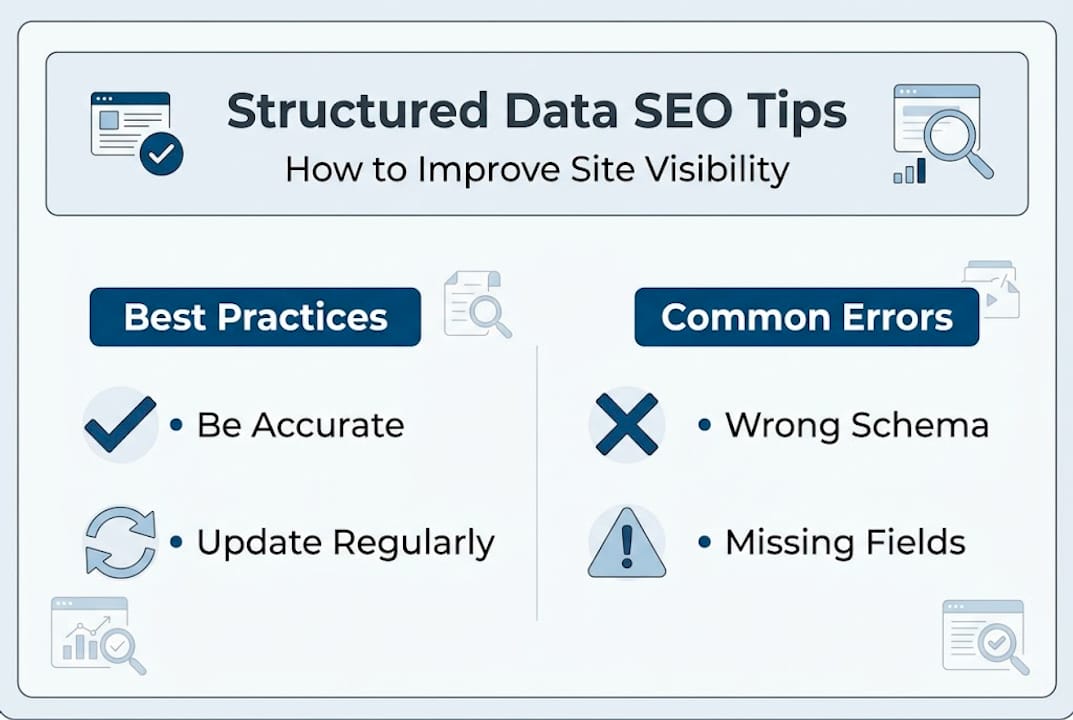
- Be accurate and complete. Every required field should have real, correct information. Google cross-checks schema data against your visible page content.
- Test before you publish. Use Google's Rich Results Test tool or Schema Markup Validator to catch errors before they go live.
- Update your markup regularly. If your hours change, your products change, or your services shift, your schema must reflect that immediately.
- Avoid mismatched or spammy markup. Don't add review stars to pages with no reviews, or use FAQ schema for content that isn't actually a Q&A. Google penalizes misleading markup.
The best practices for schema implementation are clear: be accurate, be complete, be specific, update regularly, and always test before deploying. Avoiding spam means your markup stays trustworthy.
Pro Tip: Start with one or two schema types that match your highest-traffic pages. Get those right before scaling to the rest of your site. Quality implementation on a few pages beats incomplete markup across all of them.
One of the most common mistakes we see is businesses setting up schema once and never revisiting it. Structured data is not a "set it and forget it" task. Treat it like your content: it needs regular attention. If you want to build a content workflow that keeps all your SEO elements current, including schema, read our guide on how to improve your content workflow.
Why structured data is the SEO advantage most businesses still miss
Here's something worth saying plainly: most small businesses are leaving real search visibility on the table because they've never touched structured data.
The typical mindset is, "My site has the right keywords and some good content, so Google should rank me." That was a reasonable assumption in 2015. In 2026, with AI-powered search results, rich SERP features, and local packs dominating the top of the page, content alone is not enough.
What makes structured data such a strong opportunity right now is precisely that most of your competitors haven't implemented it. You don't need to outspend larger brands. You need to give Google clearer information than they do. That's a technical edge, not a budget issue.
We also think continuous schema optimization is becoming non-negotiable as AI-driven local SEO tactics reshape how results are delivered. AI search features pull heavily from structured, verified data sources. Businesses that have their schema in order will be surfaced first. Those that don't will keep wondering why their competitors appear and they don't.
The window to act before structured data becomes universal best practice is still open. Not for long.
Supercharge your SEO with expert help
Structured data is one of the highest-leverage SEO moves available to small businesses, and getting it right the first time saves you from costly corrections later. If you're not sure where to start, or you want someone to audit and implement schema properly across your site, we're here to help.

At Digital Marketing All, our affordable website solutions include structured data implementation as part of a complete SEO foundation. Or, if you want a fully managed online presence without the upfront cost, check out our rent a site option. Both are built to perform in local and national search from day one. Reach out today and let's get your business showing up where it counts.
Frequently asked questions
How do I add structured data to my small business website?
Most SMBs add structured data using plugins like Yoast SEO, website builders with built-in schema tools, or by having a developer embed schema.org markup manually into the site's HTML. The approach depends on your platform and technical comfort level.
How quickly does structured data help my SEO?
Improvements typically appear within a few weeks after accurate schema is added and indexed, though timing varies by crawl frequency. LocalBusiness schema in particular can show map pack gains relatively quickly once Google re-crawls your pages.
What's the most important schema type for local SEO?
LocalBusiness schema is the most critical for local visibility because it directly supports map pack placement and local panel appearances. Map pack visibility can increase by 30 to 60 percent with accurate LocalBusiness markup in place.
Can structured data trigger penalties or spam warnings from Google?
Yes, mismatched or misleading schema can result in manual actions from Google. Always ensure your markup accurately reflects page content and validate it with Google's Rich Results Test before publishing.