

TL;DR:
- Building a tailored content workflow ensures better alignment with SMB goals and team capabilities.
- AI tools significantly reduce content production time but require human review to maintain quality.
- Regular audits, clear roles, and ongoing optimization are essential for effective content marketing processes.
If your content marketing feels like a constant scramble, you're not alone. Many small to medium-sized businesses waste hours each week on disorganized processes, inconsistent publishing, and unclear team roles. The result is content that underperforms and a marketing strategy that never gains real traction. This guide gives you a practical, step-by-step framework to build a content marketing workflow that saves time, improves quality, and positions your business to benefit from AI-powered tools. Whether you're starting from scratch or fixing a broken process, these strategies will help you move from chaos to clarity.
Table of Contents
- What you need to build an effective content marketing workflow
- Step-by-step SMB content marketing workflow
- Integrate AI into your content marketing workflow
- Common mistakes and how to troubleshoot your workflow
- Why a tailored workflow beats any template
- Take your workflow further with digital marketing expertise
- Frequently asked questions
Key Takeaways
| Point | Details |
|---|---|
| Identify and organize steps | A defined workflow prevents wasted effort and keeps your marketing consistent. |
| Leverage AI for efficiency | AI tools can reduce content creation time and help maintain quality throughout your process. |
| Avoid common workflow pitfalls | Solve bottlenecks by reviewing roles, audits, briefs, and distribution regularly. |
| Customize for your business | The best workflow adapts to your goals, market, and digital maturity—not just templates. |
What you need to build an effective content marketing workflow
Before you build anything, you need the right foundation. A solid content marketing workflow starts with three core components: the right tools, clearly defined team roles, and a plan for integrating AI where it makes the most sense.
Essential tools for your workflow:
- Content calendar: A shared calendar keeps your team aligned on deadlines, topics, and publishing dates. Tools like Trello, Asana, or Notion work well for SMBs.
- Collaboration platform: Slack, Google Workspace, or Microsoft Teams keeps communication centralized and reduces back-and-forth email chains.
- Analytics software: Google Analytics 4, Search Console, or a platform like Semrush helps you measure what's working and what needs adjustment.
- AI writing and ideation tools: ChatGPT, Jasper, or similar tools speed up brainstorming, drafting, and repurposing content across channels.
Team roles that matter:
Even if you're a small team, someone needs to own each function. The key roles are strategist (sets goals and direction), creator (writes or produces content), editor (reviews for quality and brand voice), and distributor (handles publishing and promotion). One person can cover multiple roles, but each responsibility must be assigned.
Content marketing workflows typically follow a multi-step process including strategy, audience research, and planning. Skipping any of these steps creates gaps that slow your entire operation down.
| Tool category | Example tools | Primary function |
|---|---|---|
| Project management | Asana, Trello, Notion | Task tracking and deadlines |
| Communication | Slack, Google Workspace | Team collaboration |
| Analytics | GA4, Semrush, Search Console | Performance measurement |
| AI assistance | ChatGPT, Jasper, Copy.ai | Ideation and drafting |
Pro Tip: Choose tools that scale with your business. A platform that works for a 3-person team should still work when you grow to 10. Avoid tools that lock you into rigid structures you'll outgrow quickly.
If you're also managing a social media strategy setup, make sure your content workflow integrates with your social publishing schedule from the start. Disconnected workflows create duplicate work.
Step-by-step SMB content marketing workflow
With your tools and roles in place, it's time to map out each phase of your workflow. SMBs often use a 6-9 step process for content marketing, including audit, keyword research, and iterative refresh cycles. Here's how to execute each one.
- Set strategy and goals. Define what success looks like. Are you driving leads, building brand awareness, or improving search rankings? Your goals shape every decision that follows.
- Research your audience and ICP. Identify your ideal customer profile (ICP). Know their pain points, preferred content formats, and where they spend time online.
- Conduct a content audit. Review existing content to identify what's performing, what's outdated, and what gaps need to be filled.
- Do keyword research. Use tools like Semrush or Ahrefs to find high-intent keywords your audience is actively searching. Follow simplified SEO steps to prioritize terms with real traffic potential.
- Build content clusters. Group related keywords into topic clusters. Each cluster has one pillar page and several supporting articles that link back to it.
- Create content. Write, design, or produce your content with SEO and audience intent in mind. Use blog creation for rankings to structure posts that perform in both Google and AI-generated results.
- Publish with SEO best practices. Optimize titles, meta descriptions, headers, and internal links before publishing. Apply SEO content writing tips to every piece.
- Distribute across channels. Share content through email, social media, paid promotion, and partner networks. Match the format to each channel.
- Measure performance. Track traffic, engagement, conversions, and rankings. Compare results against your original goals.
- Refresh and update. Revisit older content every 3 to 6 months. Update statistics, improve readability, and add new internal links.
"A workflow without a refresh cycle is just a publishing schedule. The real value comes from treating content as a living asset."
| Stage | Traditional workflow | AI-enhanced workflow |
|---|---|---|
| Ideation | Manual brainstorming | AI-generated topic clusters |
| Drafting | Writer starts from scratch | AI draft, human refinement |
| SEO optimization | Manual keyword placement | AI-assisted optimization |
| Distribution | Scheduled manually | Automated multi-channel posting |
| Performance review | Monthly manual reports | Real-time AI analytics dashboards |
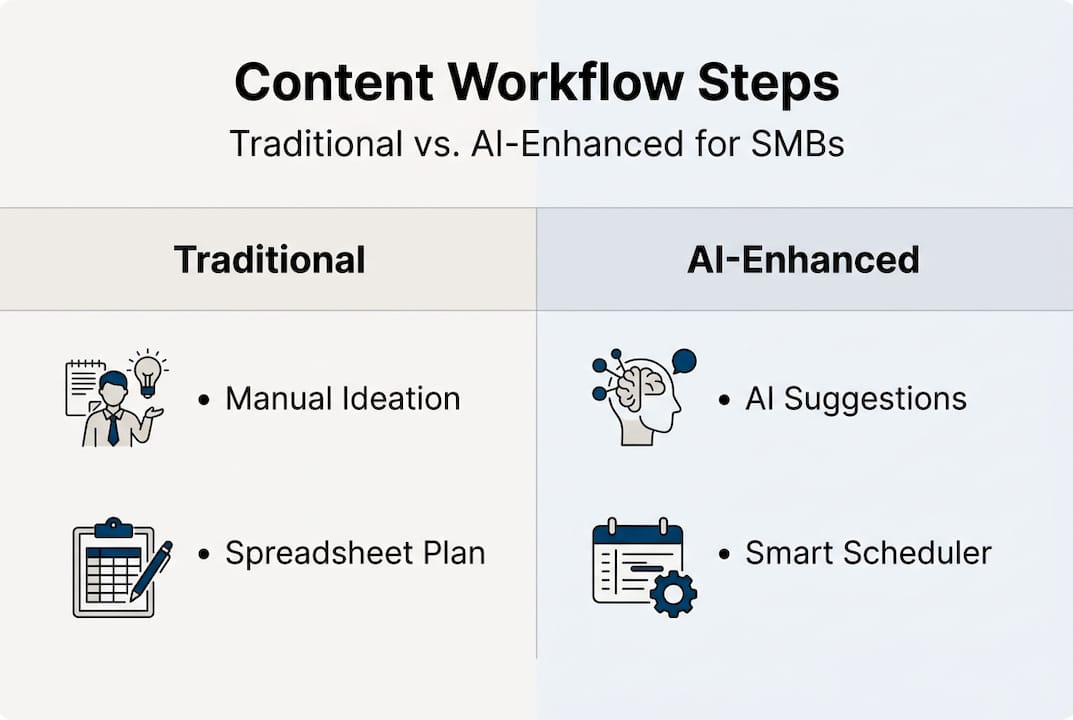
Pro Tip: Build your refresh cycle into your content calendar from day one. Set a recurring task every quarter to review your top 10 pieces. Small updates compound into significant ranking improvements over time.
Integrate AI into your content marketing workflow
Once your workflow is defined, AI becomes your most powerful productivity tool. AI integration streamlines SMB workflows by automating ideation, drafting, SEO optimization, and repurposing. The result is faster production without sacrificing quality when you apply it correctly.
Here's how a typical AI-assisted content workflow looks:
- Define your content pillars. Identify 4 to 6 core topics that align with your business goals and audience interests.
- Train AI on your brand voice. Feed your AI tool with examples of your best content so it mirrors your tone and style.
- Create a detailed brief. Before generating anything, write a brief that includes target keyword, audience, goal, and structure.
- Generate a first draft. Use AI to produce a working draft quickly. This is a starting point, not a finished product.
- Human review and refinement. Your editor refines the draft, adds original insights, and ensures the content reflects your brand accurately.
Tasks AI can automate in your workflow:
- Generating topic ideas based on trending keywords
- Writing first drafts for blog posts, social captions, and email sequences
- Summarizing long-form content into short-form formats
- Suggesting internal linking opportunities
- Creating meta descriptions and title tag variations
- Repurposing articles into video scripts or podcast outlines
AI tools can reduce content production time from several hours to under 30 minutes per piece. That's a significant efficiency gain for small teams managing multiple channels. Pair AI with video content tools to repurpose written content into video formats that rank well in search.

You can also use AI to boost visibility by optimizing content for featured snippets and AI-generated search results. For a deeper look at advanced tactics, explore secret SEO strategies that give your content a competitive edge.
Pro Tip: Never publish AI-generated content without a human review pass. AI can produce factual errors, generic phrasing, and off-brand tone. A 15-minute editorial review protects your credibility and keeps your content genuinely useful.
Common mistakes and how to troubleshoot your workflow
Even well-designed workflows break down. Knowing where things typically go wrong helps you fix problems before they cost you traffic, time, or leads.
Mistake 1: Skipping the content audit. Many SMBs jump straight to creating new content without reviewing what already exists. This leads to duplicate topics, missed optimization opportunities, and wasted effort. Fix it by scheduling a quarterly audit before any new content planning begins.
Mistake 2: Unclear roles and responsibilities. When everyone assumes someone else is handling a task, things fall through the cracks. Fix it by documenting who owns each workflow step in your project management tool. No ambiguity.
Mistake 3: Weak or missing content briefs. Vague briefs produce vague content. A strong brief includes the target keyword, audience segment, content goal, word count, and key points to cover. Fix it by creating a brief template your team uses every time.
Mistake 4: Poor channel distribution strategy. Publishing great content and then only sharing it once on one platform is a missed opportunity. Fix it by building a distribution checklist that covers email, social, paid, and partner channels for every piece.
Mistake 5: Neglecting KPI measurement. If you're not tracking performance, you're guessing. Fix it by setting up a monthly review where you compare content performance against your original goals. Human review is essential for maintaining brand voice and quality even in AI-driven workflows, and the same discipline applies to performance analysis.
Watch out for search optimization pitfalls that can quietly undermine your content's visibility even when the workflow itself is running smoothly.
Pro Tip: Schedule a 30-minute workflow review session every month with your team. Ask three questions: What's slowing us down? What's working well? What should we stop doing? This habit keeps your process sharp and prevents small inefficiencies from becoming big problems.
Why a tailored workflow beats any template
Here's something most marketing guides won't tell you: the best workflow is the one you actually use, not the one that looks perfect on paper. Templates are a useful starting point, but they're built for a generic business, not yours.
Most templates miss the variables that matter most to SMBs: your specific market, your team's digital maturity, and the cultural habits that shape how your team actually works. A workflow borrowed from a SaaS company in San Francisco won't automatically translate to a regional service business in the Midwest.
The hard-won lesson we've seen repeatedly is that businesses that test, adjust, and iterate their own workflows consistently outperform those that copy best practices without adapting them. Your customized strategy should reflect your goals, your tools, and your audience, not someone else's.
True workflow optimization comes from ongoing feedback loops, not a static checklist you set and forget. Build in regular review points and treat your workflow as a living system that evolves with your business.
Take your workflow further with digital marketing expertise
Building a strong content marketing workflow is a major step forward. But getting consistent results from that workflow often requires more than a good process. It requires the right expertise behind it.

At Digital Marketing All, we help SMBs build and execute content strategies that drive real visibility and leads. From managing online reviews that strengthen your reputation to Yelp reputation support that builds local trust, and website strategy consulting that ties your content to conversions, we offer the hands-on guidance your business needs. If you're ready to stop guessing and start growing, let's build a workflow that works for your specific goals.
Frequently asked questions
What are the most important steps in a content marketing workflow for SMBs?
Strategy and goals, research, planning, content creation, publishing, distribution, measurement, and iterative refresh are the key steps. SMB workflows typically follow a 6-9 step process that covers each of these phases.
How does AI really impact content workflow efficiency?
AI can automate ideation, drafting, and SEO, reducing content production time from hours to under 30 minutes per piece. AI workflow automation makes it possible for small teams to produce more content without sacrificing quality.
How can I avoid common workflow mistakes?
Ensure clear roles, regular content audits, detailed briefs, strong channel strategies, and ongoing KPI measurement. Human review ensures brand voice and quality are maintained even when AI tools handle the heavy lifting.
Why should I customize my workflow instead of using templates?
Customization allows you to match the workflow to your goals, tools, and market, leading to better long-term results. Iterative feedback and tailored solutions consistently outperform generic templates for SMBs.
Recommended
- Short-Form Video Secrets to Boost Your Views Fast
- Ranking Higher in Searches: Simplified SEO Strategies
- Why Short-Form Video Is Your Secret Weapon for Business Growth in 2025
- Why Short-Form Videos Are the Most Powerful Marketing Tool in 2025
- Streamline your wedding venue marketing workflow: SA guide