

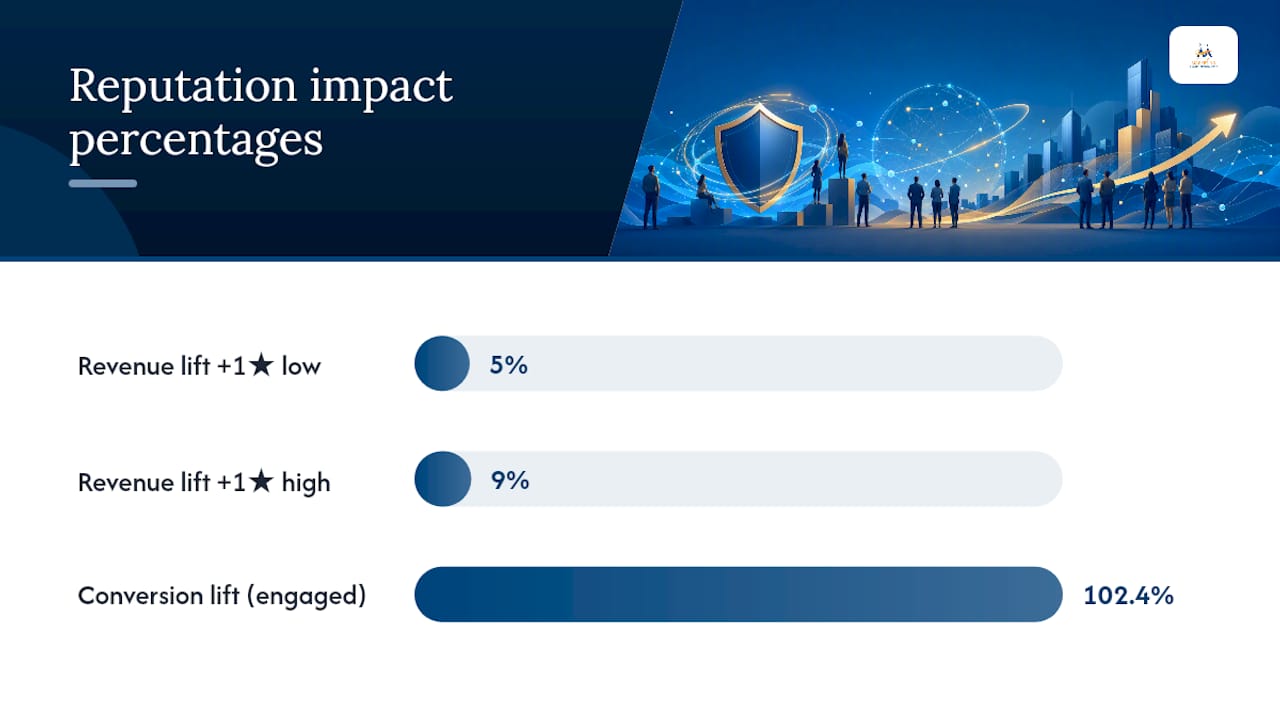
The benefits of reputation management come down to five outcomes: more customer trust, higher conversion rates, stronger revenue, better hiring, and faster recovery when something goes wrong. A one-star increase in average rating correlates with a 5% to 9% revenue lift for many businesses, and visitors who interact with reviews before buying convert 102.4% higher than those who don't. A study of 251 small business owners found that active reputation management directly improves Google star ratings and overall performance, especially in competitive markets.
Here's how those gains typically show up by business function:
- Sales: Higher star ratings and recent reviews shorten the path from search to purchase.
- Marketing: Reviews become free, credible content that improves local search visibility.
- Hiring: Candidates check employer reviews the same way customers check product reviews.
- Operations: Early detection of complaints prevents small problems from becoming public crises.
Table of Contents
- What Are the Benefits of Reputation Management, Exactly?
- How Does Reputation Management Affect Trust, Revenue, and Hiring?
- How Do Businesses Actually Build a Strong Reputation?
- What Does the Research Say About Reputation and Revenue?
- Which KPIs Prove Reputation Management Is Working?
- Which Platforms and Tools Should SMBs Prioritize First?
- Should You Manage Reputation In-House or Hire an Agency?
- What's a Realistic 90-Day Reputation Management Checklist?
- What Should Business Owners Expect From Reputation Work?
- How Digital Marketing All Helps You Build a Stronger Reputation
- Sources
- FAQ
What Are the Benefits of Reputation Management, Exactly?
Reputation management is the ongoing practice of monitoring, shaping, and responding to how a business appears across search results, review platforms, and social channels. It's broader than "review management," which usually refers to the tactical job of asking for reviews and replying to them. Reputation management includes that work, but it also covers social listening, search-result monitoring, and coordinating messaging across PR, customer service, and marketing.
Think of it this way: review management is a task list. Reputation management is the system that decides what's on that list and why.
For a small business, reputation management typically includes monitoring and engaging with local businesses in southern California as part of building a trusted online profile.
- Monitoring Google Business Profile and Google Reviews for new activity and ranking changes.
- Responding to Yelp and Facebook Reviews within a consistent window, not just when someone complains.
- Watching social mentions for complaints that haven't yet become public reviews.
- Managing what appears on page one of search results for the business name, including news mentions and directory listings.
A restaurant that replies to Yelp reviews is doing review management. A restaurant that tracks sentiment trends, flags a recurring complaint about wait times, fixes the staffing issue, and then adjusts its Google Business Profile description to reflect faster service is doing reputation management. Learn more about the scope of online brand reputation and how it applies to smaller operations.
How Does Reputation Management Affect Trust, Revenue, and Hiring?
Reputation touches more parts of a business than most owners initially assume. Here's how the effects break down by category.
Trust and conversion
Shoppers treat reviews as a substitute for personal recommendations. Roughly 93% of consumers read reviews before making a purchase, and that behavior holds across nearly every product and service category. When a prospective customer sees consistent, recent, positive feedback, they skip the skepticism stage that normally slows down a purchase decision. A weak or outdated review profile does the opposite. It makes even a good product look questionable.
Revenue and search visibility
The dollar impact is well documented. Harvard Business School's research on ratings found that a one-star increase in average rating drives a 5% to 9% revenue increase across many business categories. For a local business generating $600,000 a year, that's a potential swing of $30,000 to $54,000 tied to nothing more than review quality and volume. Businesses with strong ratings and steady review activity also tend to rank higher in local search results, because review velocity and recency function as ranking signals search engines actually weigh.
Quick math: A jump from 3.8 to 4.8 stars isn't just a vanity metric. On a $600K revenue base, it can represent tens of thousands of dollars in new business, before a single dollar is spent on ads.
Customer retention and lifetime value
Customers who feel heard tend to stay. A business that responds to negative reviews thoughtfully, rather than defensively, often converts an unhappy customer into a repeat one. This isn't guesswork. It shows up directly in the retention data companies track after implementing structured response workflows.
Talent attraction and hiring
Job candidates research employers the same way customers research products, and a damaged online reputation shows up in longer hiring cycles and higher recruiting costs. Reputation management fosters not just customer loyalty but also helps attract stronger talent because candidates trust a business with visible, consistent positive signals across review and employer sites.
Crisis resilience and partnerships
A business with a reputation management system in place absorbs a bad review or a negative news mention without it spiraling. One angry post doesn't sink a company with 200 recent five-star reviews behind it. It's a different story for a business with no recent reviews and a thin online presence, where a single complaint can dominate the first page of search results for months.

Reputation extends into B2B territory too. Verified reputation profiles now factor into $4.2 trillion in B2B trade decisions, and vendors with above-average reputation scores can command price premiums of 3% to 8% over competitors with weaker profiles.
How Do Businesses Actually Build a Strong Reputation?
Reputation doesn't improve by accident. It's the output of a repeatable process.
- Monitor continuously. Track Google Business Profile, Yelp, Facebook Reviews, and broader web mentions daily or weekly, not quarterly.
- Generate reviews proactively. Ask satisfied customers at the right moment, usually right after a positive interaction, rather than hoping reviews accumulate organically.
- Respond on a consistent schedule. Every review, positive or negative, gets a reply within a set window, ideally 24 to 48 hours.
- Triage social listening signals. Catch complaints on social media before they escalate into public reviews or viral posts.
- Optimize search-result presence. Address what shows up on page one for the business name, including outdated directory listings or old news coverage.
- Run proactive PR and content. Publish positive coverage and customer stories that push down anything unflattering in search results.
Platforms like Google Business Profile, Yelp, and Facebook Reviews cover the review-generation and response layer. Broader listening tools track brand mentions across the open web and social platforms.
Pro Tip: Avoid templated responses copied word-for-word across reviews. Search engines and customers both notice canned language, and review velocity and recency matter more for ranking than sheer review count. A steady trickle of fresh reviews outperforms a one-time push that goes stale.
What Does the Research Say About Reputation and Revenue?
The connection between reputation and revenue isn't a marketing claim. It's been studied directly. The study of 251 small business owners found that reputation management practices measurably increase Google star ratings and overall business performance, with the effect growing stronger in more competitive markets. Owners with higher customer orientation and more confidence using digital tools saw larger gains, suggesting execution quality matters as much as having a strategy on paper.
A broader academic review of online review research reinforces the point at scale: reviews shape sales, product performance, and consumer trust across industries, and how a business responds to reviews (not just what customers write) shapes those outcomes.
Roughly 9 in 10 consumers check reviews before buying, and a single star of improvement in average rating tracks with a mid-single-digit-to-high-single-digit percentage revenue gain across the businesses studied.
For B2B companies, the picture is similar but plays out over longer sales cycles, with reputation signals like verified reviews and case studies influencing win rates rather than a single purchase click. Readers who want the full mechanics behind these numbers can dig into why reputation management drives business success for a deeper breakdown.
Which KPIs Prove Reputation Management Is Working?
Tracking the right numbers turns reputation management from a feel-good activity into a line item a CFO will respect.
- Average star rating across Google, Yelp, and Facebook, tracked monthly.
- Review velocity — the pace of new reviews coming in, since stale profiles lose ranking weight.
- Response rate and response time to both positive and negative reviews.
- Conversion lift among visitors who interact with reviews versus those who don't.
- Organic and local search visibility, measured through map-pack rankings and branded search impressions.
- Referral traffic from review platforms and directory listings.
- Customer lifetime value trends before and after reputation improvements.
Report these monthly to ownership, and quarterly in more depth if you're working with a board or investor group. The cleanest way to prove attribution is a before/after comparison using a control period, comparing revenue and conversion trends in a similar prior stretch before major reputation changes took effect.
Which Platforms and Tools Should SMBs Prioritize First?
Not every platform deserves equal attention out of the gate. Start where your customers already are.
- Google Business Profile and Google Reviews come first for almost every local business; this is where most search-driven discovery happens.
- Yelp matters heavily for restaurants, home services, and hospitality.
- Facebook Reviews still carries weight for community-oriented and local businesses with an active social following.
- Birdeye and Podium automate review requests and centralize responses across multiple platforms.
- Brandwatch and Sprout Social add social listening for businesses that need to catch brand mentions beyond formal reviews.
- Google Alerts offers a free, basic way to track brand mentions across the open web.
- Yext helps manage listing accuracy across directories, which affects both search visibility and review consistency.
Entry-level tools cover monitoring and basic response workflows. Enterprise platforms add automation, reporting dashboards, and CRM integration, which pays off once review volume gets too high to manage manually. For most SMBs, the tipping point arrives somewhere around 20 to 30 new reviews a month across all platforms combined.
Should You Manage Reputation In-House or Hire an Agency?
The right choice depends on capacity, risk, and how fast you need results.
- Assess internal capacity. If nobody owns review response consistently, that gap alone justifies outside help.
- Check review volume. A handful of reviews a month is manageable in-house; dozens across multiple platforms usually isn't.
- Weigh crisis exposure. Businesses in regulated or reputation-sensitive industries need faster response capability than a part-time team can typically deliver.
- Consider procurement risk. B2B companies facing vendor reviews during RFPs should treat reputation as a sales function, not an afterthought.
When vetting an agency, ask about response-time service levels, reporting cadence, which platforms they cover, and whether they can show real case outcomes. Warning signs you need specialist help include damaging content ranking on page one for your business name, procurement teams flagging your reviews as a disqualifier, or a negative trend that's lasted more than a quarter. The step-by-step reputation management checklist is a useful gut check before that conversation.
What's a Realistic 90-Day Reputation Management Checklist?
- Audit every profile — Google Business Profile, Yelp, Facebook, and any industry-specific review sites. (Week 1)
- Set up monitoring with alerts for new reviews and brand mentions. (Week 1)
- Automate review requests triggered after a purchase or service completion. (Week 2 to 4)
- Build response templates as starting points, customized per review, not copy-pasted. (Week 2 to 4)
- Schedule weekly triage to catch and address negative trends before they compound. (Ongoing from Week 4)
- Fix search-result issues — outdated listings, broken directory entries, unclaimed profiles. (Days 30 to 60)
- Set up monthly reporting tied to the KPIs above. (Day 60 onward)
Owners typically handle the audit and vendor selection; marketing staff or a hired vendor manage day-to-day monitoring and response.
Pro Tip: The fastest measurable win is usually just responding to every unanswered review from the last 90 days. It costs nothing and often moves the needle on rating trends within a month, before any other tactic kicks in. For local businesses specifically, reputation tactics tied to local SEO tend to compound fastest.
What Should Business Owners Expect From Reputation Work?
Reputation management rarely delivers dramatic results in the first month, and owners who expect a 30 day transformation usually end up disappointed. What typically happens instead: by day 30, response workflows are running and review velocity starts climbing. By day 90, star ratings begin shifting, and local search visibility often improves. By day 180, revenue attribution becomes clear enough to show a CFO or investor.
The biggest friction point isn't the tools. It's internal buy-in, particularly around review solicitation cadence and response tone that sounds human rather than corporate. Businesses that treat this as a quarterly project instead of a paid-ads afterthought tend to see it compound. Reputation gains stack over time in a way that paid acquisition, which resets every time the budget runs out, simply doesn't.
How Digital Marketing All Helps You Build a Stronger Reputation
Running review requests, response workflows, and Google Business Profile optimization on top of everything else that comes with owning a small business is a lot to juggle without dropping something. Digital Marketing All handles review generation, reputation monitoring, and profile optimization as part of a broader visibility strategy built for how customers and AI search tools actually find businesses today. Unlike a one-off review tool that only handles requests, this connects reputation directly to search visibility and AI-driven discovery, so a stronger star rating also translates into stronger rankings.
If you want to see where your business currently stands in AI-driven search results and get a clear roadmap for closing the gap, check out the LLM Directory & AI Search Roadmap. A discovery call typically covers a review-profile audit, a visibility gap assessment, and a proposed 90 day plan with specific KPI targets attached.
Reputation management works because consistent monitoring, review response, and search optimization compound into measurable trust, revenue, and hiring gains over time.
| Point | Details |
|---|---|
| Revenue impact is measurable | A one-star rating increase correlates with a 5% to 9% revenue lift for many businesses. |
| Reviews drive conversion | Visitors who engage with reviews convert 102.4% higher than those who don't. |
| Strategy beats sporadic effort | A study of 251 SMB owners found active reputation management improves both ratings and performance. |
| Prioritize the right platforms | Start with Google Business Profile, Yelp, and Facebook Reviews before adding tools like Birdeye or Sprout Social. |
| Digital Marketing All connects reputation to visibility | Its review generation, monitoring, and Google Business Profile optimization tie directly into AI search visibility strategy. |
Sources
For readers who want the primary data behind these numbers: the HBS research on ratings and revenue anchors the star-rating figures; the SMB reputation study provides direct small-business evidence; the ScienceDirect literature review covers broader economic effects; and TrustSync's review statistics compile current consumer behavior data.
- From reviews to revenue: examining the impact of online reputation management on small business performance
- How Online Reputation Affects Revenue: Data and Strategies (2026) | Endorsa
FAQ
Why Is Reputation Management Important?
It's important because reputation signals directly shape buying decisions, search rankings, and hiring outcomes. A one-star rating increase can shift revenue by 5% to 9%, and weak reputation profiles quietly cost businesses customers who never even reach out.
What Is a Reputational Benefit?
A reputational benefit is a measurable business advantage that comes from a strong public image, such as higher conversion rates, easier talent recruitment, price premiums in B2B deals, or faster recovery from a negative event.
How Long Does It Take to See Results From Reputation Management?
Response workflows and review velocity typically improve within 30 days, star ratings shift by around 90 days, and clear revenue attribution usually becomes visible by 180 days.
Can a Small Business Manage Reputation Without an Agency?
Yes, if review volume is low and someone owns the process consistently; businesses with high review volume, multiple locations, or active crisis exposure usually benefit from bringing in specialist help like Digital Marketing All's review management services.
Does Reputation Management Affect B2B Sales, Not Just Retail?
Yes. Verified reputation signals now influence $4.2 trillion in B2B trade decisions, and vendors with stronger reputation profiles can command price premiums during procurement.