

Managing your online reputation comes down to eight repeatable steps: audit your digital footprint, set up continuous monitoring, collect and manage reviews, respond to negative feedback, optimize your listings and SEO, publish owned content, build a crisis playbook, and measure progress with clear KPIs. Follow this sequence and you will control what buyers find when they search for your business.
Here is the full process at a glance:
- Audit your digital footprint — search your brand name and catalog every listing, review profile, and social account.
- Set up monitoring and listening — configure alerts for your brand name, key staff, and top products across reviews, social, and news.
- Collect and manage reviews — build a repeatable request process across Google, Yelp, and industry-specific platforms.
- Respond to negative feedback — reply within 24 hours using structured templates that acknowledge, investigate, and resolve.
- Optimize listings and SEO — fix citation errors, complete your Google Business Profile, and add review schema to your site.
- Publish owned content — create case studies, customer stories, and data-led posts that rank above negative results.
- Build a playbook and crisis framework — assign roles, define escalation thresholds, and run tabletop drills quarterly.
- Measure and report — track review volume, average rating, response time, sentiment share, and branded SERP visibility weekly.
Your next action in the next 24 hours: Run a Google search for your business name in an incognito window and note every result on the first two pages. That is your starting audit.
Key Takeaways
A consistent, eight-step reputation management process, from audit through measurement, is what separates businesses that control their online narrative from those that react to it.
| Point | Details |
|---|---|
| Audit first, always | Map every listing, review profile, and search result before taking any other action. |
| Reviews drive decisions | 97% of consumers read reviews before visiting a local business, making continuous collection non-negotiable. |
| Speed wins on responses | Reply to High-severity reviews within two hours; all others within 24–48 hours using structured templates. |
| AI readiness matters | 63% of B2B buyers use AI in their purchase journey, and 94% fact-check outputs against third-party reviews. |
| Digital Marketing All | Provides done-for-you review generation, profile optimization, and AI-ready reputation management for U.S. businesses. |
Table of Contents
- What does a step-by-step reputation management process actually look like?
- Step 1: How do you audit your digital footprint?
- Step 2: How do you set up ongoing monitoring and listening?
- Step 3: How do you collect and encourage customer reviews?
- Step 4: How should you respond to negative reviews?
- Step 5: How do you optimize listings and SEO to shape search results?
- Step 6: What owned content actually improves your reputation?
- Step 7: How do you build a reputation playbook and crisis framework?
- Step 8: Which KPIs tell you if your reputation is improving?
- Why does your online reputation directly affect revenue?
- What should your weekly, monthly, and quarterly reputation routine look like?
- What most business owners get wrong about reputation management
- Digital Marketing All helps you manage your reputation without the guesswork
- Sources
- FAQ
What does a step-by-step reputation management process actually look like?
Online reputation management (ORM) is the practice of shaping what people find, read, and believe about your business online. The seven-step corporate ORM framework published by Forbes confirms that the sequence matters: you cannot respond effectively to reviews you have not found, and you cannot measure improvement without a baseline. The eight steps above follow that same logic, adapted for U.S. small and mid-sized businesses that need ready-to-use tools, not theory.
Step 1: How do you audit your digital footprint?
A reputation audit maps every place your brand appears online so you know what buyers see before you do. Most business owners are surprised by how many listings exist with wrong phone numbers, outdated hours, or no photos at all.
What your audit must cover:
- Google Business Profile and Google Maps
- Yelp, Trustpilot, BBB, and any industry-specific directories (Healthgrades for healthcare, Avvo for legal, Houzz for home services)
- Social profiles: Facebook, Instagram, LinkedIn, X (formerly Twitter), and TikTok if relevant
- The first two pages of Google results for your brand name, your name plus "reviews," and your name plus your city
- News mentions and forum threads (Reddit, Quora, niche forums)
Build a simple spreadsheet with five columns: Platform, URL, Issue Found, Impact (High/Medium/Low), and Owner. Work through each channel and log every gap, error, or negative result. Prioritize by impact: a wrong phone number on Google Business Profile is a High impact issue because it costs you calls today. An outdated photo on a low-traffic directory is Low.
For tools, Google Alerts (free) catches new mentions as they appear. Semrush's Brand Monitoring and BrightLocal's local audit tools give you a faster, more complete picture of citation accuracy and review spread. If your budget is limited, start with the free manual audit and add a paid tool once you know which platforms matter most for your industry.
Pro Tip: Search your brand name in an incognito browser window so you see results without your own browsing history influencing them. Do this from a mobile device too, since mobile results often differ from desktop.
Step 2: How do you set up ongoing monitoring and listening?
A one-time audit goes stale within weeks. You need a live monitoring system that flags new mentions, reviews, and AI-generated summaries the moment they appear.
Channels to watch:
- Review platforms: Google, Yelp, Facebook, BBB, and any industry-specific site from your audit
- Social media: brand mentions, tagged posts, and hashtags across all active platforms
- News and press: Google News alerts for your brand name and key executives
- Forums and communities: Reddit threads, Quora answers, and niche industry forums
- Search features: Google's "People Also Ask" boxes and AI Overviews that summarize your brand
- AI tools: ChatGPT, Perplexity, and Google Gemini responses when users ask about your business category
Set up Google Alerts for your brand name, your top products or services, and your key staff members. Use a tool like Mention, Brand24, or Sprout Social to centralize incoming signals. Sprout Social's review management guide recommends connecting all review channels to a single dashboard so nothing slips through.
For triage, assign each incoming signal a severity level:
- High: a one-star review on Google with more than 10 upvotes, a news article, or a social post gaining shares
- Medium: a negative comment on social media with limited reach, or a new review on a secondary platform
- Low: a neutral mention in a forum or a new listing that needs minor updates
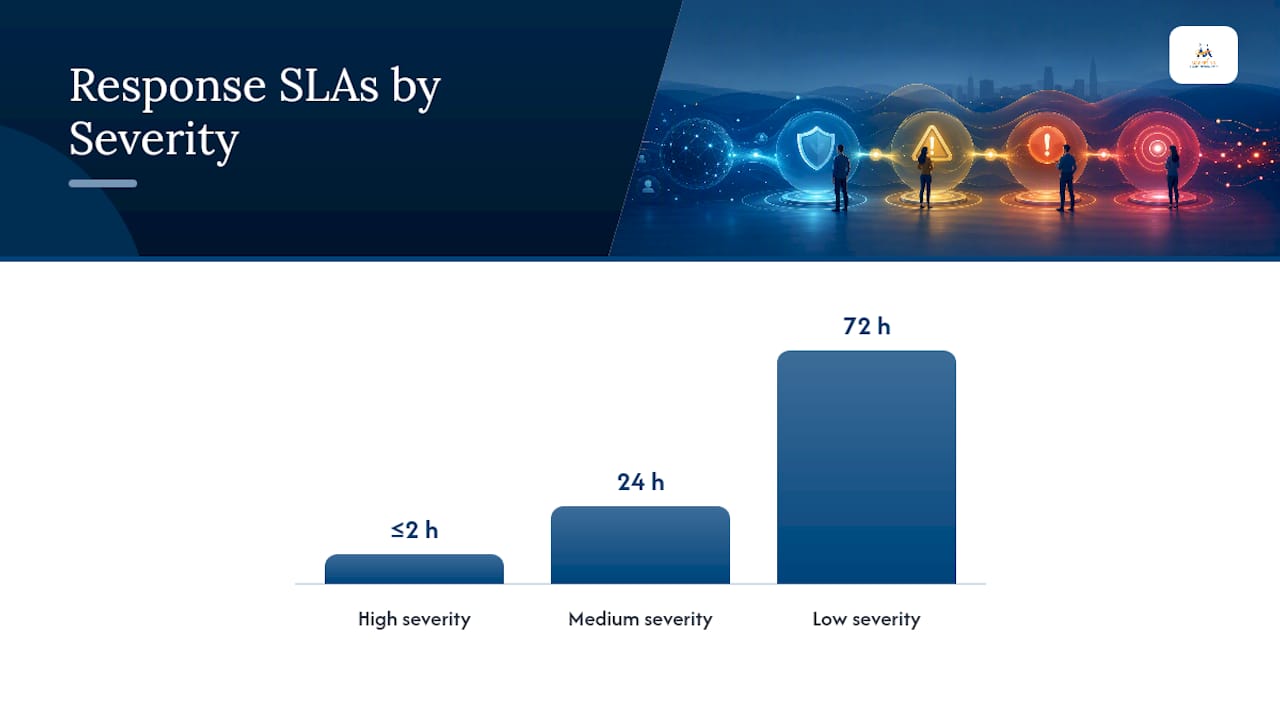
Define who responds to each severity level and set a response SLA: High signals within two hours, Medium within 24 hours, Low within 72 hours. Write these rules into your playbook (Step 7) so the team does not have to decide in the moment.
You should also check AI-generated summaries of your business periodically. AI tools are now part of the B2B buying journey, with 63% of buyers using AI during their purchase process and 94% fact-checking those AI outputs against third-party sources. If an AI tool is summarizing your business inaccurately, your review profiles and owned content are the primary inputs you can control to correct it.
Step 3: How do you collect and encourage customer reviews?
Reviews are the single most visible reputation signal for U.S. buyers. According to Capital One Shopping's 2026 review statistics report, Nearly all consumers read online reviews of a local business before visiting. That number alone justifies building a repeatable review-request process.
Where to collect reviews for U.S. businesses:
Prioritize Google first. Google reviews appear directly in search results and Maps, making them the highest-impact platform for most businesses. Add Yelp if you are in hospitality, food, or home services. Add Facebook if your audience skews local and social. Then layer in industry-specific platforms: Healthgrades, Zocdoc, or Vitals for healthcare; Avvo or Martindale for legal; Houzz or Angi for home services.
Review request templates and timing:
Send review requests within 24–48 hours of a completed transaction or service, when the experience is fresh. Three channels work well:
- Email: "Hi [First Name], thank you for choosing [Business Name]. We would love to hear about your experience. It takes less than two minutes: [Google Review Link]."
- SMS: "Thanks for visiting [Business Name]! Mind leaving us a quick Google review? [Link]"
- In-receipt QR code: Print a QR code on paper receipts or email invoices that links directly to your Google review form.
Compliance note: Google, Yelp, and the FTC all prohibit incentivizing reviews with discounts, gifts, or cash. Never offer a reward in exchange for a review. Yelp specifically prohibits asking customers to leave reviews at all, so for Yelp, focus on making it easy for customers who volunteer feedback rather than actively soliciting it.
Pro Tip: Ask for reviews at the moment of highest satisfaction, not at the end of a billing cycle. A customer who just received a great result is far more likely to write a detailed, positive review than one who gets a generic follow-up email a month later.
BrightLocal's 2026 Local Consumer Review Survey confirms that review quantity, recency, and owner responses all influence consumer choice. Collecting reviews continuously, not in one-time bursts, keeps your profile credible.
Handling fake or abusive reviews:
If you receive a review that violates platform policies (fake, spam, or defamatory), flag it using the platform's built-in reporting tool. On Google, use the "Report review" option in your Business Profile dashboard. Document the review with a screenshot before reporting. If the review contains false statements of fact that damage your business and the platform does not remove it, consult a defamation attorney. The legal threshold for defamation in the U.S. requires proving the statement is false, published, and caused harm, so not every negative review qualifies.
Step 4: How should you respond to negative reviews?
Speed and tone are the two variables buyers evaluate when they read your responses. BrightLocal's research shows that owner responses materially influence consumer choice, and prospective customers read your replies as much as they read the original complaint.
Three response templates:
Template 1 — Acknowledge (use when you need more information): "Hi [Name], thank you for sharing your experience. We are sorry to hear this did not meet your expectations. We would like to learn more so we can make it right. Please reach out to us at [email/phone] and we will follow up directly."
Template 2 — Investigate (use when the issue is under review): "Hi [Name], we take this seriously and are looking into what happened. Our team will be in touch within [X] business days. We appreciate your patience."
Template 3 — Resolve (use when the issue is resolved or you can offer a clear outcome): "Hi [Name], we are glad we had the chance to connect and address this. We have [specific action taken]. We hope to serve you better in the future."
For Google-specific reply guidance, this practical playbook on responding to Google reviews covers tone, length, and personalization in detail. The core principle: use the reviewer's first name, reference the specific issue without repeating negative keywords, and keep replies under 150 words.
Tone and timing guidance:
- Respond to all reviews, positive and negative, within 24 hours for High-severity issues and 48 hours for others.
- Never argue, never use legal language in a public reply, and never copy-paste the same response to multiple reviews. Rotating templates with light personalization signals authenticity to both readers and AI tools that scan your profile.
- Keep your brand voice consistent. Guidance on brand voice for Google review replies recommends defining two or three voice attributes (e.g., "warm, direct, solution-focused") and checking every reply against them before posting.
Escalation flow:
- Offer a refund or replacement when the complaint is factually valid and the cost is lower than the reputational damage.
- Move offline when the issue requires personal information, a detailed investigation, or a legal discussion.
- Escalate to legal or crisis team when the review contains threats, false statements of fact, or coordinated fake-review patterns.
Step 5: How do you optimize listings and SEO to shape search results?
Search results are the first thing a buyer sees. Optimizing your profiles and website pushes positive content up and negative results down.
Listings priority checklist:
- Google Business Profile: Complete every field. Add photos, business hours, service areas, and a keyword-rich business description. Post updates at least twice a month to signal activity.
- Yelp, Facebook, and BBB: Verify ownership, correct any citation errors (name, address, phone), and add photos.
- Industry directories: Claim and complete profiles on the two or three directories most relevant to your category.
- Data aggregators: Correct your information on Neustar Localeze, Data Axle, and Foursquare, which feed dozens of downstream directories.
On-site SEO tactics:
Add review schema markup (Schema.org's Review and AggregateRating types) to your website so Google can display star ratings directly in search results. Create dedicated pages for your top services with title tags that include your brand name and location. Publish a press page, a team page, and a customer results page, all of which tend to rank for branded queries and push down unrelated or negative results.

Pro Tip: Target your own brand name as a keyword. Write a Wikipedia-style "About" page optimized for "[Brand Name] + [City]" and "[Brand Name] + reviews." These pages often outrank third-party review sites for branded searches within 60–90 days of publishing.
Citation fix order:
Fix your Google Business Profile first, then Yelp, then Facebook, then the data aggregators. Correcting aggregators last ensures the corrected data propagates downstream without being overwritten by stale aggregator data.
Step 6: What owned content actually improves your reputation?
Owned content, meaning content you publish and control, serves two purposes: it shapes perception for readers and it gives search engines positive signals to rank above negative results.
Content ideas focused on proof:
- Case studies: Document a specific client problem, your solution, and the measurable result. These rank well for branded queries and give B2B buyers the peer validation they need.
- Customer stories: Short video or written testimonials tied to a specific outcome ("We reduced our response time by 40% after working with [Business Name]").
- Data-led posts: Publish original data from your own operations or surveys. Original data attracts backlinks, which improves domain authority and pushes your pages higher in search.
- FAQ pages: Answer the questions your customers ask most often. These pages frequently appear in Google's "People Also Ask" boxes and AI Overviews.
Distribution checklist:
- Publish on your website with proper title tags and internal links.
- Share on LinkedIn, Facebook, and any platform where your buyers are active.
- Repurpose blog posts into short video scripts or social graphics.
- Use content excerpts in review response templates to reinforce your brand story.
- Submit data-led posts to industry publications for syndication and backlinks.
Measuring whether content is changing perception:
Watch three signals: engagement rate on the content itself (time on page, shares), SERP position for your branded queries over 30-day intervals, and the volume of AI citations that reference your business positively. AI tools increasingly pull from review profiles and owned content when generating summaries, so fresh, well-structured owned pages improve both human and AI-generated impressions of your brand.
Step 7: How do you build a reputation playbook and crisis framework?
A playbook converts your reputation process from a set of individual decisions into a repeatable system. Without one, every crisis becomes an improvised response that varies by who happens to be available.
Playbook checklist:
- Roles: Assign a primary responder (usually customer service or marketing), a secondary reviewer (manager or brand lead), and a legal/crisis escalation contact.
- Message bank: Pre-write holding statements for the three most likely crisis scenarios: a product failure, a service complaint that goes viral, and a coordinated fake-review attack.
- Legal triggers: Define the exact conditions that require legal review before any public response (defamation claims, regulatory complaints, threats).
- External comms: Identify your PR contact or agency and confirm their availability for after-hours escalations.
Crisis matrix:
| Scenario | Severity | Response Action |
|---|---|---|
| Single negative review, isolated | Low | Respond within 48 hours using template |
| Negative review with 10+ upvotes or media pickup | Medium | Respond within 4 hours, notify manager |
| Coordinated fake-review attack or viral complaint | High | Activate crisis team, legal review, public statement within 2 hours |
Pro Tip: Run a tabletop exercise once per quarter. Present your team with a fictional crisis scenario (a one-star review going viral, a news story, a social media pile-on) and walk through the playbook step by step. Teams that drill respond faster and make fewer public mistakes when a real crisis hits.
Involve sales, customer support, and any external PR contacts in the drill. The goal is to confirm that everyone knows their role before the pressure is real.
Step 8: Which KPIs tell you if your reputation is improving?
Measuring reputation without defined KPIs produces activity, not progress. Track these metrics on a consistent schedule and tie them to business outcomes.
KPI list:
- Review volume: Total new reviews per month, by platform
- Average rating: Overall star rating and trend over 30/60/90 days
- Response rate and response time: Percentage of reviews answered and average hours to first reply
- Sentiment share: Ratio of positive to negative mentions across all monitored channels
- SERP visibility for branded queries: Position of your own pages vs. third-party review sites for "[Brand Name] + reviews" searches
- AI citation checks: Monthly spot-check of ChatGPT, Perplexity, and Google Gemini responses to queries about your business category
Dashboard and reporting cadence:
- Daily: Alert triage (new reviews, social mentions above Medium severity)
- Weekly: Review volume, response rate, and any new negative patterns
- Monthly: Full sentiment report, SERP position snapshot, content performance, and a summary for leadership
- Quarterly: Full audit refresh, playbook review, and crisis drill
Connecting reputation to revenue:
Track whether months with higher average ratings correlate with higher lead volume or conversion rates from your website. If you use a CRM, tag leads by source and note whether they mention reviews or referrals. Over time, this connection gives you a business case for continued investment in reputation management, not just a marketing metric.
Why does your online reputation directly affect revenue?
The business case for reputation management is not abstract. Capital One Shopping's 2026 data shows that Nearly all consumers read online reviews before visiting a local business. That means nearly every potential customer forms an opinion about your business before they ever contact you.
The stakes are higher than most owners realize. BrightLocal's 2026 Local Consumer Review Survey found that review quantity, recency, and owner responses all materially influence consumer choice. A business with recent reviews and visible owner responses consistently outperforms one with older reviews and no replies, even when the older business has a higher average rating.
The AI dimension adds another layer. The 2026 TrustRadius B2B Buying Disconnect report found that 63% of B2B buyers now use AI during their purchase journey, and 94% fact-check AI outputs against peer reviews and third-party sources. If your review profiles are thin or outdated, AI tools will either skip your business or summarize it inaccurately. Continuous review collection and active profile management are now prerequisites for appearing credibly in AI-generated recommendations, not just in traditional search.
For a deeper look at why reputation management matters for business success, the evidence consistently points to the same conclusion: reputation is a revenue driver, not a PR nicety.
What should your weekly, monthly, and quarterly reputation routine look like?
Reputation management is not a one-time project. It requires a consistent operational cadence to stay ahead of problems and compound positive signals over time.
Weekly tasks:
- Review all new mentions and reviews flagged by your monitoring tools
- Respond to any unanswered reviews within your SLA
- Check Google Business Profile for new questions in the Q&A section
- Post one update or photo to your Google Business Profile
Monthly tasks:
- Pull a full sentiment report from your monitoring dashboard
- Audit your top five listings for accuracy (hours, phone, address, photos)
- Publish at least one piece of owned content (blog post, case study, or video)
- Send review requests to customers from the past 30 days
- Review SERP positions for your top branded queries
Quarterly tasks:
- Run a full digital footprint audit (repeat Step 1)
- Update your crisis playbook with any new scenarios or personnel changes
- Run a tabletop crisis drill with your team
- Review your KPI trends and adjust your content or review-request strategy based on what the data shows
Red flags that require immediate action:
- A sudden spike in one-star reviews within 24–48 hours (possible coordinated attack)
- Repeated negative themes across multiple reviews (signals a real operational problem)
- A news article or social post gaining significant shares before you have responded
- An AI tool summarizing your business with inaccurate or negative information
Governance note: Keep your messaging consistent across all customer-facing teams. Customer service, sales, and marketing should all use the same approved language for common complaints and brand descriptions. A practical guide to reputation management tactics for local businesses can help you align internal teams on approved messaging before a crisis forces the issue.
What most business owners get wrong about reputation management
The most common mistake is treating reputation management as damage control. Owners wait until a bad review appears, respond once, and consider the problem solved. That reactive posture misses the compounding value of a proactive system.
The second mistake is investing in tools before investing in process. A $500-per-month monitoring platform does nothing if no one has defined who reads the alerts or how fast they must respond. The process, specifically the playbook, the SLAs, and the response templates, delivers more value than the tool itself. Start with a free Google Alert and a simple spreadsheet before you spend on software.
For small teams, the right sequence is: fix the audit first, then build the review-request habit, then add monitoring tools as volume grows. Most businesses see meaningful improvement in their average rating within 90 days of consistently requesting reviews and responding to every piece of feedback.
When to hire external help: if your team cannot commit two to four hours per week to reputation tasks, or if you are facing a crisis that requires legal coordination and PR strategy simultaneously, external support pays for itself quickly. The calculation is straightforward: one lost contract or one viral complaint that goes unanswered costs more than a month of managed service.
Two patterns we see repeatedly: a home services company that went from a 3.6 to a 4.4 average rating on Google in four months by doing nothing more than sending a post-job SMS review request and responding to every review within 24 hours. A B2B software firm that recovered from a coordinated fake-review attack by documenting the pattern, reporting it to Google with evidence, and publishing a transparent response post that ranked above the negative reviews within six weeks. Neither fix required a large budget. Both required a clear process and consistent execution.
Digital Marketing All helps you manage your reputation without the guesswork
Your reputation is already being shaped online, whether you are actively managing it or not. Digital Marketing All's review generation and reputation management services give you a done-for-you system that covers the steps most business owners never get to: continuous review collection across the platforms that matter, Google Business Profile optimization, AI-ready profile management, and a response workflow that keeps your brand voice consistent.
The difference between managing reputation yourself and working with Digital Marketing All is execution speed and coverage. Our team monitors your brand across review sites, social channels, and AI-generated summaries, then responds and reports on a schedule that keeps your profiles fresh and your ratings moving in the right direction. You get a monthly report tied to real business metrics, not just star counts.
To see what a managed reputation audit covers and what outcomes to expect, visit our review generation and management page and request an assessment for your business.
Sources
The sources below support the guidance in this article and are worth bookmarking for ongoing reference:
- Online Review Statistics (2026): Influence on Buying Decisions
- Online Review Management in 2026 | Sprout Social
Important: Platform rules for review removal and legal takedown requests change frequently. Always verify current policies directly on Google's, Yelp's, or the FTC's official pages before attempting a removal or legal action.
FAQ
What is the process of reputation management?
Reputation management is a continuous cycle: audit your digital footprint, monitor for new mentions and reviews, collect fresh reviews, respond to feedback, optimize your listings and content, and measure progress against defined KPIs. The Forbes ORM framework confirms that sequencing these steps correctly, starting with the audit, is what makes the process effective.
What are the phases of reputation management?
The three broad phases are: assessment (audit and baseline measurement), active management (monitoring, review collection, response, and content publishing), and maintenance (ongoing cadence, KPI tracking, and periodic full audits). Most businesses cycle through all three continuously rather than completing them in a linear sequence.
How long does it take to repair a damaged online reputation?
Most businesses see measurable improvement in their average rating within 60–90 days of consistently requesting reviews and responding to all feedback. Pushing negative search results off the first page with owned content typically takes three to six months, depending on domain authority and publishing frequency.
What is the formula for reputation management?
A practical formula is: Audit + Monitor + Collect Reviews + Respond + Optimize + Publish + Measure. Each step feeds the next. Fresh reviews improve your average rating, which improves your SERP position, which drives more traffic to your optimized profiles, which generates more reviews.
How do AI tools affect your online reputation?
AI tools like ChatGPT and Perplexity pull from your review profiles and owned content when generating business summaries. With 94% of B2B buyers fact-checking AI outputs against third-party reviews, thin or outdated profiles cause AI tools to either skip your business or summarize it inaccurately. Continuous review collection and well-structured owned content are the most direct inputs you can control.