

TL;DR:
- Online visibility is about how easily your business can be found across all digital channels, including AI-generated answers and zero-click search features. In 2026, building authority through consistent information, entity recognition, and reviews is essential for capturing attention in an AI-driven search environment. Tracking impressions, brand mentions, and local rankings helps measure growth beyond traditional traffic metrics.
Most small business owners assume online visibility means getting more website traffic. That assumption is costing them leads. What is online visibility, really? It is how easily your business can be found across every digital touchpoint, including search engines, social media feeds, AI-generated answers, and SERP features that deliver information without a single click to your site. In 2026, AI tools like Google's AI Overviews and ChatGPT are answering user questions directly, which means your business can be highly visible without ever collecting a page view. Understanding this shift is the first step toward building a presence that consistently generates leads.
Table of Contents
- Understanding online visibility: definitions and dimensions
- How AI and zero-click search reshape online visibility
- Comparing traditional SEO visibility with modern brand visibility
- Practical strategies to enhance your online visibility with AI-driven tools
- Measuring success: metrics and tools for visibility tracking
- Why the future of online visibility depends on embracing AI visibility-first SEO
- Boost your online visibility with expert AI-driven digital marketing solutions
- Frequently asked questions
Key Takeaways
| Point | Details |
|---|---|
| Online visibility definition | Online visibility means how easily customers find your business across digital platforms, including search and social media. |
| AI's impact | AI and zero-click search have changed visibility, making traditional click-based metrics insufficient. |
| Visibility vs awareness | Being visible means appearing where buyers pay attention, which differs from brand awareness stored in memory. |
| Measure with new metrics | Track presence in AI search features and SERP elements, not just rankings and clicks. |
| Use AI-driven strategies | Optimizing for entity recognition and AI mentions improves local search rankings and lead generation. |
Understanding online visibility: definitions and dimensions
Online visibility is not a single number. It is a collection of signals that determine how prominently your business appears wherever your potential customers are paying attention.
The most common technical definition comes from SEO tools: SEO visibility is a percentage estimating how likely users are to see your site in organic results for tracked keywords on platforms like Google. A score of 30% means your site appears, on average, in positions that would earn about 30% of the potential impressions for those keywords. That metric is useful, but it only tells part of the story.
Modern brand visibility extends far beyond traditional search rankings. It includes your presence in AI-generated answers, social media feeds, review platforms, video results, and voice search responses. Buyers today do not always start their journey with a Google search. They ask ChatGPT, they scroll Instagram, they check Google Maps reviews. Your visibility across all of those channels determines whether you are in the conversation when a purchase decision is forming.
There is an important distinction between visibility and awareness. Awareness is whether someone recognizes your brand name. Visibility is whether your brand appears in the moment someone is actively looking for what you offer. You can have strong brand awareness among existing customers and still be nearly invisible to new prospects searching online.
Key platforms that influence your online visibility today include:
- Google Search (organic results, local pack, featured snippets, AI Overviews)
- Google Maps and Google Business Profile (critical for local discovery)
- AI platforms (ChatGPT, Google Gemini, Perplexity)
- Social media feeds (Facebook, Instagram, LinkedIn, TikTok)
- Review sites (Yelp, Trustpilot, industry-specific directories)
- YouTube (the second largest search engine in the world)
"Brand visibility is not just about web traffic. It means being present in the environments where your buyers are paying attention, and in 2026, that increasingly means AI-generated answers and zero-click search features."
You can learn more about how online visibility affects traffic and lead generation across these platforms to understand the full picture before building your strategy.
How AI and zero-click search reshape online visibility
The importance of online visibility has never been higher, and neither has the complexity of achieving it. AI and zero-click search results have fundamentally changed what it means to be visible.

Zero-click search happens when Google answers a user's question directly on the results page, through featured snippets, knowledge panels, People Also Ask boxes, or AI Overviews. The user gets their answer and never clicks through to a website. For years, SEO focused almost entirely on clicks and rankings. That model is now incomplete.
Search visibility is evolving to include SERP features and AI-assisted results, tracking brand presence beyond just clicks and traffic. In practical terms, this means your business could rank on page one of Google and still generate fewer leads than a competitor who appears in the AI Overview for that same query.
Here is how to think about your visibility in the AI era:
- Featured snippets pull a direct answer from a webpage and display it above all organic results. Appearing here can generate massive impressions with few clicks, but it confirms your authority on a topic.
- Knowledge panels display brand and entity information in a sidebar. If your business has a well-structured Google Business Profile and consistent information across directories, you are more likely to earn one.
- AI Overviews (Google's AI-generated summaries) cite sources and synthesize information. Being cited as a source signals that Google's AI recognizes your content as authoritative.
- AI chat tools like ChatGPT pull from indexed content, training data, and live web searches. Brands with strong entity recognition and consistent online information show up more reliably in these responses.
- People Also Ask boxes expand visibility for conversational queries, particularly valuable for local businesses targeting specific service questions.
Tracking your brand presence in AI search results requires different tools and a different mindset than traditional rank tracking. You need to monitor not just where you rank, but whether you are being cited, mentioned, or recommended at all.
Pro Tip: Search for your core services in an incognito browser and study the SERP features that appear. If a competitor is in the featured snippet or AI Overview and you are not, that is the gap you need to close first.
Comparing traditional SEO visibility with modern brand visibility
Understanding what affects online visibility today means recognizing that two different models of visibility now coexist, and the best strategy uses both.
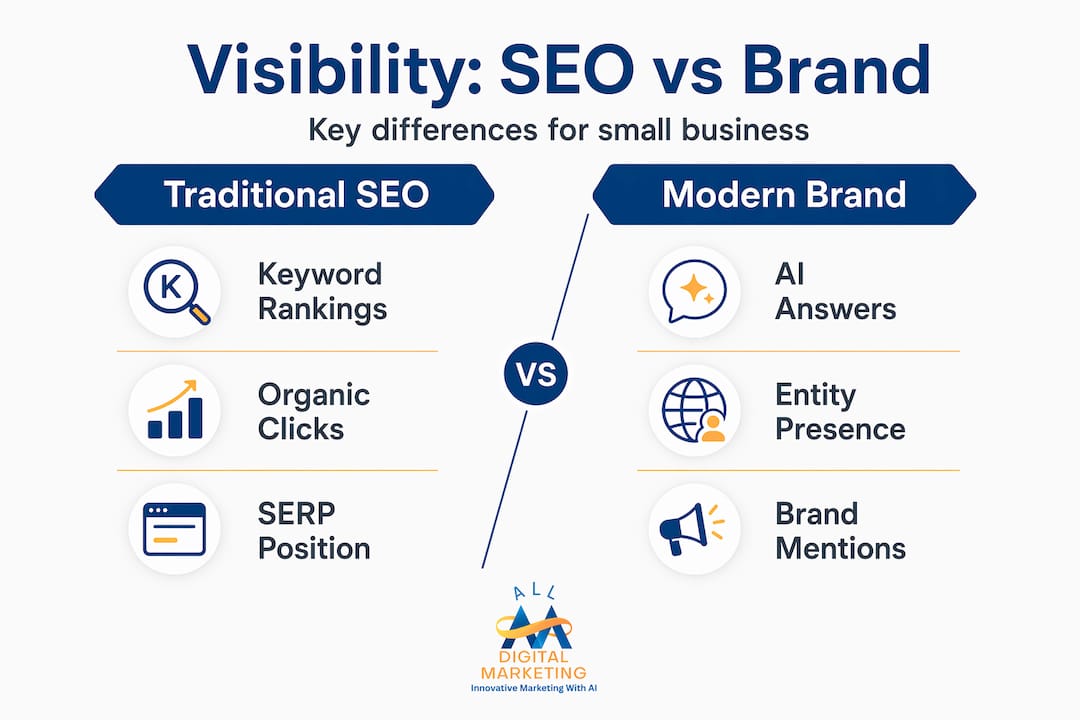
| Dimension | Traditional SEO visibility | Modern brand visibility |
|---|---|---|
| Primary metric | Keyword rankings and organic clicks | Share of presence, AI mentions, impressions |
| Platforms tracked | Google organic results | Search, AI tools, social, reviews, maps |
| Success indicator | Traffic volume | Brand recognition in buying moments |
| Content focus | Keyword density and backlinks | Entity authority and topic relevance |
| Measurement tools | Rank trackers, Google Analytics | AI visibility indexes, Search Console, mention tracking |
| Lead generation connection | Click-to-site conversion | Presence during intent signals across channels |
Traditional SEO visibility remains valuable. Higher SEO visibility is a good indicator of search health but does not always guarantee proportional leads or conversions. A site ranking for 500 low-intent keywords may produce less revenue than a site ranking for 20 high-intent local terms. Rankings are a means to an end, not the end itself.
Modern brand visibility fills the gaps. Brand visibility targets presence where buyers pay attention, which is not the same as brand awareness or just web traffic. When your business is mentioned in an AI response to "best HVAC company near me," that is brand visibility in action, regardless of whether the user clicked a link.
The practical implications for small business owners are significant:
- Visibility without conversion context is wasted. Appearing in search results for irrelevant queries does not generate leads.
- Local visibility often outperforms national visibility for SMBs. A plumber who dominates local SERP features earns more than one who ranks nationally for generic keywords.
- Reviews and reputation are now visibility signals. Google surfaces businesses with strong, recent reviews more prominently in local packs and AI answers.
- Consistent NAP data (Name, Address, Phone) across directories reinforces entity recognition in AI systems.
For more depth on increasing your business search visibility in today's environment, the shift from rank-focused to presence-focused strategy is exactly where most small businesses have the most room to grow.
Practical strategies to enhance your online visibility with AI-driven tools
Now that we know the differences in visibility types, here are concrete steps you can take right now to improve your presence where it matters most.
Knowing how to improve online visibility in 2026 means working on multiple fronts at once. Here is a prioritized approach:
-
Claim and fully optimize your Google Business Profile. This is the single highest-leverage action for local businesses. Add photos, set accurate categories, post weekly updates, and respond to every review. Google's local AI recommendations draw heavily from this data.
-
Build entity recognition with consistent information. List your business accurately on Google, Bing, Apple Maps, Yelp, Facebook, and relevant industry directories. AI systems cross-reference these sources to confirm your business is legitimate and authoritative.
-
Create content that directly answers local questions. Write FAQ pages, service pages, and blog posts that answer the specific questions your customers ask. This is how you get into featured snippets and AI Overviews.
-
Target SERP features intentionally. Use clear headers, concise answers (40-60 words) below those headers, and structured data markup (schema) to signal that your content is a direct answer to a query.
-
Monitor your AI brand mentions. Tools like Brand24, Mention, and Semrush's brand monitoring feature track when and where your business name appears online, including in AI-generated summaries. Unexplained drops in mentions can signal a reputation issue before it affects your rankings.
-
Use video content for dual-platform visibility. A properly optimized YouTube video can appear in both Google video results and voice search responses. Short-form videos on social platforms also generate visibility signals that AI systems increasingly factor in.
Associating your brand with the right entities benefits you more in zero-click search results than almost any other strategy. In plain language, this means connecting your business with specific services, locations, industries, and trusted organizations so that AI systems know exactly who you are, what you do, and where you do it.
Pro Tip: Add a dedicated FAQ section to every key service page on your website. Format questions as full sentences and answer them in two to three concise sentences. This structure is exactly what Google and AI tools look for when generating zero-click answers.
If you want a full breakdown of how to apply AI visibility strategies to your specific business, or how to work with AI overview marketing strategies to appear in Google's AI-generated summaries, those resources walk through the tactics in detail.
Measuring success: metrics and tools for visibility tracking
After learning strategies to improve visibility, understanding how to measure your progress is essential. Measuring online visibility in 2026 requires tracking more than your position on page one.
Here are the core metrics to monitor:
| Metric | What it tells you | Tool to use |
|---|---|---|
| SEO visibility score | Percentage likelihood of appearing in organic results | Semrush, Ahrefs |
| Impressions | How many times your site appeared in search results | Google Search Console |
| Click-through rate (CTR) | Percentage of impressions that resulted in clicks | Google Search Console |
| AI/zero-click brand mentions | How often your brand appears in AI answers and SERP features | Brand24, Mention, Semrush |
| Local pack ranking | Your position in the Google local map results | BrightLocal, Whitespark |
| Review volume and rating | Quantity and quality of reviews across platforms | Google Business Profile, Yelp |
Clicks may not reflect exposure in zero-click contexts, which is why impressions and AI mentions are now just as important to track as click-through rates. A business that appears in 10,000 AI-generated search summaries per month is building awareness and trust even if few of those interactions produce a direct click.
Key tools for visibility tracking include:
- Google Search Console: Free, essential, and pulls directly from Google's index. Use it to track impressions, CTR, and which queries trigger your pages.
- Semrush or Ahrefs: Both offer SEO visibility scores, keyword tracking, and competitor comparison tools.
- BrightLocal: Specifically built for local SEO tracking, including local pack rankings and citation audits.
- Brand24 or Mention: Real-time monitoring of brand mentions across the web, including AI-generated content and social media.
Common pitfalls in visibility tracking: relying on a single metric, measuring rankings without tying them to impressions, and ignoring local pack and review data. Many businesses also fail to track their competitors' visibility alongside their own. If your visibility score is flat but your competitors' scores are climbing, that is a problem even if your absolute numbers look stable.
Pro Tip: Set up a monthly visibility report that includes at least five metrics: impressions from Search Console, local pack position from BrightLocal or a similar tool, review count and average rating, AI mention volume from a brand monitoring tool, and your organic traffic from Google Analytics. Together, these give you a complete picture of your actual digital presence.
For a deeper look at measuring AI search visibility and why some businesses disappear from AI results entirely, the patterns are consistent and fixable with the right adjustments.
Why the future of online visibility depends on embracing AI visibility-first SEO
Here is an opinion that may surprise you: most businesses that think they have an SEO problem actually have a visibility problem that SEO alone cannot solve.
For the past decade, the digital marketing industry taught business owners that rankings equal results. Get to page one, get the clicks, get the leads. That was never entirely accurate, and in 2026, it is dangerously outdated thinking. The businesses growing fastest right now are not necessarily the ones with the highest domain authority. They are the ones that show up where their customers are paying attention, which increasingly means AI-generated answers, SERP features, and zero-click results.
AI SEO is the logical response to zero-click search, emphasizing recognition, trust, and presence where users seek answers. That is not a trend. It is a structural change in how search engines and AI tools surface information. Fighting it by doubling down on traditional keyword rankings is like insisting on phone book ads in 2010.
The businesses most at risk are those with decent organic traffic who assume they are visible. They see stable click numbers, assume everything is fine, and do not notice that AI tools are increasingly sending potential customers to competitors with stronger entity signals and more consistent digital footprints. Visibility gaps in AI-driven environments are largely invisible in traditional analytics, which is exactly why so many business owners miss them until the leads dry up.
What actually works? Focusing on being recognized as an authority within a specific geographic area and service category. This means structured data, consistent business information across platforms, active review management, and content that directly answers real customer questions. Not clever copy. Not keyword tricks. Just clear, accurate, well-organized information that AI systems can confidently cite.
The businesses that embrace this shift now will build compounding advantages over the next two to three years. Those that wait are not just falling behind. They are actively losing ground to competitors who understand that in an AI-first search environment, presence and trust outperform rankings every time. If you want to understand where that AI-driven marketing strategy is heading and what it means for your business specifically, the data is clear and the window to act ahead of the curve is still open.
Boost your online visibility with expert AI-driven digital marketing solutions
If you are ready to move from understanding online visibility to actually improving it, Digital Marketing All offers the tools and expertise to get you there. Our services are built specifically for small and medium-sized businesses that want to appear prominently in local search results, AI-generated answers, and SERP features. We help with review generation and management to strengthen your local reputation and Google Business Profile presence. Our professional website services are designed for conversion, not just traffic. And if you want a fast path to local dominance, our website rental services put a high-performing site to work for your business immediately. Let us help you build the kind of presence that generates real leads in 2026 and beyond.
Frequently asked questions
What is online visibility and why is it important for my business?
Online visibility determines how easily potential customers find your brand across digital platforms like search engines, social media, and AI tools. Without strong visibility, even a great business loses leads to competitors who are simply easier to find online.
How does AI affect online visibility and search presence?
AI tools now shape what users see before they ever click a link. Control of brand presence in AI-assisted results is essential because users increasingly receive answers without visiting websites, making traditional click-based metrics an incomplete measure of your actual reach.
What metrics should I track to measure online visibility accurately?
Track SEO visibility scores, impressions, click-through rates, and brand mentions in AI-driven search features using Google Search Console and AI monitoring tools. Measuring presence in AI and zero-click search is now just as critical as monitoring organic clicks.
Can higher SEO visibility guarantee more leads and conversions?
No. Higher visibility doesn't always produce proportional business results without a supporting strategy that addresses conversion, relevance, and local intent. Visibility is the starting point, not the finish line.
How can small businesses improve their brand visibility effectively today?
Focus on entity recognition, local SEO, active review management, and content structured to answer specific customer questions. Focusing on entity coverage and presence in SERP features produces measurable gains in zero-click visibility faster than chasing keyword rankings alone.