

TL;DR:
- Nearly half of all Google searches have local intent, making local SEO essential for visibility. Businesses must tailor content and optimize assets like Google Business Profile and local landing pages based on different user intent stages. Understanding and responding to local user behavior increases conversions and ensures a competitive advantage in local search results.
Local intent is defined as a searcher's goal to find geographically relevant products, services, or information through a search engine. It is the force behind nearly half of all online searches. 46% of all Google searches carry local intent, meaning users want results tied to a specific place, not just a general answer. That single statistic explains why Google Business Profile, Google Maps, and local landing pages have become critical assets for small and medium-sized businesses. Understanding local intent is the foundation of any effective local SEO strategy, and this guide breaks it down from definition to execution.
What is local intent in search and why does it matter?

Local intent, also called local search intent in SEO practice, is the underlying purpose of a query that signals the user wants results near a specific location. A search like "emergency plumber Chicago" is explicit. A search like "coffee shop open now" is implicit. Both carry strong local intent, and Google treats them differently than informational queries with no geographic signal.
The business impact is direct. 78% of local mobile searches result in an offline purchase within 24 hours. That means a user searching for your service on their phone is not browsing casually. They are close to a decision, and your visibility at that moment determines whether they walk through your door or a competitor's.
Local intent matters because it changes what Google shows. Traditional organic results, the standard blue links, get pushed down or replaced entirely when Google detects a local query. Maps, local packs, and verified business profiles take over the page. If your business is not optimized for those placements, you are invisible to the customers most ready to buy.
Pro Tip: Search your own primary service keyword from a mobile device in incognito mode. If you do not see your business in the local pack or map results, that is your gap to close first.
What are the four types of local intent?
Local SEO experts classify local intent into four distinct types, each mapped to a stage in the customer journey. Treating all local searches as one category is the most common mistake businesses make. Each type demands a different content response.
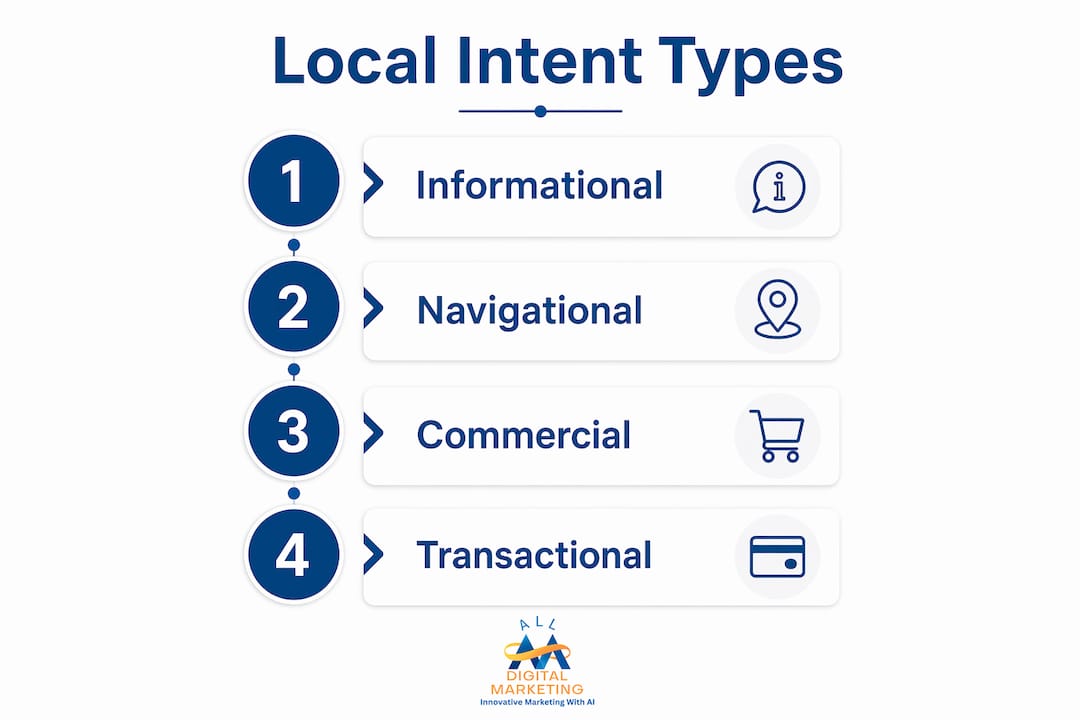
| Intent Type | User Goal | Example Query | Best Content Response |
|---|---|---|---|
| Informational | Learn about a local topic | "How much does a roof repair cost in Denver?" | Blog posts, FAQs, local guides |
| Navigational | Find a specific business or location | "Starbucks near Union Square" | Google Business Profile, Maps listing |
| Commercial | Compare options before deciding | "Best HVAC companies in Austin" | Review pages, comparison content, testimonials |
| Transactional | Take immediate action | "Book a plumber in Dallas now" | Click-to-call buttons, booking forms, landing pages |
Informational local intent
Informational local intent drives users who are researching, not yet buying. They want context, pricing ranges, or how-to answers tied to their area. A roofing company that publishes a page titled "Average Roof Repair Costs in Phoenix" captures this audience early and builds trust before the user is ready to call.
Navigational local intent
Navigational queries target a specific business the user already knows. Your Google Business Profile is the primary asset here. If your profile is incomplete, outdated, or unverified, you lose the user even when they are searching for you by name.
Commercial local intent
Commercial intent signals a user comparing options. They are not ready to buy, but they are close. Review pages, star ratings, and comparison content on your website directly influence this stage. A business with 200 Google reviews and a 4.8-star rating wins commercial intent searches over a competitor with 12 reviews and no response to feedback.
Transactional local intent
Transactional intent is the highest-value stage. The user wants to act now. Matching landing pages to the transactional intent stage, with click-to-call buttons, booking forms, and clear service areas, produces the highest conversion rates for local businesses. Generic homepages do not convert transactional searchers. Specific, action-oriented pages do.
How does local intent change google's search results?
When Google detects local intent, the search results page transforms. Local packs, Google Maps, and Google Business Profiles dominate the page, and traditional organic blue links drop below the fold or disappear entirely. This is not a minor shift. For a transactional local query, a business ranked #1 organically may receive far less traffic than a business ranked #2 in the local pack.
Google uses two types of signals to detect local intent. Explicit signals include location words in the query itself, such as "near me," a city name, or a neighborhood. Implicit signals come from the user's device location, search history, and behavioral patterns. A user searching "emergency dentist" at 9 PM from a mobile device in Atlanta triggers local intent even without typing "Atlanta."
| SERP Feature | Triggered By | Business Asset Required |
|---|---|---|
| Local Pack (3-pack) | Local intent queries | Google Business Profile |
| Google Maps | Location-based searches | GBP with accurate address |
| Knowledge Panel | Branded navigational searches | Verified GBP + structured data |
| Local Ads | Paid local campaigns | Google Ads with location extensions |
| Review Stars | Commercial intent queries | Review schema + GBP reviews |
Real-time data plays a decisive role in local pack rankings. Hours of operation, current reviews, star ratings, and response time all feed into how Google ranks and displays your business. A profile showing "Closed" during business hours, or one with no recent reviews, signals low trust to both Google and the user.
Pro Tip: Set up Google Business Profile posting on a weekly schedule. Fresh posts signal active management to Google and give users a reason to choose you over a dormant competitor listing.
How can small businesses optimize for local intent?
Optimizing for local search intent requires a structured approach across several assets. The following tactics address each stage of local intent and are ordered by impact for small and medium-sized businesses.
-
Claim and fully complete your Google Business Profile. Google Business Profile optimization is the single highest-leverage action for local visibility. Add every service, upload photos weekly, verify your address, and respond to every review. GBP is your frontline local SEO asset.
-
Build intent-specific landing pages. Do not send all local traffic to your homepage. Create separate pages for each service and location combination. A page titled "Emergency Plumbing Services in Nashville" targets transactional intent directly. A page titled "How to Choose a Plumber in Nashville" targets commercial and informational intent.
-
Use both explicit and implicit local keywords. Include city names, neighborhood names, and landmark references in your page titles, headers, and body content. Also optimize for implicit signals by embedding your address in your site footer and using consistent NAP (Name, Address, Phone) data across all directories.
-
Generate and manage reviews actively. Reviews are not just social proof. They are a ranking signal. Businesses with higher review volume and recency rank better in local packs. Ask every satisfied customer for a review immediately after service, while the experience is fresh.
-
Add structured data markup to your website. Schema markup for LocalBusiness, Service, and Review types tells Google and AI platforms exactly what your business does and where. Structured data and accurate location information are critical for visibility in AI-powered local discovery tools like ChatGPT, Perplexity, and Google's AI Overviews.
-
Prioritize mobile experience. 30% of all mobile searches are location-based, and mobile users convert twice as fast as desktop users. Your site must load in under three seconds on mobile, display click-to-call buttons prominently, and make directions accessible in one tap.
-
Follow a proven local SEO checklist. A structured local SEO checklist for small businesses helps you audit existing gaps and prioritize fixes by impact, rather than guessing where to start.
For deeper tactical guidance, the Digitalmarketingall resource on proven local search tactics covers step-by-step implementation for each of these areas.
How does local user behavior drive urgency in local SEO?
Local searchers behave differently from general web users. They are closer to a decision, operating under time pressure, and often searching from a mobile device in the moment of need. Understanding this behavior changes how you build and prioritize your marketing assets.
The urgency pattern is consistent across industries. A user searching "urgent care near me" at 7 PM is not comparing options for next week. They need an answer in the next few minutes. A user searching "best Italian restaurant downtown" on a Saturday afternoon is in commercial intent mode, comparing before deciding. These two users require completely different responses from your business.
Here is how to align your assets with local user behavior:
-
Use urgency language in transactional content. Phrases like "open now," "same-day service," and "available today" match the mindset of high-intent local searchers. Include them in your Google Business Profile description, ad copy, and landing page headlines.
-
Match your Google Business Profile hours to reality. Nothing destroys trust faster than showing "Open" when you are closed. Accurate hours are a basic requirement, but many businesses neglect holiday hours and special closures.
-
Target "near me" and time-sensitive keywords in paid campaigns. Google Ads with location extensions and call extensions capture transactional local intent at the exact moment of search. Pair these with landing pages that load fast and convert immediately.
-
Respond to reviews within 24 hours. Commercial intent searchers read reviews and watch how businesses respond. A prompt, professional response to a negative review signals reliability. Silence signals indifference.
The behavioral gap between informational and transactional local searchers is wide. Businesses that serve both with tailored content capture the full customer journey, from first research to final purchase. Those that only optimize for one stage leave significant revenue on the table.
Key takeaways
Local intent optimization requires matching every business asset to the specific stage of the searcher's journey, from awareness to purchase.
| Point | Details |
|---|---|
| Local intent drives nearly half of searches | 46% of Google searches carry local intent, making it the dominant search behavior for nearby customers. |
| Four intent types require four content strategies | Informational, Navigational, Commercial, and Transactional intent each demand a different page type and call to action. |
| Google Business Profile is your top local asset | A fully optimized GBP listing determines whether you appear in the local pack, maps, and knowledge panels. |
| Mobile urgency is real and measurable | 78% of local mobile searches convert offline within 24 hours, so speed and click-to-call access are non-negotiable. |
| Structured data unlocks AI visibility | Schema markup and accurate location data are required for discovery on AI platforms beyond traditional Google results. |
Why most businesses get local intent backwards
I have reviewed hundreds of local business websites over the years, and the pattern is almost always the same. The business invests in a beautiful homepage, writes one generic "Services" page, and calls it local SEO. Then they wonder why their Google Business Profile gets more traffic than their website.
Here is what I have found: most businesses optimize for the intent they wish their customers had, not the intent those customers actually show. They want every visitor to be a transactional searcher ready to book. So they build transactional pages for every query, including the ones where the user is still in research mode. That mismatch kills conversions before they start.
The shift toward AI-powered local discovery makes this worse. Tools like Google's AI Overviews and Perplexity pull structured, specific data to answer local queries. A business with vague, generic content gets skipped. A business with clear service descriptions, location data, and schema markup gets cited. I have seen small businesses with modest budgets outrank larger competitors simply by getting their structured data right and keeping their GBP updated consistently.
The AI-driven local SEO strategies that Digitalmarketingall documents are not future-facing theory. They are the current reality of how local searches get answered. The businesses winning local search right now are the ones that treat intent matching as a discipline, not an afterthought.
— Diane
Ready to capture more local search traffic?
Local intent optimization works best when your reputation and your Google Business Profile work together. Digitalmarketingall specializes in helping small and medium-sized businesses build both. Our review generation and management service helps you collect more verified reviews, respond strategically, and build the trust signals that move you up in local pack rankings. Reviews are not optional for local SEO. They are a direct ranking factor and the first thing commercial intent searchers check. If your review profile is thin or unmanaged, you are losing customers to competitors who have made reputation a priority. Contact Digitalmarketingall to start building the local visibility your business deserves.
FAQ
What is local intent in simple terms?
Local intent is the goal behind a search query that signals the user wants results near a specific location. It covers searches for nearby businesses, services, directions, and location-specific information.
How is local intent different from general search intent?
General search intent seeks information without a geographic filter. Local intent adds a location requirement, either stated explicitly with a city name or implied by the user's device location and query context.
Which type of local intent converts the fastest?
Transactional local intent converts fastest because the user is ready to act immediately. Pairing transactional queries with click-to-call buttons and fast-loading landing pages captures these high-value searchers at the moment of decision.
Does google always show a local pack for local intent searches?
Google shows a local pack when it detects strong local intent signals, but not for every query. Explicit location terms and device GPS data increase the likelihood of triggering local pack results over standard organic listings.
How do i know if my business is optimized for local intent?
Search your primary service keyword from a mobile device in your city. If your business does not appear in the local pack or map results, your Google Business Profile, review volume, or on-page local signals need attention.