

TL;DR:
- Auto-suggest optimization shapes search engine autocomplete suggestions to enhance brand visibility before users finish typing.
- It influences which queries appear, capturing early search intent and increasing click-through and conversion rates.
Auto-suggest optimization is the deliberate practice of shaping search engine autocomplete suggestions to increase brand visibility before users finish typing their queries. Known formally as search box optimization (SBO), it sits at the intersection of SEO, reputation management, and user behavior strategy. Google Autocomplete and Bing Suggest both pull from signals you can directly influence, including branded keyword pairings, search volume, and social mentions. One focused SBO campaign drove a 25% increase in branded organic traffic within six months. That result is not an outlier. It reflects what happens when you stop waiting for users to find you and start shaping the search box itself.
What is auto-suggest optimization and why does it matter?
Auto-suggest optimization is the process of influencing which query completions appear when users type into a search engine. The industry term is search box optimization, though "auto-suggest optimization" and "autosuggest optimization" are widely used by practitioners to describe the same strategy. The goal is to get your brand, product, or service to appear as a suggested query before the user hits Enter.
Search suggestions are not random. They reflect visualized demand data, meaning every suggestion is a window into real customer language and real search behavior. When your brand appears in those suggestions, you capture intent at the earliest possible moment in the search process.
The strategic opportunity is significant. A user who sees your brand name suggested before they finish typing is more likely to click it, more likely to trust it, and more likely to convert. That is why digital marketers are shifting budget and attention toward this channel. Understanding faster visibility tactics for autosuggest is now a core competency for any serious SEO professional.
How do search engines generate autocomplete suggestions?
The technology behind search auto-suggestion is more complex than most marketers realize. Understanding it tells you exactly what levers you can pull.
The data structures behind the search box
Search engines use a data structure called a Trie (pronounced "try") to store and retrieve query completions at speed. A Trie organizes words by shared prefixes, so typing "dig" instantly surfaces all stored queries beginning with those three letters. More advanced systems use Finite State Transducers (FST), which compress the Trie into a memory-efficient format that handles typos and alternate spellings simultaneously.
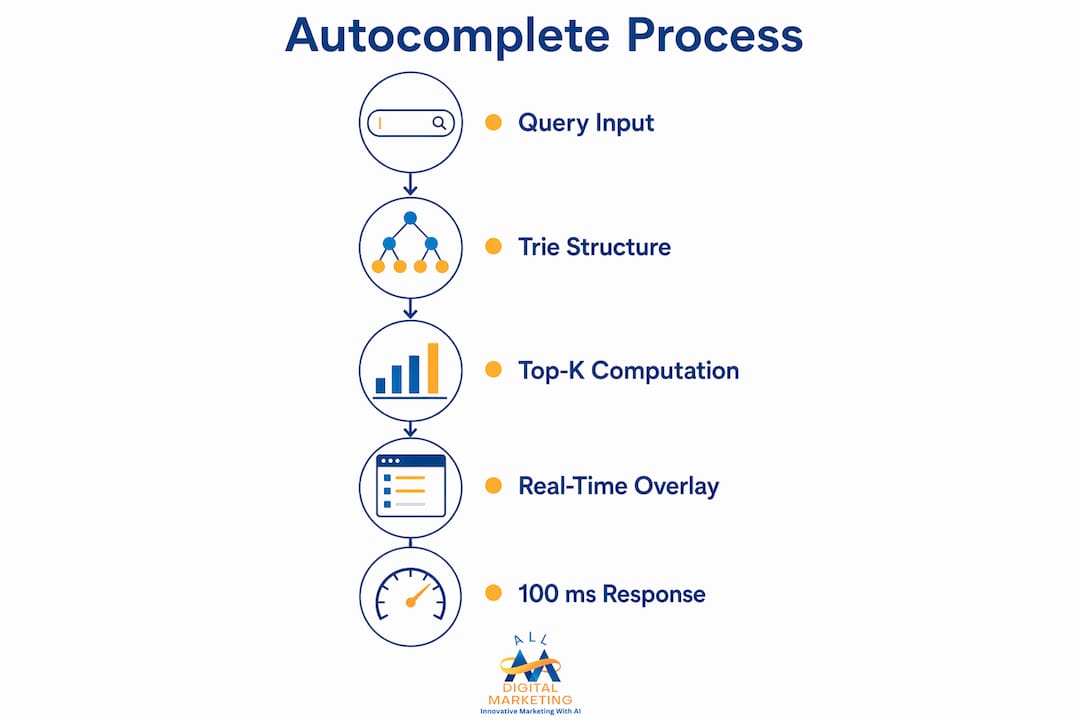
Google's autocomplete system combines a static daily-rebuilt Trie with a real-time streaming overlay. The immutable daily Trie handles more than 99% of queries. The streaming overlay catches trending terms within minutes of a spike. That hybrid design is why you see breaking news topics appear in suggestions almost immediately while most suggestions stay stable day to day.
To speed up responses further, search engines precompute top-K completions at every Trie node during the build phase. That means the system does not sort suggestions live. It retrieves a pre-ranked list in constant time, which is critical given the latency constraints below.
The 100-millisecond rule
Search engines enforce a strict 100-millisecond latency budget for every auto-suggest query, with backend processing completing in under 50 ms. That constraint shapes every architectural decision in the system. It is also why you cannot game suggestions with a single burst of activity. The system is built for stability and speed, not real-time manipulation.
| Processing Layer | Technology Used | Function |
|---|---|---|
| Static index | Daily-rebuilt Trie / FST | Handles 99%+ of queries at O(1) speed |
| Real-time overlay | Streaming lambda architecture | Surfaces trending terms within minutes |
| Client optimization | Debouncing and caching | Reduces server requests per keystroke |
| Spam filtering | User diversity thresholds | Blocks bot-driven query manipulation |
Debouncing, caching, and prefetching reduce server load and cut latency on the client side. Debouncing means the system waits until you pause typing before firing a request, rather than querying on every keystroke. CDNs cache popular prefix responses so common queries return instantly without hitting the origin server.
Pro Tip: Time your content campaigns to align with the daily batch rebuild cycle. Publishing and promoting content in the morning gives it the best chance of being indexed and weighted before the next Trie rebuild runs.
Auto-suggest vs. autocomplete vs. predictive search: what's the difference?
These three terms are often used interchangeably, but they describe distinct behaviors. Confusing them leads to misaligned optimization strategies.
Autosuggest and autocomplete differ in a specific way. Autosuggest offers multiple query options based on what you have typed so far. Autocomplete completes your partial input into a single whole word or phrase. The distinction matters because each requires a different optimization approach.
Here is how the three concepts compare:
| Term | Behavior | Example |
|---|---|---|
| Autosuggest | Shows a dropdown list of related query options | Typing "best pizza" shows 5–8 query options |
| Autocomplete | Completes the current word or phrase inline | Typing "restaur" auto-fills "restaurant" |
| Predictive Search | Personalizes suggestions using history and trends | Shows your city's top queries based on location |
Autosuggest is the broadest concept and the primary target for search box optimization. It pulls from aggregate search behavior, trending data, and editorial filtering.
Autocomplete is narrower. It focuses on completing the literal string you are typing. Optimizing for it means owning the exact prefix space your brand occupies.
Predictive search adds a personalization layer. Autosuggest systems use machine learning, log aggregation, and filtering to deliver suggestions tailored to individual users based on location, search history, and device. This means two users typing the same prefix can see different suggestions.
The practical implication: your optimization efforts influence the aggregate suggestion pool, but individual users may see personalized variations. Focus your strategy on the signals that feed the aggregate model, not on trying to control the personalized layer directly.
How to optimize for auto-suggest: proven strategies
Influencing search engine autosuggest features requires a coordinated approach across content, reputation, and search behavior signals. Here are the strategies that produce measurable results.

1. build branded keyword pairings
Create content that consistently pairs your brand name with high-intent modifier terms. If your brand is "Acme Roofing," you want pages, press releases, and social content that repeatedly associate "Acme Roofing" with terms like "reviews," "near me," "cost," and "emergency repair." Search engines read co-occurrence patterns. The more your brand appears alongside specific queries in indexed content, the more likely those pairings surface as suggestions.
2. capitalize on trending events
Trending interest spikes elevate new terms into suggestion pools quickly. Publishing timely content tied to industry events, seasonal demand, or news cycles gives your brand a path into the streaming overlay layer. A local HVAC company that publishes content around "heat wave AC repair" during a summer heat event can appear in suggestions within hours, not weeks.
3. manage your reputation signals
Reviews, press mentions, and social media discussions directly influence autocomplete suggestion quality and ranking. Search engines treat brand mentions as quality signals. A brand with hundreds of positive reviews across Google, Yelp, and industry publications sends stronger signals than one with thin or negative coverage. Reputation management is not separate from SBO. It is a core input.
4. drive genuine search volume
Suggestions require real users performing real searches. Artificial inflation through bots or click farms is filtered out. Spam and bot queries are blocked by user diversity thresholds that require a minimum number of distinct submitters before a term becomes eligible. The ethical path is to drive genuine search volume through paid search campaigns, email marketing, and social media that prompt real users to search your brand name with specific modifiers.
5. synchronize with batch update cycles
The daily Trie rebuild is your optimization clock. Content published and promoted before the rebuild runs has the best chance of being weighted in the next cycle. Plan your content calendar around this rhythm. A Monday morning press release, a Tuesday product launch email, and a Wednesday social push create a compounding signal that the batch processor picks up.
Pro Tip: Use Google Trends and tools like Semrush or Ahrefs to identify rising query modifiers in your niche. Publish content targeting those modifiers before they peak. You want to be in the suggestion pool when the spike hits, not after it fades.
A content strategy checklist, like the quick content strategy guide from MYB Workshops, can help you align your publishing cadence with the signals that feed autosuggest systems.
What measurable impact does auto-suggest optimization have?
The results from search box optimization are trackable and significant. Here is what the data shows.
A focused SBO campaign produced a 25% branded traffic increase within six months. That growth came directly from users clicking brand-name suggestions in the autocomplete dropdown before completing their searches. The traffic quality was higher than standard organic traffic because users who click a suggested brand query already have intent.
Key metrics to track when running an auto-suggest optimization program:
- Branded search volume: Monitor month-over-month growth in searches for your brand name plus modifier terms using Google Search Console.
- Click-through rate from branded queries: A rising CTR on branded queries signals that your suggestions are appearing and getting clicked.
- Impression share for branded terms: Track how often your brand appears in suggestion-driven results versus total eligible impressions.
- Conversion rate from branded organic traffic: Suggestion-driven visitors convert at higher rates. Segment this traffic in Google Analytics 4 to measure the lift.
- Autocomplete appearance frequency: Use manual searches across multiple devices and locations to audit which suggestions appear for your target prefixes.
"Search suggestions are not just a UX feature. They are a direct map of what your customers are thinking at the moment they decide to search. Owning that space means owning the first moment of intent."
Integrating SBO with your broader SEO and PPC strategy multiplies the impact. When users see your brand in autocomplete suggestions and then encounter your paid ad and organic listing on the results page, the combined presence reinforces trust and drives higher conversion rates. Explore how autocomplete marketing compares to PPC to understand where each channel delivers the strongest return.
Key takeaways
Auto-suggest optimization works because it captures user intent before a query is fully formed, giving brands a measurable advantage in both visibility and conversion quality.
| Point | Details |
|---|---|
| Core definition | Auto-suggest optimization shapes search engine autocomplete suggestions to increase brand visibility before users finish typing. |
| Technical foundation | Google's hybrid Trie and streaming overlay system rebuilds daily, making consistent content signals more effective than one-time bursts. |
| Reputation signals matter | Reviews, press mentions, and social discussions feed autocomplete ranking quality and must be managed actively. |
| Ethical volume is required | Bot-driven query inflation is filtered out; only genuine search volume from real users moves the needle. |
| Measurable results exist | A focused SBO campaign produced a 25% branded traffic lift in six months, with higher conversion rates than standard organic traffic. |
Why marketers underestimate the search box
I have spent years watching digital marketers pour budget into PPC and traditional SEO while ignoring the one place every search begins: the search box itself. The conventional wisdom says you win by ranking on page one. That is true, but incomplete. The search box is page zero.
The technical constraints are real. The 100-millisecond latency budget and the daily batch rebuild cycle mean you cannot force your way into suggestions overnight. Marketers who expect instant results from SBO get frustrated and abandon the strategy too early. The ones who succeed treat it like brand building: consistent signals over time, not a single campaign.
The ethical dimension matters too. There is a clear line between legitimate influence and manipulation. Legitimate influence means creating real content, earning real reviews, and driving real searches. Manipulation means bots, fake reviews, and artificial query inflation. Search engines filter the latter aggressively. Beyond the technical risk, manipulation undermines the brand trust you are trying to build.
The future of this channel is moving toward AI-generated search experiences. Google's AI Overviews and Bing's Copilot integration are already pulling from the same signals that feed autocomplete. Brands that build strong autosuggest presence now are positioning themselves for the AI-driven search environment that is already here. If you want to understand the full competitive picture, the local SEO autosuggest tactics guide from Digitalmarketingall is worth your time.
The marketers who win in 2026 will be the ones who stopped thinking about search as a results page problem and started treating it as a search box problem.
— Diane
Build the brand signals that drive suggestion rankings
Auto-suggest optimization does not operate in isolation. The reputation signals that feed autocomplete rankings, including reviews, brand mentions, and social proof, require active management. Digitalmarketingall's review generation and management service is built specifically to help businesses build the brand signal volume that search engines reward. More verified reviews across Google, Yelp, and industry platforms means stronger quality signals in the autocomplete ranking model. If your brand is not appearing in suggestions for your core query prefixes, a weak review profile is often the first place to look. Start building those signals today.
FAQ
What is search box optimization vs. auto-suggest optimization?
Search box optimization (SBO) is the formal industry term for the practice. Auto-suggest optimization and autosuggest optimization are widely used informal variants that describe the same strategy of influencing search engine autocomplete suggestions.
How long does it take to appear in autocomplete suggestions?
Results vary, but a focused campaign typically shows measurable branded suggestion growth within three to six months. One documented case produced a 25% branded traffic lift within six months of consistent effort.
Can you manipulate autocomplete suggestions with bots?
No. Search engines use user diversity thresholds and rate limiting to filter out bot-driven query inflation. Only queries from a minimum number of distinct real users are eligible to enter the suggestion pool.
What signals influence autocomplete suggestion rankings?
Search engines weigh search volume, trending interest, user diversity, brand mentions, reviews, and editorial filtering. Machine learning and log aggregation also personalize suggestions based on individual user history and location.
How does auto-suggest optimization connect to local SEO?
Local SEO and autosuggest optimization share the same reputation signals. A strong Google Business Profile, consistent local citations, and positive reviews all feed the brand quality signals that influence which suggestions appear for location-based queries.