

TL;DR:
- Autosuggest optimization, or Search Box Optimization (SBO), influences autocomplete suggestions to accelerate brand visibility and trust. It captures users early in their query formation, offering faster and exclusive positioning compared to traditional SEO. Ethical demand creation through genuine content, reputation building, and campaign coordination ensures sustainable autosuggest success.
Autosuggest optimization, formally known as Search Box Optimization (SBO), is the practice of strategically influencing the autocomplete suggestions users see as they type queries into Google and other search engines. The reason to optimize for autosuggest is direct: 71% of search queries are influenced by autocomplete, and businesses that appear in those suggestions gain visibility 45 to 60 days faster than traditional SEO allows. That speed advantage, combined with the psychological weight of appearing as a Google-endorsed suggestion, makes SBO one of the most underused channels in digital marketing today. This article breaks down exactly how autosuggest works, what it delivers, and the practical steps digital marketers and small business owners can take to claim their spot before a competitor does.
Why optimize for autosuggest instead of traditional SEO?
Traditional SEO and autosuggest optimization both target Google, but they intercept the user at completely different moments. Standard SEO competes for rankings after a user has already typed and submitted a full query. SBO captures the user while they are still forming that query, which is an earlier and more influential moment in the decision process.
Search engines use a lambda architecture that combines a stable daily autocomplete index with a real-time streaming overlay to surface trending queries. This means autosuggest results are not static. They respond to genuine search volume patterns, which is exactly why building real user demand is the foundation of any SBO strategy.
The competitive exclusivity of autosuggest is another factor that separates it from conventional SEO. Exclusive keyword ownership in autosuggest prevents competitors from appearing in the same suggestion slot. On a standard search results page, your competitor can rank directly above you. In autosuggest, owning a keyword phrase means you occupy that suggestion position alone.
Paid ads offer speed but require continuous spend. The moment your budget runs out, your visibility disappears. Autosuggest visibility, built through genuine demand creation, persists as long as search volume for your target phrase remains active. That makes SBO a more cost-efficient long-term channel for businesses with limited ad budgets.
Pro Tip: Start your SBO keyword research by typing your core service into Google and noting every autocomplete suggestion that appears. Those suggestions represent real queries your potential customers are already forming. Build your content and brand messaging around those exact phrases.
What benefits does autosuggest optimization deliver to businesses?
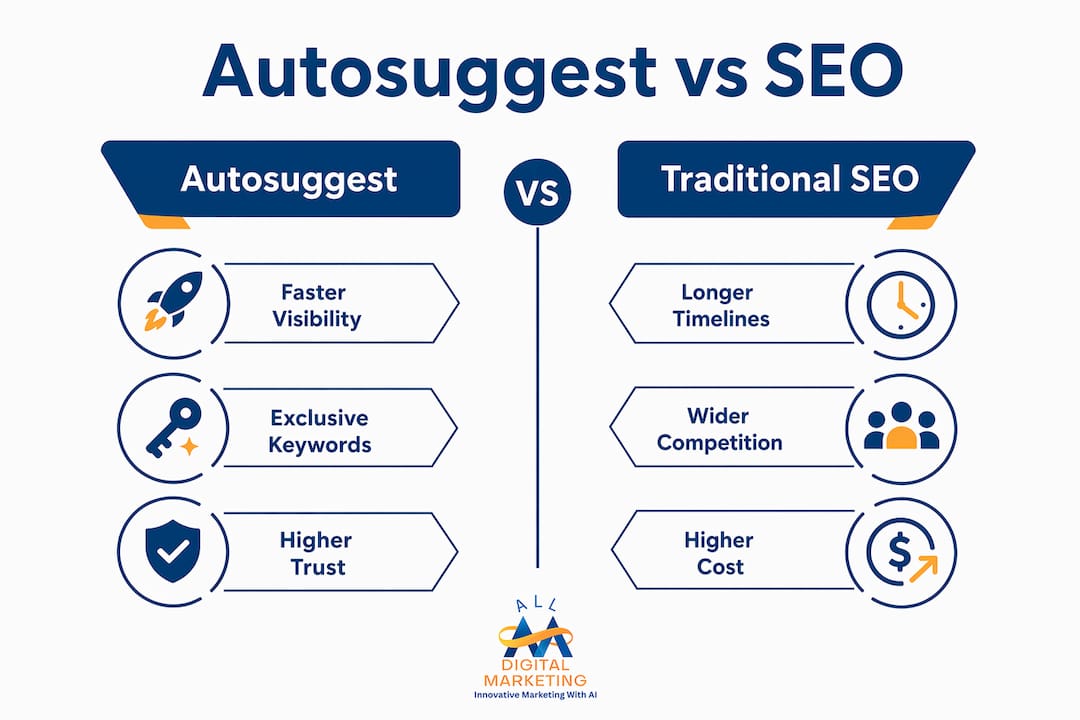
The advantages of autosuggest optimization are measurable, psychological, and competitive. Focused SBO strategies can increase branded organic traffic by 25% within six months. That figure reflects a meaningful shift in how customers discover and engage with a brand before they even reach the search results page.
The psychological dimension is equally significant. Users interpret autocomplete suggestions as implicit endorsements from the search engine itself. When your brand name appears in a Google suggestion, the user perceives it as Google recommending you. That perception increases trust and click-through rates in a way that a paid ad simply cannot replicate.
"Autosuggest placement provides a form of 'autocomplete branding' that improves long-term consumer recall." This insight from search intelligence specialists confirms that repeated autosuggest appearances do more than drive single clicks. They build brand memory across multiple search sessions, compounding recognition over time.
Here is a summary of the core benefits businesses consistently see from autosuggest optimization:
- Faster visibility: Brands appear in autosuggest results 45 to 60 days after a focused SBO campaign, compared to 3 to 12 months for traditional SEO rankings.
- Higher click-through rates: The perceived Google endorsement effect increases the likelihood that users select your brand suggestion over others.
- Exclusive positioning: Owning an autosuggest keyword phrase blocks competitors from that specific suggestion slot, creating a durable competitive advantage.
- Better lead quality: Users who click autocomplete suggestions are mid-intent searchers. They are actively forming a specific query, which means they convert at higher rates than broad traffic.
- Cost efficiency: Unlike PPC campaigns, autosuggest visibility does not require ongoing spend once established through genuine demand.
- Brand recall: Repeated appearances in autosuggest across multiple search sessions reinforce brand recognition without additional advertising cost.
For small business owners competing against larger brands with bigger ad budgets, the competitive edge from autocomplete positioning is particularly valuable. You can own a local or niche keyword phrase in autosuggest that a national competitor has never thought to target.
What ethical and technical nuances should marketers understand?
Autosuggest cannot be forced through shortcuts. Attempting to manipulate Google's autocomplete through bot-driven queries or click farms carries real consequences. Manually manipulating autosuggest via fake searches poses significant risks, including penalties and filtering that remove your brand from suggestions entirely. Google's systems detect unnatural query patterns and suppress them.
Ethical autosuggest optimization requires creating real demand through genuine user search behavior. This means producing content that earns organic searches, running coordinated campaigns that prompt real users to search for your brand phrases, and building authority signals that reinforce your relevance for target queries. The process is slower than bot manipulation but produces results that last.
Search engines also apply safety and diversity filters to autosuggest results. These filters penalize brands that attempt to monopolize suggestions or trigger content policy violations. The practical implication is that even legitimate SBO efforts must stay within natural search volume growth patterns. Sudden artificial spikes in query volume for a specific phrase will trigger suppression rather than promotion.
Here are the key technical and ethical principles to follow:
- Build genuine search demand. Create content, campaigns, and brand experiences that motivate real users to search for your target phrases.
- Respect query volume growth rates. Gradual, consistent growth in branded search volume signals authenticity to Google's algorithms.
- Avoid bot-driven queries. Any tactic that uses automated tools to simulate search behavior violates Google's guidelines and risks permanent suppression.
- Monitor for filter triggers. If your brand phrase touches sensitive topics or policy-restricted categories, autosuggest may filter it regardless of search volume.
- Be patient with indexing cycles. The 100 ms latency budget of autocomplete systems means suggestions rely on precomputed data. New phrases take time to enter the stable index.
- Diversify your keyword targets. Focusing all SBO efforts on a single phrase creates fragility. Build demand across a cluster of related phrases to create a more resilient autosuggest presence.
Pro Tip: Track your target autosuggest phrases weekly using incognito browser searches across multiple locations. This gives you an unbiased view of which phrases are appearing and how your brand's position shifts over time without personalization affecting the results.
How to optimize for autosuggest: practical steps for marketers
Effective autosuggest optimization is a coordinated effort across keyword research, content strategy, local SEO, and campaign alignment. The steps below reflect what actually moves the needle for digital marketers and small business owners.

Identify high-intent keyword phrases
Start with phrases that users are already beginning to type. Focus on queries that combine your service category with geographic modifiers, problem statements, or comparison terms. A plumber in Austin should target phrases like "plumber Austin emergency" or "best plumber Austin TX" rather than generic terms. Use Google's own autocomplete as your primary research tool, supplemented by keyword platforms like Ahrefs or Semrush to validate search volume.
Build brand authority through content and reputation
Google's autosuggest algorithm weighs search volume, but it also factors in brand authority signals. Publishing consistent, high-quality content that earns backlinks and social engagement increases the authority weight behind your brand phrases. Reputation management plays a direct role here. Brands with strong review profiles across Google, Yelp, and industry directories carry more authority in local autosuggest results.
Optimize your Google Business Profile
Maintaining accurate business information and customer reviews in your Google Business Profile is essential for local autosuggest visibility. Google's local autocomplete draws directly from Business Profile data when surfacing location-specific suggestions. A complete, regularly updated profile with active review generation gives you a measurable advantage in local SBO. You can learn more about local autosuggest tactics that apply specifically to this channel.
Coordinate SBO with your broader search strategy
Combining SBO with existing SEO and paid ad campaigns creates a fully integrated search strategy. When your PPC ads drive branded searches, those searches contribute to the query volume that autosuggest algorithms use to surface your brand. When your SEO content ranks for target phrases, it reinforces the authority signals that support autosuggest inclusion. The three channels amplify each other when aligned around the same keyword clusters.
The table below compares the three primary search visibility channels across key performance dimensions:
| Channel | Speed to visibility | Cost model | Exclusivity | Lead quality |
|---|---|---|---|---|
| Traditional SEO | 3 to 12 months | Time and content investment | Low, competitors rank alongside you | Medium, broad intent range |
| PPC advertising | Immediate | Ongoing spend required | Low, competitors bid same keywords | Medium, depends on ad targeting |
| Autosuggest (SBO) | 45 to 60 days | Upfront effort, lower ongoing cost | High, exclusive keyword ownership possible | High, mid-intent query formation |
Measure and refine continuously
Track branded search volume trends in Google Search Console to monitor whether your target phrases are gaining traction. Set up conversion tracking to identify traffic that enters your site through branded queries, which often correlates with autosuggest-driven visits. Review your autosuggest phrase performance monthly and adjust your content and campaign focus based on which phrases are gaining or losing visibility. For a deeper look at traffic growth potential, the data on autosuggest traffic growth in 2026 provides useful benchmarks.
What I've learned about autosuggest that most articles won't tell you
Most SEO content treats autosuggest as a nice-to-have feature sitting at the edge of a broader strategy. After working with businesses across local and national markets, I can tell you it is one of the highest-leverage channels available, and it is consistently underinvested.
The part that surprises most clients is the psychological impact. When I show a business owner their brand appearing in Google's autocomplete for the first time, the reaction is always the same: they immediately understand why it matters. Seeing your brand name suggested by Google feels like a credibility signal that no ad can replicate. That reaction is not just emotional. It reflects how real customers respond when they see the same thing.
What I have also found is that the businesses that succeed with SBO are the ones that treat it as a demand creation exercise, not a technical trick. The brands that try to shortcut the process with artificial query volume almost always end up suppressed within weeks. The brands that invest in genuine content, reputation management, and coordinated campaigns see their phrases enter autosuggest and stay there.
The integration point between SBO and traditional SEO is where the real compounding happens. When both channels target the same keyword clusters, branded search volume grows organically, autosuggest inclusion follows, and the combined effect on qualified traffic exceeds what either channel delivers alone. That is the strategy worth building. You can see how this plays out in practice through the competitive advantages of autocomplete marketing for businesses that commit to it.
— Diane
How Digitalmarketingall can help you appear in autosuggest
Digitalmarketingall works with local and national businesses to build the authority signals that drive autosuggest visibility. A critical component of that authority is your online review profile. Businesses with strong, consistent review generation across Google and Yelp carry more weight in local autocomplete algorithms. Digitalmarketingall's review generation and management service builds that foundation systematically, generating verified reviews that strengthen your brand's credibility signals. When combined with a focused SBO strategy, a strong review profile accelerates your path to autosuggest inclusion and sustains it over time. Contact Digitalmarketingall to start building the search presence your business needs.
FAQ
What is autosuggest optimization?
Autosuggest optimization, also called Search Box Optimization (SBO), is the practice of influencing which autocomplete suggestions appear when users type queries into search engines. It targets the query formation stage rather than the completed search results page.
How long does it take to appear in Google autosuggest?
Businesses using focused SBO strategies typically achieve autosuggest visibility within 45 to 60 days, significantly faster than the 3 to 12 months required for traditional SEO rankings.
Can you force your brand into Google autosuggest artificially?
Attempting to manipulate autosuggest through bot-driven queries or fake searches risks penalties and suppression from Google's filters. Sustainable autosuggest presence requires genuine user search demand built through content, campaigns, and reputation management.
Why does appearing in autosuggest increase click-through rates?
Users interpret autocomplete suggestions as implicit endorsements from the search engine, which increases trust and the likelihood of clicking. This perceived credibility effect is distinct from what paid ads or standard organic rankings deliver.
How does Google Business Profile affect autosuggest results?
Maintaining accurate business information and active customer reviews in your Google Business Profile directly supports local autosuggest visibility. Google's local autocomplete algorithm draws on Business Profile data when surfacing location-specific suggestions.
Key takeaways
Autosuggest optimization delivers faster, more exclusive brand visibility than traditional SEO by capturing users at the moment of query formation, not after a search is submitted.
| Point | Details |
|---|---|
| Speed advantage | SBO delivers autosuggest visibility in 45 to 60 days versus 3 to 12 months for standard SEO. |
| Exclusive keyword ownership | Owning an autosuggest phrase blocks competitors from that specific suggestion slot. |
| Psychological credibility | Users treat autocomplete suggestions as Google endorsements, increasing trust and click-through rates. |
| Ethical demand creation | Sustainable SBO requires genuine user search behavior, not bot manipulation, to avoid penalties. |
| Integration multiplies results | Aligning SBO with SEO and PPC campaigns around shared keyword clusters compounds traffic and conversion gains. |