

TL;DR:
- Autosuggest optimization influences over 71% of search queries, shaping user decisions early in the search process. It offers a faster, cost-effective alternative to traditional SEO by building authentic search behavior and controlling suggestion rankings through exclusivity models. Combining SBO with content, reviews, and local SEO strategies enhances visibility and drives measurable business results within 45 to 60 days.
Knowing how to improve autosuggest rankings is one of the most underused advantages in local SEO today. Autocomplete suggestions influence roughly 71% of all search queries, which means the moment a user begins typing into a search bar, the suggestions that appear are already shaping their decision. For local businesses competing against larger brands, that moment is everything. Traditional SEO takes months to deliver results, and paid search burns budget fast. Autosuggest optimization offers a third path: faster visibility, lower cost per lead, and a presence that feels organic to the searcher.
Table of Contents
- Key takeaways
- How autosuggest ranking systems actually work
- Keyword research tailored for autosuggest triggers
- Step-by-step tactics to boost autofill suggestions
- Measuring performance and troubleshooting issues
- Comparing autosuggest optimization with other approaches
- My perspective on autosuggest optimization after years of watching campaigns run
- Ready to increase your autosuggest visibility?
- FAQ
Key takeaways
| Point | Details |
|---|---|
| Autosuggest drives most searches | Over 71% of queries are shaped by autocomplete, making it a critical channel for local visibility. |
| SBO beats traditional SEO timelines | Search Box Optimization delivers autocomplete presence in 45 to 60 days versus 3 to 12 months for standard SEO. |
| Ranking signals follow a clear formula | Popularity, freshness, trending, and personalization are the four weighted signals search engines use to rank suggestions. |
| Keyword exclusivity is a real advantage | SBO exclusivity models let businesses own specific autocomplete phrases, blocking competitors from those spots. |
| Measurement requires specific metrics | Track visibility timelines, click-through rates, and lead quality to evaluate autosuggest performance accurately. |
How autosuggest ranking systems actually work
Before you can improve your position in autocomplete, you need to understand what determines it. Search engines like Google, Bing, and YouTube do not randomly generate suggestions. They run a structured two-stage system: candidate generation followed by reranking. The first stage uses precomputed data structures to rapidly retrieve the top candidate phrases matching the typed prefix. The second stage applies more expensive scoring to reorder those candidates by relevance, personalization, and freshness.
The scoring itself follows a weighted formula. Ranking signals prioritize popularity at 0.5, freshness at 0.2, trending at 0.2, and personalization at 0.1. Popularity dominates. This means high search volume around a phrase is the single biggest driver of autosuggest placement. Freshness and trending signals work together to surface queries gaining momentum, which is why a local business that generates a burst of branded search activity can see autocomplete movement relatively quickly.
Platform differences matter for local targeting
Google, Bing, and YouTube each weight these signals differently and serve different user intents. Google's autocomplete is geolocation-aware, which gives local businesses an inherent advantage when targeting city-specific phrases. Bing leans more on web index freshness. YouTube autocomplete is dominated by content consumption patterns, so video strategy plays a larger role there. For most local business campaigns, Google is the primary platform, and its location signals make geo-targeted phrases like "best dentist in [city]" or "plumber near [neighborhood]" highly attainable through focused effort.
How autosuggest differs from traditional SEO
Traditional SEO targets the ten blue links. Autosuggest optimization targets the moment before those links appear. The mechanism is different: you are shaping search demand rather than competing for existing demand. Search Box Optimization for autocomplete works by driving coordinated, authentic search activity around specific keyword phrases so that Google's popularity signal registers your phrase as worth suggesting. This is not about gaming the algorithm with fake clicks. It is about building real search behavior that the algorithm recognizes.
A dual-column dropdown layout that shows standard suggestions alongside personalized recommendations is a UX pattern worth knowing because it reveals how sophisticated autocomplete interfaces are becoming. For your own site search or any embedded search tool, this design increases engagement and conversion.
| Platform | Primary ranking signal | Local targeting capability | Best for |
|---|---|---|---|
| Popularity + location | Strong | Most local business categories | |
| Bing | Index freshness | Moderate | Complementary reach |
| YouTube | Content consumption | Limited | Service education content |
Keyword research tailored for autosuggest triggers
Autosuggest keyword research is not the same as traditional keyword research. You are not looking for head terms to rank on page one. You are looking for the partial phrases users type before they finish their query. That distinction changes everything about how you select targets.

Start by identifying the first three to five words a searcher would type when looking for your client's service. A user searching for a cosmetic dentist in Dallas does not type "best cosmetic dentist Dallas Texas" all at once. They type "cosmetic dentist" and wait for the dropdown. That prefix is your target. Building a list of these prefix phrases, organized by service category and geography, gives you a working autosuggest keyword map.
Criteria for selecting the right phrases
Not every phrase is worth targeting. Evaluate candidates against these four criteria:
- Search volume: Phrases with at least moderate monthly search volume have enough popularity signal to be achievable. Very low volume phrases often do not appear in autocomplete at all.
- User intent alignment: The phrase must match the service you are promoting. Broad phrases with ambiguous intent bring unqualified traffic even when you rank in autocomplete.
- Competition level: Check whether large national brands already dominate the suggestion slot. Highly competitive phrases require more time and resources to displace.
- Geographic specificity: City or neighborhood modifiers reduce competition and improve conversion rates because the searcher's intent is already localized.
SBO exclusivity models allow businesses to own specific autocomplete keyword phrases, locking competitors out of those suggestion slots. This exclusivity is one of the most compelling reasons to work with a dedicated SBO provider rather than attempting a DIY approach. When you control a phrase in a market, competitors using the same service cannot target it simultaneously.
Integrate your autosuggest keyword selections with the broader messaging your client already uses across their website, Google Business Profile, and content. Consistency between what appears in autocomplete and what appears on the landing page reinforces trust and reduces bounce rates.
Pro Tip: Run your candidate phrases through Google's own search bar in an incognito window set to your target city. Note which completions already appear and which prefix variations trigger no suggestions at all. Gaps in suggestion coverage often represent the most accessible entry points for new autosuggest optimization campaigns.
Step-by-step tactics to boost autofill suggestions
With your keyword map in hand, execution comes down to a clear sequence of steps. These autosuggest optimization steps cover both the technical and strategic dimensions.
-
Secure keyword phrase exclusivity through an SBO provider. Identify an SBO service that offers geographic and keyword exclusivity. This prevents another business in your market from targeting the same autocomplete phrase simultaneously. Exclusivity is what makes the investment defensible long term.
-
Drive coordinated authentic search activity. The popularity signal needs real search behavior. Work with your SBO provider to generate genuine, compliant search volume around your target prefix phrases. This is what moves the needle on the algorithm's popularity weighting.
-
Optimize the landing page the autosuggest click delivers. Experts confirm that SBO delivers the best ROI when paired with landing page optimization that converts autocomplete traffic. If the page users land on is slow, unclear, or not locally relevant, you lose the lead immediately. The page must load fast, display a local phone number prominently, and match the intent of the autocomplete phrase exactly.
-
Coordinate with your existing content marketing and SEO. Well-coordinated SBO campaigns integrated with traditional SEO and content marketing amplify visibility across multiple touchpoints. When your client's blog, Google Business Profile, and social content all reinforce the same keyword themes, the freshness and relevance signals stack in your favor.
-
Apply AI-informed content structuring. Structured content with clear headings and concise answers positioned directly under those headings enhances autocomplete ranking signals in AI-driven search. This matters increasingly as AI search platforms like ChatGPT Search and Google's AI Overviews integrate autocomplete-like behavior. LLM integration into query auto-completion has been shown to improve suggestion diversity by 38%, which means AI-structured content has measurable impact.
-
Manage indexing freshness actively. Autocomplete indices require maintenance. Stale suggestions can persist if index merges are delayed, which means if you change your keyword strategy or update landing pages, the autocomplete system may not reflect those changes immediately. Build regular index refresh checkpoints into your campaign schedule.
-
Implement UI/UX improvements for your own search tools. If your client's website includes a search bar or chat tool, deploy a dual-column dropdown layout that separates algorithmic completions from personalized product or service recommendations. This increases engagement and on-site conversion without additional ad spend.
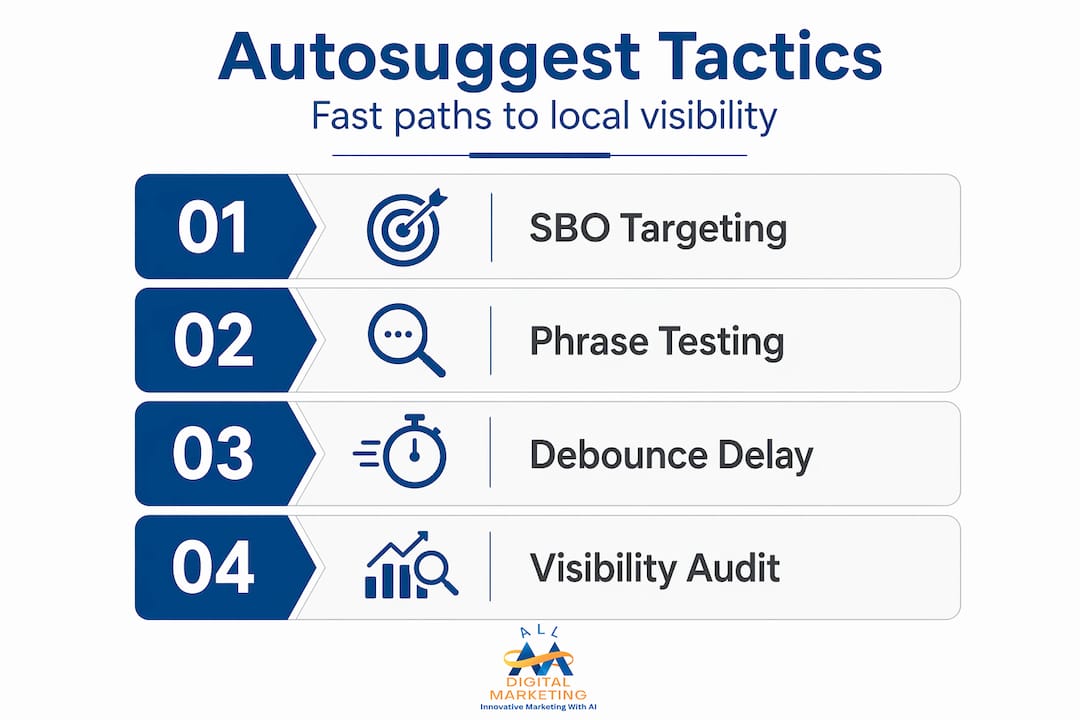
Pro Tip: Apply a 200 to 300ms debounce delay to any autosuggest interface your team manages. This prevents stale query results from showing and aligns with the median human reaction time, making the interface feel noticeably faster and more accurate.
| Tactic | Timeline to impact | Primary signal affected | Difficulty |
|---|---|---|---|
| SBO phrase targeting | 45 to 60 days | Popularity | Medium |
| Landing page optimization | Immediate | Conversion rate | Low |
| Content structure for AI search | 30 to 90 days | Relevance + freshness | Medium |
| Index freshness management | Ongoing | Freshness | Low |
| Dual-column UI deployment | Immediate | On-site conversion | Medium |
Measuring performance and troubleshooting issues
Knowing how to optimize for autosuggest is half the work. The other half is knowing whether it is working and fixing it when it is not. SBO delivers autocomplete visibility within 45 to 60 days, so set your first evaluation checkpoint at the 60-day mark. Before that, you are measuring leading indicators, not outcomes.
Key metrics to monitor throughout your campaign:
- Autosuggest visibility: Manually check your target prefix phrases in incognito mode across devices weekly. Document when your phrase appears and in what position.
- Click-through rate from autocomplete: If you have access to Google Search Console or a similar tool, track branded and near-branded query impressions and clicks. A rising click volume on your target phrases confirms the suggestion is appearing and attracting clicks.
- Lead quality from organic sources: Autosuggest traffic behaves differently from paid traffic. It tends to produce higher-intent leads because the searcher completed a self-initiated query. Track form fills, calls, and conversion rates from organic traffic separately.
- Bounce rate on target landing pages: A high bounce rate signals a mismatch between the autocomplete phrase and the page content. Fix the page before the algorithm penalizes the click-through pattern.
"Autocomplete success is not just about appearing in the dropdown. It is about what happens after the click. A phrase that appears in suggestions but produces no conversions is a visibility metric, not a business result. Align your phrase selection and landing page content from day one."
Common problems to watch for include suggestion delays caused by index merge lag, increased competition from a rival who starts targeting the same phrase, and algorithm volatility during major Google updates. If your phrase disappears from suggestions unexpectedly, check whether a major algorithm update rolled out and whether your landing page still reflects the original keyword intent.
When campaigns stall or plateau, that is usually the right time to engage expert autosuggest optimization services that have direct experience diagnosing platform-specific ranking behavior.
Comparing autosuggest optimization with other approaches
Digital marketers working with local businesses frequently face the question of how autosuggest optimization fits alongside what they are already doing. The answer is that it fits best as a complement, not a replacement.
Traditional SEO builds long-term domain authority and page-level rankings, but the timeline is 3 to 12 months before meaningful movement. Paid search delivers immediate placement but stops entirely when the budget stops. SBO sits between those two: faster than SEO, more durable than paid. That positioning makes it particularly useful for local businesses in competitive markets who need early lead flow while their organic SEO effort matures.
Combining SBO with review generation and reputation management multiplies the effect. When a searcher sees your client's phrase in autocomplete, clicks through, and then sees a high volume of recent, positive reviews, the conversion probability increases significantly. Reviews also contribute to Google Business Profile prominence, which reinforces the local relevance signal that autosuggest systems use for geo-targeted phrases.
Pro Tip: Launch your SBO campaign at least 30 days before a seasonal peak in demand for your client's industry. Because the popularity signal takes weeks to build, starting early means your phrase appears in autocomplete at precisely the moment search demand spikes. This timing advantage is one of the clearest examples of auto-suggest optimization delivering measurable seasonal ROI.
Successful local campaigns that combine local SEO strategies with SBO consistently outperform those that rely on either approach alone. The reason is signal reinforcement: when the same keyword themes appear across autocomplete, organic rankings, Google Business Profile, and review content, the algorithm registers a coherent and credible local entity.
| Approach | Time to visibility | Cost structure | Durability | Best combined with |
|---|---|---|---|---|
| Traditional SEO | 3 to 12 months | Ongoing content investment | High | SBO, content marketing |
| Paid search | Immediate | Budget-dependent | None without spend | Landing page optimization |
| SBO | 45 to 60 days | Subscription or retainer | Medium to high | SEO, reviews, reputation |
| Review generation | 30 to 90 days | Low to medium | High | SBO, local SEO |
My perspective on autosuggest optimization after years of watching campaigns run
I have seen SBO campaigns produce fast, measurable results for local businesses, and I have also seen campaigns fail to deliver anything beyond a suggestion appearing in a dropdown that no one clicks. The difference almost always comes down to one thing: whether the team treated autocomplete as a standalone tactic or as part of a connected strategy.
In my experience, the biggest misconception about autosuggest optimization is that controlling the suggestion slot is the finish line. It is actually the starting line. What I have consistently seen is that businesses who pair autocomplete presence with a compelling, locally relevant landing page and an active review profile convert at a rate that justifies the entire investment. Those who do not are essentially paying to generate impressions.
What I have learned from campaigns that started strong and then stalled is that keyword selection at the outset determines longevity. Targeting a phrase that was easy to rank in autocomplete but did not match real searcher intent produced vanity metrics without revenue. The phrases that drove real results were always the ones that matched an actual transaction the customer was ready to make.
AI advancements are changing the picture faster than most marketers realize. As platforms integrate LLMs into their autocomplete systems, the diversity and relevance of suggestions will increase, which means there will be more phrase opportunities to target, but also more competition for attention in the dropdown. The marketers who invest in understanding these systems now will have a structural advantage as AI-powered search expands. Cross-channel coordination is not optional at that point. It becomes the foundation that makes every individual tactic work.
— Diane
Ready to increase your autosuggest visibility?
At Digitalmarketingall, we work with local businesses and the marketers who serve them to build autosuggest presence that generates real leads, not just impressions. Our approach combines Search Box Optimization with review generation and management that reinforces your credibility the moment a searcher lands on your client's page. We also offer Yelp optimization services for businesses where platform reputation directly influences local discovery. If you want to increase autosuggest visibility and connect it to a broader strategy that holds up over time, explore how Digitalmarketingall's search box optimization services can accelerate your results. The window to own your local autocomplete phrases is open now. The businesses acting on it are building an advantage that compounds month over month.
FAQ
What is Search Box Optimization and how does it work?
Search Box Optimization is a technique that drives coordinated search activity around specific keyword phrases to influence autocomplete suggestions on platforms like Google. It works by building the popularity signal that autocomplete ranking systems weigh most heavily, typically delivering visible results within 45 to 60 days.
How long does it take to rank in autosuggest?
Most SBO campaigns produce measurable autosuggest placement within 45 to 60 days, compared to the 3 to 12 months required for traditional SEO to deliver similar visibility. The timeline depends on the competitiveness of the target phrase and the geographic market.
Can competitors target the same autosuggest phrase I am targeting?
With standard SEO or organic efforts, yes. But SBO exclusivity models allow businesses to lock a specific keyword phrase in a given market, preventing other businesses using the same SBO service from targeting it simultaneously. This creates a sustainable competitive position in autocomplete.
What metrics should I track to measure autosuggest success?
Track autosuggest visibility through manual incognito checks, monitor click-through rates from organic queries in Google Search Console, measure lead quality and conversion rates from organic traffic, and watch landing page bounce rates. These four metrics together give you a clear picture of whether your autosuggest optimization is producing business results.
Does autosuggest optimization work on platforms other than Google?
Yes, though the approach varies. Bing responds more to index freshness signals, while YouTube autocomplete is driven by content consumption patterns. For most local businesses, Google is the primary platform because its geolocation awareness makes city-specific phrase targeting particularly effective.