
TL;DR:
- Auto complete marketing, or Search Box Optimization (SBO), intercepts users early in their search journey by securing exclusive autocomplete suggestions. It delivers faster visibility—in 45 to 60 days—compared to traditional SEO, and prevents competitors from occupying prime suggestion positions. Integrating SBO with existing strategies enhances lead quality, aligns keywords with user intent, and maximizes brand visibility across platforms.
Auto complete marketing is the practice of optimizing a brand's presence in search engine autocomplete suggestions to capture user attention before a search is finalized. Known in the industry as Search Box Optimization (SBO), this strategy intercepts potential customers at the earliest possible moment in their search journey. 71% of search queries are influenced by autocomplete suggestions, which means the brand that appears in the dropdown has a significant head start over every competitor waiting in the search results. Tools like Google Autocomplete, Algolia, and specialized SBO providers have made this approach accessible to digital marketers and business owners who want faster, higher-quality leads.
What is auto complete marketing and how does it differ from traditional SEO?
Auto complete marketing, or SBO, works by positioning a brand's keyword phrases inside the predictive dropdown that appears as users type into Google, Bing, or YouTube. Traditional SEO competes for rankings after a user has already completed their query and hit enter. SBO intercepts the user before that moment, steering the search itself toward a phrase your brand owns.
The mechanics are straightforward but the strategic implications are significant. When a user begins typing "best HVAC company in," Google's autocomplete algorithm predicts what they are likely to type next. A business that has successfully executed SBO will appear as a suggested completion, such as "best HVAC company in Dallas." The user clicks the suggestion, and the search is effectively guided before it was ever finished.
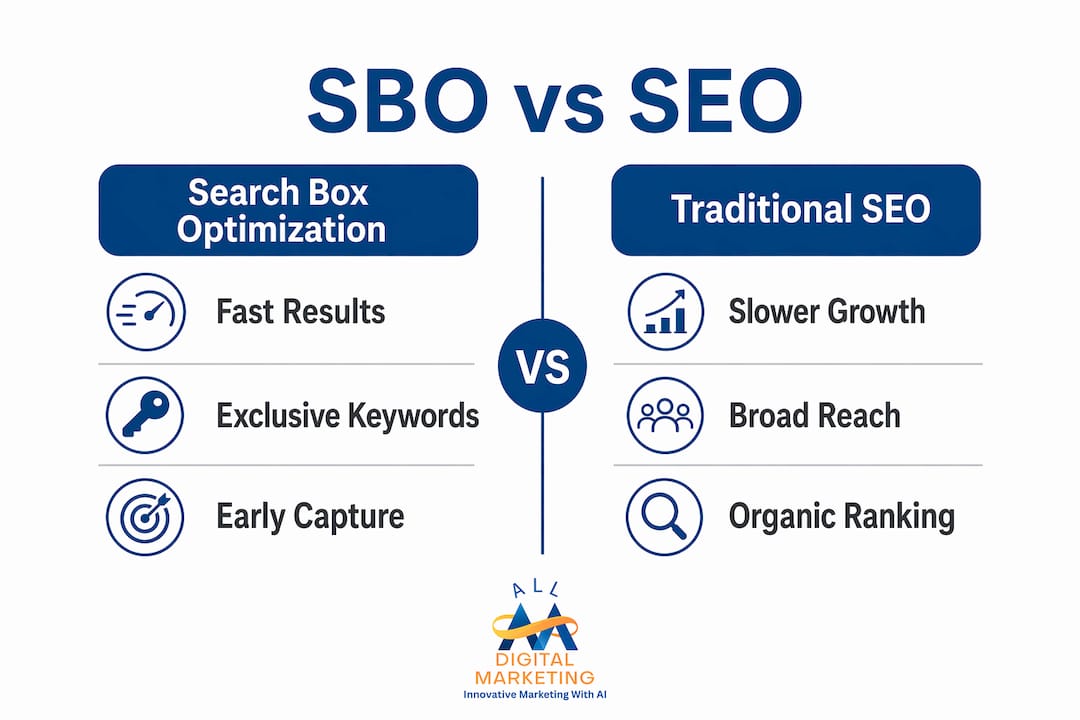
Exclusive keyword ownership within the autocomplete dropdown is what separates SBO from every other search strategy. In traditional SEO or PPC, multiple competitors can rank for the same keyword simultaneously. In SBO, one brand owns the autocomplete suggestion for a specific phrase. That exclusivity prevents competitors from occupying the same prime suggestion position.
The speed advantage is equally compelling. SBO delivers visibility within 45 to 60 days, compared to traditional SEO timelines that typically run 3 to 12 months. For businesses that need qualified traffic quickly, that difference is decisive.
| Factor | Search Box Optimization (SBO) | Traditional SEO |
|---|---|---|
| Visibility timeline | 45 to 60 days | 3 to 12 months |
| Keyword competition | Exclusive ownership | Multiple competitors rank simultaneously |
| Intercept point | Before search is completed | After search results are displayed |
| Lead intent | Higher, guided by suggestion | Variable, depends on query specificity |
| Cost model | Typically fixed or subscription | Ongoing content and link investment |
Pro Tip: SBO does not replace your existing SEO investment. Think of it as a front door that brings users to your brand before they ever see the search results page where your competitors live.
What are the best practices for selecting keywords for autocomplete campaigns?
Keyword selection for SBO follows different rules than standard SEO keyword research. The focus is on partial phrases and common search starts, specifically the kinds of incomplete queries that trigger autocomplete predictions. A user typing "emergency plumber" is already in buying mode. Your goal is to own the completion of that phrase in your target geography or niche.
Effective keyword selection for auto complete marketing involves evaluating four dimensions simultaneously.
- Search volume and intent: Choose phrases with enough monthly search volume to generate meaningful traffic, but prioritize intent over volume. A phrase like "best personal injury lawyer in Chicago" signals purchase intent far more clearly than "personal injury lawyer."
- Competition level: Assess how many other brands are attempting to own the same autocomplete phrase. Lower competition phrases in specific local markets are often more attainable and more profitable than broad national terms.
- Partial phrase triggers: Focus on the first two to four words a user is likely to type. Autocomplete activates early in the typing process, so your phrase needs to match common search starts, not just completed queries.
- Brand and landing page alignment: Every autocomplete keyword you target must connect directly to a landing page that delivers exactly what the suggestion promises. Misaligned keywords and landing pages increase bounce rates and degrade the entire value of your SBO campaign.
Avoid the common mistake of selecting keywords based purely on what sounds good for your brand. The autocomplete suggestion must reflect how real users actually begin their searches. Google's autocomplete algorithm is trained on real search behavior, so phrases that feel natural to your marketing team but do not match actual user language will not gain traction.
Pro Tip: Use Google Search Console and Google Trends to identify the partial phrases users are already typing in your category. These tools reveal the exact language patterns that trigger autocomplete, giving you a data-backed starting point for keyword selection.
The alignment principle extends beyond the landing page. Autocomplete keywords must connect with your broader brand messaging, your content marketing themes, and your paid media campaigns. Consistency across all channels reinforces the autocomplete suggestion as credible and relevant, which supports both user trust and algorithmic favorability. For a deeper look at intent-driven keyword selection, Digitalmarketingall has published specific guidance on exclusive keyword strategies.
How to integrate auto complete marketing with your existing digital strategy
SBO is a strategic complement to traditional SEO, not a replacement. The two strategies operate at different points in the search journey and serve different functions. SBO captures attention at the start of the search. SEO builds long-term authority and captures traffic after the search is completed. Running both simultaneously gives your brand coverage at every stage.
Here is a practical integration framework for coordinating SBO with your existing marketing channels.
-
Align autocomplete phrases with your content calendar. If your SBO campaign targets "best roofing contractor in Phoenix," your blog, video content, and social posts should reinforce that exact phrase and topic. Consistent content signals strengthen the autocomplete algorithm's confidence in your brand's relevance to that phrase.
-
Coordinate with your PPC campaigns. SBO and pay-per-click advertising are not competing strategies. SBO intercepts users before they reach the search results page. PPC captures users who complete their search and scan the results. Running both means your brand appears at two separate decision points in the same search session.
-
Maintain landing page continuity. The user experience from autocomplete click to landing page must be seamless in terms of message and intent. If the autocomplete suggestion reads "affordable dental implants in Austin," the landing page must lead with that exact offer. Any disconnect between the suggestion and the page content drives immediate exits.
-
Expand across platforms. Google Autocomplete is the primary target for most SBO campaigns, but Bing and YouTube also have autocomplete features with significant user bases. YouTube's autocomplete is particularly valuable for businesses in categories where video content drives purchase decisions, such as home improvement, fitness, and legal services.
-
Track autocomplete-specific metrics. Standard SEO dashboards do not capture autocomplete performance. Set up tracking for click-through rates from autocomplete suggestions separately from organic search clicks. This data tells you which phrases are generating traffic and which need adjustment.
For businesses comparing SBO against paid search budgets, Digitalmarketingall's analysis of SBO versus PPC provides a direct cost-benefit breakdown worth reviewing before allocating your next marketing budget.
What tools and platforms support auto complete marketing campaigns?
Several platforms and tools support SBO execution, ranging from specialized autocomplete optimization services to analytics tools that monitor suggestion performance.
-
Google Autocomplete API: Google does not offer a direct API for controlling autocomplete suggestions, but its Search Console and Keyword Planner tools provide the data needed to identify which partial phrases are generating autocomplete activity in your category. These tools are the foundation of any SBO keyword research process.
-
Algolia Autocomplete: Algolia's Autocomplete library is a JavaScript tool designed for building internal site search experiences, not external search engine SBO. It is worth understanding the distinction. Algolia helps users find content within your website faster. External SBO targets the Google or Bing search bar before users ever reach your site. Both are valuable, but they solve different problems.
-
Specialized SBO providers: Several agencies and platforms focus specifically on search box optimization as a managed service. These providers handle keyword selection, autocomplete signal building, and performance monitoring on behalf of clients. Digitalmarketingall offers this as a core service, particularly for local and national businesses seeking rapid visibility gains.
-
Google Ask Advisor: Google's Ask Advisor connects Google Ads, Analytics, and Merchant Center into a unified interface that delivers personalized campaign recommendations. For marketers running SBO alongside paid search, Ask Advisor provides cross-channel insights that help coordinate messaging and budget allocation across both strategies.
-
Rank tracking and analytics tools: Tools like SEMrush and Ahrefs do not track autocomplete rankings directly, but they provide the keyword volume and competition data needed to prioritize which phrases to target. Pair these with manual autocomplete testing in incognito browsers across different geographic locations to verify suggestion performance.
The most effective SBO campaigns combine specialized provider expertise with rigorous analytics. Monitoring click-through rates from autocomplete suggestions, tracking landing page performance for SBO-driven traffic, and testing new keyword phrases regularly are all practices that separate high-performing campaigns from stagnant ones. For local businesses specifically, Digitalmarketingall's guide on improving autosuggest rankings covers platform-specific tactics in detail.
How does auto complete marketing impact lead quality and conversion rates?
The lead quality advantage of SBO is one of its most underappreciated benefits. Users clicking from autocomplete suggestions often have clearer intent because the suggestion itself guided them toward a more specific query. A user who types "emergency roof repair" and selects the autocomplete suggestion "emergency roof repair Dallas TX" has self-qualified as a local, high-intent prospect before they even reach your website.
"Autocomplete suggestions do not just predict what users want to type. They shape what users decide to search for. A brand that owns that suggestion owns the decision."
This intent shaping is what makes SBO fundamentally different from display advertising or even standard organic search. Display ads reach users who may or may not be in a buying mindset. Organic search captures users who have already formed a complete query. SBO influences the formation of the query itself, which means the traffic it generates arrives with a level of specificity that other channels rarely match.
The competitive protection dimension is equally important. Exclusive keyword ownership in autocomplete prevents competitors from appearing in that same suggestion slot. A user who selects your brand's autocomplete suggestion never sees a competitor's name in that dropdown. They arrive at your landing page without having been exposed to competing offers at the critical moment of search initiation.
Industries that benefit most from SBO include legal services, healthcare, home services, financial planning, and real estate. These are categories where users often begin searches with partial, intent-rich phrases and where the cost per qualified lead from traditional PPC is high. SBO's ability to intercept these users before the paid search auction even begins translates directly into lower cost per acquisition and higher conversion rates for businesses in these sectors.
Key takeaways
Auto complete marketing, executed as Search Box Optimization, delivers faster visibility, higher-intent leads, and exclusive keyword positioning that traditional SEO and PPC cannot replicate at the same stage of the search journey.
| Point | Details |
|---|---|
| SBO intercepts early | Autocomplete suggestions capture users before they complete their search, ahead of all organic and paid results. |
| Speed advantage is real | SBO delivers visibility in 45 to 60 days versus 3 to 12 months for traditional SEO. |
| Exclusivity protects your position | One brand owns each autocomplete phrase, blocking competitors from that suggestion slot entirely. |
| Keyword-page alignment is non-negotiable | Mismatched autocomplete phrases and landing pages increase bounce rates and destroy campaign ROI. |
| SBO complements, not replaces, SEO | Running both strategies gives your brand coverage at every stage of the search journey. |
Why I think most marketers are sleeping on SBO
I have worked with digital marketing strategies long enough to recognize when a tactic is genuinely underused versus when it is just overhyped. SBO falls firmly in the underused category, and the reason is simple: most marketers do not realize they can influence what appears in the autocomplete dropdown. They assume it is entirely algorithmic and beyond their control. That assumption is costing them leads.
The misconception I see most often is treating SBO as a shortcut to avoid doing real SEO work. That framing is wrong and it leads to poor results. SBO works best when it is layered on top of a functioning SEO and content strategy. The autocomplete suggestion brings the user to your site. Your content, reputation, and page experience determine whether they convert. Neither works as well without the other.
What I find genuinely exciting about SBO in 2026 is the intersection with AI-driven search. As Google integrates more AI-generated answers into search results, the traditional organic ranking model is under pressure from zero-click searches. SBO sidesteps this problem entirely because it operates before the search results page is ever generated. A user who clicks your autocomplete suggestion never sees an AI overview that answers their question without a click. That is a structural advantage that will only grow more valuable as AI search expands.
My practical advice: start with two or three high-intent local phrases, align your landing pages precisely to those phrases, and monitor click-through rates weekly for the first 60 days. The data will tell you quickly which phrases are gaining traction. From there, expand your keyword portfolio systematically. Businesses that approach SBO with this kind of discipline consistently outperform those that treat it as a set-and-forget tactic. For advanced strategies on competing against AI-driven search results, the Digitalmarketingall guide on dominating Google autosuggest is worth your time.
— Diane
Ready to put your brand in the autocomplete dropdown?
Digitalmarketingall specializes in helping local and national businesses own their search box presence through proven SBO strategies. Beyond autocomplete optimization, the agency's review generation and management services strengthen the brand credibility that supports autocomplete performance. Strong reviews signal authority to search algorithms and build user trust when your brand appears in suggestions. For businesses that want to amplify local reach further, geo-fencing tactics from Digitalmarketingall pair directly with SBO campaigns to target high-intent users in specific geographic areas. Contact Digitalmarketingall to build a search visibility strategy that intercepts your best prospects before your competitors even enter the picture.
FAQ
What is auto complete marketing?
Auto complete marketing, also called Search Box Optimization (SBO), is the practice of positioning a brand's keyword phrases inside search engine autocomplete suggestions. It intercepts users before they complete their search, steering queries toward phrases your brand owns.
How long does it take to see results from SBO?
SBO typically delivers measurable visibility within 45 to 60 days, significantly faster than traditional SEO which requires 3 to 12 months to build comparable authority.
Can any business use search box optimization?
Yes. SBO is particularly effective for local service businesses in competitive categories like legal, healthcare, home services, and real estate, where high-intent partial queries are common and cost-per-lead from PPC is high.
Does SBO replace traditional SEO?
No. SBO and SEO serve different stages of the search journey. SBO captures attention before the search is completed. SEO builds long-term authority and captures traffic after users view search results. Running both together maximizes coverage.
What happens if my autocomplete keyword does not match my landing page?
Misaligned autocomplete suggestions and landing pages drive immediate bounce-offs, wasting the traffic SBO generates and signaling poor user experience to search algorithms. Every autocomplete phrase must connect directly to a landing page that delivers exactly what the suggestion promises.