

TL;DR:
- Online reviews influence consumer trust and significantly impact local search rankings.
- Consistent and detailed reviews help small businesses build credibility, improve visibility, and convert more customers.
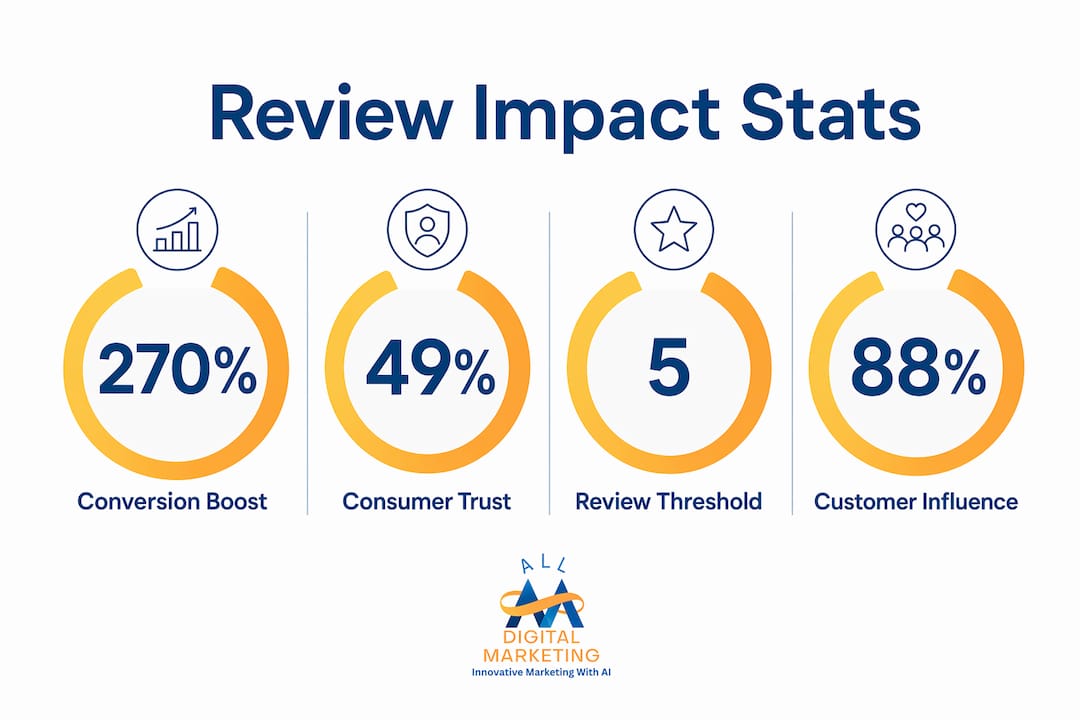
Online reviews are defined as public, user-generated evaluations of a business's products or services that directly shape consumer trust and local search rankings. The importance of online reviews for small to medium-sized businesses cannot be overstated. 88% of consumers read reviews before making a purchase. That single statistic means your potential customers are already forming opinions about your business before they ever contact you. Reviews also carry significant weight in Google's local search algorithm, making them one of the most controllable factors in your local visibility. The FTC now enforces strict rules around review authenticity, so the stakes for getting your review strategy right have never been higher.
Why the importance of online reviews goes beyond star ratings
Online reviews function as social proof, and social proof is the primary mechanism that converts a skeptical stranger into a paying customer. When someone searches for a plumber, a dentist, or a restaurant, they are not just looking for a name. They are looking for evidence that other people made the right choice. Reviews provide that evidence in a format that feels personal and trustworthy.

49% of consumers trust online reviews as much as a personal recommendation from a friend. That level of trust is remarkable given that the reviewer is a complete stranger. It means your review profile carries nearly the same persuasive weight as word-of-mouth referrals, which most business owners consider their most valuable source of new customers.
The impact on conversion rates is equally striking. Displaying reviews can increase conversions by up to 270%, with the biggest jump occurring when a business moves from zero to five reviews. That means even a handful of genuine reviews can produce a measurable lift in the number of visitors who actually contact or buy from you.
The role of customer reviews also extends to how consumers read them. Shoppers today scan for authenticity signals. They look for specific details, photos, and language that sounds like a real person rather than a marketing script. A review that mentions "the technician arrived on time and fixed the issue in 45 minutes" carries far more weight than "great service, highly recommend." Encouraging your customers to leave detailed feedback is one of the most direct ways to build credibility.
Pro Tip: Ask customers to mention a specific detail in their review, such as the name of the staff member who helped them or the exact service they received. Specificity signals authenticity to both readers and search algorithms.
Negative reviews also play a role in building trust. A business with only five-star ratings can look curated or fake. A mix of ratings, handled professionally, signals that your reviews are real and that you take customer feedback seriously. Consumers read business responses to reviews 89% of the time before deciding whether to trust a business. Responding to every review, positive or negative, is not optional if you want to build genuine credibility.
What role do online reviews play in local SEO and search visibility?
Reviews are one of the most powerful ranking signals in Google's local search algorithm. Review signals account for around 20% of local pack ranking factors in 2026. That means roughly one in five points determining whether your business appears in the top three local results comes directly from your review profile.
Google evaluates several specific dimensions of your reviews, not just the total count. The key factors include:
- Review velocity. How frequently you receive new reviews matters more than your total number. A business collecting two or three reviews per week signals active customer engagement.
- Recency. Reviews from the past 90 days carry more weight than older ones. A large volume of reviews from two years ago provides less ranking benefit than a steady stream of recent feedback.
- Sentiment. Google's algorithm reads the language inside your reviews. Positive language tied to specific services or locations reinforces your relevance for those search terms.
- Owner response rate. Responding to 80% or more of your reviews produces measurable local ranking improvements. Google treats consistent responses as a signal that the business is active and engaged.
- Review diversity. Reviews spread across multiple platforms, including Google Business Profile, Yelp, and industry-specific directories, strengthen your overall authority.
The relationship between reviews and local SEO creates what practitioners call a ranking flywheel. More reviews improve your ranking. A higher ranking generates more visibility. More visibility brings more customers who leave more reviews. The businesses that start this cycle early build a compounding advantage over competitors who treat reviews as an afterthought.
| Ranking factor | Why it matters |
|---|---|
| Review velocity | Weekly new reviews outrank businesses with higher but stale totals |
| Response rate | Responding to 80%+ of reviews improves local pack position |
| Sentiment analysis | Keyword-rich review language reinforces local search relevance |
| Review recency | Reviews from the past 90 days carry the strongest ranking weight |
| Profile completeness | Google Business Profile combined with active reviews is the top controllable signal |
AI-powered search tools, including Google's AI Overviews and generative search features, also pull from review data when assembling answers to local queries. A business with a strong, recent, and well-responded review profile is more likely to appear in AI-generated recommendations. This makes reputation monitoring an active, ongoing task rather than a one-time setup.
How should SMBs manage and grow their online reviews?
The most effective review strategy for a small or medium-sized business combines consistent acquisition, timely responses, and strict compliance with platform and legal rules. Getting this right does not require a large budget. It requires a repeatable process.
- Prioritize your first five reviews. The conversion lift from zero to five reviews is the steepest part of the curve. Focus your initial efforts on reaching this threshold for each core service or product you offer.
- Use SMS review requests. Text message requests outperform email for review conversion. Send a direct link to your Google Business Profile review page within 24 hours of a completed service while the experience is still fresh.
- Respond within 24 hours. Speed of response signals attentiveness. A prompt, specific reply to a negative review often does more for your reputation than a dozen five-star ratings.
- Never incentivize reviews. Offering discounts, gifts, or any reward in exchange for a review violates both FTC guidelines and Google's policies. The FTC's 2024 rule imposes civil penalties up to $51,744 per violation. The financial and reputational risk is not worth it.
- Encourage photos and videos. Customers who include photos or videos in their reviews produce content that is significantly more persuasive. Video reviews drive 2.1x higher engagement than photo reviews and 4.3x higher than text-only reviews.
- Maintain review velocity. Businesses with consistent weekly new reviews outrank those with higher total counts but stale recent activity. Build a habit of requesting reviews after every completed transaction.
Pro Tip: Create a short, branded card or follow-up text that includes a direct link to your Google Business Profile review page. Remove every extra step between the customer and the review form. Friction kills follow-through.
AI tools now assist with personalizing review request messages and drafting responses at scale. For a business owner managing operations, customer service, and marketing simultaneously, these tools reduce the time cost of maintaining an active review presence. The key is to review and personalize any AI-generated response before publishing. Generic responses undermine the authenticity that makes review management effective in the first place. For a deeper look at building your overall reputation, the online reputation management guide for SMBs from Digitalmarketingall covers the full picture.
What are the biggest misconceptions about online reviews?
The most common misconception is that a perfect 5.0 star rating is the goal. Consumers trust star ratings between 4.0 and 4.7 more than a perfect score. A flawless rating triggers skepticism because it looks curated. Ratings in the 4.2 to 4.6 range consistently outperform 5.0 in conversion studies because they feel earned rather than manufactured.
Negative reviews are not a crisis. They are an opportunity. A business that responds to a one-star review with a specific, solution-focused reply often earns more trust from prospective customers than the business with nothing but praise. The response demonstrates accountability, and accountability is what buyers are actually evaluating.
The impact of online feedback also has a ceiling. Review volume produces diminishing returns beyond a certain threshold. The jump from zero to five reviews produces the largest conversion lift. Moving from 50 to 100 reviews produces a much smaller incremental gain. This means chasing raw volume at the expense of quality or recency is a misallocation of effort.
| Misconception | Reality |
|---|---|
| Perfect 5.0 ratings build the most trust | Ratings between 4.0 and 4.7 convert better; perfect scores signal fake reviews |
| More total reviews always means better rankings | Consistent weekly velocity outranks higher but stale totals |
| Negative reviews hurt your business | Professionally handled negative reviews increase credibility and trust |
| Incentivizing reviews is a gray area | FTC penalties reach $51,744 per violation; the practice is clearly prohibited |
| Text reviews are sufficient | Video reviews generate 4.3x more engagement than text-only reviews |
Fake reviews are a growing enforcement target. The FTC's 2024 rule created real financial consequences for businesses that buy, fabricate, or manipulate reviews. Google's AI detection systems are also improving at identifying patterns associated with inauthentic review activity. Businesses that built their profiles on purchased reviews face increasing risk of penalties, ranking drops, and public exposure.
Review diversity matters more than most business owners realize. A profile with 200 Google reviews and nothing elsewhere looks thinner than a profile with 150 Google reviews, 40 Yelp reviews, and 30 reviews on an industry-specific platform. Spreading your acquisition efforts across relevant platforms builds a more credible and resilient reputation. Pairing this with consistent reputation management tactics gives your business a durable advantage in local search.
Key Takeaways
Online reviews are the single most controllable factor in both consumer trust and local search visibility for small and medium-sized businesses.
| Point | Details |
|---|---|
| Reviews drive conversions | Moving from zero to five reviews can increase conversions by up to 270%. |
| Velocity beats volume | Consistent weekly new reviews outrank businesses with higher but stale totals. |
| Responses build trust | 89% of consumers read business responses before deciding to trust a company. |
| Perfect ratings backfire | Ratings between 4.0 and 4.7 convert better than a flawless 5.0 score. |
| FTC compliance is non-negotiable | Fake or incentivized reviews carry civil penalties up to $51,744 per violation. |
What I've learned from watching SMBs win and lose on reviews
Working in digital marketing long enough means watching the same pattern repeat. A business owner spends years building a great product or service, then loses a local search position to a competitor with half the quality but twice the review activity. It is frustrating to watch, and it is entirely preventable.
The shift I've noticed most in the past two years is how sophisticated consumers have become at spotting inauthentic reviews. They look for generic language, suspiciously clustered posting dates, and profiles with no photos. A flood of five-star reviews posted in the same week reads as a red flag, not a recommendation. Authenticity is now a skill that both consumers and algorithms evaluate.
The business owners who get this right treat reviews as a core part of their customer relationship process, not a marketing task they delegate and forget. They respond personally, they ask for specific feedback, and they use what they learn to improve their service. That feedback loop is what separates businesses that grow from those that plateau.
My honest advice is to stop thinking about reviews as a reputation metric and start thinking about them as a local SEO signal that compounds over time. A business that collects three genuine, detailed reviews per week for a year builds an advantage that is very difficult for a competitor to close quickly. Start the process now, build the habit, and treat every customer interaction as a potential review opportunity.
— Diane
How Digitalmarketingall helps SMBs build a stronger review presence
Building a consistent review strategy takes time, process, and the right tools. Digitalmarketingall works with small and medium-sized businesses to create review generation and management systems that produce real results without violating FTC or Google guidelines. The approach covers everything from setting up your Google Business Profile correctly to building the follow-up sequences that turn satisfied customers into published reviewers. Pair that with targeted local advertising campaigns that put your business in front of high-intent local buyers, and you create a visibility engine that works on multiple levels at once. If you want your business to rank higher, convert more visitors, and build a reputation that holds up to scrutiny, Digitalmarketingall has the expertise to make it happen.
FAQ
Why do online reviews matter for small businesses?
Online reviews directly influence both consumer trust and local search rankings. With 88% of consumers reading reviews before purchasing, a strong review profile is one of the most effective ways to attract new customers.
How many reviews does a business need to see results?
The conversion lift is steepest when moving from zero to five reviews. After that, consistent weekly velocity matters more than reaching a specific total count.
Can a business ask customers to leave reviews?
Yes, businesses can ask customers for honest reviews. The FTC prohibits incentivizing reviews with rewards or payment, with penalties reaching $51,744 per violation.
Do negative reviews hurt local search rankings?
Negative reviews alone do not significantly hurt rankings. Responding promptly and professionally to negative feedback is a positive ranking signal and builds consumer trust.
What type of review content is most effective?
Video reviews generate 4.3x higher engagement than text-only reviews. Encouraging customers to include photos, videos, and specific details produces the most persuasive and credible review content.