

TL;DR:
- Traditional SEO processes are too slow for today's AI-driven search landscape, requiring a structured, disciplined workflow. Building clear ownership roles, flexible tools, and an iterative measurement system enables SMBs to leverage AI effectively and maintain competitive visibility. Success depends on process discipline and human oversight, not just on AI tools or quick automation.
Many small and medium-sized businesses struggle to rank locally and attract consistent leads because their SEO processes are slow, inconsistent, or built for a search landscape that no longer exists. Google and other search engines now use AI to interpret intent, evaluate content quality, and personalize results at a scale that traditional, manual SEO simply cannot match. The good news is that AI-powered workflows can close this gap. This guide walks you through a practical, step-by-step approach to building an AI-enhanced SEO process that generates more visibility, more leads, and more return on every hour you invest.
Table of Contents
- Why your SEO workflow needs a reboot now
- What you need: Tools, team, and technical stack checklist
- Step-by-step: An AI-powered SEO workflow for SMBs
- Verify success: Measuring results and avoiding common pitfalls
- Why 'process' wins: Lessons and truths from real AI SEO adoption
- Level up your SEO results with expert support
- Frequently asked questions
Key Takeaways
| Point | Details |
|---|---|
| AI transforms ROI | Automation accelerates SEO while targeted human input ensures accuracy and lasting gains. |
| Process beats tools | A standardized workflow with clear roles drives consistent results even as technology shifts. |
| Measure what matters | Track traffic, rankings, leads, and time savings to refine your SEO and justify your investment. |
| Adaptability is crucial | Use provider-agnostic designs so you can switch AI tools easily as needs and offerings evolve. |
Why your SEO workflow needs a reboot now
Search engines have changed dramatically. Google's AI systems, including its Search Generative Experience and AI Overviews, now evaluate content based on nuanced signals like topical authority, entity relationships, and user intent patterns. Ranking well today means producing content that AI can interpret as genuinely helpful, not just keyword-optimized pages stuffed with phrases.
For most SMBs, that shift creates a real problem. Traditional SEO workflows rely on manual tasks: spreadsheets for keyword tracking, one-off content briefs, and occasional audits that happen when someone remembers to schedule them. These processes are not just slow. They are structurally incompatible with the speed and sophistication that modern AI-driven search engines demand.
The consequences are visible. Businesses miss keyword opportunities because no one owns the research process. Content gets published without proper intent alignment. Technical issues linger for months because audits are infrequent. Each of these gaps represents lost traffic and lost leads.
One of the most important insights from AI vs. SEO research is that AI does not replace SEO. It raises the standard for how SEO must be executed. That distinction matters because it tells you what to focus on: not replacing your team with tools, but upgrading your process so your team can work at a higher level.
What separates high-performing SMBs from those stuck on page two comes down to structure. As AI-driven SEO frameworks research confirms, a practical AI-powered SEO workflow needs explicit execution frameworks to prevent cross-team chaos, including standardized workflows and clear ownership models.
Without that structure, even the best AI tools will underperform. You end up with duplicated work, inconsistent outputs, and a team that doesn't know who is responsible for what.
Here is what a broken workflow typically looks like:
- Keyword research done sporadically with no documented process
- Content created without reference to search intent or competitive gaps
- Technical audits skipped because "we did one last year"
- No clear person accountable for monitoring rankings or leads
- Tools purchased but underused because no one set them up properly
Understanding ranking in the AI era means recognizing that visibility now extends beyond page one. AI-generated answers, local packs, and featured snippets are all part of the equation. If your workflow does not account for those, you are leaving significant traffic on the table.
"The businesses winning in AI-powered search are not necessarily the ones with the best tools. They are the ones with the most disciplined processes."
With the challenge established, let's clarify what you'll need to set up an effective AI-enhanced SEO process.
What you need: Tools, team, and technical stack checklist
Before you run a single AI-powered audit or generate a single keyword brief, you need to get your foundation right. That means having the right tools, the right roles, and the right structure in place. Skipping this step is one of the most common reasons AI SEO initiatives fail within the first 90 days.
Essential tool categories
Your AI SEO stack does not need to be expensive or complex. You do need tools that cover the core functions. Here is a breakdown of what each category handles and why it matters:
| Tool category | Core function | Why it matters for SMBs |
|---|---|---|
| Keyword research | Finds and clusters search terms by intent | Targets the right audience at the right buying stage |
| Content optimization | Scores content against top-ranking pages | Closes gaps between your content and competitors |
| Technical audit | Crawls site for errors, speed, and structure issues | Prevents ranking penalties from fixable problems |
| Analytics and reporting | Tracks traffic, rankings, and conversions | Measures what is working and what needs adjustment |
| Local SEO management | Manages Google Business Profile and citations | Critical for location-based lead generation |
The most important design principle for your stack is flexibility. AI SEO basics make clear that no single tool dominates every category, and the landscape evolves quickly. That is why, as this approach to AI SEO pipelines shows, SMBs benefit from implementing a provider-agnostic adapter layer to keep tooling swappable and avoid major refactors when better options emerge.
In practical terms, that means you build your process around the function, not the specific tool. Your keyword research step should work whether you are using one platform or another. Your content review checklist should apply regardless of which AI writing assistant you use. This approach protects your investment in process when tools change or improve.

Roles and ownership model
Every step in your workflow needs a named owner. Without this, tasks fall through the cracks and accountability becomes impossible. Here is a simple ownership structure that works for most SMBs:
- SEO lead: Owns the overall strategy, keyword priorities, and performance reporting
- Content manager: Executes content briefs, manages writers or AI outputs, and handles publishing
- Technical SEO owner: Runs audits, fixes crawl errors, manages site speed and schema
- Local SEO owner: Updates Google Business Profile, manages reviews, and tracks local rankings
- QA reviewer: Reviews AI-generated content and automated outputs before anything goes live
For very small businesses, one person may cover multiple roles. That is fine. What matters is that every function has an assigned owner, even if one person wears several hats.
Pro Tip: Document your ownership model in a shared project management tool. When team members know exactly what they own, execution speed increases and duplicated effort drops sharply.
Before moving to execution, run through this technical readiness checklist:
- Google Search Console and Google Analytics 4 connected and verified
- Site crawl completed with major errors flagged
- Google Business Profile claimed, verified, and fully populated
- Core Web Vitals benchmarked
- AI tools configured with your brand name, location data, and target keyword categories
Exploring AI-driven content strategies can also help you align your content planning with the emotional and intent-based signals that AI search engines now prioritize. Content that resonates with real human needs performs better in AI-evaluated search environments.
Armed with the right resources, you're ready to implement the workflow.
Step-by-step: An AI-powered SEO workflow for SMBs
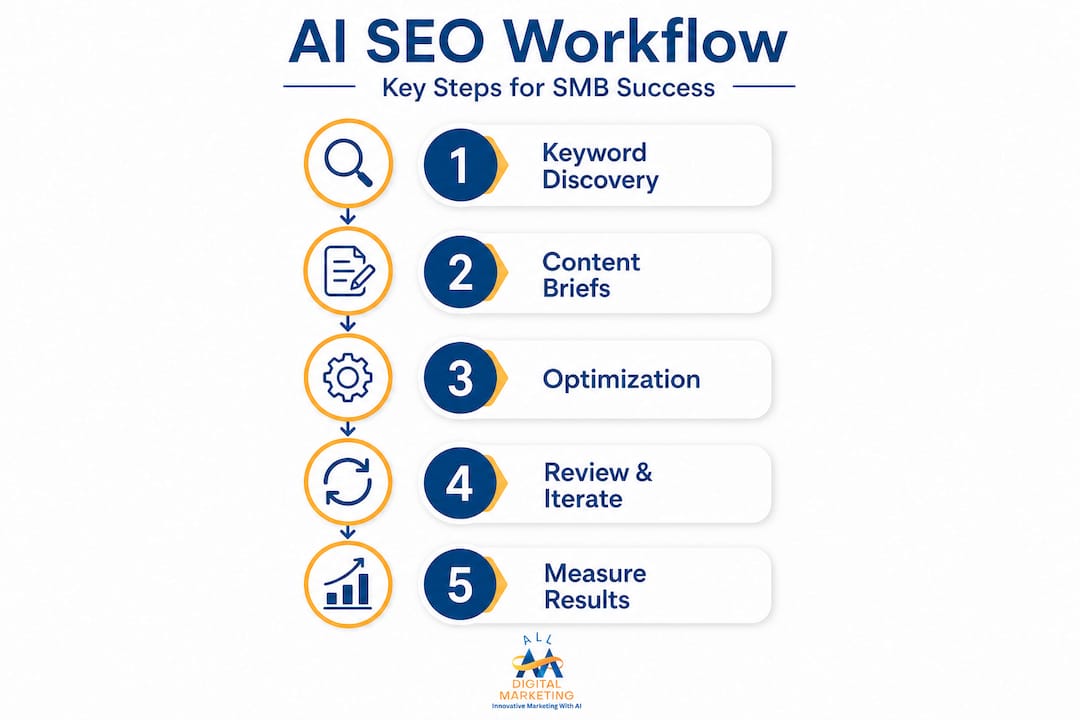
This is the core of your new process. Each step uses AI to accelerate execution while keeping humans in the loop for decisions that require judgment, context, and accuracy. Follow these steps in sequence for the best results.
-
Run AI-assisted keyword research. Start by feeding your AI keyword tool your core service categories, location, and customer pain points. Let the tool generate a broad list of keyword variations, questions, and long-tail phrases. Export everything and move to the next step.
-
Group keywords by search intent. This is where AI saves enormous time. Use an AI tool or a language model to sort your keyword list into intent buckets: informational (people learning), navigational (people looking for a specific brand or location), and transactional (people ready to act or buy). This grouping determines which content type to create for each cluster.
-
Create structured content briefs. For each intent cluster, generate a content brief that includes the primary keyword, supporting keywords, recommended headings, and a target word count. AI tools can pull competitor data to identify content gaps you should fill. Your content manager then reviews and approves each brief before writing begins.
-
Produce and optimize content. Whether you use AI to draft content or human writers to create it, every piece should pass through an AI content optimization tool that scores it against top-ranking pages. Look at semantic coverage, heading structure, and readability. Make adjustments before publishing.
-
Run automated technical audits. Schedule weekly or bi-weekly crawls of your site using your technical audit tool. Flag issues in a shared log and assign them to your technical SEO owner with a resolution deadline. Common issues include broken links, slow-loading pages, missing meta descriptions, and unoptimized image files.
-
Conduct human QA review. This step is non-negotiable. Every AI-generated output, whether a content draft, a keyword list, or an audit report, must be reviewed by a human before it informs a decision or goes live. AI tools can make errors, hallucinate data, or miss local context. As Fast Company's research confirms, the workflow must include human oversight and QA for accuracy.
-
Publish, index, and monitor. Submit new content to Google Search Console for indexing. Set up rank tracking for your target keywords. Monitor performance weekly for the first month, then monthly once trends stabilize.
Here is a side-by-side comparison of AI-augmented versus manual-only execution across key workflow steps:
| Workflow step | Manual-only time | AI-augmented time | Quality difference |
|---|---|---|---|
| Keyword research | 4 to 6 hours | 30 to 60 minutes | AI finds more variations faster |
| Intent grouping | 2 to 3 hours | 10 to 20 minutes | AI sorts at scale without fatigue |
| Content brief creation | 1 to 2 hours per brief | 15 to 30 minutes | Consistency improves with AI templates |
| Technical audit | 3 to 5 hours | Automated, ongoing | AI catches more issues continuously |
| Performance reporting | 2 to 3 hours weekly | Real-time dashboards | Faster insight with fewer errors |
Pro Tip: Run your AI-generated keyword list against your actual customer inquiries and support tickets. Real customer language often reveals high-value terms that AI tools overlook because they rely on search volume data rather than direct buyer conversations.
Winning with AI SEO requires pairing AI speed with human judgment. Neither alone is enough for consistent, high-quality results. You also want to keep an eye on Generative Engine Optimization, which focuses on getting your content surfaced in AI-generated answers, not just traditional blue-link results.
With a working process, it's critical to evaluate actual performance. Let's see how to measure your results.
Verify success: Measuring results and avoiding common pitfalls
Implementing an AI-powered workflow without a clear measurement plan is like running a campaign with no budget tracking. You cannot tell what is working, what needs adjustment, or where to invest more effort. Measurement is what separates businesses that iterate toward growth from those that spin their wheels.
Key performance indicators to track
Start with these core KPIs (key performance indicators) from day one:
- Organic traffic: Track total sessions from search engines weekly. Look for upward trends month over month.
- Keyword rankings: Monitor your target keywords weekly using your rank tracking tool. Note movements above or below the top 10.
- Lead volume: Count form submissions, phone calls, and chat inquiries attributed to organic search.
- Time savings: Log how long each workflow step takes before and after AI adoption. This is your efficiency ROI (return on investment).
- Cost per lead: Divide your SEO investment by the number of leads generated. Compare this to your paid advertising cost per lead.
AI tools can materially affect organic traffic, keyword movement, time savings, and cost-per-result, which is why SMB workflows should measure tool outcomes against manual baselines. Without that comparison, you cannot prove whether the AI investment is paying off.
How to A/B test your AI outputs
A/B testing in SEO does not mean the same thing as in paid advertising, but the principle applies. Create two versions of a page: one optimized manually and one using AI recommendations. Publish both, track performance over 60 to 90 days, and compare rankings and engagement metrics. The winner informs your default approach going forward.
You can also test different AI tools against each other. Run your keyword research with two different platforms, then track which keyword list produces better ranking movement after 90 days. This kind of empirical testing builds internal confidence in your tools and processes.
"The biggest risk in AI SEO is not the tools. It is over-automation: trusting AI outputs without verification and publishing content that misrepresents your business or alienates your actual customers."
Common pitfalls to avoid
- Over-automating: Running AI outputs directly to publication without human review is a fast path to errors, inconsistencies, and content that does not reflect your brand voice
- Skipping technical fixes: Many businesses focus all energy on content while technical issues quietly suppress rankings
- Ignoring local signals: For SMBs, local SEO signals like Google Business Profile activity, review responses, and citation consistency are often more impactful than broad content plays
- Unclear ownership: Without a named owner for each KPI, no one feels responsible when numbers drop
- Chasing vanity metrics: Traffic volume without lead volume tells you nothing useful about business impact
Understanding strategies for Google's AI Overviews is also critical for SMBs that want to appear in AI-generated answer boxes, not just ranked pages. And understanding Google's AI Overviews from a technical standpoint helps your team optimize content structure and authority signals to qualify for those featured positions.
Quick wins typically appear within the first 30 to 60 days through technical fixes and content updates on existing pages. Long-term gains from new content and authority building typically take 90 to 180 days to fully materialize. Plan your reporting cadence accordingly so stakeholders understand the realistic timeline.
Applying all these steps, what's the bigger truth about succeeding with AI SEO?
Why 'process' wins: Lessons and truths from real AI SEO adoption
Here is something most AI SEO content glosses over: the tool you choose matters far less than the process you build around it. We see this play out repeatedly. A business invests in a premium AI SEO platform, generates a wave of enthusiasm, and then six months later is back where it started because nobody maintained the workflow.
Switching tools is easy. Switching from no process to a disciplined, accountable one is genuinely hard. It requires buy-in from leadership, training for your team, and a willingness to measure outcomes honestly even when results are disappointing at first.
The uncomfortable truth is that AI SEO adoption often fails not because the technology doesn't work, but because businesses treat it like a product rather than a process. They expect the tool to run itself. They skip the human review steps because they feel redundant. They don't assign clear owners because it feels like extra overhead. Then they are surprised when results don't materialize.
AI does surface things that humans miss: keyword gaps you never thought to target, technical errors buried deep in your site structure, content patterns that correlate with top rankings. That is real value. But AI cannot decide what your brand stands for. It cannot verify that an AI-generated fact is accurate for your specific market. It cannot make the judgment call about whether a content angle aligns with your customer relationships. Those are irreplaceable human contributions.
The most resilient SMBs we work with share a common trait: they treat their SEO workflow like infrastructure. They review it quarterly, update ownership when team roles change, and benchmark their results continuously. When search engines update their algorithms, which they will, these businesses adapt quickly because their process is already built for measurement and iteration.
Don't chase every AI trend. New tools launch every month with bold claims about ranking improvements. Most of them deliver incremental gains at best. The businesses that consistently win the AI search game are focused on execution quality and process discipline, not on having the newest tool in their stack.
A mature, well-documented AI SEO workflow also gives you a durable competitive advantage. Most of your local competitors are still operating with informal, reactive SEO practices. A structured workflow that runs consistently and measures outcomes makes your business more visible, more efficient, and better positioned for whatever changes search engines introduce next.
Level up your SEO results with expert support
Building an effective AI-powered SEO workflow takes time, and it takes the right knowledge to do it correctly from the start. If you are ready to move faster or want expert guidance tailored to your specific business and local market, we can help. At Digital Marketing All, we work directly with SMBs to design, implement, and manage AI-driven SEO strategies that generate real leads and measurable growth. From keyword research to local SEO and Google Business Profile optimization, our team handles the complexity so you can focus on running your business. Explore custom AI SEO help and find out how a structured, expert-led approach can deliver the visibility and lead volume your business needs.
Frequently asked questions
What is an AI-powered SEO workflow?
An AI-powered SEO workflow uses artificial intelligence tools to automate and optimize key SEO tasks like keyword research, content planning, and technical audits. As Fast Company's research confirms, the workflow must always include human oversight and QA to ensure accuracy and relevance.
How do I ensure my team actually adopts an AI SEO process?
Give every workflow step a clearly named owner, use standardized procedures everyone can follow, and hold regular reviews to identify gaps. AI-driven SEO frameworks research confirms that explicit execution frameworks and clear ownership models are essential to prevent cross-team confusion and duplication.
Can I swap out one AI tool for another in my process?
Yes, and you should design your workflow to make that easy. Building a provider-agnostic AI pipeline with adapter layers means you can switch tools as better options emerge without overhauling your entire process.
What metrics matter most to measure AI SEO results?
Focus on keyword rankings, organic traffic growth, lead volume, and time or cost savings. Measuring tool outcomes against manual baselines gives you a clear, evidence-based view of your actual ROI and helps you make smarter investment decisions going forward.