

TL;DR:
- A social media audit helps identify current strengths and gaps for better optimization.
- Consistent use of local keywords and NAP details improves local search visibility.
- Strategic focus and regular monitoring are key to growing engagement and local online presence.
You post regularly, you stay active, and yet local customers still don't seem to find you online. For many small and medium-sized businesses, social media feels like a treadmill: lots of effort, little forward movement. The truth is that posting frequency alone doesn't drive local visibility. Strategic optimization does. This guide walks you through a clear, step-by-step framework to sharpen your social media presence, improve local search prominence, and connect with the customers who are already looking for what you offer.
Table of Contents
- Audit your current social media presence
- Set clear goals and choose the right platforms
- Optimize profiles for local SEO and discoverability
- Create and schedule content for maximum engagement
- Track, refine, and win: Measure your success
- The real reason most SMBs fail at social media optimization
- Drive better results with expert optimization solutions
- Frequently asked questions
Key Takeaways
| Point | Details |
|---|---|
| Audit to set your baseline | Review your profiles, metrics, and competitors to find your real strengths and gaps. |
| Focus your resources | Pick the best platforms and set clear, achievable goals tailored to your audience. |
| Optimize for local SEO | Update profiles with local keywords, visuals, and Google Business integration for easy discovery. |
| Engage and measure | Post consistently, encourage community involvement, and refine efforts based on real data each month. |
| Quality over quantity | A few well-optimized actions deliver better results than spreading yourself thin everywhere. |
Audit your current social media presence
With the problem defined, the first essential step is understanding your social media starting point. A proper audit tells you what's actually working, where you're losing potential customers, and what gaps your competitors are quietly filling.
Start by reviewing every active profile your business has. Check for completeness: do all profiles have a clear bio, a profile photo, a cover image, and a working website link? Next, look at consistency. Your business name, address, and phone number should match exactly across every platform. Inconsistencies here hurt both trust and local search rankings.
When reviewing performance, audit your strategy by going beyond vanity metrics. Follower counts feel rewarding but they rarely translate to revenue. Instead, focus on:
- Engagement rate: Likes, comments, and shares relative to your reach
- Click-through rate (CTR): How many viewers actually visit your website
- Comment quality: Are people asking questions, tagging friends, or just scrolling past?
- Response time: How quickly you reply to messages and comments
Competitor analysis is equally valuable. Identify two or three local competitors and study what content earns them the most engagement. Look for gaps: topics they're missing, platforms they've abandoned, or audiences they're ignoring. Those gaps are your opportunities.
| Audit area | What to check | Why it matters |
|---|---|---|
| Profile completeness | Bio, photo, links | Builds trust and discoverability |
| Brand consistency | Name, address, tone | Supports local SEO accuracy |
| Engagement metrics | Rate, CTR, comments | Shows real audience connection |
| Competitor gaps | Content, platforms | Reveals growth opportunities |
As the audit steps 2026 guide recommends, inventorying your profiles and analyzing engagement metrics beyond vanity numbers gives you the clearest picture of where to invest your energy next.
"You can't optimize what you haven't measured. A social media audit is the foundation every local business needs before making any changes."
Pro Tip: Save a snapshot of your current metrics before making any changes. That baseline becomes your most powerful benchmarking tool three months from now. Pair your social audit with search optimization tactics for a fuller picture of your online visibility.
Set clear goals and choose the right platforms
Once you know your baseline, next is defining clarity and focus for your efforts. Without specific goals, every post is a guess.
The most effective approach is setting SMART goals: Specific, Measurable, Achievable, Relevant, and Time-bound. Instead of "get more followers," try "increase website clicks from Instagram by 20% in 90 days." That kind of goal tells you exactly what to track and when you've succeeded.
Choosing the right platforms matters just as much. The American Marketing Association's social media marketing strategy research confirms that selecting 1 to 3 platforms where your audience is actually active, and tracking KPIs like CTR and conversions, produces far better results than spreading thin across every channel.
Here's a quick platform comparison for local SMBs:
| Platform | Best for | Local SMB advantage |
|---|---|---|
| Community building, events | Local groups, Facebook Ads targeting | |
| Visual products, services | Reels discovery, location tags | |
| TikTok | Short video, younger audiences | Viral potential, low ad cost |
| B2B services | Professional credibility | |
| Nextdoor | Hyper-local reach | Neighborhood-level visibility |
Here's how to narrow your focus:
- Research where your ideal customer spends the most time
- Evaluate which platforms support your content style (video, images, text)
- Choose 1 to 3 channels based on audience fit and your team's capacity
- Define one primary KPI per platform (CTR, conversions, or direct messages)
- Review platform performance monthly and drop what isn't delivering
Pro Tip: If you're unsure which platform to prioritize, start with Facebook. It still holds the largest local SMB audience and offers the most targeted advertising options for choosing the right platforms. For a deeper breakdown of platform ROI, explore this SMB marketing ROI guide.
Optimize profiles for local SEO and discoverability
With your goals and platforms picked, it's time to upgrade your business's digital storefront for maximum local impact. Your profile is often the first impression a potential customer sees. Make it count.
The single most impactful step is ensuring consistent NAP: your business Name, Address, and Phone number must be identical across every platform and directory. Even a small formatting difference, like "St." versus "Street," can confuse search engines and cost you local ranking positions.

Beyond NAP, use your bio and description to naturally include location-based keywords. For example, a plumber in Austin should include phrases like "Austin plumbing services" or "licensed plumber in Austin, TX." These keywords help your profile appear when nearby customers search.
Here's a quick checklist for profile optimization:
- Add your city and service area to your bio
- Enable map pins or location tags on every applicable platform
- List accurate business hours and update them for holidays
- Upload branded profile and cover images that reflect your local identity
- Link directly to your Google Business Profile from your social bios
According to the Local SEO Guide from The SMB Hub, optimized social profiles with location details directly enhance "near me" visibility, and consistent posting drives important signals to Google. Pairing optimized profiles with a strong Google Business Profile presence is especially effective.
| Profile element | Optimization action | Local SEO impact |
|---|---|---|
| Bio/description | Add city and service keywords | Improves local search match |
| NAP details | Match exactly across all platforms | Boosts trust and ranking |
| Business hours | Keep current and accurate | Reduces bounce from bad info |
| Cover image | Use location-specific branding | Builds local recognition |
To boost social SEO further, optimize your Google Business Profile and review the key local search ranking factors that influence where you appear.
Create and schedule content for maximum engagement
Now that your profiles are ready, creating the right content and keeping it regular builds trust and keeps your audience coming back. Consistency signals credibility to both your followers and search engines.
Start with a content calendar. Batch-create your posts for the week or the month so you're never scrambling for ideas at the last minute. A simple spreadsheet works fine. Plan your topics, formats, and posting dates in advance.
Follow the 80/20 rule: 80% of your content should educate, entertain, or inform your audience, while only 20% promotes your products or services directly. This ratio keeps followers engaged rather than tuning you out.
Here's what a strong local SMB content mix looks like:
- Local events, news, or community spotlights
- Behind-the-scenes glimpses of your team or process
- Customer testimonials and success stories
- User-generated content (UGC) shared with permission
- Helpful tips relevant to your industry
- Occasional promotional posts, offers, or announcements
For posting frequency, consistent posting of 3 to 5 times per week on platforms like Instagram and TikTok, combined with active community engagement, drives the best visibility results.
The American Marketing Association also notes that resource-limited business owners should automate scheduling using tools like Buffer or Hootsuite to stay consistent without burning out.
- Map out your content themes for the month
- Write or record content in batches (one focused session per week)
- Schedule posts using a tool like Buffer, Hootsuite, or Later
- Respond to every comment and message within 24 hours
- Review which post types performed best and repeat them
Pro Tip: Repurpose your best-performing content. A strong testimonial post can become a short video, a story, and an email snippet. One idea, three pieces of content. To learn how to increase social ROI, explore our guide built specifically for SMBs.
Track, refine, and win: Measure your success
Finally, it's not enough to set and forget. Tracking and adjusting turns good intentions into growing results. Data removes the guesswork and shows you exactly where to focus next.
Most platforms offer free built-in analytics dashboards. Use them weekly. The key metrics to monitor are:
- Reach and impressions: How many people saw your content
- Engagement rate: Comments, shares, and saves relative to reach
- Click-through rate: Traffic sent to your website
- Conversions: Calls, form submissions, or purchases from social traffic
- Follower growth rate: Steady growth signals healthy momentum
Spot trends by comparing content types. If educational videos consistently outperform static images, that's your signal to shift production. If posts with local hashtags drive more profile visits, use them every time.
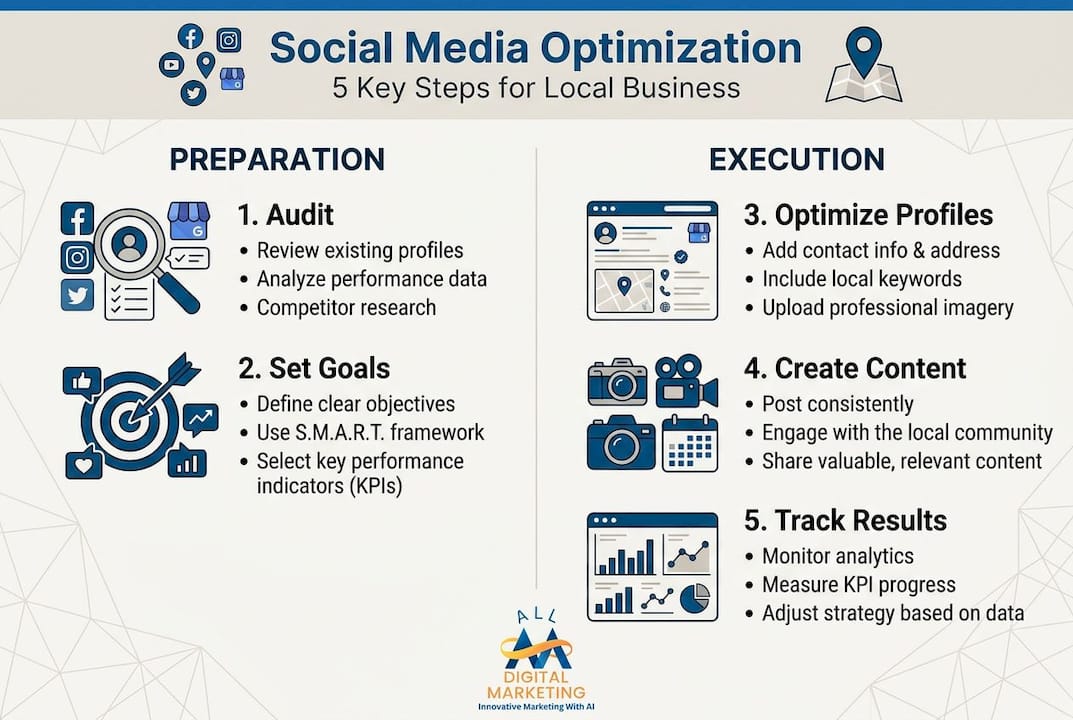
| Review frequency | Action to take | Goal |
|---|---|---|
| Weekly | Check engagement and reach | Catch dips early |
| Monthly | Compare content type performance | Double down on winners |
| Quarterly | Reassess platform and goal alignment | Stay strategically focused |
Know when to pivot. If a platform shows three consecutive months of declining engagement, it may not be the right fit for your audience. Reallocate that time to your strongest channel.
As the Social Media Marketing Strategy framework confirms, tracking KPIs like CTR and conversions (not just likes) produces meaningful, measurable growth. Use your analytics to measure campaign effectiveness and explore digital marketing strategies to expand your approach in 2026.
"Analytics without action is just data. Review your numbers regularly and commit to making at least one strategic adjustment every month."
The real reason most SMBs fail at social media optimization
After seeing the official steps, it's worth digging into what makes social media optimization truly effective in practice. Here's the honest take: most small businesses fail not because they post too little, but because they post without strategy.
Busywork feels productive. Posting five times a day feels like effort. But scattered, low-intent content creates noise rather than results. Real optimization comes from strategic focus: a few well-chosen platforms, consistent quality, and content built around what your local audience actually needs.
The biggest overlooked opportunity we see consistently is location features. Most SMBs never use location tags, local hashtags, or geo-targeted content intentionally. These are free tools that directly improve your "near me" discoverability. Linking social to SEO through these features is one of the highest-return moves available to any local business.
Set real goals, track them honestly, and focus on adding genuine value to your community. Google notices consistent, location-relevant social signals. Your customers notice quality. Both reward businesses that do the basics exceptionally well, not those who do everything halfway.
Drive better results with expert optimization solutions
For those eager to turn insights into action, working with experts offers an even faster path to results. Knowing the right steps is one thing; executing them consistently while running a business is another challenge entirely.
If your in-house resources are stretched thin, partnering with a specialized team can fast-track your local visibility gains. At Digital Marketing All, we fine-tune your social profiles, develop content strategies built for your market, and integrate review generation services to strengthen your reputation where it counts most. Whether you need search price optimization or a full-scale social and local SEO strategy, our expert team is ready to help you move from effort to measurable results.
Frequently asked questions
What are the most important social media performance metrics for small businesses?
Track engagement rate, click-through rate, conversions, and growth relative to your goals. The metrics beyond vanity like engagement rate and CTR tell you far more than follower counts alone.
How often should a small business post on social media to boost visibility?
Aim for at least 3 times per week per platform, prioritizing consistency over volume. Research confirms 3 to 5 posts weekly on platforms like Instagram and TikTok delivers strong visibility results.
Can optimizing social media really impact my local SEO rankings?
Yes. Optimized profiles and regular posting with local keywords improve your prominence in "near me" searches and on Google Maps. Location-optimized profiles directly enhance local discoverability and send positive signals to search engines.
Which content types usually perform best for small business social media?
Behind-the-scenes posts, local events, customer testimonials, and user-generated content typically earn the highest engagement for local SMBs. Authentic, community-focused content consistently outperforms polished promotional material.