

TL;DR:
- On-page SEO offers quicker, measurable results by optimizing website elements directly controlled by the business.
- Key focus areas include content quality, keywords, meta tags, site speed, mobile design, and internal linking.
- Prioritizing on-page SEO helps local businesses achieve faster visibility and strong foundational rankings.
Most local business owners assume SEO is a waiting game driven by backlinks from other websites. That belief slows down real progress. On-page SEO delivers faster results than off-page methods and is especially valuable for small and medium-sized businesses that want quick, measurable wins. On-page SEO puts you in the driver's seat because every element you optimize lives on your own website. This guide breaks down exactly what on-page SEO means, which elements matter most, and how to apply a practical checklist to start climbing search rankings without waiting on anyone else.
Table of Contents
- What is on-page SEO? A clear definition for business owners
- Essential elements: What to optimize for top search performance
- On-page vs off-page SEO: Key differences and what really matters for local businesses
- A step-by-step checklist: How to apply on-page SEO for your website
- Our experience: Why on-page SEO is the ultimate growth lever for local businesses
- Take your next step: Professional help with on-page SEO
- Frequently asked questions
Key Takeaways
| Point | Details |
|---|---|
| On-page SEO impact | Optimizing your own website elements gives you fast, direct improvements in search rankings. |
| Critical elements | Pay special attention to your title tags, meta descriptions, content quality, and mobile experience. |
| Results timeline | On-page changes can deliver ranking and visibility results in as little as 2-4 weeks. |
| Local business focus | On-page SEO is the highest ROI path for small and local businesses to compete online. |
What is on-page SEO? A clear definition for business owners
Now that you see the importance of on-page over off-page factors, let's break down what on-page SEO really means for your business.
On-page SEO means optimizing your website's own elements like content and structure so search engines can understand and rank your pages. It is everything you control directly, from the words on a page to the way images are labeled. This is different from off-page SEO, which focuses on earning links and mentions from other websites. Off-page work is valuable, but it depends on third parties. On-page SEO depends entirely on you.
For local businesses, this distinction is important. You may not have the budget or connections to build a large backlink profile right away. But you can absolutely improve your own pages today. That is why on-page SEO is often the highest-return starting point for small and medium-sized businesses. Changes you make to your own site can show up in search results within weeks, not months.
Here are the core elements that fall under on-page SEO:
- Content quality and relevance: Does your page answer what your customer is searching for?
- Keywords: Are the right terms used naturally throughout your text, headings, and metadata?
- Title tags and meta descriptions: Do they clearly describe the page and include your target keyword?
- Heading structure: Are H1, H2, and H3 tags used logically to organize your content?
- Image alt text: Are your images labeled so search engines can read them?
- URL structure: Are your page URLs short, descriptive, and keyword-friendly?
- Internal linking: Do your pages connect to each other in a way that helps users and search engines navigate?
- Page speed and mobile design: Does your site load fast and work well on phones?
"On-page SEO is the foundation that makes everything else in your digital strategy work harder. Without it, even the best backlinks land on pages that search engines struggle to trust."
If you want a broader view of how these pieces fit together, explore these simplified SEO strategies and learn more about boosting website traffic through smart optimization.
Essential elements: What to optimize for top search performance
Understanding the basics is step one. Here is exactly what elements you need to focus on, with actionable details for each.
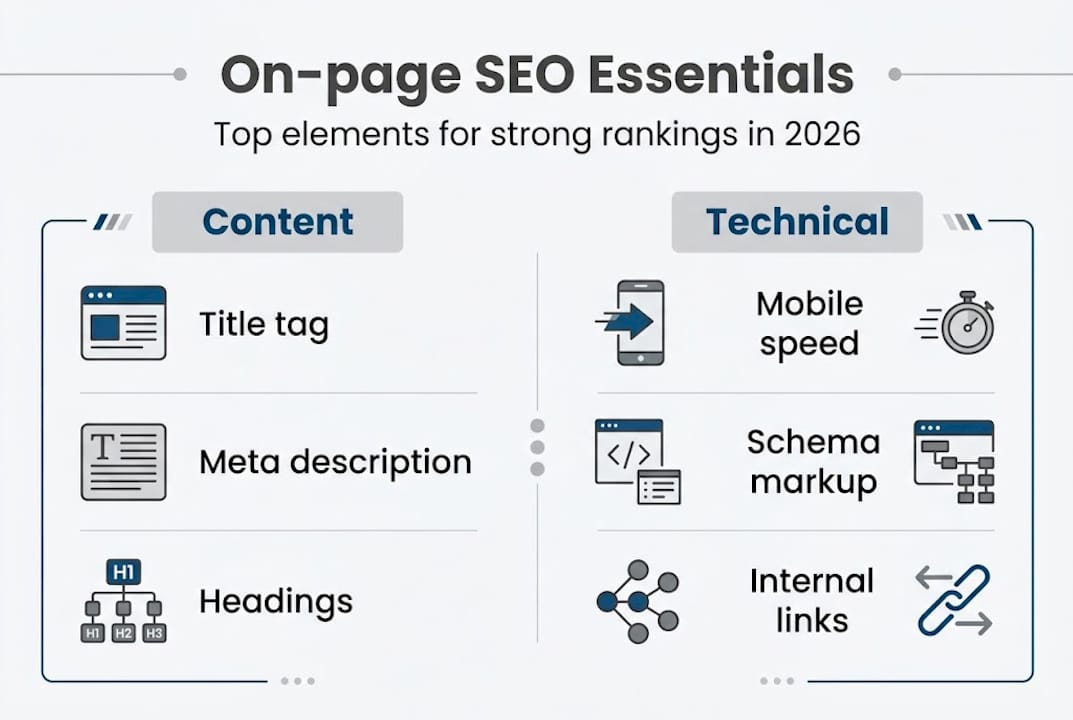
Every page on your website has several technical and content layers that influence how Google ranks it. Key mechanics include optimizing title tags, meta descriptions, headings, content, image alt text, URL structure, internal links, mobile-friendliness, and page speed. Each one sends a signal to search engines about what your page is about and how trustworthy it is.

| Element | Best practice | Quick win opportunity |
|---|---|---|
| Title tag | Under 60 characters, includes primary keyword | Rewrite vague titles immediately |
| Meta description | Under 160 characters, compelling and clear | Add a call to action to increase clicks |
| Heading (H1) | One per page, includes main keyword | Make sure every page has exactly one H1 |
| Content length | 1,400 to 1,800 words for competitive topics | Expand thin pages with useful detail |
| Image alt text | Descriptive, keyword-relevant | Audit images for missing alt tags |
| Page speed | Under 2.5 seconds load time | Compress images and enable browser caching |
| Mobile design | Fully responsive layout | Test every page on a mobile device |
| URL structure | Short, lowercase, keyword-rich | Fix long or confusing URLs during updates |
Here is the order of priority for getting started:
- Fix or write strong title tags for every page
- Write unique meta descriptions for each page
- Add one clear H1 heading per page
- Expand thin content to at least 800 words per service page
- Add descriptive alt text to all images
- Simplify and shorten your URLs
- Run a speed test and fix the top issues
- Confirm your site is mobile-friendly using Google's free tool
Pro Tip: Many top-ranking pages have between 1,400 and 1,800 words of relevant content. If your service pages are just a few paragraphs, that is likely hurting your rankings. Add FAQs, detailed descriptions, and local context to build depth.
For more guidance on getting this right, review these SEO best practices and apply these SEO-friendly website tips to your next site update.
On-page vs off-page SEO: Key differences and what really matters for local businesses
Now let's see how on-page SEO stacks up against other types, so you can prioritize the efforts that bring results the fastest.
The difference between on-page and off-page SEO comes down to control. On-page is yours to manage. Off-page depends on what others do. For a local plumber, landscaper, or dental office, that distinction shapes where you should spend your energy first.
| Factor | On-page SEO | Off-page SEO |
|---|---|---|
| Who controls it | You | Third parties |
| Time to see results | 2 to 4 weeks | Several months |
| Cost to implement | Low to moderate | Moderate to high |
| Best for | Content, structure, relevance | Authority, trust signals |
| Local business ROI | High | Moderate, builds over time |
On-page changes can show results in 2 to 4 weeks, while off-page methods often take considerably longer. That speed matters when you are running a business and need leads now, not next quarter.
Here is what local businesses gain by prioritizing on-page first:
- Faster visibility: Google can re-crawl your updated pages quickly
- Better user experience: Cleaner pages reduce bounce rates and increase time on site
- Local relevance signals: Mentioning your city, neighborhood, and services clearly helps Google match you to nearby searches
- Foundation for everything else: Off-page strategies work better when your pages are already well-optimized
One strategy that works especially well for local businesses is building separate location pages. If you serve three cities, create a dedicated page for each one. Use local keywords, include the city name in the title tag, and write content specific to that area. This approach targets local search intent far more effectively than one generic service page.
Technical SEO, which covers site structure, crawlability, and schema markup, works alongside on-page SEO to reinforce your results. Think of on-page as the content layer and technical SEO as the infrastructure beneath it. Both matter, but on-page is where most local businesses should start. Explore more about off-page SEO strategies once your on-page foundation is solid.
A step-by-step checklist: How to apply on-page SEO for your website
Understanding what to do is powerful, but knowing exactly how to get started turns insight into action. Here is your checklist.
On-page SEO is foundational for SMBs; addressing page elements creates quick wins that compound over time. Use this checklist to work through your site systematically.
- Research your keywords. Use free tools like Google Search Console or Google's autocomplete to find what your customers actually type. Focus on phrases with local intent, such as "roof repair in Austin" rather than just "roof repair."
- Update your title tags. Every page needs a unique title under 60 characters that includes your primary keyword. Avoid stuffing multiple keywords. One clear, relevant phrase is enough.
- Write strong meta descriptions. Keep them under 160 characters. Tell the reader what they will find and why they should click. Include a soft call to action like "Learn more" or "Get a free estimate."
- Structure your headings. Use one H1 per page. Use H2s for main sections and H3s for subsections. Include your keyword in the H1 naturally.
- Add alt text to every image. Describe what is in the image and include a relevant keyword where it fits naturally. Never leave alt text blank.
- Clean up your URLs. Short, lowercase URLs with your keyword perform better. Avoid numbers, symbols, or long strings of words.
- Link internally. Connect related pages to each other. A blog post about lawn care tips should link to your lawn care service page. This helps users navigate and helps Google understand your site structure.
- Test your page speed. Use Google PageSpeed Insights. Aim for a load time under 2.5 seconds. Compress images, reduce unnecessary plugins, and use a reliable host.
- Check mobile responsiveness. Open every page on your phone. Text should be readable without zooming. Buttons should be easy to tap.
- Track your results. Set up Google Search Console and Google Analytics. Monitor which pages gain impressions and clicks after your updates.
Pro Tip: Match your content to searcher intent. Someone searching "how to fix a leaky faucet" wants information. Someone searching "plumber near me" wants to hire someone. Your page content and call to action should match what the searcher actually wants.
For a broader view of how on-page SEO fits into your overall growth plan, explore these digital marketing strategies built specifically for small businesses in 2026.
Our experience: Why on-page SEO is the ultimate growth lever for local businesses
After working with dozens of local business websites, one pattern stands out clearly. The businesses that see the fastest, most consistent growth are not the ones with the most backlinks. They are the ones with the cleanest, most relevant, and most user-friendly pages.
Google's algorithm has shifted significantly toward rewarding genuine relevance and strong site experience. A well-structured page with clear content, fast load times, and accurate local signals consistently outperforms a cluttered page with a long backlink list. We have seen local service businesses double their organic traffic simply by fixing title tags, expanding thin content, and adding location-specific pages. No ad spend. No outreach campaigns.
The real insight is this: your website is an asset you own. Every improvement you make to it compounds. A better title tag works for you every day, every week, every year. That is not true of a paid ad the moment you stop funding it. Businesses that invest time and care into their own pages build a durable competitive advantage. Explore more SEO power tactics to keep building on that foundation.
Take your next step: Professional help with on-page SEO
Ready to see real improvements? Here is how to take your SEO to the next level with expert assistance.
Applying on-page SEO yourself is absolutely possible, and this guide gives you a strong starting point. But if you want faster results and a complete strategy, working with professionals makes a significant difference.

At Digital Marketing All, we combine on-page optimization with reputation tools to help you get more reviews and build trust signals that support your rankings. We also run targeted Google Ads campaigns that work alongside your organic strategy for maximum visibility. Whether you need a full site audit, content improvements, or a complete local SEO plan, our team is ready to help. Visit our digital marketing experts to explore done-for-you services and find out what your site needs most.
Frequently asked questions
How long does it take to see results from on-page SEO?
Most local businesses see measurable ranking improvements within 2 to 4 weeks of making on-page changes. Consistent updates over time produce compounding gains.
Do I need technical skills to improve on-page SEO?
Basic on-page SEO can be handled by beginners using guides, website builders, and free tools like Google Search Console. Complex issues such as site structure or schema markup may benefit from professional support.
What are the must-have elements for on-page SEO in 2026?
Every business should optimize title tags, meta descriptions, content quality, heading structure, mobile responsiveness, and site speed. These are non-negotiable for competitive rankings.
Is on-page SEO more important than off-page SEO for local businesses?
On-page SEO is the best starting point because it delivers faster ROI and more control than off-page methods. Build your on-page foundation first, then layer in off-page strategies.
Recommended
- Skyrocketing Your Business: Secret SEO Strategies for 2025
- Ranking Higher in Searches: Simplified SEO Strategies
- Searcher Intent Optimization: The 2026 Guide to Ranking #1
- Unlock Google Domination: 15 Action-Fueled SEO Content Writing Tips for 2025
- Crack the Code with Seo Tips: Boost Your Rankings Fast!