

TL;DR:
- Digital marketing ROI measures profit as a percentage of all marketing-related revenue versus costs. Business owners must include all costs, track revenue attribution accurately, and wait appropriate periods to assess long-term channels like SEO. Relying on full cost data and the incremental net profit formula provides the most truthful measure of marketing effectiveness.
Digital marketing ROI is defined as the percentage profit your business earns for every dollar spent on marketing, calculated by comparing all revenue attributed to marketing against all associated costs. For small and medium-sized business owners, knowing how to measure digital marketing ROI separates confident budget decisions from costly guesswork. A 5:1 revenue-to-spend ratio is considered strong performance across most channels. That benchmark means for every $5 in revenue, you spent $1 on marketing. Getting there requires accurate formulas, honest cost accounting, and reliable revenue attribution. This guide covers all three.
How to measure digital marketing ROI: the full picture
The standard formula for calculating marketing ROI is: ((Revenue Attributed to Marketing − Total Marketing Cost) ÷ Total Marketing Cost) × 100. This core ROI formula yields a percentage that tells you exactly how much profit you generated above what you spent. A result of 200% means every $1 invested returned $3 in revenue, producing $2 in net profit above cost.
Most business owners stop at ad spend when tallying costs. That is the most common mistake in ROI measurement. Total marketing cost must include every dollar tied to the campaign, from media spend to the hours your team spent writing copy or managing accounts. Leaving out those costs inflates your ROI figure and leads to bad budget decisions.
The formula also requires accurate revenue attribution. You need to know which sales, leads, or sign-ups came from which marketing effort. Without that link, the formula produces a number that looks precise but reflects nothing real. The sections below walk through cost accounting and attribution in detail.
What costs should small businesses include in ROI calculations?
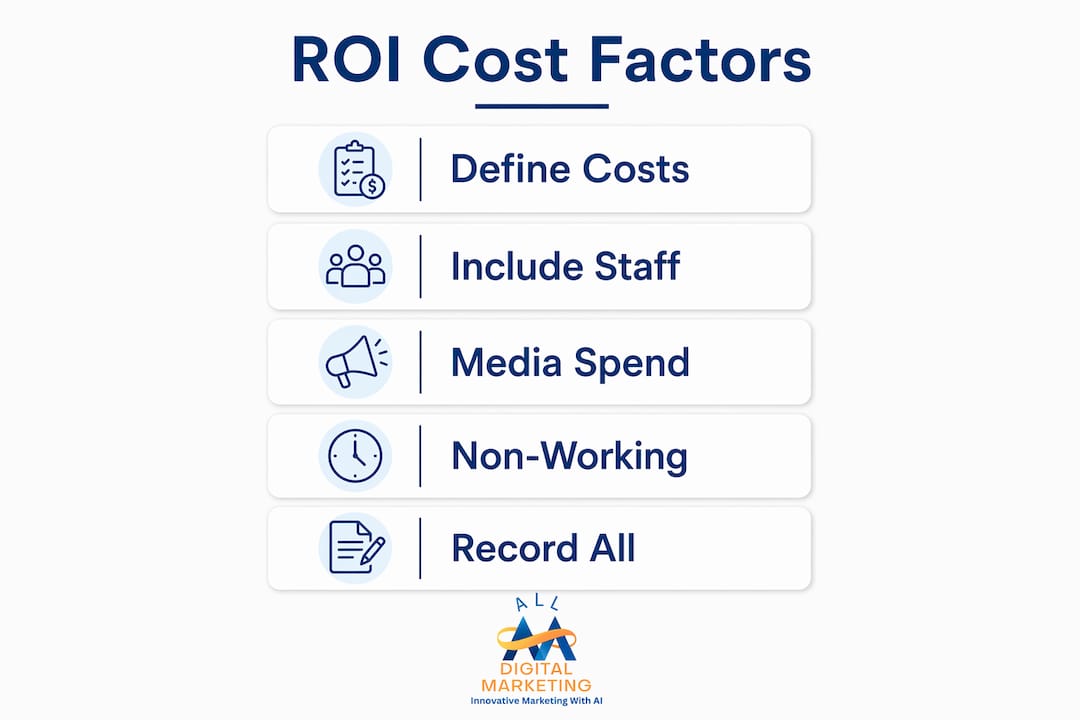
Accurate ROI starts with a complete cost picture. Costs fall into two categories: working costs and non-working costs. Working costs are direct media spend, such as Google Ads budgets, Meta ad spend, and sponsored content fees. Non-working costs cover everything else required to run the campaign.
Non-working costs include:
- Agency fees and freelancer payments for creative, strategy, or management work
- Staff salaries and time allocated to planning, writing, designing, or reporting
- Software subscriptions for email platforms, analytics tools, CRM systems, and scheduling apps
- Cost of goods sold (COGS) for e-commerce businesses selling physical products
- Overhead allocations such as a portion of office costs tied to marketing operations
Excluding staff time from cost calculations is the most common error that inflates ROI figures. A campaign that appears to return 400% ROI may actually return 180% once you account for the 15 hours your marketing coordinator spent managing it. That gap between reported and real ROI causes businesses to over-invest in channels that are not as profitable as they appear.
Separating working costs from non-working costs also helps you identify where inefficiency lives. If your non-working costs consistently exceed your media spend, you have a production cost problem, not a media problem. Tracking both categories in separate columns on your reporting sheet makes that pattern visible immediately.

Pro Tip: Build a simple cost log at the start of every campaign. Record every expense, including internal staff hours at an estimated hourly rate, before the campaign launches. Updating it weekly takes five minutes and prevents major attribution errors at reporting time.
How can SMBs track and attribute revenue to specific campaigns?
Revenue attribution is the process of connecting a sale or lead back to the marketing effort that generated it. Without reliable attribution, your ROI formula produces a number that cannot guide decisions. Four steps make attribution reliable for small and medium-sized businesses.
-
Tag every external link with UTM parameters. UTM tagging assigns campaign, source, and medium labels to every URL you share. UTM parameters feed directly into Google Analytics 4, letting you see exactly which campaign drove each session and conversion. Use a consistent naming convention across all channels so your data stays comparable month to month.
-
Configure Google Analytics 4 conversion tracking. Set up GA4 goals for every action that matters: form submissions, phone call clicks, purchases, and email sign-ups. GA4's event-based model captures multi-touch behavior, meaning you can see every touchpoint a customer hit before converting, not just the last one.
-
Log lead sources in your CRM. Automated attribution tools are imperfect. Manual CRM logging of lead sources remains necessary for accurate revenue attribution, especially for phone leads or walk-in customers who mention a specific ad or search result. Train your sales team to ask and record how each lead found you.
-
Choose the right attribution model. The table below compares the most common models.
| Attribution model | How it assigns credit | Best use case |
|---|---|---|
| Last-click | 100% credit to the final touchpoint | Simple paid campaigns with short sales cycles |
| First-touch | 100% credit to the first touchpoint | Awareness campaigns and brand tracking |
| Linear | Equal credit across all touchpoints | Multi-channel campaigns with long consideration periods |
| Data-driven | Credit distributed by actual conversion influence | Businesses with sufficient GA4 conversion data |
Last-click attribution consistently undervalues channels like SEO and social media that assist conversions without closing them. A customer might find you through an organic search result, return via a remarketing ad, and convert through a direct visit. Last-click gives all credit to the direct visit and zero to the SEO effort that started the relationship. Data-driven attribution corrects that distortion, but it requires a meaningful volume of conversion data before GA4 can model it accurately.
Allow adequate time before drawing conclusions. Paid channels need 30–60 days of data before ROI figures stabilize. SEO and content marketing require 6–12 months. Cutting a channel's budget at the 45-day mark because ROI looks low is one of the most expensive mistakes an SMB can make. For a deeper look at why SEO timelines differ from paid, the long-term ROI comparison between SEO and paid channels explains the mechanics clearly.
What formulas and methods calculate digital marketing ROI reliably?
Three formulas cover the full range of SMB needs, from a quick monthly check to a CFO-ready profitability report.
Basic ROI formula
((Revenue − Marketing Cost) ÷ Marketing Cost) × 100
This version works for a fast channel comparison. If your email campaign generated $8,000 in revenue and cost $1,000 to run, your ROI is 700%. The limitation is that it excludes COGS and non-working costs, so it overstates true profitability for product-based businesses.
COGS-adjusted ROI formula
((Revenue − COGS − Marketing Cost) ÷ Marketing Cost) × 100
For e-commerce businesses, subtracting the cost of goods sold gives a more honest picture. If that same $8,000 in email revenue came from products that cost $4,000 to produce, your adjusted ROI drops to 300%. That is still strong, but it is a very different number than 700%.
Incremental net profit ROI
Incremental net profit ROI accounts for all non-working costs, COGS, and campaign budget to produce the closest measure of real profitability. The formula compares the net profit generated by the campaign against what you would have earned without it. This approach is accepted by finance teams and gives the most accurate read on whether a channel is genuinely profitable.
Pro Tip: Track ROAS (Return on Ad Spend) separately from ROI. ROAS measures revenue per dollar of ad spend only: Revenue ÷ Ad Spend. It is useful for comparing individual ad sets within a campaign. ROI measures total profitability including all costs. Use ROAS to tune campaigns daily and ROI to make monthly budget decisions.
The table below shows how the same campaign looks across three calculation methods.
| Calculation method | Revenue | Costs included | Result |
|---|---|---|---|
| Basic ROI | $8,000 | Media spend only ($1,000) | 700% |
| COGS-adjusted ROI | $8,000 | Media spend + COGS ($5,000) | 60% |
| Incremental net profit ROI | $8,000 | Media spend + COGS + staff time ($6,200) | 29% |
The gap between 700% and 29% on the same campaign is not unusual. It shows exactly why full cost inclusion matters. Reporting the 700% figure to justify continued spending while the real return is 29% leads to budget decisions that hurt the business over time. For social media campaigns specifically, the social media ROI metrics guide covers how to apply these formulas at the ad set level.
What are common pitfalls when measuring digital marketing ROI?
Several errors consistently skew ROI results for small and medium-sized businesses. Recognizing them early saves months of misdirected spending.
- Excluding staff costs. Every hour your team spends on a campaign has a dollar value. Omitting it inflates ROI and makes expensive channels look efficient.
- Relying on last-click attribution. As noted above, last-click ignores the full customer path and systematically undervalues awareness channels like SEO and social media.
- Ignoring offline conversions. A customer who sees your Google Ad and then calls your store is a conversion. If you do not log that call as attributed to the campaign, the revenue disappears from your ROI calculation.
- Measuring too early. Evaluating SEO ROI at 60 days produces meaningless data. Shortening timelines risks cutting budget before full benefits appear.
- Mixing vanity metrics with ROI data. Impressions, follower counts, and likes do not appear in the ROI formula. Vanity metrics often fail to reflect true marketing ROI. Keep them in a separate reporting section so they do not distort your profitability view.
The most practical fix for most of these errors is a consistent monthly reporting sheet. Simple monthly tracking sheets covering channel spend, leads, conversions, and ROI give SMBs a reliable baseline before they need a full dashboard. Build one sheet per channel, update it on the same date each month, and compare results quarter over quarter. That discipline alone catches most attribution errors before they compound.
Pro Tip: Set a calendar reminder to audit your UTM naming conventions every quarter. Inconsistent tagging, such as "Facebook" in one month and "facebook" in the next, splits your data into separate rows in GA4 and makes channel comparisons impossible. Consistent naming is free and takes 10 minutes to enforce.
For tracking local marketing results specifically, the local marketing results guide from Digitalmarketingall covers how to connect offline customer behavior to your digital campaign data.
Key Takeaways
Accurate digital marketing ROI requires full cost inclusion, reliable revenue attribution, and enough time for each channel to show real results before you draw conclusions.
| Point | Details |
|---|---|
| Use the complete ROI formula | Include all working and non-working costs, not just ad spend, for an honest result. |
| Tag every link with UTMs | Consistent UTM parameters feed GA4 with the data needed to attribute revenue accurately. |
| Choose the right attribution model | Data-driven attribution reflects true channel contribution; last-click distorts it. |
| Respect channel timelines | Allow 30–60 days for paid channels and 6–12 months for SEO before judging ROI. |
| Track ROI and ROAS separately | Use ROAS for daily campaign tuning and ROI for monthly budget decisions. |
Why most SMBs are reading their ROI numbers wrong
After working with small and medium-sized businesses on digital marketing performance, one pattern stands out above all others. Business owners trust the number their ad platform reports and treat it as ROI. It is not. Platform-reported ROAS counts only the revenue the platform can attribute to itself, using its own attribution model, excluding every cost except ad spend. That number is always optimistic. Sometimes it is wildly so.
The businesses that make the best budget decisions are the ones willing to do the unglamorous work: logging lead sources in a CRM, tracking staff hours against campaigns, and waiting the full 6–12 months before judging whether SEO is working. That patience feels uncomfortable when you are spending money every month. But cutting an SEO investment at month three because you cannot see the return yet is like pulling a plant out of the ground to check if the roots are growing.
The incremental net profit ROI method is the one I trust most. It is the hardest to calculate and the least flattering, but it is the only formula that tells you whether a channel is genuinely building your business or just generating activity. If your CFO or accountant reviewed your marketing numbers, incremental net profit ROI is the figure they would ask for. Build your reporting around it from the start, even if the early numbers are humbling. Honest data leads to better decisions, and better decisions compound over time.
— Diane
How Digitalmarketingall helps you turn ROI data into real growth
Understanding your ROI numbers is one part of the equation. Acting on them is the other. Digitalmarketingall works with small and medium-sized businesses to build the kind of online presence that drives measurable, attributable results. One area where ROI shows up faster than most business owners expect is online reputation. Strong reviews increase conversion rates on every channel, which means your existing marketing spend produces more revenue without increasing cost. The review generation and management service from Digitalmarketingall helps you collect and manage customer reviews systematically, so your marketing dollars work harder across search, local, and paid channels.
FAQ
What is the basic formula to calculate marketing ROI?
The formula is ((Revenue Attributed to Marketing − Total Marketing Cost) ÷ Total Marketing Cost) × 100. A result of 200% means every $1 spent returned $3 in revenue.
What counts as a good digital marketing ROI benchmark?
A 5:1 revenue-to-spend ratio, equal to 500% ROI, is considered strong performance. A ratio below 2:1 signals inefficiency, though benchmarks vary by industry and channel.
Why does last-click attribution distort ROI results?
Last-click gives 100% of conversion credit to the final touchpoint and ignores every earlier interaction. This systematically undervalues channels like SEO and social media that assist conversions without closing them.
How long should I wait before measuring SEO ROI?
SEO and content marketing require 6–12 months before ROI figures reflect real performance. Evaluating results earlier risks cutting a channel before it has had time to produce returns.
What is the difference between ROI and ROAS?
ROI measures total profitability across all costs and revenue. ROAS measures only revenue returned per dollar of ad spend. Use ROAS to compare individual ad sets and ROI to make channel-level budget decisions.