

TL;DR:
- Generative engine optimization enhances your website content to ensure AI systems cite your business as an authoritative source in responses from tools like ChatGPT and Google AI Overviews. It builds upon traditional SEO principles by prioritizing factual accuracy, schema markup, and recency, leading to increased AI citations and visibility. Implementing crawlable content, structured data, and question-led pages within a 90-day cycle can rapidly improve your share of AI-driven search mentions and competitive presence.
Generative engine optimization (GEO) is defined as the practice of structuring your website content so AI-powered search systems can find, understand, and cite your business as a reliable authority in their generated answers. While traditional SEO focuses on ranking in a list of blue links, GEO targets a different outcome: getting your content quoted directly inside AI responses from tools like Google AI Overviews, ChatGPT, and Perplexity. Salesforce describes GEO as an SEO strategy that prioritizes context, accuracy, and recency over keyword volume. For small and medium-sized businesses, this shift represents one of the most significant changes to search visibility since Google launched local packs. The good news is that you do not need to rebuild your marketing from scratch. GEO builds directly on the SEO foundations you already have.
What is generative engine optimization and how does it differ from traditional SEO?
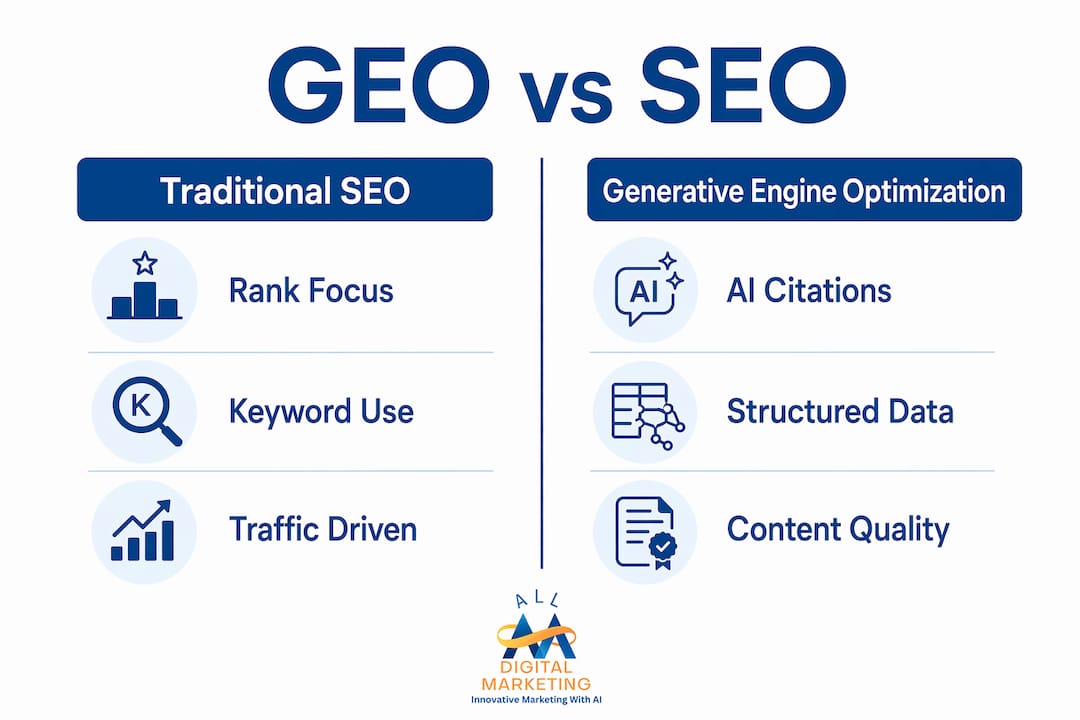
Generative engine optimization and traditional SEO share the same foundation but diverge sharply in what they optimize for. Traditional SEO targets ranking signals: backlinks, keyword density, page authority, and click-through rates in a results list. GEO targets citation signals: whether an AI system selects your content as the source it quotes when generating an answer for a user.
Google's own John Mueller confirms that GEO and AEO are extensions of SEO, not separate disciplines. This matters because it means you are not starting over. You are refining what you already do with a sharper focus on content clarity, factual accuracy, and structured data.
The practical difference shows up in how AI systems process content. A traditional search engine ranks pages. An AI system reads pages, extracts meaning, and synthesizes an answer. That means keyword frequency matters far less than factual clarity and recency. Salesforce's Mahvish Khan puts it directly: GEO success depends on structuring content so large language models can "find, understand, and reference" your data rather than guessing from keyword density alone.
Here is a side-by-side comparison of where the two approaches overlap and where they split:
| Factor | Traditional SEO | Generative engine optimization |
|---|---|---|
| Primary goal | Rank in search results | Get cited in AI-generated answers |
| Content focus | Keyword relevance and volume | Factual accuracy, context, and recency |
| Technical priority | Backlinks and page authority | Crawlability, schema markup, structured data |
| Success metric | Organic traffic and ranking position | Citation velocity and share of voice |
| Content format | Long-form keyword-optimized pages | Definition-first, question-led, answer-rich pages |
| Update frequency | Periodic refreshes | Ongoing 90-day content cycles |
Both approaches require crawlable, high-quality content. Neither rewards thin pages or keyword stuffing. The overlap is large enough that improving your GEO performance almost always improves your SEO performance at the same time.
Pro Tip: If your existing content already ranks well for informational queries, you are closer to GEO-ready than you think. Start by auditing your top-performing pages for definition-first structure and schema markup before creating anything new.
What are the foundational best practices for AI search visibility?
Google Search Central's 2026 guidance states clearly that optimizing for generative AI features is fundamentally an SEO task. The agency recommends crawlable, valuable, and unique content above all else. No special AI text files, no content chunking tricks, and no gimmicks. That guidance is the most authoritative starting point for any SMB building a GEO strategy.

Technical requirements that AI systems depend on
AI search systems like Google's generative features pull from the same index as traditional search. Google's generative AI systems rely on publicly crawlable content from the Search index to provide grounded responses. If your pages are blocked by robots.txt, hidden behind login walls, or slow to load, no amount of content quality will get you cited. Technical SEO is the prerequisite, not an afterthought.
Schema markup is where SMBs can gain a measurable edge. Three schema types deliver the highest return for local and service businesses: "LocalBusiness, Service, and Product`. These structured data formats tell AI systems exactly what your business does, where it operates, and what it offers, without requiring the AI to infer that information from paragraph text.
Content quality signals that drive citations
Content freshness is a direct citation factor. GEOWriter's 90-day playbook for local businesses recommends treating content in 90-day cycles: publish, monitor citation performance, refresh with updated data or new expert quotes, and repeat. AI systems weight recent content more heavily because their training and retrieval systems favor recency as a proxy for accuracy.
Structured, authoritative content that AI systems can reliably interpret requires more than good writing. It requires expert quotes, cited data, and clear factual claims. A page that says "our plumbers are experienced" gives an AI system nothing to cite. A page that says "our licensed plumbers in Austin have completed over 2,000 service calls since 2019" gives the AI a specific, verifiable claim it can reference.
Here is a practical checklist of technical and editorial steps to build your GEO foundation:
- Confirm all key service and location pages are indexed in Google Search Console
- Add
LocalBusiness,Service, orProductschema to every primary page - Write a clear definition or direct answer in the first two sentences of every page
- Include at least one data point, expert quote, or specific statistic per page
- Update your top 10 pages with fresh information on a 90-day cycle
- Remove duplicate content across location pages and replace with unique, location-specific details
- Check page speed scores in Google PageSpeed Insights and fix any Core Web Vitals failures
- Build an internal linking structure that connects related service and location pages
Pro Tip: Multi-location businesses face a specific duplication risk. Never copy the same service page across locations with only the city name swapped. Write unique content for each location that references local landmarks, local customer needs, or location-specific services. AI systems penalize thin, templated pages the same way traditional search does.
How can SMBs implement GEO to improve local search and AI citations?
A practical GEO implementation for a small or medium business does not require a large budget or a dedicated AI team. It requires a clear process, consistent execution, and the right measurement framework. The following phases give you a resource-conscious path from zero to measurable citation performance.
Phase 1: Content audit and baseline measurement
Before writing a single new page, audit what you already have. Identify your top 20 pages by organic traffic and check each one for three things: a definition-first opening sentence, at least one schema markup type, and a content date within the last 90 days. Pages that fail all three criteria are your highest-priority GEO opportunities. Tools like Google Search Console, Screaming Frog, and Ahrefs make this audit straightforward even for small teams.
Set a citation baseline by searching for your business category and location in Google AI Overviews, ChatGPT, and Perplexity. Note which competitors appear in AI-generated answers. This is your share-of-voice benchmark. You cannot measure progress without knowing where you start.
Phase 2: Schema markup and structured content
Implement schema markup on every service and location page. For a local business, LocalBusiness schema should include your NAP (name, address, phone number), business hours, service area, and category. Consistent NAP data across your website, Google Business Profile, and directory listings is a foundational trust signal for AI systems that cross-reference multiple sources.
GEOWriter's citation velocity tracking recommends maintaining 2 to 3 new citations per location per week to compound visibility over time. That pace requires a content calendar, not a one-time publishing sprint. Plan for one new or refreshed piece of location-specific content per week per location.
Phase 3: Question-led content creation
AI systems are built to answer questions. Content that mirrors question-and-answer structure gets cited more often because it matches the format AI systems use to generate responses. Every service page should answer the five questions a prospective customer would ask: What is this service? Who needs it? How does it work? What does it cost? Why should I choose this provider?
The GEOWriter local business playbook calls these "grounding pages." They are location-specific, schema-rich, and built around customer questions rather than keyword lists. A grounding page for a roofing company in Denver would answer "What does a roof replacement cost in Denver in 2026?" with a specific range, a local context explanation, and a clear call to action.
Phase 4: Measurement and iteration
| Metric | What it measures | How to track |
|---|---|---|
| Citation velocity | New AI citations per location per week | Manual AI search queries + tracking sheet |
| Share of voice | % of AI answers that mention your brand vs. competitors | Weekly AI search audits |
| Content decay rate | Drop in citation frequency after 90 days without updates | Citation velocity trend over time |
| Index coverage | % of key pages indexed by Google | Google Search Console coverage report |
Effective GEO workflows incorporate citation rate baselines, ongoing content refreshes tied to index decay, and citation velocity monitoring instead of traditional traffic-focused metrics. This is a meaningful shift for SMBs accustomed to measuring success by page views or keyword rankings. Citation velocity is the new north-star metric for AI search performance.
For SMBs that want to connect GEO performance to revenue, integrate your citation tracking with your CRM. When a new lead comes in, ask how they found you. If the answer is "I asked Google" or "I asked ChatGPT," that is a GEO conversion. Tracking these manually at first gives you enough data to justify further investment.
What are common misconceptions about generative engine optimization?
The most damaging misconception about GEO is that it requires a completely separate strategy from SEO. It does not. Google explicitly advises against tactics like content chunking, creating llms.txt files, and chasing inauthentic mentions. These approaches waste time and resources that would be better spent on content quality and technical fundamentals.
A second common myth is that AI-specific schema markup or special formatting gives you a citation advantage. Schema markup helps AI systems understand your content, but only the core types (LocalBusiness, Service, Product, FAQ) deliver consistent returns for SMBs. Chasing obscure schema types or adding excessive structured data to thin pages does not move the needle.
Multi-location businesses often fall into the doorway page trap. They create dozens of near-identical location pages with swapped city names, assuming volume will drive citations. AI systems recognize and discount this pattern the same way Google's core algorithm does. Each location page must contain genuinely unique, locally relevant content to earn citation consideration.
The final misconception worth addressing is that GEO is about writing for AI rather than writing for people. MAGEO's iterative testing methodology shows that citation outcomes are engine-specific and require ongoing refinement, but the underlying quality signal is always human-readable clarity. Content that confuses a human reader will not earn AI citations either.
Pro Tip: Before publishing any new page with GEO in mind, read it out loud. If it sounds like it was written for a robot, rewrite it for a person. AI systems are trained on human-quality writing and they recognize the difference.
Key takeaways
Generative engine optimization succeeds when you combine crawlable, factually accurate content with consistent schema markup, question-led structure, and a 90-day refresh cycle that maintains citation velocity.
| Point | Details |
|---|---|
| GEO extends SEO | Build on existing SEO foundations; do not replace them with unproven AI-specific tactics. |
| Crawlability is non-negotiable | AI systems pull from the same index as traditional search, so technical SEO is a prerequisite. |
| Citation velocity drives growth | Aim for 2 to 3 new citations per location per week through fresh, structured content. |
| Question-led content earns citations | Structure pages to answer the five questions your customers ask before buying. |
| Measure share of voice, not just traffic | Track how often AI systems cite your brand versus competitors to gauge real GEO progress. |
GEO is not a future strategy. It is the present one.
I have worked with enough SMBs to know that "AI search optimization" sounds intimidating until you realize most of the work is just good content practice done more consistently. The businesses I see winning in AI citations right now are not the ones with the biggest budgets. They are the ones that updated their service pages last month, added schema markup six months ago, and wrote their location pages like they were answering a customer's actual question.
What surprises most business owners is how quickly citation visibility compounds. One well-structured grounding page can start appearing in AI answers within weeks of indexing. Add three more, refresh them on a 90-day cycle, and your share of voice grows without paid media spend. That is a meaningful advantage for any SMB competing against larger brands with bigger advertising budgets.
The shift I find most significant is the move away from ranking on page one as the primary goal. A business cited in a ChatGPT or Perplexity answer reaches a user who never sees a search results page at all. That is a fundamentally different kind of visibility, and it rewards authority and clarity over link volume. SMBs that embrace this now will have a compounding advantage over competitors who wait.
My honest recommendation: do not wait for a perfect GEO strategy before acting. Audit your top five pages this week, add schema markup, rewrite the opening sentence of each to lead with a direct claim, and set a reminder to refresh them in 90 days. That single sprint will put you ahead of most of your local competitors.
— Diane
Strengthen your GEO performance with review management
Online reviews are a direct credibility signal for AI citation systems. When AI tools like Google AI Overviews and Perplexity evaluate which businesses to recommend, review volume, recency, and sentiment all factor into that decision. A business with 200 recent, detailed reviews carries more authority than one with 20 outdated ones.
Digitalmarketingall's review generation and management service helps SMBs build and maintain the review presence that supports both AI citations and consumer trust. Consistent, high-quality reviews reinforce the factual authority signals that GEO depends on. If you are ready to strengthen your AI search credibility, explore how AI-driven SEO strategies combined with active review management can accelerate your local visibility.
FAQ
What is generative engine optimization in simple terms?
Generative engine optimization is the practice of structuring your content so AI-powered search tools like Google AI Overviews, ChatGPT, and Perplexity cite your business in their generated answers. It builds on traditional SEO with a stronger focus on factual clarity, schema markup, and content recency.
Does GEO replace traditional SEO?
No. Google's official guidance confirms that GEO is an extension of SEO, not a replacement. Crawlability, high-quality content, and technical fundamentals remain the foundation for both.
How do I measure GEO success for my local business?
Track citation velocity (how often AI systems mention your business per week), share of voice (your citations versus competitors), and content decay (how citation frequency drops after 90 days without updates). Google Search Console handles index coverage; AI citation tracking requires manual weekly audits.
Do I need special AI files or content formatting for GEO?
No. Google explicitly advises against tactics like llms.txt files and content chunking. Focus on crawlable, factually accurate pages with core schema markup types like LocalBusiness, Service, and FAQ instead.
How quickly can a small business see GEO results?
A well-structured grounding page with schema markup can appear in AI-generated answers within weeks of indexing. Consistent 90-day content refresh cycles compound that visibility over time, making GEO a medium-term investment with measurable returns.