

An email drip campaign is an automated sequence of emails triggered by a subscriber's action that guides that contact toward one measurable goal without a single manual send. That goal is your goal completion rate, the percentage of enrolled contacts who complete the action the sequence was built for, whether that's booking a demo, finishing checkout, or replying to a sales email. Marketers and small business owners use drips to nurture leads and re-engage cold contacts at a scale manual follow-up can't match.
TL;DR:
- Drip campaigns require specific triggers, deliberate delays, branching logic, and clear exit rules to avoid failure and maximize goal completion.
- Successful triggers are action-based, such as trial signups or cart abandonment, rather than vague page views that do not indicate intent.
- Proper domain authentication, list verification, and phased domain warming are critical pre-launch steps to ensure emails land inboxes effectively.
- Goal metrics should focus on actual conversion or action completion rates, not open rates or click-throughs alone, with ongoing A/B testing to optimize performance.
- An agency can streamline the entire process, from setup and content creation to ongoing testing and optimization, saving time and improving results.
Table of Contents
- What Makes a Drip Campaign Different From Nurture Automation?
- What Are the Main Types of Drip Campaigns?
- When Should You Actually Launch a Drip?
- How Do You Build a Drip Campaign Step by Step?
- What Metrics Actually Tell You a Drip Campaign Is Working?
- What Belongs on Your Pre-Launch Deliverability Checklist?
- How Does an Agency Approach Drip Campaign Launches?
- Let Digital Marketing All Handle Your Drip Campaign Build
- Sources
- FAQ
What Makes a Drip Campaign Different From Nurture Automation?
A drip campaign is a fixed, linear sequence of emails released on a schedule after a trigger fires. Broader marketing automation and nurture programs are adaptive: they branch based on behavior, pull from multiple content pools, and can run indefinitely across channels. A drip is the disciplined subset of automation, and that discipline is exactly why it works. When you try to make one sequence do everything, a welcome message, a sales pitch, a product update, it does nothing well.
Every functional drip campaign is built from four components, and skipping any one of them is where sequences quietly fail.
Trigger. The action that enrolls a contact: a form submission, a cart abandonment, a trial signup, a purchase. The trigger has to be specific. "Visited the pricing page" is a weak trigger because it doesn't signal intent the way "started a free trial" does.
Delay. The time between emails. Too short and you read as spam; too long and the contact forgets why they signed up. A drip email campaign guide built for conditional logic can vary delays by segment, but even a basic linear tool needs deliberate spacing.
Condition. The branching logic that reroutes a contact based on behavior, click this link, get email B instead of email C. Simple platforms handle straight-line sequences fine. If you need conditional paths or CRM syncing, you need a platform built for branching logic.
Goal and exit. The action that ends the sequence successfully, and the rule that removes a contact once they've converted, unsubscribed, or gone cold. Without an exit condition, a customer who just bought your product keeps getting "why haven't you bought yet?" emails. That's not a hypothetical, it's one of the most common complaints agencies hear from frustrated subscribers.
None of this matters if the emails don't land in the inbox. Before you write a single subject line, your sending domain needs authentication in place, SPF, DKIM, and DMARC records configured correctly. Skipping this step is the single most common reason a technically well-built drip underperforms: the emails simply never arrive. Domain reputation also builds over time, so a brand-new sending domain needs a gradual ramp-up in volume before it can handle full-scale drip traffic without tripping spam filters.
What Are the Main Types of Drip Campaigns?
Different goals call for different sequence shapes. Here are the formats that cover most real-world use cases, with a starting template for each.
- Welcome or onboarding. Several emails spread over approximately two weeks, with one call to action per message. Email 1 confirms signup and sets expectations. Emails 2 through 4 introduce core features one at a time. Email 5 or 6 asks for a small commitment, a profile completion, a first purchase. This structure aligns with benchmark data showing welcome series performing best at 5 to 7 emails over roughly two weeks, and it's a format many small teams underuse by cramming everything into two emails instead of stretching it out.
- Lead nurture. 8 to 12 emails over 60 to 90 days, mixing educational content, case studies, and soft offers. This is the workhorse for B2B sales cycles where the buyer isn't ready to talk to sales yet.
- Abandoned cart. 3 emails over 72 hours. Email 1 (2 hours after abandonment) is a simple reminder. Email 2 (24 hours) adds social proof or answers a common objection. Email 3 (48 to 72 hours) introduces urgency, a discount or a stock warning. This sequence matters more than most marketers realize: global cart abandonment rates stay stubbornly high across e-commerce, which makes recovery emails one of the highest-ROI drips you can build.
- Re-engagement or win-back. 2 to 4 emails over 10 to 30 days targeting subscribers who've gone quiet. The first email asks directly if they still want to hear from you; the last one offers a clean unsubscribe path. This protects your list and your sender reputation at the same time.
- Post-purchase. Confirmation email immediately, an education email about product use within a week, then an upsell or cross-sell email once the customer has had time to see value.
- B2B vs. B2C cadence. B2B sequences run longer and slower, matching multi-stakeholder buying cycles, while B2C sequences compress into days because purchase decisions happen faster and urgency decays quickly.
Each of these is a template to adapt, not a script to copy. The trigger and goal have to match your actual funnel, or the sequence will run on autopilot toward the wrong outcome.
When Should You Actually Launch a Drip?
Not every marketing moment needs a drip campaign. The decision comes down to whether you have a clear trigger and a single conversion goal, and whether an existing sequence is already handling that contact.
- Match the goal to the trigger. A form submission on a lead magnet should trigger a welcome or nurture drip. A trial signup should trigger onboarding. A completed purchase should trigger post-purchase, not re-enrollment in the welcome series.
- Enforce one goal per drip. If you can't state the single action that defines success in one sentence, the sequence isn't ready to build.
- Define your exit conditions before writing email one. Decide exactly what removes a contact: goal completion, unsubscribe, or a set number of days without engagement.
- Set suppression rules. A contact already in an active nurture sequence should not simultaneously enter a promotional drip, that's how subscribers end up buried in a week of unrelated emails and unsubscribe out of fatigue. Entry suppression is an easy control to overlook, and it's one of the fastest ways to quietly wreck engagement across your whole list.
Poor trigger choices have real costs. Enrolling every website visitor in a sales-heavy drip based on a single page view produces high unsubscribe rates and burns domain reputation for the sequences that actually matter. Choose triggers that reflect genuine intent, not just traffic.
How Do You Build a Drip Campaign Step by Step?
Start with the goal, not the content. Write down the single measurable action you want and the specific segment you're targeting, "trial users who haven't activated a core feature within 5 days," not "everyone on the list."
From there, outline the content arc before you write a word of copy. Each email needs its own micro-objective that ladders up to the sequence goal:
- Email 1: confirm and set expectations
- Email 2 to 3: educate on the core value proposition
- Email 4: address the most common objection
- Email 5: ask for the conversion action directly
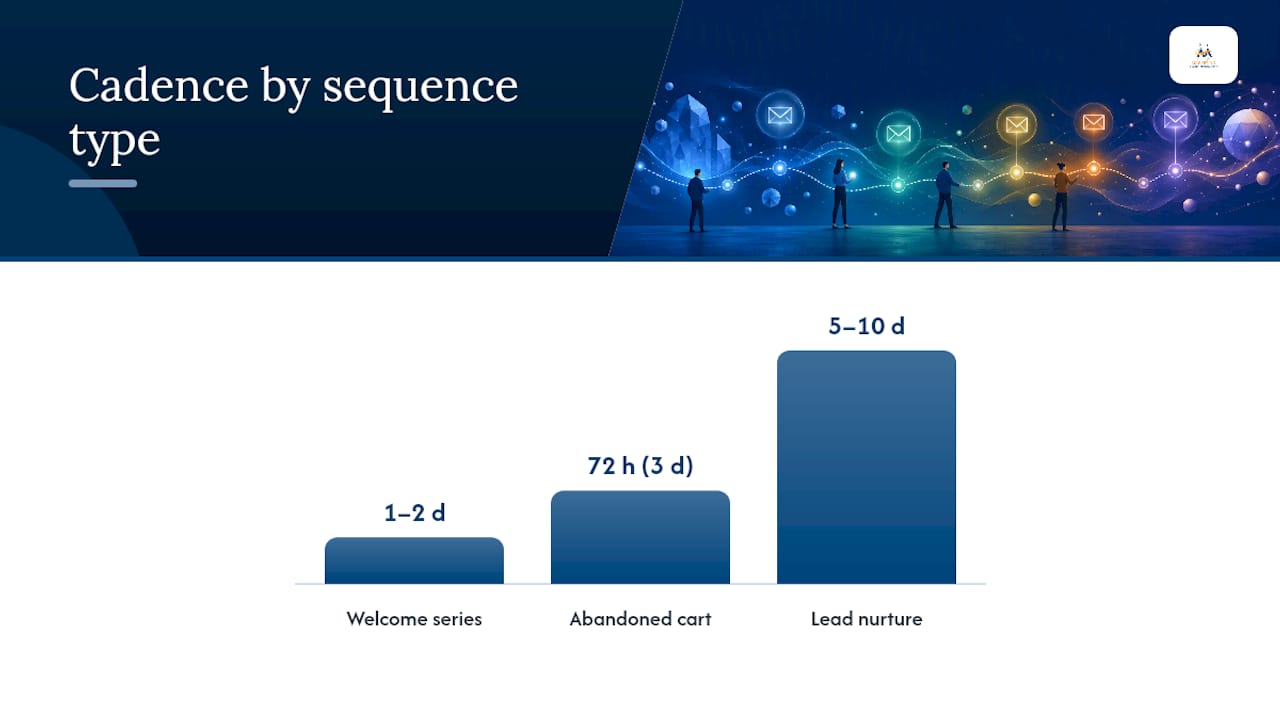
Cadence should match the sequence type. A welcome series moves fast, daily or every other day across the first two weeks. A lead nurture sequence spreads emails 5 to 10 days apart across two to three months. An abandoned cart sequence compresses everything into 72 hours because purchase intent decays by the hour.
Segmentation should go beyond a first name field. Tag contacts by source, behavior, or persona, and let those tags determine which version of the sequence they see. Personalization measurably improves engagement across email campaigns generally, and for small businesses without a data science team, form-level tagging is the most practical entry point. Rather than building complex behavioral scoring, trigger sequences off the tag a contact picks up at signup, a newsletter tag gets nurture content, a demo-request tag gets sales-focused content.
Build entry suppression before launch, not after you notice contacts stacking up in three sequences at once. Branching logic, if your platform supports it, should reroute based on real signals: did they click, did they visit a specific page, did they reply.
Every email needs one purpose and one call to action. An email asking a reader to both "read this case study" and "book a demo" usually gets neither action taken. Pick one.
Pro Tip: Draft your exit and suppression rules before you write the first email. Sequences designed goal-first almost always outperform sequences where the rules get bolted on after launch as an afterthought.
Before launch, a form optimization pass on your signup and lead capture forms will improve the quality of the trigger data feeding your drip from day one.
What Metrics Actually Tell You a Drip Campaign Is Working?
Open rate tells you almost nothing about whether a drip is doing its job. Goal completion rate, the share of enrolled contacts who complete the defined action, is the number that matters, and it's the metric most sequences never actually track.
The second most useful diagnostic is per-email drop-off. Rather than looking at aggregate open rates across the whole sequence, track exactly where contacts stop engaging, often the drop between email 1 and email 3, since that's where most disengagement happens.
Track these five metrics for every active sequence:
- Open rate — inbox placement and subject line performance
- Click-through rate — whether the content earns engagement
- Conversion or goal completion rate — whether the sequence achieves its purpose
- Unsubscribe rate — a signal of cadence or relevance problems
- Bounce and spam complaint rate — a direct threat to sender reputation
Nurtured leads convert at meaningfully higher rates than non-nurtured contacts across industry lead nurturing data, which is the core argument for building drips properly rather than relying on one-off blasts.
Test one variable at a time. Subject lines are the easiest starting point, but send-time windows deserve equal attention: Tuesday through Thursday mornings tend to outperform for many B2B audiences, though your own data should override any general rule. CTA phrasing and cadence length are worth testing next.
When a test shows weak clicks but strong opens, rewrite the copy. When opens themselves are low across the board, the problem usually isn't the email, it's deliverability or send timing. Don't rewrite content to fix an infrastructure problem.
What Belongs on Your Pre-Launch Deliverability Checklist?
Technical setup determines whether your carefully written sequence ever reaches an inbox. Skip this step and even the best copy underperforms.
- Authenticate your domain. Set up SPF, DKIM, and DMARC before sending anything. A common and quietly damaging mistake is skipping authentication entirely and wondering why deliverability craters weeks later.
- Warm up new domains gradually. Start with small volumes to established, engaged contacts and increase over two to four weeks rather than blasting your full list on day one.
- Verify your list before import. Remove invalid addresses and known spam traps; a clean list protects the reputation of every sequence that follows.
- Tag and sync at the CRM level. Connect your form tool to your CRM so trigger data, tags, and lead source all sync automatically instead of requiring manual entry.
- Build suppression lists. Maintain a running list of unsubscribes and hard bounces that automatically excludes those contacts from future sends.
- Set up goal-tracking analytics. Confirm your platform can report goal completion rate and per-email drop-off, not just aggregate opens, before you launch.
A lead qualification workflow built around clean tagging makes the handoff between drip and sales team far smoother once contacts start converting.
How Does an Agency Approach Drip Campaign Launches?
Digital Marketing All's launch process starts with a five-point readiness check before a single email goes live: a defined goal, a specific trigger, all emails drafted and reviewed, authentication configured, and a verified, clean list. Skip any one of these and the sequence underperforms no matter how good the copy is.
The pitfalls we fix most often for clients follow a pattern. No suppression rules, so contacts stack up in overlapping sequences and unsubscribe out of fatigue. Cadence that's either too aggressive (daily sends that read as spam) or too slow (gaps long enough that contacts forget the original trigger). And segmentation that stops at a first name field instead of using tags tied to actual behavior or source.
The fix in each case is rarely a full rebuild. It's usually a suppression rule added, a delay adjusted by two or three days, or a single tag introduced at the form level that lets the sequence branch intelligently instead of treating every contact identically.
— Diane O'Brien
Let Digital Marketing All Handle Your Drip Campaign Build
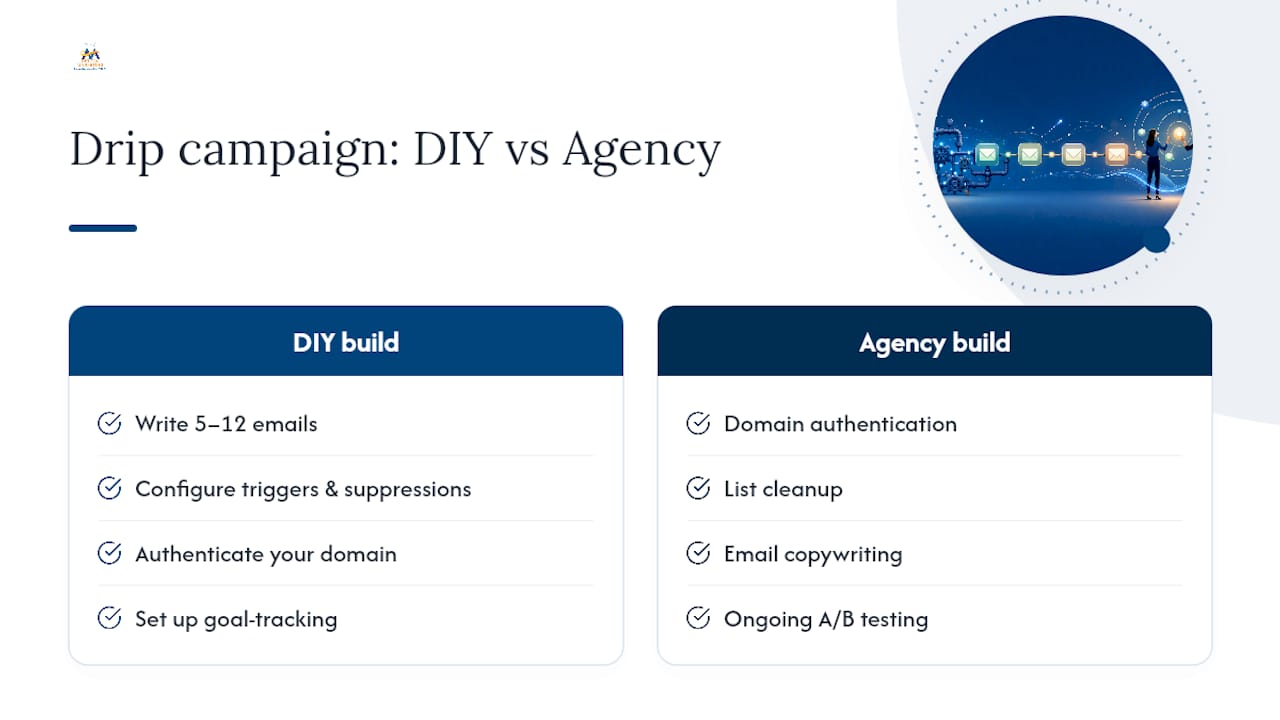
Building a well-sequenced drip campaign takes real time: writing five to twelve emails, configuring triggers and suppression rules, authenticating a domain, and setting up goal-tracking that actually reports the number that matters. A full-service agency can handle the entire structure for you, from domain authentication and list cleanup through email copywriting and ongoing A/B testing, so your sequences launch already optimized instead of needing months of trial and error to find the right cadence.
This fits business owners who want nurture and re-engagement sequences running in the background without becoming a part-time email marketer to manage them. If your leads are going cold between form fill and follow-up, or your abandoned carts are quietly walking away, that gap is exactly what a managed sequence closes. Visit the Digital Marketing All waiting room to see how a managed campaign gets structured, or reach out through Digital Marketing All's partner page to get a build started for your business.
Sources
- Setting up your first drip email campaign
- Shopping cart abandonment rate worldwide
- B2B SaaS and B2B email nurture benchmarks 2026
FAQ
What Is the Difference Between a Drip Campaign and an Autoresponder?
An autoresponder is typically a single automated reply, while a drip campaign is a full sequence of multiple emails spaced over time and built around one measurable goal.
How Many Emails Should a Drip Campaign Have?
It depends on the type: welcome series run 5 to 7 emails over about 14 days, lead nurture sequences run 8 to 12 emails over 60 to 90 days, and abandoned cart sequences typically run just 3 emails over 72 hours.
Should I Use Single Opt-In or Double Opt-In for My List?
Double opt-in confirms genuine interest and tends to protect sender reputation better since it filters out fake or mistyped addresses before they ever enter a sequence, while single opt-in grows lists faster but carries a higher risk of invalid addresses and spam complaints.
What's a Good Goal Completion Rate for a Drip Campaign?
There's no single universal benchmark since it varies heavily by sequence type and industry, which is exactly why tracking per-email drop-off and comparing your own sequences against each other over time matters more than chasing an external number.
How Do I Fix a Drip Campaign With High Unsubscribe Rates?
Check cadence first, sends that are too frequent are the most common cause, then review whether suppression rules are preventing contacts from landing in multiple overlapping sequences at once.
Can Digital Marketing All Manage My Drip Campaigns for Me?
Yes, full drip sequence management services can include domain authentication, segmentation, copywriting, and goal-tracking setup for small and medium-sized businesses.