

Video marketing delivers six core business advantages that compound over time: higher audience engagement, stronger search discoverability, improved conversion rates, lasting brand awareness, accelerated customer trust, and the ability to repurpose one asset into dozens. Each of these advantages is measurable, and each one builds on the others when you execute with a clear strategy.
Here is what the sections below will show you how to capture:
- Engagement: Video holds attention longer than text or static images, driving deeper interaction across every platform.
- SEO and discoverability: Search engines and AI models now treat video as source material, surfacing it in rich results and AI overviews.
- Conversions and sales: Product demos, testimonials, and personalized video consistently lift conversion rates at the decision stage.
- Brand awareness and recall: Visual storytelling creates stronger memory traces than written content alone.
- Trust and customer education: Explainers and webinars answer objections before sales ever has to.
- Repurposing and scale: One webinar or long-form video can generate clips, blog posts, social content, and email assets for months.
The sections below explain why each advantage matters for your bottom line, which formats to use at each funnel stage, how to distribute and optimize for search, and how to measure what actually moves revenue.
Key Takeaways
Video marketing's strongest business advantage is that a single well-optimized asset, properly distributed and tracked, generates engagement, search visibility, and pipeline simultaneously across multiple channels.
| Point | Details |
|---|---|
| SEO and AI discoverability | Transcripts, VideoObject schema, and timestamps make videos surfaceable in SERPs and AI overviews. |
| Funnel-matched formats | Short-form drives awareness; webinars and demos convert high-intent B2B buyers. |
| CRM-linked tracking | Connecting video views to your CRM turns watch data into lead-scoring signals for sales. |
| Repurposing multiplies ROI | One webinar can generate clips, blog posts, and email assets that perform for months. |
| Digital Marketing All | Audits video SEO, distribution, and KPI instrumentation to turn existing assets into measurable pipeline. |
Table of Contents
- The core advantages of video marketing, explained with one action each
- Which video formats work at each stage of the buyer's journey
- The expert playbook for video distribution, SEO, and production at scale
- How to measure video impact and the KPIs that actually matter
- Common video marketing mistakes and how to fix them fast
- What we've seen work for B2B and small-to-medium businesses
- Digital Marketing All can audit your video strategy and build what's missing
- Sources
- FAQ
The core advantages of video marketing, explained with one action each
1. Video captures and holds audience attention
Online video consumption continues to climb across all age groups and platforms, according to Statista's time-spent tracking. That rising attention window is the foundation every other advantage sits on. If your content does not hold attention, nothing downstream works.
Business impact: More time on page signals content quality to search algorithms and gives you more opportunity to move a viewer toward a next step.
Quick action: Add a video to your highest-traffic landing page and measure average session duration before and after.
KPI to track: Average watch time and page session duration.
Pro Tip: Place your strongest point or hook in the first eight seconds. Viewers who pass that threshold are far more likely to watch past the halfway mark.
2. Video strengthens SEO and AI discoverability
Search engines and AI models increasingly extract answers directly from video content. Search Engine Land's analysis confirms that semantically rich videos with transcripts and structured metadata appear in AI-generated overviews and traditional SERPs. A video without a transcript is invisible to crawlers; one with a semantic transcript, VideoObject schema, and timestamps is treated as a primary source.
Business impact: Videos that rank in rich results capture clicks that text-only pages cannot.
Quick action: Add a full transcript and VideoObject schema to every video you publish this month. The video SEO checklist at Digital Marketing All walks through each step.
KPI to track: Impressions and clicks from video-rich results in Google Search Console.
3. Video lifts conversion rates at the decision stage
Product demos, customer testimonials, and personalized video messages consistently move prospects from consideration to purchase. Wyzowl's annual survey shows continued high adoption and strong positive ROI perception among marketers who use video at the bottom of the funnel. The mechanism is straightforward: video reduces uncertainty. A prospect who has watched a two-minute demo arrives at a sales call with fewer objections.

Business impact: Shorter sales cycles and higher close rates, particularly for complex or high-ticket products.
Quick action: Record a 90-second product walkthrough and embed it on your primary product or service page.
KPI to track: Conversion rate on pages with video versus pages without.
Pro Tip: CRM-linked video players let sales reps see exactly who watched a demo and how much of it they watched, turning viewing data into a lead-scoring signal. Vidyard's guide to video for lead generation explains how to set this up.
4. Video builds brand awareness and recall
Academic research published in Frontiers in Psychology shows that video elicits stronger emotional engagement and persuasion than static formats, which directly supports brand recall and behavior change. When a viewer feels something while watching, they remember the brand that made them feel it.
Business impact: Higher unaided brand recall means your name comes to mind first when a buyer is ready to purchase.
Quick action: Produce one short brand story video (60–90 seconds) that communicates your core value proposition without a hard sell, and distribute it as a paid social ad.
KPI to track: Brand search volume lift and video view-through rate.
5. Video accelerates customer trust and education
Explainer videos, how-to content, and FAQ videos answer objections before a prospect ever speaks to sales. This is especially powerful for service businesses where the buying decision depends on understanding a process. HubSpot's State of Video Marketing data notes that webinars remain the gold standard for generating high-intent B2B leads, precisely because a 30–45 minute attendee has already self-qualified through sustained engagement.
Business impact: Prospects who arrive at a sales conversation already educated close faster and churn less.
Quick action: Identify your three most common pre-sale questions and record a short video answering each one. Embed them on your FAQ or pricing page.
KPI to track: Sales cycle length for video-educated leads versus non-video leads.
6. Video content repurposes into a scalable content engine
One well-produced webinar or long-form video can generate short social clips, a blog post, an email sequence, quote graphics, and a podcast episode. Wistia's research shows that webinar recordings sustain traffic and lead generation for months after the live event, making them one of the highest-ROI content investments available. The key is treating every video shoot as a content harvest, not a one-time broadcast.

Business impact: Lower cost per content asset and a consistent publishing cadence without proportionally increasing production spend.
Quick action: After your next webinar or long-form recording, extract five 60-second clips for LinkedIn, TikTok, and YouTube Shorts before the week is out.
KPI to track: Total content assets generated per video shoot and organic reach per repurposed clip.
7. Video drives paid media efficiency
Video ads consistently outperform static display ads on engagement metrics across YouTube, LinkedIn, and TikTok. Statista's video advertising data for the U.S. tracks ad spend and format performance trends that show video commanding an increasing share of digital ad budgets. The reason is simple: video ads communicate more information per second than a banner, which means a shorter path from impression to intent.

Business impact: Better click-through rates and lower cost per acquisition on paid campaigns.
Quick action: A/B test a 15-second video ad against your current best-performing static ad on the same audience and budget for two weeks.
KPI to track: Cost per click, view-through rate, and cost per acquisition.
Which video formats work at each stage of the buyer's journey
Understanding customer journey mapping is the prerequisite for choosing the right format. The wrong format at the wrong stage wastes production budget and confuses the viewer. A product demo shown to someone who has never heard of your brand is premature; a brand awareness video shown to someone ready to buy is a missed opportunity.
| Funnel Stage | Video Format | Primary Goal | Best Platform |
|---|---|---|---|
| Awareness | Short social clips (15–60 sec) | Reach and discovery | TikTok, Instagram Reels, YouTube Shorts |
| Awareness | Brand story / thought leadership | Recall and affinity | YouTube, LinkedIn |
| Consideration | Explainer videos (2–5 min) | Education and objection handling | YouTube, website landing pages |
| Consideration | Webinars (30–60 min) | High-intent lead capture | LinkedIn Live, Zoom, on-demand replay |
| Decision | Product demos (3 minutes) | Conversion | Website, email sequences |
| Decision | Customer testimonials (1–3 min) | Trust and social proof | Website, sales decks, email |
| Retention | Onboarding and how-to videos | Activation and churn reduction | Help centers, email, LMS |
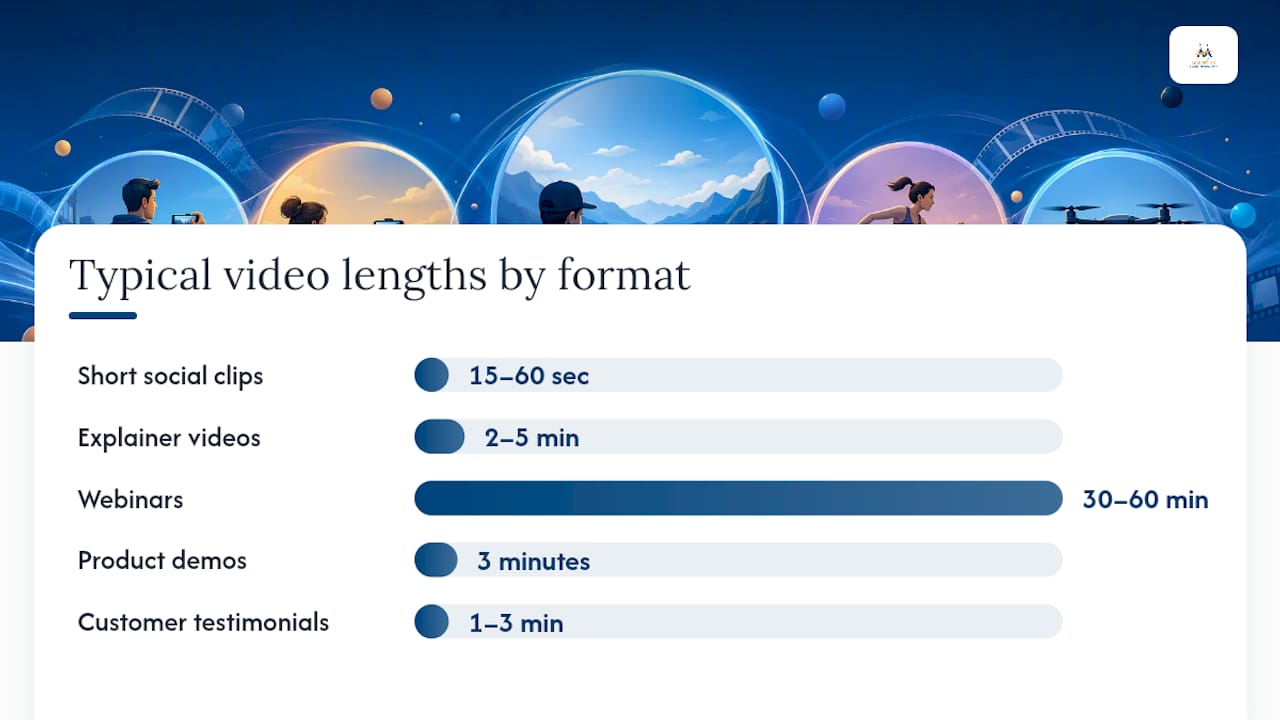
HubSpot's video marketing data reinforces that short-form video leads in social ROI while webinars remain the highest-value B2B lead generator. A blend of both is the most effective approach for most businesses.
Repurposing checklist:
- Record every webinar and upload the full replay to YouTube with a full transcript.
- Extract three to five short clips (60–90 seconds each) from the strongest moments.
- Write a blog post using the webinar transcript as a first draft.
- Pull two to three quote graphics from key statements for LinkedIn and X.
- Create a short email sequence using the webinar's key takeaways as individual messages.
- Embed the replay on a dedicated landing page with VideoObject schema for SEO.
For a deeper look at video content marketing strategy and how to align formats to business goals, Digital Marketing All's guide covers the full framework.
The expert playbook for video distribution, SEO, and production at scale
Distribution playbook
- Publish natively on your primary platform first (YouTube for search, LinkedIn for B2B, TikTok for discovery). Native uploads outperform shared links on every major platform's algorithm.
- Embed on owned pages with a transcript and VideoObject schema. This turns your website into a video-indexed asset that search engines can crawl.
- Repurpose within 48 hours of the original publish date. Clip extraction, social cuts, and email assets should be templated so the team can execute fast.
- Promote with paid amplification on the two or three platforms where your audience is most active. Even a small budget behind a strong organic video accelerates reach.
- Measure and iterate at the 30-day mark. Pull watch time, retention curves, and conversion events to decide which formats to double down on.
Video SEO checklist
Search engines and AI models treat video as source material when it is technically and semantically prepared. Search Engine Land's tactical guide outlines the steps that increase the chance a video surfaces in SERPs and AI overviews:
- Add a full, verbatim transcript to every video page.
- Implement VideoObject schema with name, description, thumbnailUrl, uploadDate, and duration fields.
- Use chapter timestamps in YouTube descriptions and on-page to signal content structure.
- Write a semantic title and description that match the language your audience uses in search queries.
- Host long-form videos on YouTube (for search reach) and embed on your site for SEO credit. Short-form can live natively on TikTok or Reels.
- Submit video sitemaps to Google Search Console.
For a complete walkthrough, the video SEO guide at Digital Marketing All covers each technical step. Understanding how Google's AI Overviews use video as source material adds important context for why these steps matter now more than ever.
Platform priority guidance
Choose two or three platforms based on where your audience spends time and what intent they bring:
- YouTube: Best for search-intent content, tutorials, and long-form. Pairs well with YouTube algorithm optimization for compounding organic reach.
- LinkedIn: Best for B2B thought leadership, webinar promotion, and decision-stage content targeting professionals by job title.
- TikTok: Best for awareness-stage reach with short-form content, particularly for consumer brands and younger B2B buyers.
Production and scaling
In-house teams handle speed and brand consistency well but often lack specialist editing or motion graphics skills. A hybrid model works for most SMBs: one in-house person manages strategy, scripting, and light editing while a specialist vendor handles production-heavy assets like brand films or webinar post-production. AI-assisted tools (auto-captioning, transcript generation, clip detection) cut post-production time materially. The video content creation workflow at Digital Marketing All provides team structure templates for exactly this model.
Pro Tip: Aim for a consistent publishing cadence over high production value. A steady stream of useful, well-titled videos compounds in search rankings far faster than sporadic high-budget productions.
How to measure video impact and the KPIs that actually matter
Most teams measure views. Views are a vanity metric unless paired with retention, conversion, and pipeline data. Here is the KPI stack that actually connects video to revenue:
Core KPIs:
- Watch time and retention rate: The percentage of the video viewers complete. A retention drop at a specific timestamp tells you exactly where you lost them.
- Conversion events: Form fills, demo requests, or purchases that occur during or immediately after a video session.
- Assisted conversions: Video touchpoints that appear in a buyer's path before a conversion, even if video was not the last click.
- Video-influenced pipeline: Deals where a prospect watched a video at some point during the sales cycle, tracked via CRM-linked video analytics.
- Cost per view and cost per acquisition: For paid video campaigns, these determine whether the channel is efficient.
Instrumentation steps:
- Connect your video platform (YouTube Studio, Wistia, Vidyard, or Vimeo) to Google Analytics 4 via event tracking.
- Set up UTM parameters on every video link shared in email, social, or paid campaigns.
- Link video viewing data to your CRM so sales can see which prospects watched which videos and for how long.
- Create a lead scoring rule that adds points when a prospect watches more than 50% of a demo or webinar.
- Build a simple dashboard with watch time, retention, conversion events, and video-influenced pipeline as the four primary widgets.
Wistia's research on video marketing and Wyzowl's adoption data both confirm that marketers who track beyond views report stronger ROI perceptions, because they can actually see the connection between video and pipeline. For practical campaign ROI measurement, the corporate video ROI guide from Puritano offers useful benchmarks and measurement frameworks.
Common video marketing mistakes and how to fix them fast
Most video marketing underperforms not because of poor production but because of poor strategy, distribution, and tracking. These are the mistakes that waste the most budget, and each one has a fix you can implement within 48 hours.
Mistake 1: Treating video as a one-off campaign Fix: Build a content calendar that treats video as an always-on channel, not a campaign asset. Schedule at least one new video per week, even if it is a short clip.
Mistake 2: Ignoring video SEO entirely Fix: Add a transcript and VideoObject schema to every video page today. This single step materially improves discoverability in both traditional search and AI overviews.
Mistake 3: Measuring only views Fix: Set up conversion event tracking in Google Analytics 4 this week. Views without downstream conversion data tell you nothing about business impact.
Mistake 4: Weak or missing calls to action Fix: Every video needs one clear next step stated verbally and shown on screen in the final 15 seconds. Audit your five most-watched videos and add or strengthen the CTA.
Mistake 5: No CRM integration Fix: Connect your video platform to your CRM so sales can see viewing history. This turns passive viewers into scored leads.
Mistake 6: Producing for one platform only Fix: Repurpose every video for at least two additional formats or platforms within 48 hours of the original publish. The common corporate video mistakes guide from Puritano covers additional pitfalls worth reviewing before your next production.
Prevention checklist for future projects:
- Script includes a clear CTA before production begins.
- Transcript is drafted alongside the script, not after.
- VideoObject schema is templated and ready to populate on publish day.
- Repurposing plan (clips, blog, email) is assigned before the shoot.
- CRM event tracking is confirmed active before the video goes live.
What we've seen work for B2B and small-to-medium businesses
The pattern that shows up most consistently across B2B clients is this: short-form video drives discovery and top-of-funnel awareness, while webinars and demos close the gap between interest and intent. Businesses that treat these two formats as complementary rather than competing see the strongest results.
Webinars, in particular, tend to be underestimated by SMBs that assume they require large audiences to be worthwhile. A webinar with 40 highly qualified attendees who stay for 35 minutes produces better pipeline than a viral short-form clip with 50,000 passive views. The attendee has invested time, which signals intent in a way that a scroll-past never can.
On the production side, the teams that scale video most effectively are not the ones with the biggest budgets. They are the ones with a clear workflow: one person owns strategy and scripting, a specialist handles editing and post-production, and AI tools handle transcription, captioning, and clip detection. That structure keeps cadence consistent without burning out the team. Branded video marketing that follows this model tends to produce assets that perform for 12–18 months, not just the week of launch.
Digital Marketing All can audit your video strategy and build what's missing
If your video content is not generating leads, ranking in search, or connecting to your CRM, the issue is almost always distribution, SEO, or instrumentation, not production quality. Digital Marketing All works with SMBs to close exactly those gaps: we audit your current video assets, identify where discoverability and tracking break down, and build a distribution and SEO plan that turns existing content into long-lived business assets.
The audit covers three areas: video SEO readiness (transcripts, schema, timestamps), distribution and platform alignment, and KPI instrumentation (CRM linking, event tracking, conversion attribution). From there, we move into a pilot phase to validate the approach before scaling.
To get started, request your video marketing audit and we will show you exactly where your current video investment is leaving value on the table.
Sources
- Video for Lead Generation
- State of video marketing — HubSpot
- The SEO shift you can't ignore: Video is becoming source material
- Video marketing statistics (Wyzowl)
Recommended follow-up reading: For video SEO implementation, start with the Search Engine Land tactical guide above alongside Digital Marketing All's video SEO how-to. For webinar strategy and repurposing, Wistia's research provides the clearest benchmarks on long-term content performance.
FAQ
What are the main advantages of video marketing for small businesses?
Video marketing gives small businesses the ability to build trust, explain complex services, and rank in search without a large content team. The highest-impact advantages are improved conversion rates on product pages and stronger discoverability through video SEO.
How does video marketing improve SEO?
Search engines treat videos with transcripts, VideoObject schema, and timestamps as structured source material, surfacing them in rich results and AI overviews. A video without these elements is largely invisible to crawlers.
Which video format generates the best B2B leads?
Webinars consistently produce the highest-intent B2B leads. A prospect who attends a 30–45 minute webinar has self-qualified through sustained engagement, making them materially different from a passive social viewer.
How do you measure video marketing ROI?
Track watch time, retention rate, conversion events, and video-influenced pipeline in your CRM. Views alone do not indicate business impact; connecting video data to CRM and Google Analytics 4 is what reveals the revenue connection.
How often should a business publish video content?
Consistency matters more than frequency. A reliable cadence of one to two videos per week, optimized for search and distributed across two or three platforms, compounds in reach and ranking faster than sporadic high-production releases.