

TL;DR:
- Small businesses should focus on 1 to 2 platforms to maximize engagement and results.
- Using AI tools streamlines content creation, scheduling, and engagement, giving a competitive edge.
- Regularly tracking metrics and adjusting strategies ensures sustained growth and improved ROI.
Build a Winning Social Media Strategy for Small Businesses
Social media is no longer optional for small businesses. It is the primary arena where customers discover, evaluate, and decide to buy. According to eMarketer, 91% of SMBs use social for marketing, and 68% view it as their clearest path to growth. Yet most business owners feel stuck posting inconsistently, getting little traction, and watching competitors gain an edge. This guide walks you through every stage of building an effective strategy, from goal-setting and platform selection to content planning, execution, and optimization, with practical AI tools included throughout.
Table of Contents
- Assess your goals and audience
- Select tools and create a content plan
- Execute your strategy and engage your audience
- Measure results and optimize your process
- Our hard-won lessons for social media strategy success
- Take your social strategy even further
- Frequently asked questions
Key Takeaways
| Point | Details |
|---|---|
| Start with clear goals | Always align social media actions with specific business objectives and target audiences. |
| Leverage AI tools | Use automation for content creation, scheduling, and engagement to save time and boost impact. |
| Engage consistently | Frequent, authentic interactions foster trust and grow your audience organically. |
| Measure and adapt | Tracking performance data and adjusting your strategy keeps you on a growth path. |
Assess your goals and audience
Every solid social media strategy starts with two foundational questions: What do you want to accomplish, and who are you trying to reach? Without clear answers, your efforts will scatter across platforms and produce inconsistent results. After understanding why social media matters for your business, it is time to clarify what you want to achieve and with whom.
Setting SMART goals for social media
SMART stands for Specific, Measurable, Achievable, Relevant, and Time-bound. Vague goals like "get more followers" lead nowhere. A SMART version would be: "Increase Instagram followers by 500 in 90 days by posting five times per week." This format forces you to commit to concrete actions and gives you a measurable outcome to track.
Common SMART goals for small businesses include:
- Increase brand awareness by growing page reach by 30% in 60 days
- Generate 20 qualified leads per month through Facebook ad campaigns
- Drive 15% more website traffic from LinkedIn over the next quarter
- Improve customer retention by responding to 100% of comments within 24 hours
Identifying your target audience
Knowing your audience determines everything from your posting tone to the platforms you prioritize. Start by reviewing your existing customers. Look at demographics like age, location, income level, and job role. Then research which platforms they actively use. A local restaurant targets a different audience than a B2B software company, and those audiences live on very different platforms.
Here is a quick reference table to connect business goals, audience types, and the best platforms to reach them:
| Business goal | Target audience | Best platform |
|---|---|---|
| Brand awareness | General consumers, local buyers | Facebook, Instagram |
| B2B lead generation | Professionals, decision-makers | |
| Product sales | Visual shoppers, trend followers | Instagram, Pinterest |
| Community building | Loyal customers, enthusiasts | Facebook Groups, Reddit |
| Thought leadership | Industry peers, executives | LinkedIn, X (Twitter) |
| Short-form video reach | Younger demographics (18-34) | TikTok, Instagram Reels |
With 91% of SMBs using social media for marketing, competition on each platform is fierce. This is precisely why narrowing your focus matters so much.
Pro Tip: Do not try to be on every platform. Focus your energy on 1 to 2 platforms where your audience is most active. Doing two platforms well beats doing five platforms poorly every single time. Start with building a social media strategy that is sustainable with your current resources.
Select tools and create a content plan
Once goals and audiences are clear, the next step is choosing tools and planning content to drive engagement. The right combination of scheduling software, AI content assistants, and a well-structured content calendar will save you hours each week while improving output quality.

Choosing the right tools
The social media tool market has grown significantly, and AI-powered features are now standard in most leading platforms. Here is a comparison of popular tools and what they offer:
| Tool | Key features | AI capabilities | Best for | |---|---|---| | Buffer | Scheduling, analytics, link page | AI assistant for captions | Solo owners, small teams | | Hootsuite | Multi-platform scheduling, reports | AI content suggestions | Teams managing multiple accounts | | Later | Visual planner, link in bio | AI caption writer, hashtag tools | Instagram-heavy businesses | | Canva | Design templates, brand kits | AI image generation, Magic Write | Visual content creation | | Sprout Social | Deep analytics, CRM integration | AI sentiment analysis, scheduling | Growing SMBs | | ChatGPT/Claude | Content writing, ideation | Full AI content generation | All business sizes |
A strong AI tools for content creation stack does not need to be expensive. Many of these platforms offer free tiers that are more than adequate for small businesses just getting started.
Creating your content calendar
A content calendar is your publishing blueprint. It removes the daily stress of figuring out what to post and ensures your content mix stays balanced. Follow these steps to build one:
- Define your content pillars. These are 3 to 5 core themes that represent your brand. For example, a local gym might use fitness tips, client transformations, equipment updates, promotions, and community events.
- Plan your content mix. Aim for roughly 40% educational, 30% entertaining or relatable, 20% promotional, and 10% user-generated or community content.
- Map out a monthly posting schedule. Decide how many times per week you will post on each platform. Three to five times per week is a solid starting point.
- Use AI to generate content ideas. Tools like ChatGPT can generate a month of post ideas based on your niche, audience, and content pillars in minutes.
- Schedule posts in advance. Use Buffer, Later, or Hootsuite to schedule everything at least one week ahead.
With 70% of SMBs planning to use AI for content, adopting AI-driven content strategies now gives your business a head start before your competitors catch on.
Pro Tip: Batch-create your content in dedicated sessions rather than scrambling to post daily. Set aside two to three hours on one day each week to write captions, design graphics, and schedule everything. This keeps your strategy consistent even during your busiest weeks.
Execute your strategy and engage your audience
With your plan and tools in place, it is time to put your strategy into action and foster genuine engagement. Publishing content is only half the job. How you interact with your audience determines whether your community grows or stalls.
Posting best practices
Frequency, format, and timing all influence how your content performs. Follow these core practices:
- Post consistently. Algorithms reward accounts that publish regularly. Even three solid posts per week outperform irregular bursts of ten posts followed by silence.
- Use native formats. Each platform has preferred content types. Instagram rewards Reels, LinkedIn rewards text-based thought leadership, and Facebook rewards video and group activity.
- Post at optimal times. Generally, weekdays between 9 AM and 11 AM and again around 6 PM to 8 PM see strong engagement. Test your own audience's patterns using your platform analytics.
- Use strong visuals. Posts with high-quality images or videos consistently outperform text-only content. Even a well-designed graphic created in Canva performs better than plain text.
- Write clear calls to action. Tell your audience what to do next. "Click the link in bio," "Drop your answer below," or "Share this with a friend" all increase interaction rates.
Engagement tactics that build community
Posting great content is the start, but real growth comes from genuine interaction:
- Respond to every comment within 24 hours, even if it is just a thank-you
- Ask questions at the end of captions to spark replies
- Use Stories and polls to make followers feel involved in your business decisions
- Join relevant conversations in industry groups or hashtags
- Go live occasionally to create unscripted, authentic connection
- Share user-generated content to reward loyal followers and build social proof
With 91% of small businesses on social media, the businesses that stand out are the ones that feel human. AI can help personalize replies at scale, flag common questions, and suggest response templates so your team stays consistent without burning out. Platforms like Sprout Social and ManyChat offer AI-driven chatbot and reply automation that still feels personal.
Engagement rates and their impact on growth
Accounts with above-average engagement rates grow followers up to 3x faster than those focused purely on follower acquisition. Quality interaction signals to algorithms that your content is worth promoting.
Focus on boosting social media engagement rather than chasing vanity metrics. Real engagement drives real revenue, and understanding this shift is what separates businesses that grow from those that plateau. For a deeper look at the numbers, improving ROI with social media marketing is worth exploring.
Pro Tip: Prompt, consistent replies tell customers that a real business is behind the account. This builds trust faster than any paid ad. Set a daily 15-minute window dedicated exclusively to responding to comments and messages.
Measure results and optimize your process
Completing strategy execution, the final step is verifying your approach works and continuously improving. Without tracking the right numbers, you are guessing. With data, you make smarter decisions that compound over time.
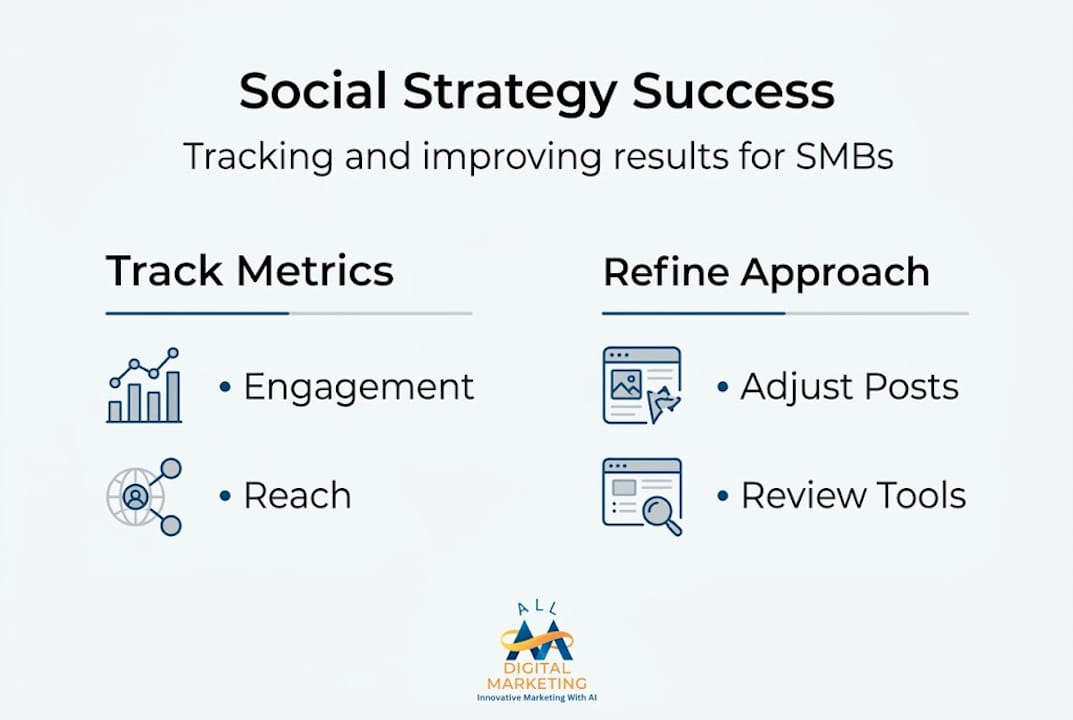
Key metrics to monitor
Focus on metrics that tie directly to your business goals:
- Reach: How many unique users saw your content
- Impressions: Total number of times your content was displayed
- Engagement rate: Likes, comments, shares, and saves divided by reach
- Click-through rate (CTR): How often people click your links
- Conversions: Actions taken on your website after clicking from social
- Follower growth rate: Week-over-week or month-over-month audience growth
- Response time: How quickly your team replies to messages and comments
Here is a reference table to match metrics with the best tools to track them:
| Metric | Tracking tool |
|---|---|
| Reach and impressions | Platform native analytics (Meta, Instagram Insights) |
| Engagement rate | Sprout Social, Hootsuite Analytics |
| Website traffic from social | Google Analytics 4 |
| Conversions and lead tracking | Google Analytics 4, HubSpot |
| Sentiment and brand mentions | Sprout Social, Mention |
| Hashtag performance | Later, Hashtagify |
Troubleshooting drops in performance
If your metrics decline, run through this checklist before making drastic changes:
- Did posting frequency drop?
- Did content quality or format change?
- Has the platform algorithm updated recently?
- Are competitors running aggressive campaigns that are pulling attention?
- Is your content mix out of balance (too promotional, not enough value)?
With 68% of small businesses viewing social as their top growth path, staying current with platform changes is not optional. It is a competitive requirement.
"Businesses that consistently review and adjust their social media strategy based on real data outperform those that rely on instinct alone. Monthly optimization cycles produce compounding results over six to twelve months." — Industry consensus from leading digital marketing research
Use resources like measuring social media effectiveness to build a reliable review process. Pair that with digital marketing strategies for small businesses to stay ahead of platform and search trends simultaneously.
Pro Tip: Schedule a monthly 30-minute strategy review. Look at what performed best, what missed, and make one specific adjustment for the next month. Small, consistent tweaks produce bigger results than sweeping overhauls.
Our hard-won lessons for social media strategy success
Here is the truth most social media guides skip: there is no overnight win. We have worked with enough small businesses to know that the ones who expect quick results usually quit before the strategy starts working. The compounding nature of social media growth rewards patience and consistent iteration, not viral moments.
Failed campaigns have taught us more than successful ones. A post that flops tells you something critical about your audience's real preferences versus what you assumed they wanted. Treat every underperforming piece of content as a data point, not a defeat.
The real edge in 2026 is speed of adaptation. Platforms change constantly. Algorithm updates, new content formats, and shifting audience habits mean your strategy from six months ago may already be partially outdated. Businesses that stay curious, test new formats quickly, and adjust based on feedback move faster than competitors who are locked into "what worked before."
Lasting social media results come from building systems, not chasing trends. A repeatable process for content creation, posting, engagement, and review is worth far more than any single viral post. Build the system, trust the data, and keep showing up.
Take your social strategy even further
You now have a clear roadmap for building and executing a social media strategy that actually grows your business. But strategy is only part of the picture.
Your online reputation directly affects how social audiences perceive your brand. At Digital Marketing All, we help businesses generate and manage reviews that reinforce your credibility across every platform. We also offer Yelp optimization to ensure your local presence is working alongside your social efforts. And if your website is not converting the traffic you are building, we can help you build your business website designed for real results. Let us be your partner in AI-driven growth.
Frequently asked questions
What is the most important element of a social media strategy for SMBs?
The most important element is clearly aligning your social media activities with your overall business goals and target audience. When strategy matches intention, every post moves your business forward. With 68% of SMBs viewing social as their top growth path, goal alignment is the factor that separates effective campaigns from wasted effort.
How can AI help improve my social media marketing?
AI tools can automate content creation, scheduling, and personalized engagement to help SMBs maintain consistency and increase reach. With 70% of small businesses planning to use AI for content, adopting these tools now positions you ahead of most competitors.
How do I know if my social media strategy is working?
Track metrics like engagement rate, reach, and conversions to measure whether your content is driving growth aligned with your goals. Since 68% of SMBs rely on social as a primary growth tool, consistent measurement is what separates guesswork from a real strategy.
What are common mistakes to avoid in social media strategy?
Avoid spreading yourself across too many platforms and failing to adjust your approach based on real analytics feedback. Consistency on fewer platforms beats inconsistency across many.
Should my business focus on all platforms or just a few?
Focus on 1 to 2 platforms where your specific audience is most active. Depth of presence on the right platforms delivers far better results than shallow activity everywhere.