

TL;DR:
- Structured data using schema.org vocabulary and JSON-LD format makes web content machine-readable, enabling rich search results and AI grounding. Implementing high-value schema types like Product, LocalBusiness, and FAQPage improves visibility, click-through rates, and AI citation reliability. Validation and ongoing monitoring via Google's testing tools and Search Console ensure accurate, effective markup that enhances search performance.
Structured data is the single most direct way to make your content machine-readable for both search engines and AI systems. By adding schema.org vocabulary to your pages in JSON-LD format, you become eligible for rich SERP features like star ratings, product prices, and FAQ dropdowns, and you give AI tools like Google's AI Overviews a reliable, grounded source to cite. The practical payoff is measurable: case examples cited by Google show rich results can drive CTR uplifts of 25%–82% compared to standard results. Three tools you'll use throughout this process are Google Search Console, the Rich Results Test, and the Schema Markup Validator.
Key entities to know before you start:
- schema.org — the shared vocabulary that defines property names and types
- JSON-LD — the recommended format for writing structured data markup
- Google Search Console — where you monitor rich result coverage and performance
- Rich Results Test — where you validate markup before publishing
Table of Contents
- What is structured data and which formats should you use?
- What are the real benefits of structured data for SEO?
- How do search engines and AI actually use your markup?
- Which schema types should you prioritize for your pages?
- What does a JSON-LD snippet look like in practice?
- How do you implement structured data step by step?
- How do you measure the impact and set realistic expectations?
- What are Google's best practices and common pitfalls?
- Which tools and resources help you build and test structured data?
- Why structured data matters more now: AI search and E-E-A-T
- Key Takeaways
- The case for treating structured data as infrastructure
- How Digital Marketing All helps you implement schema that actually works
- Useful sources
- FAQ
What is structured data and which formats should you use?
Structured data is machine-readable markup that labels the elements on a page so search engines and AI systems can classify them without guessing. Instead of a crawler inferring that a number on a page is a price, a schema.org/Product block explicitly says "this is a product, this is its price, this is its availability."
The three main formats you'll encounter are:
- JSON-LD — a JavaScript notation embedded in a
<script>tag, separate from your HTML content. Google Search Central recommends JSON-LD because it is the easiest to implement, update, and generate from templates without touching your page's HTML structure. - Microdata — attributes added directly to HTML elements. Functional, but tightly coupled to your markup, which makes maintenance harder at scale.
- RDFa — another attribute-based approach, defined by the W3C RDFa Lite specification. Useful in some publishing contexts but less common for general SEO purposes.
All three formats can reference schema.org vocabulary. The vocabulary itself defines hundreds of types and properties, from Product and LocalBusiness to Recipe and JobPosting. JSON-LD is generally the best choice because it lives in one block, can be generated server-side or injected by a CMS plugin, and does not require you to restructure your HTML when properties change.
What are the real benefits of structured data for SEO?
Structured data does not directly boost your ranking position, but it makes your existing rankings work harder. Here are the concrete benefits, in order of impact.
-
Richer search appearance and higher click-through rate. When your markup qualifies a page for rich results, Google can display star ratings, pricing, availability, or FAQ dropdowns alongside your listing. Rich results can drive CTR uplifts of 25%–82% compared to standard blue-link results, according to case examples documented by Google. More visual real estate in the SERP translates directly to more clicks.
-
Entity clarity and disambiguation. Search engines and AI systems build knowledge graphs. When your markup explicitly names your business, its services, and its location using consistent schema properties, you reduce the chance that a search system misclassifies your brand or conflates it with a similarly named entity. This is especially important for AI citation: structured data reduces ambiguity for AI overviews by explicitly labeling facts like services, locations, and product details.
-
Local search visibility. For businesses serving a specific geography,
LocalBusinessschema is one of the highest-ROI markups available. Marking up your address, hours, and service area helps match your listing to local intent queries and supports Local Pack and map-based discovery. Pair this with a well-maintained Google Business Profile for maximum local reach. -
Eligibility for specialized SERP surfaces. Product cards, recipe carousels, event listings, job postings, and voice assistant results all require specific schema types to be eligible. Without the markup, your page simply cannot appear in those features, regardless of how good the content is. Structured data is the entry ticket.
Statistic to know: Google-documented case studies report CTR uplifts of 25%–82% on pages surfaced with rich results, making structured data one of the highest-leverage technical SEO investments available.
How do search engines and AI actually use your markup?
Understanding the flow helps you prioritize what to mark up and why.
- Discovery. Googlebot and other crawlers find your JSON-LD block alongside the page HTML during a normal crawl. No separate submission is needed.
- Parsing and classification. The search system maps your schema properties to its internal knowledge graph and eligibility filters. A
Producttype with apriceandavailabilityproperty signals that this page qualifies for product rich results. - Eligibility, not ranking. Markup makes a page eligible for certain features. It does not guarantee a ranking change. A page with strong markup but thin content or low authority will not outrank a well-established competitor.
- AI grounding. This is where structured data's value is growing fastest. Pages cited by AI overviews and chat tools often contain schema markup, and structured data helps retrieval systems ground their outputs in verifiable facts rather than inferred content. When an AI tool needs to answer a question about your business hours, a
LocalBusinessblock with accurate hours is a far more reliable source than a sentence buried in a paragraph.
The key insight: structured data turns human-readable content into machine-readable facts. Search engines and AI systems can use those facts with confidence, which is why markup-rich pages tend to be preferred sources for grounded answers.

Which schema types should you prioritize for your pages?
Matching the right schema type to the right page is where most of the practical work happens. Here is a quick reference for the most valuable types.
- Product — use on any product detail page to surface pricing, availability, and ratings in search results
- LocalBusiness — use for any business with a physical location or defined service area; supports Local Pack and map discovery
- Article — use on blog posts and news pages to improve indexing signals and support AI attribution
- BreadcrumbList — use sitewide to show your URL path in the SERP, which improves navigation clarity
- Event — use on event pages to surface date, time, and location directly in results
- Recipe — use on recipe pages to qualify for recipe carousels with images and cook times
- JobPosting — use on job listing pages to appear in Google for Jobs
- Review / AggregateRating — use on product or service pages to show star ratings in results
- FAQPage — use on pages with genuine Q&A content; even when the visual rich result is not shown, FAQ schema still provides semantic context that AI systems consume
- HowTo — use on step-by-step instructional pages to qualify for step-by-step rich results
| Page type | Primary schema | Biggest visible benefit |
|---|---|---|
| Product detail page | Product | Price, rating, and availability in SERP |
| Local business page | LocalBusiness | Local Pack and map discovery |
| Blog post / article | Article | Better indexing and AI attribution |
| FAQ or help page | FAQPage | FAQ dropdown in SERP; AI grounding |
| Event listing | Event | Date and location in search results |
| Job listing | JobPosting | Appears in Google for Jobs |
One practical rule: apply one primary schema type per page and only mark up content that is actually visible to the user on that page. Marking up content that does not appear on the page violates Google's guidelines and can result in manual actions.
What does a JSON-LD snippet look like in practice?
Here is a minimal, copy-ready JSON-LD block for an Article page. Place it inside a <script type="application/ld+json"> tag in your page's <head> or <body>.
{
  "@context": "https://schema.org",
  "@type": "Article",
  "headline": "Why Use Structured Data: Boost SEO and AI Visibility",
  "description": "A practical guide to structured data benefits, schema types, and implementation steps for SEO and AI-driven search.",
  "url": "https://example.com/why-use-structured-data",
  "datePublished": "2026-01-15",
  "author": {
    "@type": "Person",
    "name": "Diane O'Brien"
  },
  "publisher": {
    "@type": "Organization",
    "name": "Digital Marketing All",
    "url": "https://digitalmarketingall.org"
  }
}
Placement and validation note: Keep the JSON-LD block truthful and synchronized with your visible page content. If your page says the author is Diane O'Brien, the markup must say the same. Before publishing, run the snippet through the Rich Results Test at search.google.com/test/rich-results and the Schema Markup Validator at validator.schema.org to catch errors and warnings. A clean validation pass is the minimum bar before deployment.
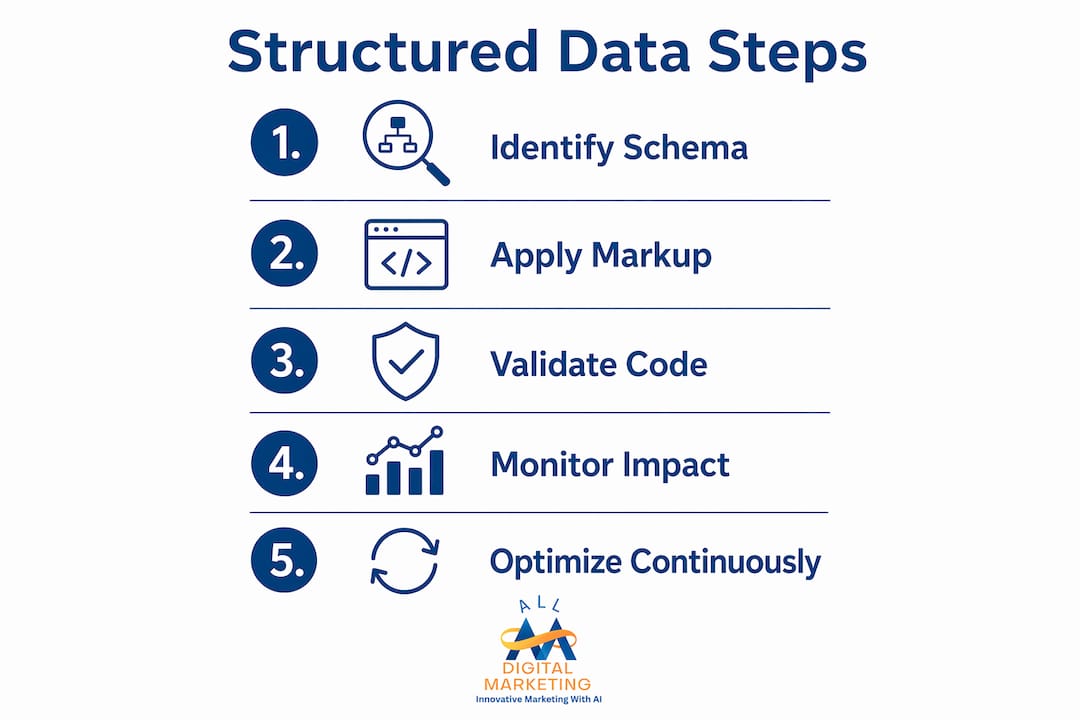
How do you implement structured data step by step?
Whether you are adding markup to one page or rolling it out across a thousand-page site, the process follows the same five steps.
-
Audit your pages for high-value candidates. Product pages, local landing pages, blog articles, FAQ pages, and event listings are the highest-priority targets. Use Google Search Console's coverage report to identify pages already getting impressions that could benefit from rich results.
-
Choose your schema types and map properties to your CMS fields. For a product page, map your CMS's price field to
schema.org/price, your stock status toschema.org/availability, and your review aggregate toschema.org/aggregateRating. Document this mapping so it stays consistent. -
Build JSON-LD templates and integrate them into your CMS or build pipeline. Most major CMS platforms (WordPress, Shopify, Webflow) have plugins that generate JSON-LD from existing content fields. For custom builds, generate the JSON-LD server-side so it is present in the initial HTML response, not injected after page load.
-
Validate before you deploy. Run every template variant through the Rich Results Test and the Schema Markup Validator. Fix all errors; address warnings where they affect eligibility. Inconsistencies between visible content and markup cause retrieval systems to treat your markup as unreliable, so accuracy matters as much as presence.
-
Deploy, then monitor Search Console. After deployment, check the Search Console "Enhancements" reports for your schema types. Watch for new rich result impressions and coverage errors. Expect initial signals within 2–8 weeks; fuller effects on CTR and impressions may take longer.
Useful tools for each stage:
- Generators: Merkle's Schema Markup Generator, Hall Analysis JSON-LD Generator
- CMS plugins: Yoast SEO, Rank Math (WordPress); JSON-LD for SEO (Shopify)
- Validation: Rich Results Test, Schema Markup Validator
- Monitoring: Google Search Console Enhancements and Performance reports
How do you measure the impact and set realistic expectations?
Structured data is not a switch you flip and immediately see ranking gains. The impact shows up in specific metrics over a defined timeline.
- Impressions and rich result impressions in Search Console's Performance report are the first signals to watch. A rise in rich result impressions means Google is rendering your markup in results.
- Click-through rate is the primary conversion metric. Compare CTR before and after markup deployment for the same pages using Search Console's date-range comparison.
- Rich results coverage in the Enhancements tab shows how many pages are valid, have warnings, or have errors for each schema type.
- Organic clicks downstream confirm whether CTR gains are translating to traffic.
Expect initial signals in 2–8 weeks after deployment. Broader CTR and engagement effects often take longer, particularly on pages that are crawled less frequently. For local pages, map-based visibility improvements can appear faster because local data is refreshed more often.
One limit to set clearly: structured data is not a direct ranking factor. It improves how your existing rankings are presented and which features you are eligible for. It cannot compensate for thin content, low domain authority, or poor page experience. Think of it as amplification, not a foundation.
When attributing impact, use segment comparisons where possible. Compare pages with markup against similar pages without it, or use a before/after analysis with a stable control group. Avoid attributing all CTR changes to markup alone; seasonal shifts and algorithm updates affect the same metrics.
What are Google's best practices and common pitfalls?
Following Google's structured data guidelines keeps your markup effective and your site penalty-free.
Do:
- Mark up only content that is visible and accurate on the page
- Use absolute URLs for all
urlandimageproperties - Prefer JSON-LD for all new implementations
- Keep markup synchronized with page content at all times
- Version-control your JSON-LD templates so changes are tracked
Don't:
- Add markup for content not shown to users (hidden content, off-page facts)
- Fabricate or inflate data in markup (fake reviews, incorrect prices)
- Use misleading markup that contradicts what the page actually says
- Remove FAQPage markup just because the visual rich result is less common; the semantic value for AI systems remains
Pro Tip: Build and maintain an entity glossary for your site — a simple document that defines your canonical business name, address format, service names, and brand identifiers. Paste from this glossary when writing JSON-LD to keep labels consistent across every page. Inconsistent entity names across pages fragment your knowledge graph signals.
The Google Search Central structured data guidelines are the authoritative reference for what is and is not permitted. Review them before deploying any new schema type, especially for sensitive types like Review and Product.
Which tools and resources help you build and test structured data?
You do not need to write markup from scratch or guess whether it is correct. These tools cover the full workflow.
Testing and validation:
- Rich Results Test (search.google.com/test/rich-results) — paste a URL or code snippet to see which rich results your markup qualifies for and any errors blocking eligibility
- Schema Markup Validator (validator.schema.org) — the official schema.org tool for checking markup against the full vocabulary specification, not just Google's subset
- Google Search Console — the Enhancements and Performance reports show real-world rich result coverage and CTR data across your entire site
Authoritative references:
- schema.org — the full vocabulary reference, including all types, properties, and expected value formats
- Google Search Central structured data docs — policy, supported types, and implementation guides specific to Google Search
Generators and automation:
- JSON-LD generators (Merkle, Hall Analysis) for quick one-off snippets
- CMS plugins for automated generation at scale
- Server-side templating for custom builds where markup must be dynamic
For teams managing dozens or hundreds of page templates, a managed service or agency can handle the audit, template build, and ongoing maintenance. This is particularly valuable when schema types need to stay synchronized with live inventory, pricing, or event data that changes frequently. For content markup alignment across marketing pages, a structured workflow between content and development teams prevents the drift that causes validation errors over time.
Why structured data matters more now: AI search and E-E-A-T
Search has shifted. Google's AI Overviews, Perplexity, and other AI-driven tools do not just rank pages; they synthesize answers from sources they trust. Structured data is one of the clearest signals of trustworthiness.

Pages cited by AI overviews often contain schema markup, and the reason is straightforward: structured data helps retrieval systems ground their outputs in verifiable facts rather than inferred content. When an AI tool needs a reliable answer about your business, a clean JSON-LD block is a far more dependable source than a sentence buried in a paragraph. Structured data reduces ambiguity for AI systems by explicitly labeling facts such as services, locations, and product details, which lowers the chance of hallucination in AI-generated answers.
The E-E-A-T connection is direct. Google's quality evaluator guidelines reward pages that demonstrate experience, expertise, authoritativeness, and trustworthiness. Accurate, consistent schema markup supports all four: it names the author, identifies the publisher, specifies the date, and links entities to verifiable sources. A page with author, publisher, datePublished, and sameAs properties filled in correctly is telling search systems exactly who is responsible for the content and where to verify it.
Statistic to know: Case examples documented by Google show CTR uplifts of 25%–82% on pages surfaced with rich results, a range that reflects how much visual prominence in the SERP can shift user behavior.
Pro Tip: If you are building an AI-driven marketing strategy, treat structured data as the foundation layer. AI systems that retrieve and cite web content rely on machine-readable signals; without them, even well-written content can be overlooked in favor of a competitor whose markup is cleaner.
As search becomes AI-first, context is as important as content. Structured data builds the semantic layer that helps both external AI systems and internal retrieval tools understand what your pages are actually about.
Key Takeaways
Structured data is a semantic layer that makes your content machine-readable for search engines and AI systems, improving rich result eligibility and citation probability without directly changing your ranking position.
| Point | Details |
|---|---|
| Rich results drive real CTR gains | Google-documented case studies show significantly higher CTR on pages with rich results. |
| JSON-LD is the recommended format | It separates markup from HTML, is easier to maintain, and can be generated from CMS templates. |
| Prioritize high-value schema types | Start with Product, LocalBusiness, Article, FAQPage, and BreadcrumbList for the fastest visible impact. |
| Validate before every deployment | Use the Rich Results Test and Schema Markup Validator to catch errors before they affect coverage. |
| Digital Marketing All implements schema at scale | The agency audits, builds, and maintains structured data as part of a broader AI-readiness and local SEO strategy. |
The case for treating structured data as infrastructure
Most businesses treat structured data as a one-time SEO task. Add some markup, validate it, move on. That framing misses the bigger opportunity.
Structured data is infrastructure, not a campaign. Every time a search engine or AI tool encounters your pages, it is making a decision about how to classify, display, and cite your content. Markup that is accurate, consistent, and comprehensive gives those systems more to work with. Markup that is absent, stale, or contradictory gives them a reason to look elsewhere.
The businesses that will win in AI-driven search are not necessarily the ones with the most content. They are the ones whose content is the most legible to machines. A local service business with clean LocalBusiness markup, accurate hours, and a well-maintained Google Business Profile will consistently outperform a competitor with better prose but no machine-readable signals. That is not a prediction; it is already happening in Local Pack results today.
One thing practitioners underestimate is the compounding effect. Each schema type you add correctly increases the number of surfaces your content is eligible for. A product page with Product, AggregateRating, and BreadcrumbList markup is eligible for product rich results, star ratings, and breadcrumb display simultaneously. The incremental effort of adding a second or third type to an already-marked-up page is small; the eligibility gain is not.
The honest caveat: structured data amplifies what is already there. If your content is thin, your authority is low, or your page experience is poor, markup will not rescue the page. Fix those fundamentals first, then let structured data do its job.
How Digital Marketing All helps you implement schema that actually works
Structured data delivers results when it is accurate, complete, and maintained over time. That is harder than it sounds at scale, especially when product prices change, business hours update, or new service pages go live without anyone updating the markup.
Digital Marketing All audits your existing pages, identifies high-value schema opportunities, builds JSON-LD templates tied to your CMS fields, and monitors Search Console coverage so errors get caught before they affect your rich result eligibility. For local businesses, the agency's local SEO services include LocalBusiness markup as part of a broader visibility strategy that covers Google Business Profile, local citations, and map-based discovery. For businesses focused on AI search visibility, structured data is integrated into every content and technical SEO engagement.
Ready to see which of your pages are leaving rich results on the table? Request a schema audit and get a clear picture of your current markup coverage and the highest-impact fixes.
Useful sources
- Google Search Central: Intro to Structured Data — the authoritative policy and implementation guide for structured data in Google Search; covers supported types, JSON-LD guidance, and rich result eligibility rules
- schema.org vocabulary reference — the full type and property catalog; use this to find the correct property names and expected value formats for any schema type
- Rich Results Test — paste a URL or code snippet to validate markup and check rich result eligibility before publishing
- Schema Markup Validator — the official schema.org tool for checking markup against the full vocabulary specification, independent of Google's subset
- json-ld.org — the specification and documentation for the JSON-LD format; useful for understanding the syntax and context rules behind the markup
FAQ
What is the primary purpose of structured data?
Structured data labels page content in a machine-readable format so search engines and AI systems can classify it accurately, making pages eligible for rich SERP features and improving the reliability of AI-generated answers that cite your content.
When should you use structured data on a page?
Use structured data on any page where a specific schema type applies to visible content: product pages, local business pages, articles, FAQ pages, event listings, and job postings are the highest-priority candidates.
What are the most valuable structured data use cases?
The highest-impact use cases are Product markup for e-commerce pages (surfaces pricing and ratings), LocalBusiness for service-area businesses (supports Local Pack visibility), and FAQPage for Q&A content (provides semantic context for AI systems even when the visual rich result is not displayed).
Does structured data directly improve search rankings?
No. Structured data is not a direct ranking factor. It improves how your existing rankings are presented in the SERP and which rich features your pages are eligible for, which can increase click-through rate and engagement without changing your position.
How do you know if your structured data is working?
Monitor the Enhancements and Performance reports in Google Search Console. Rising rich result impressions and improved CTR on marked-up pages are the clearest indicators that your markup is being rendered and driving user engagement.