

TL;DR:
- AI lead qualification uses machine learning and conversational AI to prioritize and route sales leads based on fit, intent, and urgency.
- It improves conversion rates, quickens responses, and reduces sales team burnout by focusing on high-potential prospects.
AI lead qualification uses machine learning and conversational AI to automatically score, prioritize, and route sales leads based on fit, intent, and urgency. For SMBs, the payoff is direct:
- AI identifies the highest-potential accounts most likely to convert, increasing conversion efficiency by 2–3x without adding headcount
- Lead response time drops from hours to under a minute, and responding quickly greatly increases qualification likelihood compared to waiting longer
- Sales reps stop chasing low-intent prospects, reducing burnout and freeing time for relationship-building (qualitative claim)
- Machine learning models retrain continuously on new closed-deal data, so scoring stays accurate as buyer behavior shifts
- Conversational AI replaces static forms, capturing explicit buyer intent and increasing conversion rates 2–4x over traditional MQL approaches
- SMBs control costs by matching model complexity to funnel stage, keeping AI affordable at any volume
- Vercel's case study shows AI agents matching human-level conversion performance while reducing SDR headcount considerably
Table of Contents
- Why use AI for lead qualification instead of manual scoring?
- How does AI lead qualification improve sales outcomes?
- How do you integrate AI qualification into your marketing strategy?
- What are the risks of using AI for lead qualification?
- Key Takeaways
- FAQ
Why use AI for lead qualification instead of manual scoring?
Manual qualification has three hard problems: it's slow, inconsistent, and expensive. A lead reviewed Monday morning gets careful ICP research; the same lead arriving Friday afternoon gets a quick skim. That inconsistency costs deals.
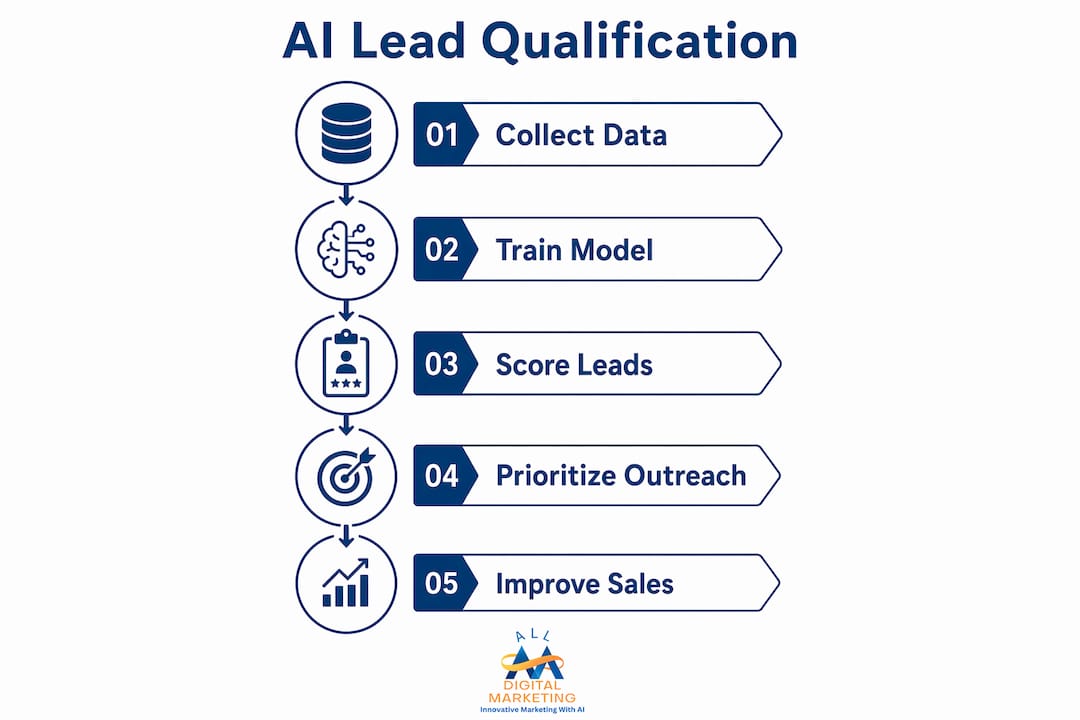
AI scoring eliminates that variability. Models train on your historical closed-won and closed-lost data, then re-score every lead in real time as signals arrive: email opens, pricing page visits, demo requests. A lead who visits your pricing page converts at a meaningfully higher rate than one who only read a blog post. The AI catches that signal instantly; a human reviewer rarely does at scale.
Conversational qualified leads take this further. Instead of a static form, an AI conversation asks open-ended discovery questions, surfaces budget and stakeholder context indirectly, and writes a full qualification summary into your CRM. The result is richer data and a warmer handoff to your sales rep.
Pro Tip: Run AI scoring in parallel with your current SDR process for 30 days before automating routing. Use that window to calibrate score thresholds against real outcomes, then trust the model.
Practically, a tiered model approach works best for SMBs. Budget models handle high-volume triage at low cost; premium models analyze your most strategic leads in depth. Scores typically run 0–100, with hot leads (75+) routed directly to a rep and mid-range leads entering automated nurture sequences.
- Use firmographic, behavioral, and intent signals as model inputs
- Integrate scoring directly with your CRM for real-time routing and reporting
- Set clear thresholds: hot leads to reps immediately, others to nurture or disqualify automatically
How does AI lead qualification improve sales outcomes?
The business case is concrete. AI-scored leads convert 2–3x more often than manually prioritized ones, with reps working the same hours. Speed-to-lead alone accounts for a significant share of that lift.
Vercel replaced most inbound SDRs with AI agents, maintained the same lead-to-opportunity conversion rates, and achieved substantial annual cost savings — a result documented in their 2025 case study and cited by industry analysts tracking AI-driven lead generation at scale.
Beyond cost savings, reps report higher job satisfaction when they spend their day on qualified conversations rather than cold triage. AI provides structured lead summaries before every call, so reps enter discovery already knowing the prospect's stated urgency, company size, and likely objections. Win rates improve because reps are working better leads, not working harder.
Pipeline hygiene improves too. When low-fit leads are automatically disqualified or placed in long-term nurture, your pipeline reflects real revenue potential rather than wishful thinking. Forecasting becomes more reliable, and sales managers spend less time scrubbing bad data.
How do you integrate AI qualification into your marketing strategy?
AI lead qualification works best when it connects to the rest of your marketing stack, not when it sits in isolation. For SMBs focused on local search and online lead generation, the integration points matter.

Closed-deal data fed back into your AI model continuously improves scoring accuracy. That same data tells you which traffic sources, content types, and PPC keywords produce your highest-scoring leads, so you can shift budget toward what actually converts. AI-driven outbound sequencing paired with qualification scoring creates a full-funnel feedback loop: better leads in, better data out, better targeting next cycle.
Local SEO and reputation management feed this loop directly. High-quality reviews improve local search rankings, which drives more inbound traffic, which gives your AI model more signal to work with. Digital Marketing All builds these connections across the full AI marketing funnel for SMBs, from search visibility to qualified pipeline.
Practical steps to get started:
- Connect your lead capture forms or conversational AI tool to your CRM on day one
- Define your ICP clearly before training any scoring model
- Shift at least one SDR from inbound triage to outbound prospecting once AI handles qualification
- Track visitor-to-SQL rate and cost per qualified lead as your primary performance metrics
- Review closed-deal data monthly to retrain and refine your model
What are the risks of using AI for lead qualification?
AI qualification is not without real limitations. Data quality is the most common barrier: if your CRM has incomplete firmographic fields or poorly tagged closed-lost records, the model trains on noise and produces unreliable scores. Garbage in, garbage out applies directly here.
Bias in historical data is a subtler risk. If your past sales team consistently ignored certain industries or company sizes, the model learns those patterns as negatives, even when those segments could convert well. Periodic audits of scoring logic help catch this.
AI also cannot replace human judgment in complex, multi-stakeholder deals. It excels at structured, repeatable inbound qualification. Outbound prospecting, enterprise negotiation, and relationship-driven sales still require people. Over-automating those touchpoints typically hurts pipeline rather than helping it. Finally, AI-powered marketing strategies require ongoing monitoring: a model that worked well six months ago may drift as your market or product evolves.
Key Takeaways
AI lead qualification gives SMBs a measurable edge in conversion efficiency, sales focus, and pipeline quality when implemented with clean data and clear thresholds.
| Point | Details |
|---|---|
| Conversion efficiency | AI identifies the top 20% of leads most likely to convert, improving close rates 2–3x without adding headcount. |
| Speed-to-lead | Responding within five minutes increases qualification likelihood 21x; AI hits that window consistently. |
| Sales team focus | Reps work only qualified leads, reducing burnout and improving win rates through better-quality conversations. |
| Cost control | A tiered model approach matches AI complexity to funnel stage, keeping qualification affordable for SMBs. |
| Full-funnel integration | Closed-deal feedback loops retrain scoring models continuously, improving both lead quality and marketing targeting over time. |
FAQ
What is AI lead qualification?
AI lead qualification uses machine learning to automatically score and route inbound leads based on fit, intent, and behavioral signals, replacing manual review with real-time, data-driven prioritization.
How much can AI improve lead conversion rates?
AI-scored leads convert 2–3x more often than manually prioritized ones, according to analysis of teams using predictive scoring trained on historical closed-deal data.
Is AI lead qualification affordable for small businesses?
Yes. A tiered model approach uses lower-cost models for high-volume triage and reserves more capable models for strategic leads, keeping per-lead costs manageable at SMB scale.
What data does an AI lead scoring model need?
Models train on firmographic data (company size, industry, job title), behavioral signals (page visits, email engagement, demo requests), and historical closed-won and closed-lost outcomes from your CRM.
Can AI replace my entire sales development team?
AI handles structured inbound qualification effectively, as Vercel's case study demonstrates. Outbound prospecting, multi-stakeholder deals, and relationship-driven sales still require human judgment and remain outside what current AI qualification tools do well.