

TL;DR:
- Regularly updating key website pages enhances search rankings and builds customer trust.
- Focusing on high-traffic and high-impact pages yields faster growth and better SEO results.
- Implementing a structured, consistent update system prevents neglect and supports sustained business growth.
A small change on your website, such as refreshing a single service page or updating a blog post with new data, can trigger measurable jumps in search rankings and customer inquiries within weeks. Most business owners overlook this because they assume their site is "good enough" after the initial launch. The truth is that search engines and customers alike judge your business by how current your information is, and a stale site quietly costs you leads every single day. This guide walks you through why content updates matter, which pages to prioritize, and how to build a system that keeps your site working harder for you.
Table of Contents
- Why fresh website content matters for business growth
- How content updates drive stronger SEO results
- What content should you update? A comparison of approaches
- Tips for a smooth content update process
- What most business owners get wrong about updating content
- Accelerate your growth with expert support
- Frequently asked questions
Key Takeaways
| Point | Details |
|---|---|
| Fresh content builds trust | Up-to-date website information increases credibility with customers and search engines. |
| Regular updates improve SEO | Consistently refreshed content helps your business rank higher and attract more visitors. |
| Not all updates are equal | Focus on high-impact pages like product listings and service information for best results. |
| Efficient workflow matters | A simple process and delegated tasks ensure you can update content consistently without burnout. |
| Quality over quantity | Small, strategic changes often deliver bigger returns than massive overhauls. |
Why fresh website content matters for business growth
Your website is often the first place a potential customer forms an opinion about your business. If the content they find is outdated, inaccurate, or thin, that impression becomes a reason to leave and find a competitor. This happens faster than most owners realize. Visitors decide within seconds whether a site feels current and credible.
Search engines behave similarly. Google and other platforms continuously crawl websites looking for signals that a business is active, relevant, and trustworthy. Pages that haven't been touched in months or years gradually lose ranking authority. When you consistently update your content, you send a clear signal that your business is engaged and that your information reflects what customers actually need right now.
"Businesses that keep their online information current are more likely to attract and retain customers. Accuracy builds the trust that drives real-world visits and purchases."
Updating business listings drives more customers online because it reinforces consistency across every platform where your business appears.
Here are the most common ways outdated content hurts businesses:
- Lost trust: Customers who find incorrect pricing, old promotions, or discontinued services immediately question your reliability.
- Reduced conversions: Landing pages with stale messaging fail to address what customers are searching for today, leading to high bounce rates.
- Lower search rankings: Search engines deprioritize sites that show no recent activity or updates.
- Missed opportunities: New services, seasonal offers, and industry developments go unannounced, leaving potential revenue on the table.
- Competitor advantage: Rivals who update regularly appear more relevant in search results, capturing the customers you're losing.
Fresh content isn't just about fixing errors. It's about evolving alongside your customers' needs, which change constantly based on market trends, seasonal demand, and shifting search behavior.
How content updates drive stronger SEO results
Search engine optimization is not a one-time setup. It's an ongoing practice, and content freshness is one of the most powerful levers you can pull. When Google's algorithms evaluate your site, they assess how well your pages match what people are currently searching for, not just what was relevant a year ago.
The stakes became much clearer after the Google 2026 update impact, which showed that stale generic content caused some affected sites to lose 71% of their organic traffic almost overnight. That's not a minor dip. For a small business, a 71% drop in search visibility could effectively shut down online lead generation. The message from Google is clear: generic, unchanged content is a liability.
Targeting user intent for SEO means making sure your pages directly answer what your customers are asking right now. Search queries evolve. The way someone searched for your service two years ago might be completely different from how they search today. Updating your content to reflect current language, concerns, and questions gives you a real advantage.
Pro Tip: When you update a page, also review the meta title and description. These short snippets appear directly in search results and dramatically affect whether someone clicks your link over a competitor's.
Technical factors also play a role. Following Googlebot 2MB content guidance ensures your pages are structured in a way that search engines can fully read and index. Bloated pages with outdated code or excessive content can limit how much of your page Google actually processes during a crawl.
| SEO Factor | Impact of Stale Content | Impact of Updated Content |
|---|---|---|
| Search ranking position | Gradual decline over months | Stable or improved ranking |
| Click-through rate | Low due to outdated meta info | Higher with relevant descriptions |
| Crawl frequency | Reduced Googlebot visits | More frequent indexing |
| Keyword relevance | Misaligned with current searches | Matched to current intent |
| Domain authority | Slow erosion | Consistent or growing strength |
Simple SEO strategies help businesses rank higher in searches by focusing on consistency, relevance, and user experience. You don't need a massive technical overhaul to see results. Often, updating existing pages with better information, stronger calls to action, and current keywords delivers faster gains than building entirely new content from scratch.
Surviving algorithm updates also depends heavily on your content habits. Businesses that refresh pages regularly tend to weather major Google updates better because their sites already reflect the quality signals that updated algorithms reward.
What content should you update? A comparison of approaches
Not every page on your site carries the same weight. Spending equal time on all of them is inefficient. The smart approach is to identify which pages have the most influence on how customers find you and how they decide to contact or buy from you, then prioritize those.
Digital marketing trends confirm that updating specific website areas like blogs and product pages yields different marketing and SEO benefits depending on how they are used and how often customers interact with them.
| Page Type | Update Frequency | Primary Benefit | Priority Level |
|---|---|---|---|
| Homepage | Every 3 to 6 months | First impression, brand credibility | High |
| Service or product pages | Every 4 to 6 months | Conversions, keyword relevance | High |
| Blog posts | Monthly or quarterly | SEO traffic, authority building | Medium-High |
| FAQ pages | Twice a year | Trust, voice search ranking | Medium |
| About and team pages | Annually or when needed | Credibility, local trust | Low to Medium |
| Testimonials and reviews | Monthly if possible | Social proof, decision-making | Medium |
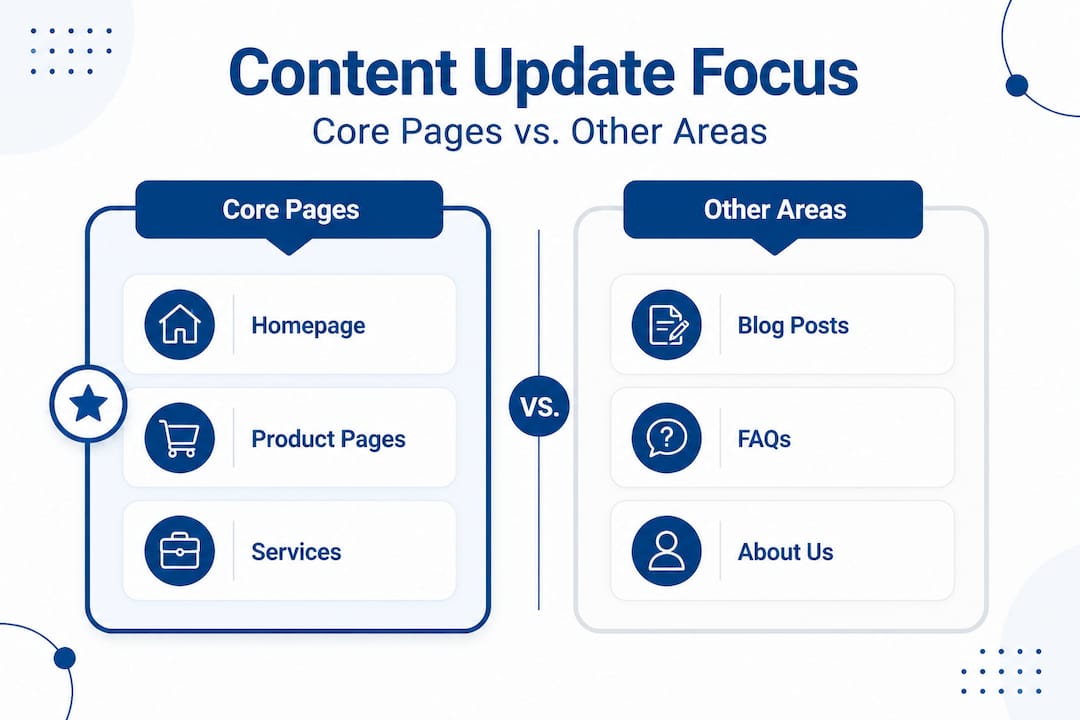
Here's where many businesses go wrong: they publish a blog post and never touch it again. That post might rank reasonably well for a while, but as the topic evolves and competitors update their versions, your page slides down the rankings. Refreshing old blog posts with new data, updated examples, and improved formatting is often faster than writing new ones, and it protects rankings you already worked hard to earn.
When prioritizing updates, focus on these key areas first:
- High-traffic pages that are already generating visits but underperforming on conversions
- Pages targeting competitive keywords where a competitor recently published updated content
- Service or product pages with outdated pricing, discontinued offerings, or missing information
- FAQ sections that don't yet reflect the questions customers are actually asking your sales team
- Landing pages connected to paid ads since outdated content directly wastes ad spend
Product and service pages deserve special attention because they sit at the bottom of the buying funnel. When someone lands on those pages, they're close to making a decision. If your page doesn't reflect current offerings, current pricing, or current value, you lose that sale even if your marketing brought them to you.
Tips for a smooth content update process
Knowing you need to update content is one thing. Actually making it happen consistently is where most businesses struggle. The key is building a repeatable system, not relying on motivation or memory.
Streamlining content workflow ensures consistent updates and better marketing results by removing the guesswork and ad hoc scrambling that leads to months of neglect.
Here's a practical step-by-step approach to building your update process:
- Create a content audit spreadsheet. List every page on your site with the date it was last updated, its current traffic level, and its primary purpose. This gives you a clear picture of what needs attention first.
- Set a quarterly review schedule. Block out time every three months to review your highest-priority pages. Even a 30-minute review session can identify outdated information that needs fixing.
- Assign ownership for each page type. If you have a team, designate who is responsible for blogs, service pages, and listings. When no one owns it, nothing gets updated.
- Use a simple checklist for each update. Check for outdated statistics, broken links, old promotions, outdated staff names, and missing calls to action. A five-point checklist makes the process fast and consistent.
- Track the results of your updates. Note the date you made changes and monitor whether rankings, traffic, or conversions shift in the following weeks. This data tells you what's working and where to focus next.
- Conduct a full site audit at least twice a year. Quarterly reviews cover your top pages, but a biannual audit catches issues on lower-traffic pages before they become serious problems.
Pro Tip: Use Google Search Console to see which of your pages are losing clicks or impressions over time. These are your best candidates for immediate content updates since Google is already signaling that they're becoming less relevant.
Delegation is underused by small business owners who feel only they can write about their business. In reality, a team member who handles customer service or sales often knows exactly what questions customers ask, what objections they raise, and what information they wish the website included. That input is invaluable for making content updates that genuinely connect with your audience.

Consistency matters more than perfection. A business that updates five pages every quarter outperforms a competitor who does a massive overhaul once every two years.
What most business owners get wrong about updating content
Here's a perspective we've developed from working with many local and national businesses: most owners think of content updates as a quantity game. They believe publishing more posts, adding more pages, or expanding every section will automatically improve results. It rarely does.
The real opportunity is in quality and strategic timing, not volume. A single service page that clearly addresses what your best customers need today will outperform five generic blog posts that don't match real search intent. We've seen businesses double their leads by updating just three core pages with sharper messaging, current data, and stronger calls to action.
The "set and forget" mentality is the most costly mistake. Core pages like your homepage and service descriptions often get updated once during a redesign and then ignored for years. These are the pages customers and Google judge most heavily. Neglecting them while churning out new blog content is like renovating the guest rooms while the lobby falls apart.
There's also a fear-based pattern we notice: businesses hesitate to change content that's currently ranking because they don't want to lose that position. This is understandable but counterproductive. The truth is that pages with solid rankings but weak content are sitting on borrowed time. Thoughtfully improving them, aligned with emotional triggers in SEO, builds rankings that are genuinely durable because they serve both users and search engines better.
Small, frequent improvements compound over time. A business that makes five targeted updates per month accumulates a powerful advantage over 12 months compared to one that makes a massive update once a year and then waits to see results.
Accelerate your growth with expert support
You now have a clear framework for why content updates matter and where to focus your efforts. The next step is putting that knowledge into action consistently, and that's where having expert support makes the difference between slow progress and real momentum.

At Digital Marketing All, we help small and medium-sized businesses implement content strategies that combine SEO, local visibility, and targeted advertising into a unified approach. Updated content works even harder when it's backed by expert Facebook ad campaigns that drive qualified traffic directly to your freshest, most relevant pages. We also use geo-fencing strategies to put your business in front of local customers at exactly the right moment. If you're ready to stop guessing and start growing, our team is ready to build a plan tailored to your business goals.
Frequently asked questions
How often should I update my website content?
For most businesses, a review every three to six months ensures fresh, relevant information and better performance in search results. High-traffic and high-conversion pages may benefit from more frequent attention.
Which website pages are most important to update?
Prioritize your homepage, high-traffic blogs, product pages, and service listings since these drive most customer decisions. Updating specific website areas yields measurably different marketing and SEO benefits depending on the page type.
Does updating content really improve SEO?
Yes, regularly updated content signals to search engines that your site is active and relevant, resulting in higher rankings and more traffic. Simple SEO strategies combined with consistent updates create compounding gains over time.
Are there risks to updating content too often?
Frequent, thoughtful tweaks are good, but major changes without tracking results can sometimes hurt rankings or confuse users. The Google 2026 core update showed that strategic, quality-focused updates protect rankings while generic changes can backfire.
How can I make updating content less overwhelming?
A simple workflow and calendar, plus delegating tasks, makes the process manageable for any business size. Streamlining your content workflow removes the inconsistency that causes months of neglect and keeps your site performing consistently.
Recommended
- Why Updating Business Listings Drives More Customers Online
- Boost Your Business Rankings: Craft Blogs That Dominate Google Search and AI Overviews in 2025
- 2025 Digital Marketing Trends: Game-Changing Updates That Could Increase Your Business Growth
- AI Content Strategy 2026 | How to Rank in AI Search
- Miks uuendada veebisaiti – Mõju müügile ja mainele
- Κατανόηση των Οφελών του Content Marketing - maverix.gr